Share on
Expanding beyond your home market often means adapting how your customers pay. As your business grows internationally, you may need to support new local payment methods, payment providers, and integrations that were not part of your original setup—whether you are entering Southeast Asia, Europe, Latin America, or another overseas market.
Each change can add another acquiring relationship, payment method, integration or operating process. Building these connections separately gives you control, but it also leaves more infrastructure for your own teams to maintain.
A white-label payment gateway can reduce some of that work while keeping the customer-facing payment experience under your brand. The practical question is therefore not simply how much of the checkout can be customized. It is how much of the payment complexity behind that checkout the provider can actually remove as your business grows.
Benefits of a White-Label Payment Gateway for SaaS and Growing Businesses
A white-label payment gateway uses payment infrastructure operated by another provider while allowing the payment experience to remain under your brand. Our earlier guide covers the basic model in more detail if you need a refresher before evaluating providers: White-label payment gateway basics.
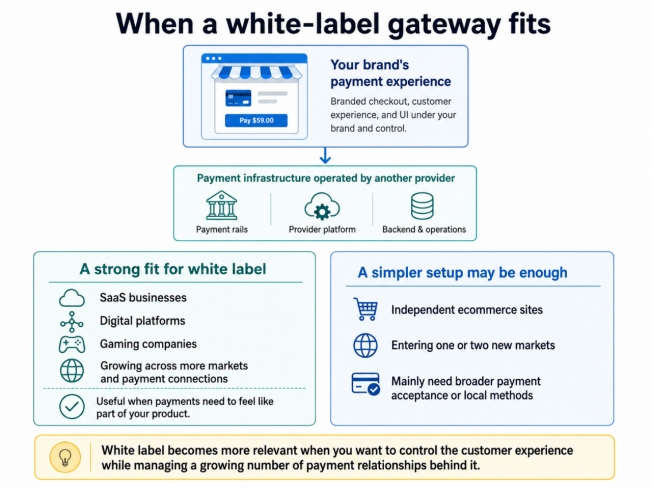
The model becomes particularly relevant for SaaS businesses, digital platforms, gaming companies and other businesses that want payments to feel like part of their own product without building every layer of payment infrastructure themselves. As the number of markets and payment connections grows, the value starts to extend beyond the branded checkout.
That does not mean every cross-border merchant needs a white-label setup. An independent ecommerce site entering one or two new markets may simply need broader global payment acceptance or easier access to local methods. The case for white label becomes stronger when the business also needs to control the customer experience while managing a growing number of payment relationships behind it.
What to evaluate beyond branding
Logo placement, colors and checkout customization still matter, but they do not show whether the payment setup will remain manageable as you expand.
Area | Why it matters | What to verify |
Acquirer connectivity | New markets can introduce additional acquiring relationships | Which acquirers can support your entities and target markets |
Payment methods | Customer preferences differ across markets | Which methods are actually available for your business |
Routing and control | Multiple connections need to work as one payment setup | How eligible transactions can be routed |
Payment operations | Complexity continues after checkout | How refunds, settlement data and reconciliation are managed |
Cost structure | Gateway fees are only part of the total cost | How much engineering, maintenance and operations work remains with your team |
Understanding acquiring services becomes more useful at this stage because the gateway may provide the integration layer while the underlying acquiring setup still affects where and how transactions can be processed. The stronger comparison is not the length of a feature list, but the infrastructure your teams would otherwise need to build and operate.
How white-label payment solutions address different business needs
Different businesses approach white-label payments for different reasons. Some want to create their own branded payment offering, while others need embedded payment capabilities, broader financial services or a more flexible way to manage multiple payment connections.
The providers below offer different approaches to white-label payments. The right choice depends on your business model, target markets, and payment requirements.
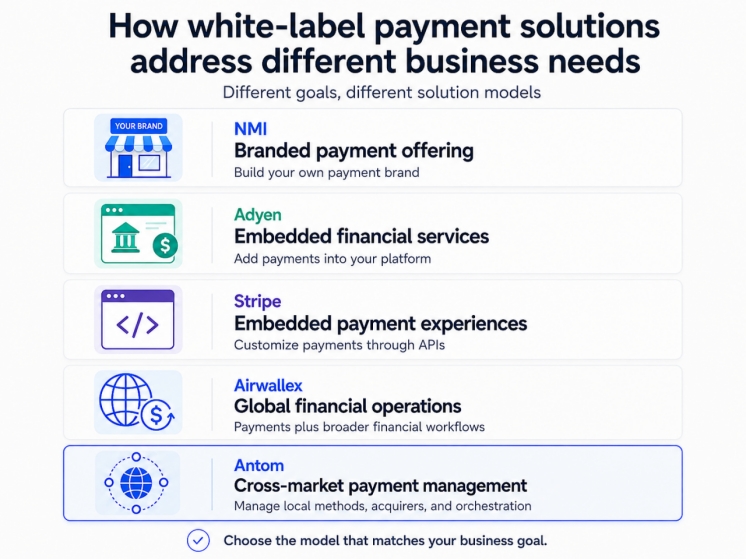
Antom: Cross-market payment management
For businesses expanding across markets, white-label payments can also be part of a broader payment infrastructure strategy — one that manages local payment methods, acquiring relationships and payment operations together as the business grows, while keeping the customer-facing experience under your brand.
We look at how this works in practice later in this guide.
NMI: Branded payment offerings
Some companies want payment capabilities to become part of their own product or service. They need customers and merchants to interact with their own brand rather than a third-party payment provider.
NMI focuses on the traditional white-label gateway model by enabling software companies, ISOs and payment platforms to offer branded payment experiences without building gateway infrastructure from scratch.
This approach is often relevant for businesses that want to create their own payment product while relying on an underlying technology provider.
Adyen: Embedded financial services
For SaaS companies and platforms, white-label payments can become part of a broader embedded finance strategy.
Adyen positions white-label payment processing around enabling businesses to offer payments and other financial services under their own brand, while using provider infrastructure for payment processing, compliance and operations.
This approach is more focused on turning financial capabilities into part of the platform experience.
Stripe: Embedded payment experiences
Stripe focuses on embedded payments for platforms and marketplaces, allowing businesses to integrate payment workflows into their own products and customer experiences.
With Stripe Connect, businesses can use embedded components or build custom payment experiences through APIs, while keeping payments within their own platform. Stripe also supports fully white-labeled payment experiences for platforms that want to build payments into their own offering.
This approach is particularly relevant for businesses that prioritize platform integration, developer flexibility and control over the payment experience.
Airwallex: Global financial operations
Some businesses need payment capabilities alongside broader financial infrastructure.
Airwallex combines payment capabilities with other financial services, helping businesses manage international payment and financial workflows through one platform.
This approach may fit companies looking for more than payment acceptance alone.
Advanced White-Label Payment Processing Platforms at a glance
Provider | Core strength | Consider it when you want to… |
Antom | Global payment infrastructure & orchestration | Expand across markets while managing local methods, acquirers and payment operations |
NMI | White-label gateway infrastructure | Build your own branded payment offering |
Adyen | Embedded financial services | Turn payments and financial services into part of your platform |
Stripe | Embedded payments & platform tools | Build and customize payment experiences within your product |
Airwallex | Global payments & financial infrastructure | Combine payment acceptance with broader financial workflows |
The sections below look more closely at three of the factors behind this comparison: acquirer connectivity, payment-method coverage and cost.
Best White-Label Payment Gateway for Multi-Acquirer Connectivity
With one acquiring relationship, the payment architecture can remain relatively simple. As you add markets, however, depending on one connection may limit coverage, while integrating every new acquirer directly can create a growing maintenance burden.
Multi-acquirer connectivity gives you more options by allowing several acquiring relationships to sit behind a common payment layer. Where routing is available, eligible transactions can follow different processing paths according to market requirements, payment-method availability or provider configuration.
Adding more acquirers does not automatically increase authorization rates. Payment performance also depends on issuers, transaction mix, acquiring setup, authentication, routing logic and local market conditions. The practical advantage is flexibility: you have more processing options as the business changes.
As those relationships multiply, payment orchestration can help coordinate several payment providers through a more unified operating layer instead of maintaining each connection as a separate workflow.
Expanding payment methods across markets
A US or European business may begin with a card-led checkout, but that mix may not reflect customer behavior when the business moves into Asia. Depending on the market, wallets, bank-based payments, real-time payments or other local options can become more important, while the acquiring structure behind them may also change. APO's current payment-method coverage illustrates this variation across markets and acquirers.
Gaming shows why this matters. In Asia, our 2026 Global Gaming & Payment Trends Report highlights the growing role of DTC web stores and third-party top-up channels alongside traditional app-store distribution. A publisher taking the same game into Southeast Asia may keep the same product while the payment journey becomes more local and fragmented.
The same principle applies to ecommerce. For an independent site, adding a local wallet is useful only if that method is actually available for the relevant merchant entity, industry and market. A provider's headline payment-method count is less useful than knowing which payment methods you can activate and how those transactions will be managed.
Local acquiring may become part of the wider infrastructure decision for the same reason. Market expansion can change not only what customers want to use at checkout, but also the acquiring relationships behind those payments.
Comparing infrastructure costs
Gateway fees are only one part of the cost of a payment setup. Direct integrations create initial engineering work, but they also create recurring work when you add another acquirer, activate another payment method, respond to API changes or reconcile different report formats.
The cost spreads beyond engineering. Finance teams may work with different settlement and reporting processes, while payment teams may need to manage more connections as the stack expands.
A white-label or orchestration layer can shift some of this recurring infrastructure work to a provider, but it should not be assumed to be cheaper in every case. A more useful comparison is total cost of ownership (TCO): how much engineering, maintenance and payment operations your business will still need to manage across the markets you expect to add next.
From market requirements to launch
A practical rollout works better when it begins with the expansion plan rather than a feature list. Target markets shape customer payment behavior; that behavior determines which payment methods matter; and those methods influence the acquiring connections required behind the checkout.
In practice, the rollout can move through five stages:
- Map target markets, merchant entities and customer payment preferences.
- Identify the acquiring and payment-method connections required.
- Decide how much checkout, routing and operational control should remain with your team.
- Complete the relevant payment gateway integration and test the actual market setup.
- Once live, follow the transaction beyond authorization, including refunds, settlement and reconciliation.
This also makes the next market easier to evaluate because your team can identify what is genuinely new before rebuilding the stack.
How Antom helps
For some businesses researching a white-label gateway, branding is only the visible part of a broader requirement. The harder problem is managing multiple acquirers and payment methods without creating a separate integration and operating process around each connection.
With Antom Payment Orchestration (APO), we help you connect payment providers and manage payment channels through one platform. After connecting an acquirer, you can activate supported payment methods through the APO Dashboard. If the same payment method is linked to multiple acquirers, you can configure routing rules for that setup.
Payment operations continue after authorization, so we also provide transaction management and reconciliation capabilities. For supported acquirers, APO consolidates settlement reports into standardized reconciliation reports, helping your team manage reconciliation through a more consistent workflow. We currently support standardized reports for Antom, Adyen, 2C2P and Checkout.com, while additional provider reports are being integrated.
With our payment infrastructure, you can also access global and local payment methods across relevant markets. Availability still depends on the payment method, market, acquirer and merchant setup, so expansion planning is more useful when it is based on the connections relevant to your business rather than a single headline coverage number.
If you're evaluating a white-label payment setup, we can help you look beyond branding and assess the payment infrastructure behind it—from acquiring connectivity and payment methods to routing and operations. Speak to our team.
FAQs
Can a white-label payment gateway connect to multiple acquirers?
It can, but this depends on the provider's infrastructure. The more useful test is which acquirers can support your merchant entities and target markets, how those connections are managed, and whether eligible transactions can be routed between them.
Does a white-label gateway support local payment methods?
Many solutions can, but availability varies by provider, merchant entity, industry, market and acquiring setup. Focus on methods that can actually be activated for the markets you plan to enter.
Is a white-label payment gateway cheaper than building in-house?
Not necessarily. Additional integrations, maintenance, monitoring, reporting and reconciliation all contribute to total cost. The more useful comparison is total cost of ownership over time.
What is the difference between a white-label gateway and payment orchestration?
White label describes how payment capabilities are delivered under your brand. Payment orchestration focuses on how multiple payment providers, acquirers and payment methods are connected and managed behind that experience. Speak to our team.