

Share on
Local acquiring generally refers to processing card payments through an acquirer or acquiring connection established in the target market or region, rather than relying only on a foreign acquiring route. The exact meaning of “local” can vary across providers and markets, but the core idea is the same: bring the acquiring side of a payment closer to the market being served.
For global businesses, this may reduce some cross-border payment friction and improve authorization performance or cost efficiency, depending on the market, card scheme rules, and merchant setup. The Bank for International Settlements notes that cross-border payments, particularly retail transactions, remain more costly, slower, less accessible, and less transparent than domestic payments.
What is local acquiring?
To understand local acquiring, it helps to first understand the acquirer.
An acquirer operates on the merchant side of a card payment, enabling businesses to accept card transactions and connect to the relevant payment ecosystem. Mastercard describes acquirers as financial institutions that provide card acceptance services to merchants.
With local acquiring, a merchant accesses an acquiring relationship or connection established in the relevant market or region. This may be arranged directly with an acquirer or through a PSP or payment platform with suitable local or regional connections.
One important nuance is that “local” does not always have exactly the same geographic meaning. Depending on the market and provider, it may refer to alignment with the customer market, issuer market, or a recognized acquiring region. What distinguishes the model is the use of a target-market or in-region acquiring setup instead of relying solely on a foreign route.
Example of local acquiring
A US ecommerce merchant sells a product to a customer in Thailand. The customer pays in Thai baht using a Visa card issued by a Thai bank. Instead of routing the transaction through the merchant’s US acquirer, the payment is processed through a Thailand-based local acquiring connection.
Element | Example |
Merchant home country | United States |
Customer market | Thailand |
Card issuer | A Thai bank |
Acquirer / acquiring connection | Thailand-based local acquiring setup |
Transaction currency | THB (Thai baht) |
Settlement currency | USD or THB, depending on the merchant setup |
Payment method | Thailand-issued Visa credit card |
Payment system / card network | Visa |
What makes this local acquiring is the acquiring setup: the transaction uses an acquirer or acquiring connection established in the Thai market rather than relying solely on a foreign acquiring route. The merchant itself can still be based in the United States, and the transaction can still travel through the Visa network. The settlement currency may also be THB or another supported currency, depending on the provider and merchant arrangement.
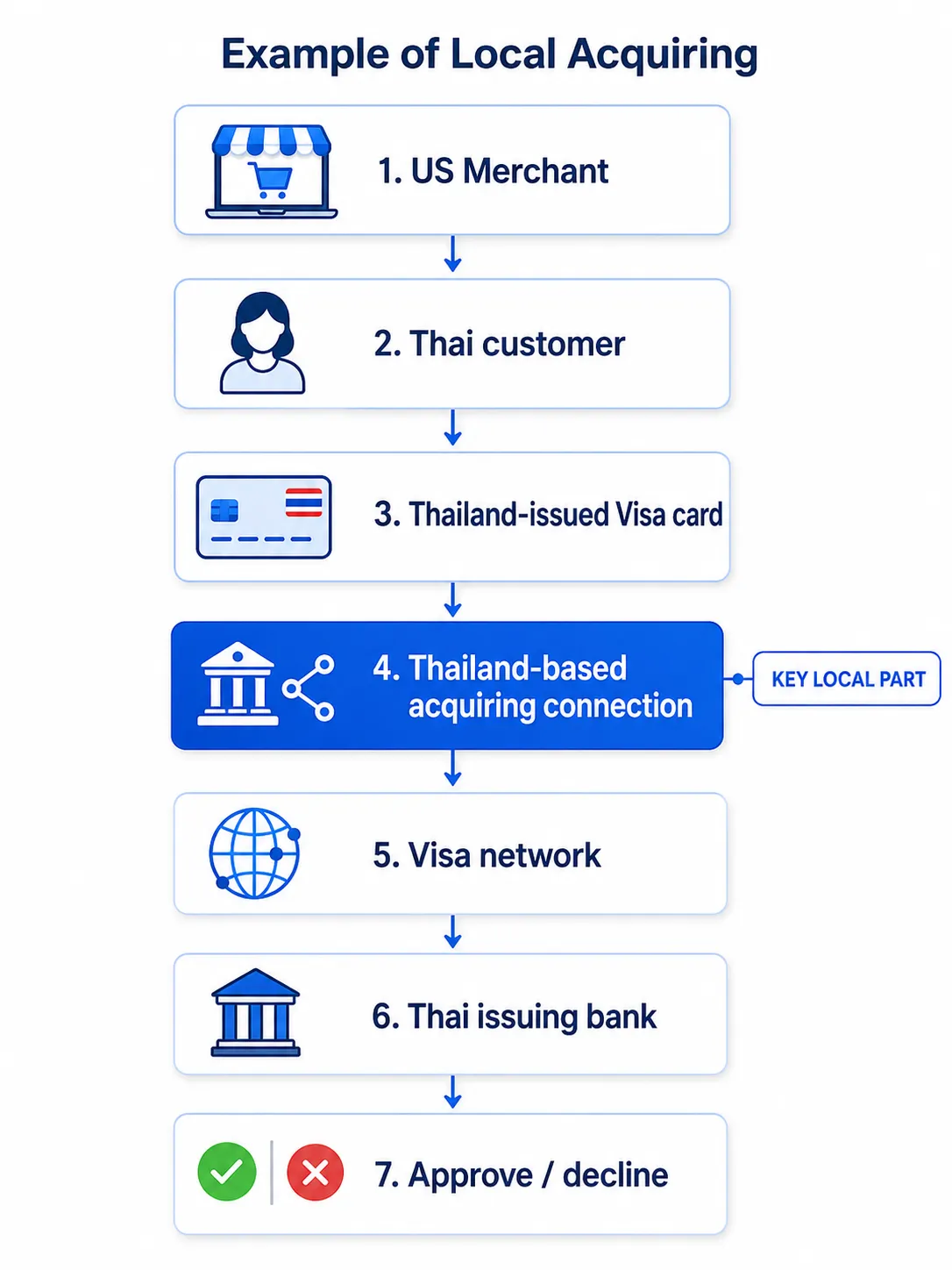
This model is not unique to the example above. McKinsey has described how payment providers can enable cross-border transactions to be authorized and processed in the consumer’s home market rather than the seller’s market, illustrating the broader logic behind local processing.
How does local acquiring work?
A simplified card payment flow looks like this:
1. The customer initiates a payment. The merchant receives the card payment request at checkout.
2. The transaction reaches the acquiring side. With local acquiring, the payment uses a local or in-region acquiring connection serving that market.
3. The request moves through the relevant card network. The network carries the authorization request toward the issuer.
4. The issuer approves or declines the payment. Visa defines authorization as the process in which a transaction receives an approval or decline from the issuing bank, or in some cases through stand-in processing.
The key point is simple:
Local acquiring changes the acquiring setup. It does not necessarily mean the entire payment stays inside domestic payment rails.
For example, a locally acquired Visa or Mastercard transaction may still use the relevant global card network. Mastercard states that its network links issuers and acquirers for transaction processing.
Local acquiring vs cross-border acquiring
Factor | Local | Cross-border |
Acquiring setup | Target market or region | Outside the target market |
Payment route | Local or in-region connection | Foreign acquiring route |
Authorization | May reduce some cross-border friction | May face additional cross-border signals |
Costs | May reduce certain cross-border charges | May involve additional international costs |
Complexity | Can require more local readiness | Often simpler for early market entry |
Neither model is automatically better for every transaction. A business testing a new country may prefer a centralized cross-border setup, while growing volume in a strategic market can make local acquiring more relevant.
What are the benefits of local acquiring?
Potentially higher authorization rates
Authorization is the most consistent benefit highlighted across local acquiring strategies, but the mechanism is often oversimplified.
A local acquirer does not simply “approve more transactions.” The issuer remains central to the approval or decline decision. Instead, local or in-region acquiring may reduce some of the friction associated with foreign acquiring routes and align transactions more closely with market-specific processing arrangements.
Actual performance still depends on issuer decisioning, transaction data, authentication, risk signals, card type, and scheme rules.
So local acquiring should be treated as one lever in payment optimization, not a guarantee of higher approval rates.
Potentially lower cross-border costs
Cross-border card payments can involve several cost components, including interchange, scheme fees, acquiring charges, and other international costs.
Local acquiring may reduce certain cross-border charges when a transaction qualifies for different domestic or regional treatment. However, the outcome varies by market, card type, scheme rules, and provider pricing.
This distinction matters because interchange itself is not simply a cross-border fee. Mastercard defines interchange as a fee paid by the acquirer to the issuer and treats it as one component of the merchant discount rate.
Better support for market expansion
Local acquiring can become particularly relevant when a business develops significant payment volume in specific markets.
For example, a US or European ecommerce merchant expanding into Singapore, Thailand, and Malaysia may need to combine:
- local or regional acquiring coverage
- relevant payment methods
- appropriate routing
- risk controls
- unified reporting and reconciliation
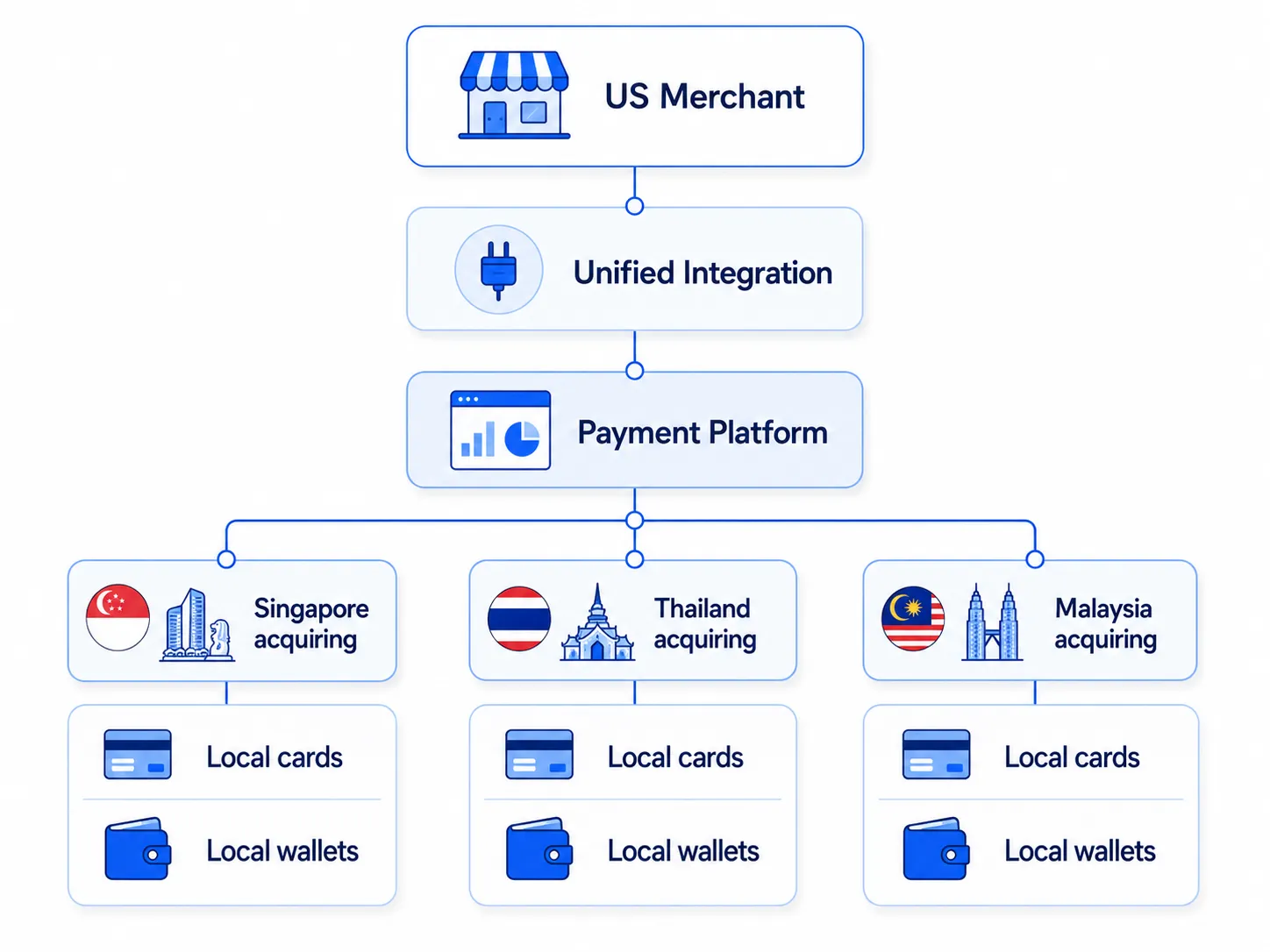
This market-by-market challenge is especially relevant for businesses expanding into Asia, where payment infrastructure and consumer preferences can vary significantly across countries. The U.S. International Trade Administration notes that online payment preferences vary by country and geography, reinforcing the need to evaluate payment coverage market by market.
Important distinction: local acquiring is not the same as local payment methods
These concepts are often grouped together, but they are not interchangeable.
Local acquiring concerns the acquiring setup for card payments.
Local payment methods concern how customers choose to pay, such as through digital wallets, bank-based payments, or other market-specific options.
Likewise, local acquiring does not automatically mean:
- the customer pays in local currency
- the merchant settles in local currency
- the entire transaction stays on a domestic network
A broader local payments strategy may combine all these capabilities, but they should be evaluated separately.
Antom’s current payment-method directory separately presents cards, wallets, online banking and other payment options across its broader network, which reinforces why payment-method coverage should not be treated as synonymous with local acquiring.
When should a business consider local acquiring?
Local acquiring may be worth evaluating when:
- a market represents a growing share of payment volume
- cross-border decline rates are unusually high
- international processing costs are increasing
- the business is making a long-term investment in a specific region
However, going local can add operational complexity. Depending on the market and setup, businesses may face additional onboarding, provider management, compliance, treasury, or reporting requirements.
For early market testing, cross-border acquiring may still be the simpler option. As transaction volume grows, businesses can reassess whether local, regional, cross-border, or hybrid routes offer the strongest balance of performance and complexity.
Conclusion
Local acquiring is not simply about making a payment “look local.” It is an acquiring strategy that can help global businesses align card processing more closely with the markets they serve.
For businesses expanding across multiple markets, the challenge is often connecting acquiring coverage with payment methods, routing, risk management, reporting, and reconciliation. PwC has similarly highlighted the importance of unified payment infrastructure for cross-border and cross-currency transactions, alongside market-relevant payment methods and active management of cross-border costs.
Antom supports 300+ payment methods across 200+ payment markets. The goal is not to make every transaction local at any cost, but to choose the setup that best matches each market and stage of growth.
FAQs
Does local acquiring always improve authorization rates?
Local acquiring may reduce some cross-border friction, but authorization still depends on the issuer, transaction data, authentication, card scheme rules, risk controls, customer behavior, and other factors.
Do merchants need a local entity for local acquiring?
Not always. Requirements vary by provider, market, licensing structure, and merchant setup. Some arrangements may require a local entity or additional compliance steps, while others can be supported through partners or regional structures.
Is local acquiring the same as offering local payment methods?
No. Local acquiring concerns the acquiring setup for card payments. Local payment methods describe how customers pay, such as through wallets, bank-based payments, local card schemes, or real-time payment methods.