


Share on
Key Insights
- Industry paradigm shift: a profound transition from product-driven to service-driven models
The global gaming industry is undergoing a fundamental paradigm shift, moving away from the traditional model of one-off game sales towards long-term service-based models. Notably, 42% of industry observers now identify Games-as-a-Service (GaaS) as the primary direction for future development, while 62% of studios cite “maximising the value of existing titles” as a top priority in their growth strategy. This highlights a clear trend: extending game lifecycles and building deeper user engagement through ongoing content updates, active community management, and sustained commercial operations has become a core driver of industry development. - Evolution of player roles: redefining value from content consumption to co-creation
Player mindset is undergoing a profound transformation: they increasingly view their role as evolving from passive consumers of content to active co-creators of experiences. For the new generation of players – particularly UGC platform enthusiasts – a game’s value is no longer determined solely by its gameplay mechanics or graphics. Increasingly, it is shaped by the social status and creative freedom the platform provides. This audience is willing to trade high-end visuals and audio for enhanced opportunities to connect and create. This shift in player preference is a key force behind the rapid growth of UGC games. - Channel strategy pivot: studios turn to direct-to-consumer (DTC) models to avoid platform commissions
To avoid the hefty 15–30% fees charged by major app stores and to build direct, unrestricted relationships with their users, more publishers are strategically shifting towards direct-to-consumer (DTC) channels. Data shows that in just five years, the share of the world’s top 50 mobile games using a DTC model has soared from 12% to 44%. This surge reflects two powerful forces: publishers seeking stronger margins and players looking for better value and greater trust in the developers behind the games. Together, these dynamics are reshaping how profits are distributed across the industry. - The ultimate challenge of globalisation: payment localisation as the key to winning the last mile
As digital wallets overtake credit cards – now accounting for more than 53% of global transactions – and as direct-to-consumer (DTC) models continue to expand, the payment ecosystem has become far more fragmented and regionalised. For gaming companies going global, this has turned payment localisation into one of the most challenging and decisive factors for success. Payments are no longer a back-office concern: they now sit at the heart of strategy, shaping conversion rates, user experience, and the overall effectiveness of international expansion. As an integrated global payment service provider, Antom has established a worldwide payment network, allowing players to pay through the methods they know best and trust most.
From APAC dominance to GaaS maturity: the forces reshaping global gaming
Asia-Pacific emerges as the leading region as mobile platforms drive future growth
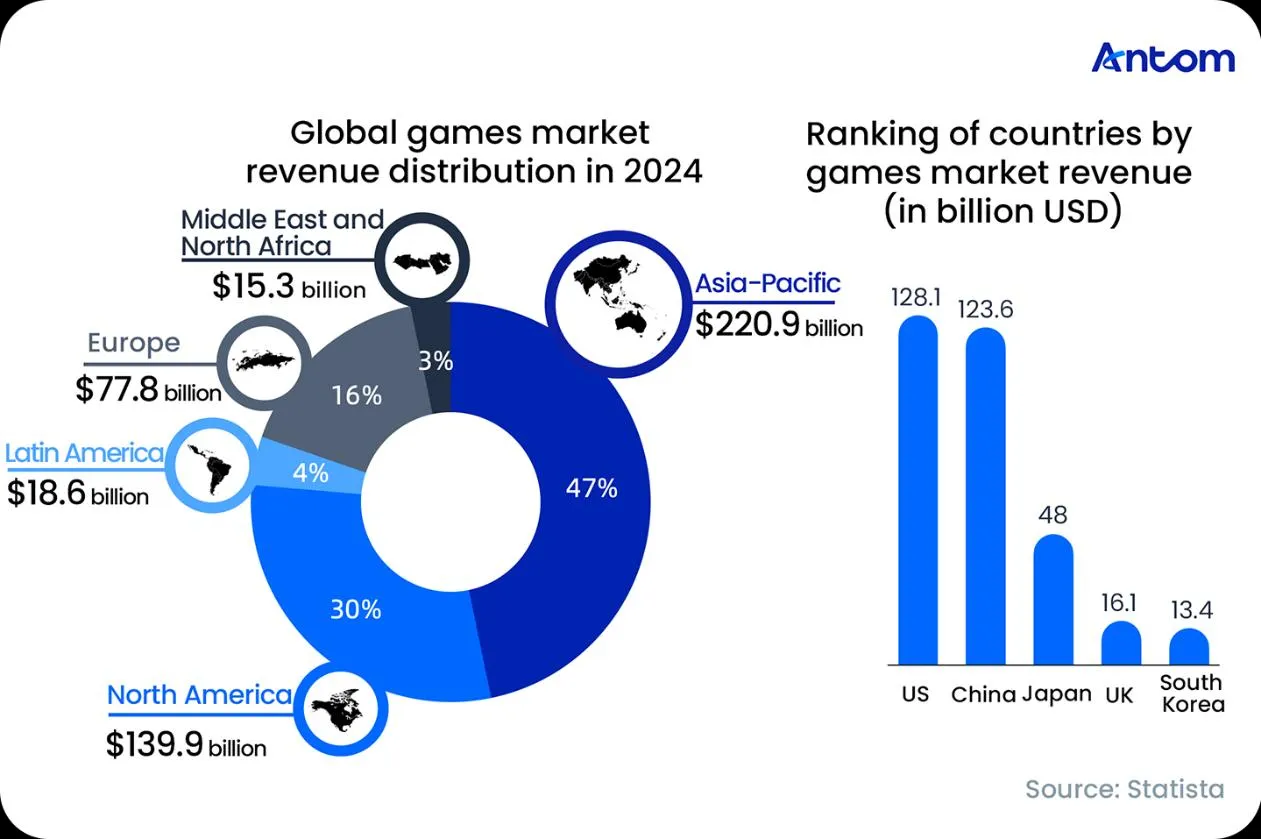
Data from 2024 shows that the global games market is heavily concentrated in two regions. Asia-Pacific remains the largest market worldwide, generating USD 220.9 billion in revenue and accounting for 47% of the global market. North America ranks second with $139.9 billion in revenue, representing a 30% market share. Combined, these two regions make up more than three-quarters of global gaming revenue, firmly establishing them as the industry’s core markets.
At the national level, market competition is primarily led by China and the United States. The US ranks first globally with $128.1 billion in revenue, followed closely by China at $123.6 billion. Together, they form the top tier of the global gaming industry. Japan remains firmly in third place with $48 billion in revenue, underscoring its longstanding position as a powerhouse in the global gaming industry.
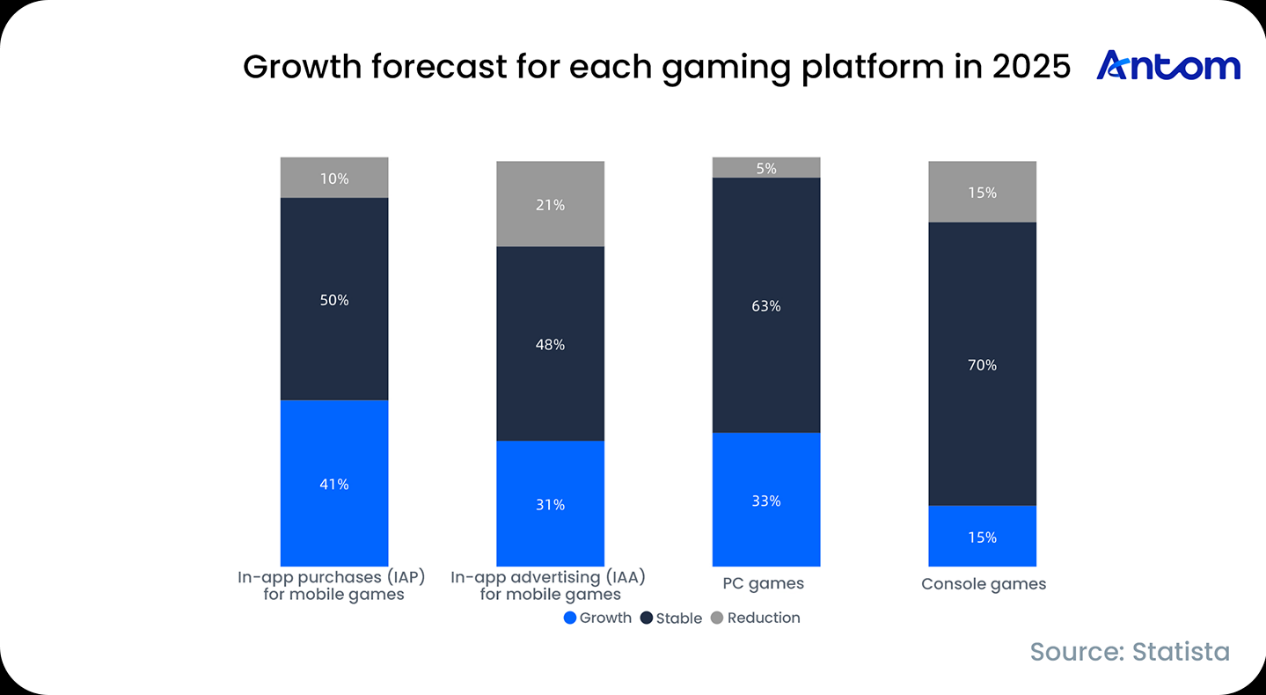
As of 2025, the mobile segment is expected to remain the main driver of growth in the global gaming market. Forecasts show that mobile games built around in-app purchases (IAP) have the strongest outlook, with 41% of industry observers predicting growth and a further 50% expecting the segment to hold steady. This reinforces IAP-based mobile gaming as the industry’s core growth engine.
In contrast, mobile titles that rely on in-app advertising (IAA) are encountering more headwinds. Among all platforms, they show the highest expectation of decline at 21%, highlighting growing uncertainty around the sustainability of the IAA model.
By comparison, other gaming platforms show a much steadier outlook. The PC gaming market remains highly mature and resilient, with 63% of industry observers expecting it to stay stable and 33% forecasting moderate growth. It also carries the lowest risk of decline at just 5%. Console gaming is the most stable segment overall, with 70% predicting no major change, though its growth potential is also the smallest, with only 15% expecting expansion.
Get Started With Antom For the Full Report!