


Share on
Payment gateway integration is the process of connecting a merchant’s website, app, or business system with payment services so it can accept and manage digital payments. The integration may support payment initiation, customer authentication, authorization, capture, refunds, status updates, settlement, and reconciliation.
However, integration is not complete simply because a payment request can be sent. A reliable setup should also help the merchant confirm the final payment result, update an order without duplicate actions, handle different payment methods, and connect transaction activity with financial records.
This guide explains that complete lifecycle in practical business terms.
In this guide
- What is payment gateway integration, and how does it work?
- What are the main payment gateway integration methods?
- What role does a payment gateway API play in the integration?
- How do merchants confirm final payment results and manage different payment flows?
- What security, reliability, testing, and operational controls are needed?
- How does Antom support global payment gateway integration?
What is payment gateway integration?
Payment gateway integration allows a merchant’s website, app, or business system to submit and manage online payments within its checkout and operational workflows. Merchants may also accept payments through external or manual channels, but those approaches do not provide the same level of automated connection between checkout, transaction status, and financial records.
The integration connects the customer-facing checkout with the systems that may perform functions such as:
- collecting or tokenizing payment credentials;
- transmitting transaction information;
- supporting customer authentication;
- requesting authorization;
- returning payment instructions or status;
- initiating capture or refunds;
- sending asynchronous notifications;
- retrieving transaction information;
- supporting settlement reporting and reconciliation.
The exact participants and sequence depend on the payment method, provider, market, and merchant configuration.
Payment gateway, processor, PSP, and acquirer
These terms are related but should not automatically be treated as interchangeable.
Participant | Primary role |
Payment gateway | Connects the merchant’s checkout or application with payment services |
Payment processor | Supports the technical processing and transmission of payment transactions |
Payment service provider | May combine gateway, processing, acquiring, risk, and other services |
Acquirer | Supports merchant acceptance and receives card transactions for processing |
Issuer | Provides the customer’s payment account or card and may approve or decline a card transaction |
Payment network or rail | Carries transaction messages between relevant participants |
A single provider may perform several of these roles. For that reason, merchants should evaluate the actual services and responsibilities within an integration rather than relying only on product labels.
For more background on the acquiring side of a transaction, see this guide to acquiring services.
Where does the payment gateway API fit?
A payment gateway API is a set of programmatic interfaces that allows a merchant application to communicate with a gateway or broader payment platform.
The API may allow the merchant to:
- create a payment;
- send transaction information;
- receive next-step instructions;
- retrieve payment status;
- capture an authorized transaction;
- cancel or refund an eligible payment;
- manage payment tokens;
- obtain transaction or financial records.
However, payment gateway integration is broader than the API itself. A complete integration may also include hosted checkout pages, frontend components, mobile SDKs, notification endpoints, databases, security controls, monitoring, and finance workflows.
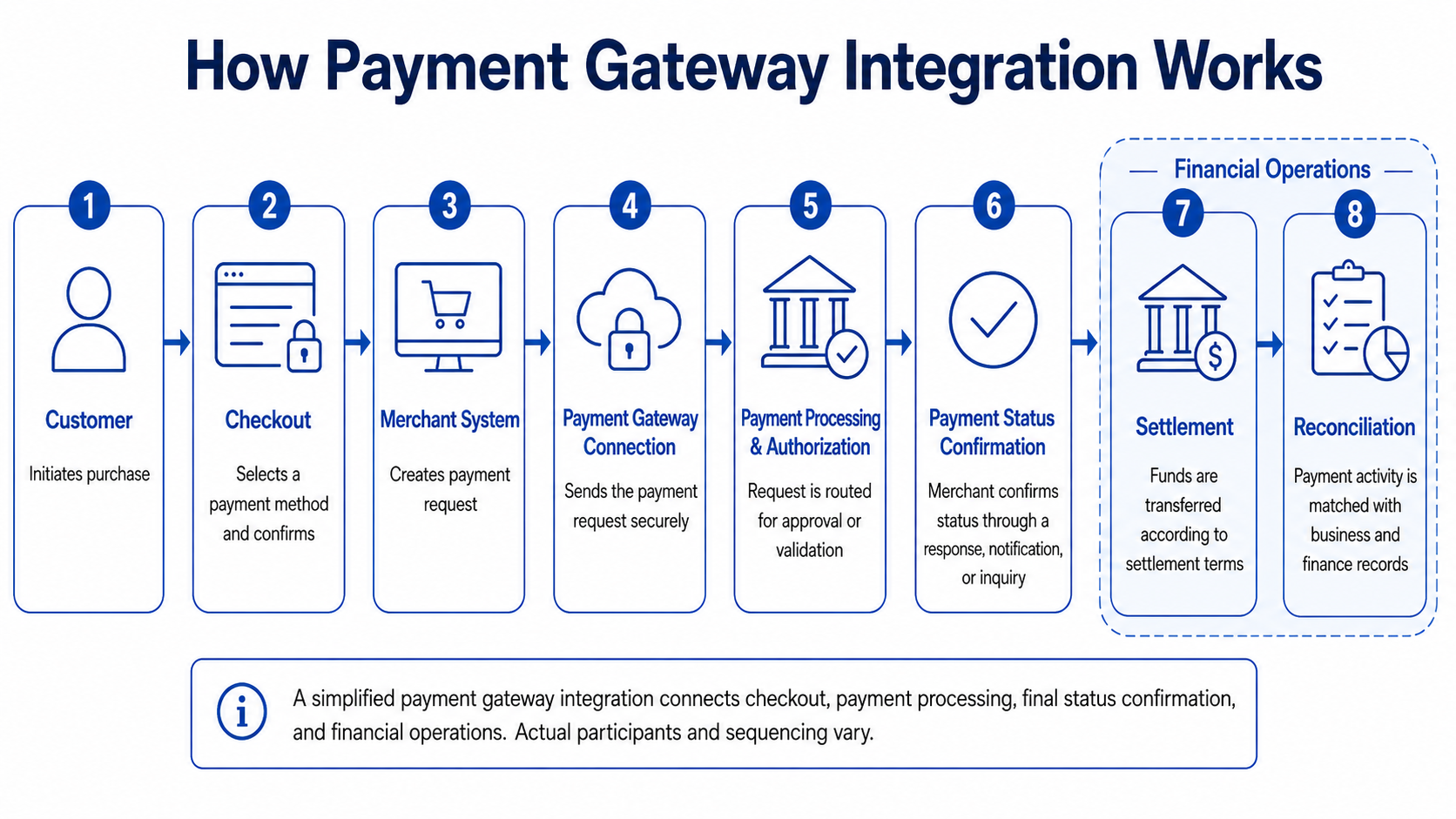
How does payment gateway integration work?
Payment gateway integration begins when a customer selects a payment method at checkout. The merchant then creates a payment request containing information such as the order reference, amount, currency, customer location, and return or notification URLs.
The payment process may involve the following steps:
- collecting payment credentials through a hosted page, embedded fields, an SDK, a digital wallet, or a stored token;
- redirecting the customer to a bank, wallet application, QR code, or authentication page;
- authenticating the customer when required, such as through EMV 3-D Secure;
- sending the transaction through the relevant bank, card network, wallet, or payment system for validation or authorization;
- capturing the payment immediately or at a later stage;
- receiving payment status through an API response, return page, asynchronous notification, or status inquiry.
After the payment is completed, settlement transfers the funds according to the payment arrangement, while reconciliation matches payment records with order details, fees, refunds, settlement amounts, and payouts. Authorization, authentication, capture, settlement, and reconciliation are therefore connected but separate stages.
Main payment gateway integration methods
Merchants can choose from several integration models. The appropriate approach depends on technical resources, checkout requirements, payment methods, and security responsibilities.
Integration method | Best for | Main trade-off |
Hosted checkout | Fast, low-complexity setup | Less control over checkout |
Embedded components | A smoother on-site experience | Requires frontend maintenance |
Direct API | Custom payment logic and workflows | Highest engineering and security workload |
Plugin integration | Quick setup on standard platforms | Limited customization and payment-method coverage |
Using a hosted or embedded model may reduce some aspects of implementation and compliance scope, but merchants should not assume that any integration method automatically removes all security obligations.
What does a payment gateway API do within an integration?
The payment gateway API provides a structured method for the merchant system and payment platform to exchange requests and responses.
In direct API integrations, the merchant may interact with the API explicitly. In hosted, embedded, or plugin-based integrations, some API activity may be managed behind provider-controlled components.
What does an API request contain?
The exact fields vary by provider, but a payment request commonly includes some combination of:
- transaction amount and currency;
- order or payment reference;
- selected payment method;
- tokenized payment credentials;
- customer or device context;
- authentication credentials;
- return URL;
- payment notification URL;
- provider-specific configuration.
Actual endpoints, field names, signature methods, and request formats depend on the provider.
Core payment API functions
A mature integration may require more than a create-payment endpoint.
API function | What it does | Example business use |
Pay or create payment | Initiates a payment attempt | Checkout |
Inquiry | Retrieves the current payment status | Resolve an uncertain result |
Capture | Confirms collection after authorization | Delayed fulfillment |
Cancel or void | Stops an eligible payment or authorization | Order cancellation |
Refund | Returns eligible funds | Returns or service recovery |
Notification | Sends an asynchronous status update | Order automation |
Tokenized payment | Uses an eligible stored substitute credential | Repeat purchases |
Reporting | Provides transaction or financial records | Payment operations |
Reconciliation support | Connects payment and settlement records | Finance operations |
Not every provider exposes these functions in the same way. Merchants should ask which parts of their actual payment lifecycle the available APIs can support.
How do merchants confirm the final payment result?
One of the most important integration questions appears after the payment request has been sent: How does the merchant know whether the payment actually reached a final state?
A browser return page or a single synchronous API response may not always provide a reliable final answer.
For example:
- the API request may time out after the payment platform receives it;
- the customer may close the browser before returning;
- the transaction may remain processing;
- the payment may complete inside a wallet or banking application;
- the notification may be delayed;
- an event may be delivered more than once.
API result, payment status, and order status
A reliable payment integration should treat the following as separate concepts:
- API result: Shows whether the request was received and processed correctly. It does not confirm that the payment was completed.
- Payment status: Shows the current transaction state, such as pending, successful, failed, or canceled.
- Order status: Shows the merchant’s internal business state and determines whether to fulfill the order, release inventory, activate a service, or record the transaction.
These statuses should not be combined into a single field.
Asynchronous payment notifications
When a payment status changes, the gateway may send a server-to-server notification. The merchant should verify the notification, match it to the correct payment and order, check the existing order status, and update the order only when appropriate.
Some payment platforms provide both server-to-server notifications and active status inquiries. In Antom integrations, notifyPayment and inquiryPayment are examples of these two mechanisms.
How do integration flows differ by payment method?
A global integration may present one payment interface to the merchant, but the underlying customer journeys can differ significantly.
One API connection does not necessarily make every payment method behave like a card.
Card payments
A simplified card flow may involve:
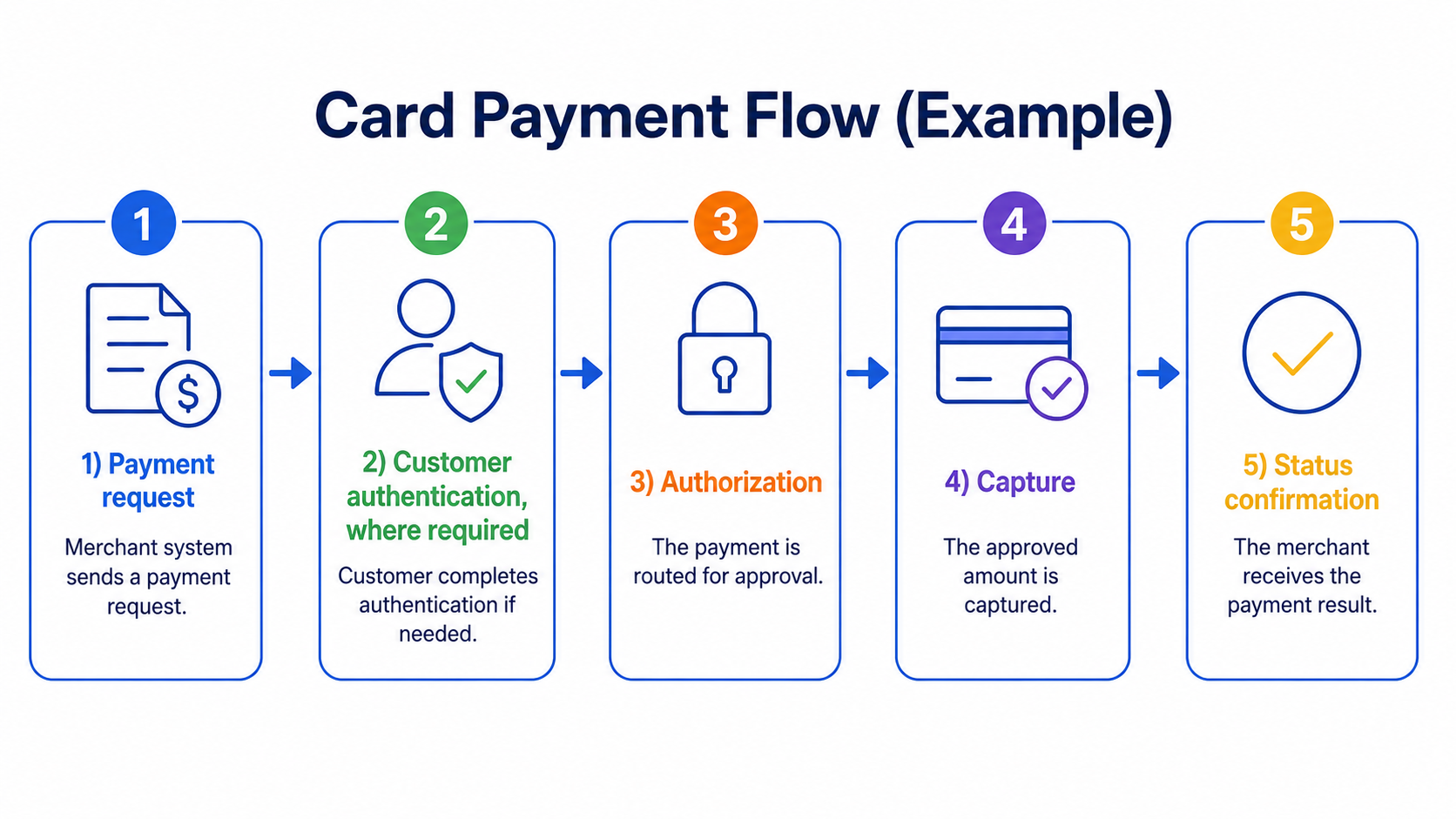
Some card transactions separate authorization and capture. Others use immediate capture, depending on the merchant and provider configuration.
Digital wallets
A wallet flow may involve:
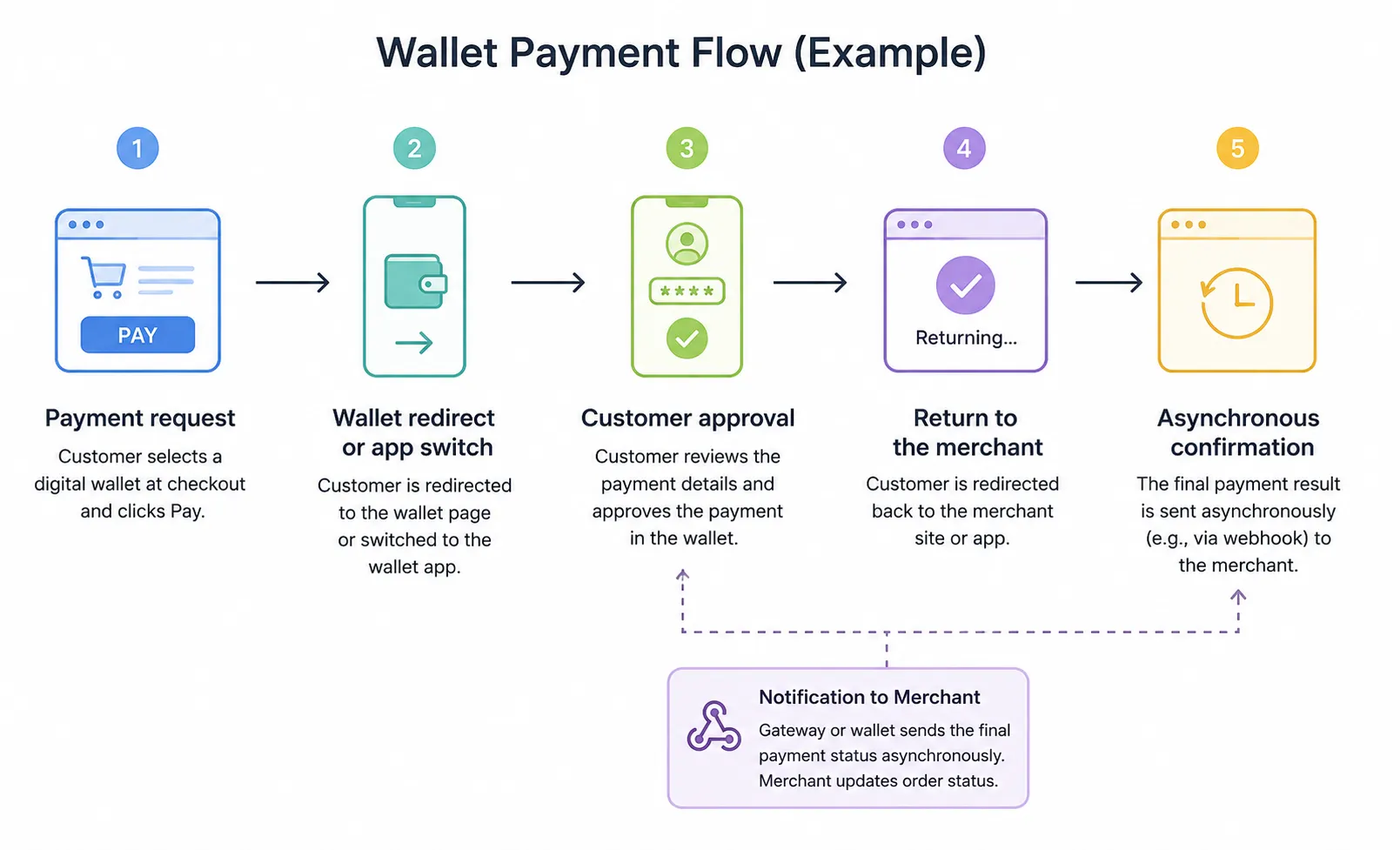
A digital wallet may be card-funded, account-based, stored-value, bank-linked, or based on another model. You should not assume every wallet uses the same underlying payment rail.
QR payments
A QR-based payment may involve:
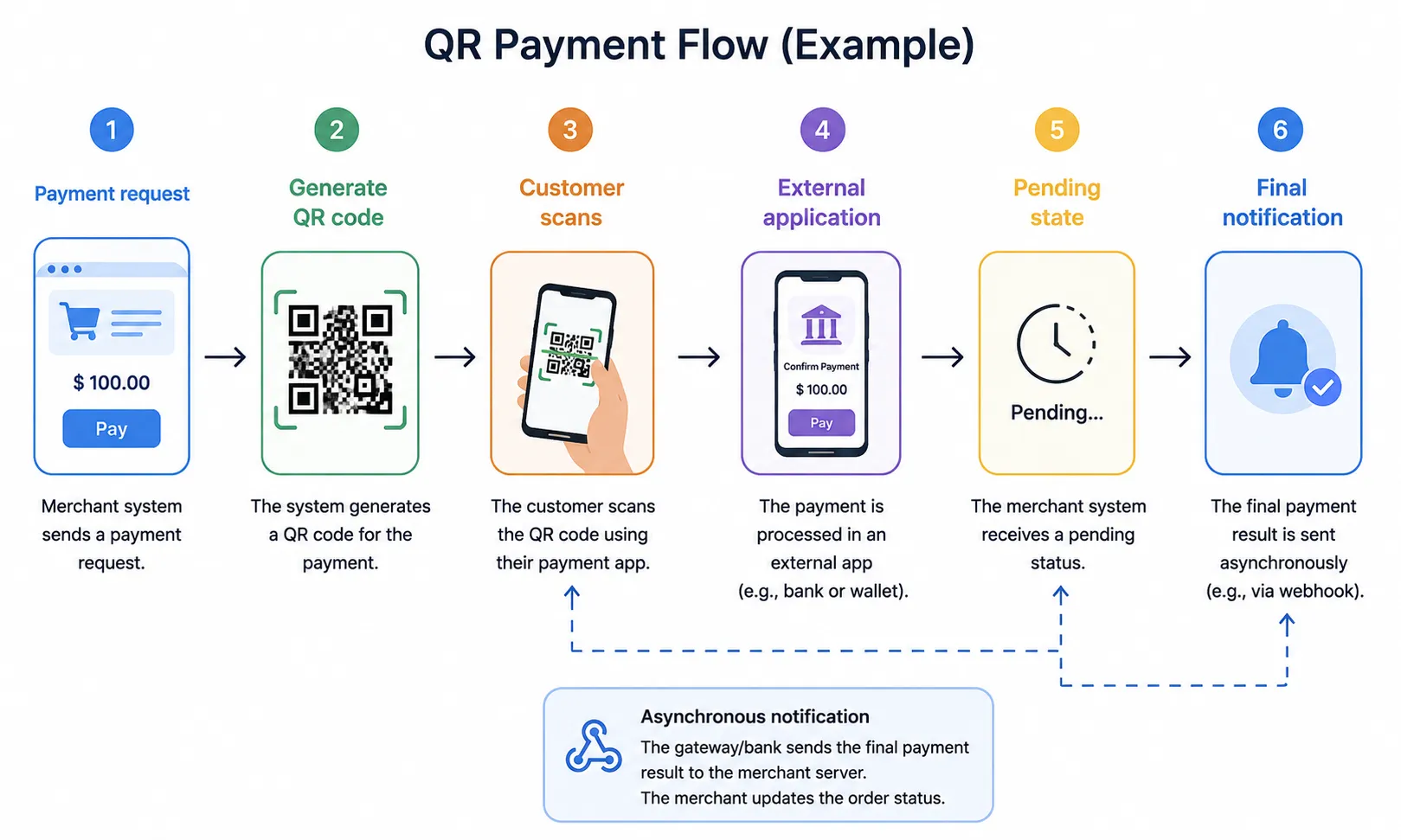
The customer may complete the payment outside the merchant’s browser session, making asynchronous status confirmation particularly important.
Bank-based payments
A bank payment may involve:
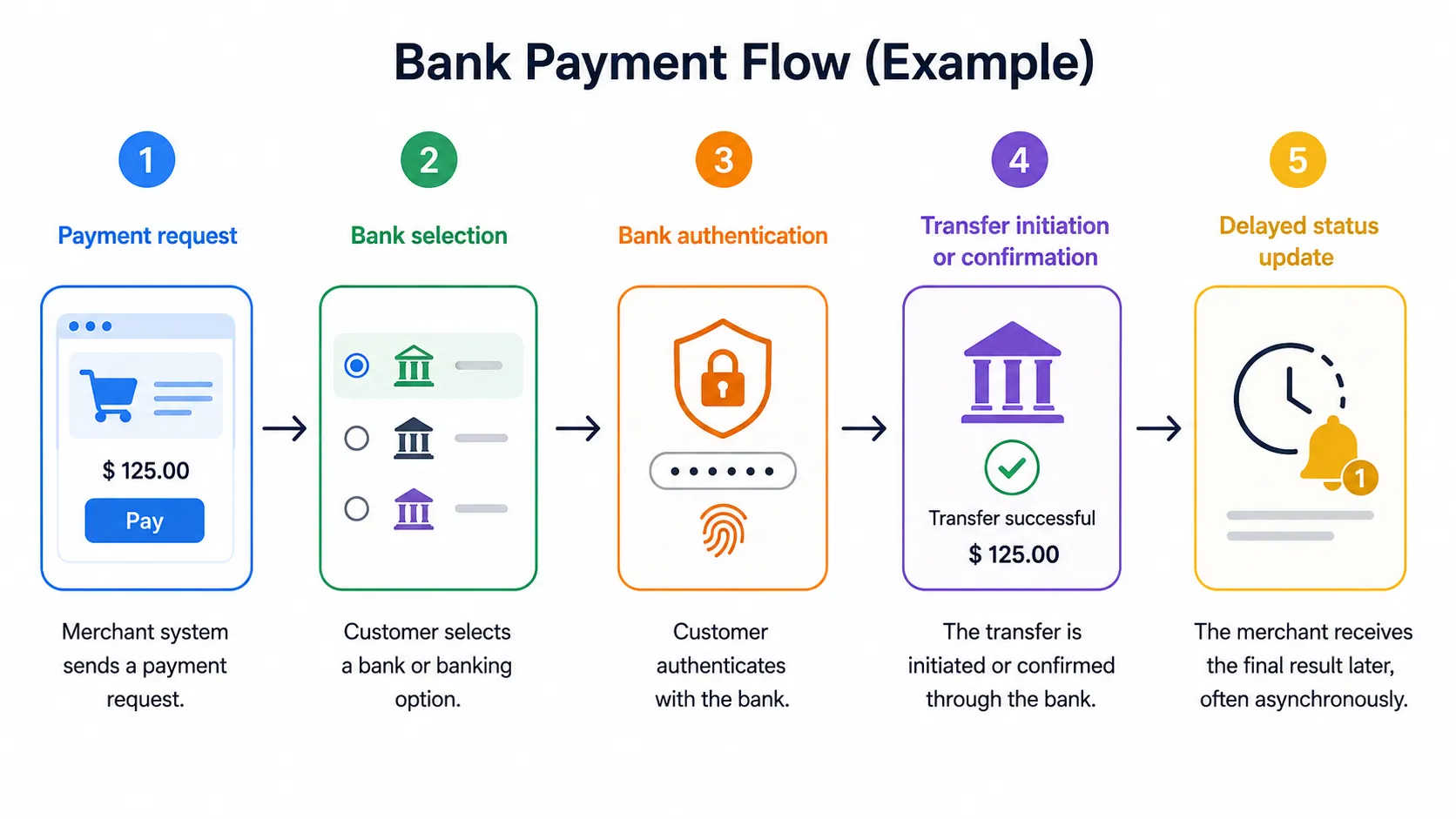
The timing, refund model, and finality may differ by scheme, market, and provider.
Why this matters for global merchants
Supporting several payment methods may create variation in:
- redirects and app links;
- authentication methods;
- status definitions;
- completion times;
- cancellation and refund behavior;
- dispute models;
- settlement timing;
- reporting fields;
- reconciliation records.
This is particularly relevant when expanding into markets where wallets, QR payments, bank applications, and real-time payment systems are widely used.
Security and reliability requirements
Payment security is not a single gateway feature. It is a set of technical and operational controls across the integration lifecycle.
- PCI DSS scope: PCI DSS helps protect payment account data. A hosted or embedded integration may reduce the merchant’s exposure, but it does not automatically remove all compliance responsibilities.
- Tokenization and encryption: Tokenization replaces sensitive payment details with a substitute value, while encryption protects data by making it unreadable without the correct key. They serve different purposes.
- Customer authentication: EMV 3-D Secure may be used to verify customers in online card payments. However, successful authentication does not guarantee authorization.
- API security: Credentials, signatures, certificates, timestamps, and access controls may be used to protect payment requests. Secret credentials should remain on secure servers and should not appear in client-side code.
- Notification verification: You should verify payment notifications using methods such as signatures, timestamps, event IDs, and duplicate checks before updating an order.
- Logging and monitoring: Logs should support troubleshooting without exposing sensitive data. Businesses should define what is recorded, masked, accessed, retained, and monitored.
How to integrate and test a payment gateway
You can use the following steps as a practical guide.
1. Confirm your payment needs
Identify the markets, currencies, payment methods, refund options, and recurring-payment features your business requires.
2. Choose an integration method
Select hosted checkout, embedded components, direct API, SDK, or plugin based on your technical resources and checkout needs.
3. Set up the test environment
Obtain test credentials and configure payment, return, and notification URLs before connecting to live payments.
4. Link payments to orders
Store the payment ID and match each transaction with the correct order in your system.
5. Define status-handling rules
Decide how your system should handle successful, pending, failed, canceled, and duplicate payments.
6. Test common scenarios
Test successful payments, declines, cancellations, timeouts, notifications, and refunds—not only the ideal payment flow.
7. Prepare for launch
Switch to production credentials, confirm live settings, limit access, and enable monitoring and alerts.
8. Maintain the integration
Regularly review transactions, settlements, refunds, API updates, and credential changes.
The exact process may vary by provider, payment method, market, and integration model.
How Antom supports global payment integration
At Antom, we help you accept payments and manage transaction and reconciliation workflows through flexible integration options.
You can integrate through APIs, Antom Checkout Page, Payment Element, and SDKs. These options help you support cards, digital wallets, online banking, bank transfers, and QR-based payment flows across different markets and devices.
We also help you manage what happens after a payment is initiated. You can use notifyPayment and inquiryPayment to confirm payment status and keep your order records aligned with transaction activity. Refunds and cancellations are handled through separate APIs and workflows. When a payment remains pending or the customer does not return to your website, server-side notifications and inquiries help you confirm the latest result independently of the customer redirect flow.
If you manage multiple payment providers or acquiring connections, Antom Payment Orchestration (APO) provides a unified layer for connecting contracted acquirers and payment providers, enabling payment methods, configuring routing, searching transactions, and accessing standardized reconciliation reports for supported acquirers. This helps centralize payment operations as your payment infrastructure expands.
Our role goes beyond initiating payment requests. We provide the integration and operational capabilities you need to connect checkout, payment status, order management, and reconciliation workflows.
FAQs
What is payment gateway integration?
Payment gateway integration is the process of connecting a merchant’s website, app, or backend system with payment services so it can initiate transactions and manage payment-related operations.
Is payment gateway integration the same as a payment gateway API?
No. The integration is the broader technical and operational setup. An API is one interface that may be used within that setup.
Other integration mechanisms may include hosted checkout pages, embedded components, SDKs, and e-commerce plugins.
What are the main payment gateway integration methods?
Common models include:
- hosted checkout;
- embedded payment components;
- direct API or server-to-server integration;
- plugins or platform-native integrations.
Some businesses use more than one model across different channels or payment methods.
Does an API response confirm that the payment succeeded?
Not always.
The response may indicate that the request was accepted, the payment is processing, customer authentication is required, or another action must occur. Merchants may need a payment notification or active inquiry to confirm the final status.
What is the difference between a webhook and a payment inquiry?
A webhook or payment notification is sent from the payment platform to the merchant when a relevant event occurs.
A payment inquiry is initiated by the merchant to retrieve the current transaction status.
A reliable integration may use both.
How does idempotency help payment integration?
Idempotency helps repeated delivery of the same logical request be recognized as the same operation instead of automatically creating a new payment.
It is particularly useful when requests are retried after timeouts or submitted more than once.