

Share on
Acquiring services help merchants accept, process, and settle customer payments through an acquirer, often an acquiring bank. They connect merchants to the card networks, issuing banks, payment processors, payment gateways, and settlement systems behind electronic payments.
When a customer pays online, the transaction may look simple. They enter card details, tap a mobile wallet, scan a QR code, or choose a local payment method. Seconds later, the checkout page confirms the payment.
Behind that moment is a much larger payment journey. The merchant, payment gateway, acquirer, card network, issuing bank, fraud and risk controls, and settlement systems all need to work together.
For global merchants, acquiring services do more than enable payment acceptance. They can influence payment success rates, processing costs, settlement speed, fraud control, chargeback handling, and the customer’s overall checkout experience.
This guide explains what acquiring services are, how they work, and how global businesses can choose the right acquiring setup for growth.
What Are Acquiring Services?
Acquiring services help merchants accept electronic payments and receive funds from customer transactions. They connect merchants with the financial and technical infrastructure behind payment authorization, processing, and settlement.
In a card transaction, the acquirer represents the merchant in the payment flow. When a customer pays with a credit or debit card, the acquirer sends the payment request through the relevant card network to the customer’s issuing bank. The issuing bank checks whether the payment should be approved or declined. If approved, the acquirer helps settle the funds into the merchant account.
You may also hear related terms such as acquirer, acquiring bank, merchant acquiring, card acquiring, or payment acquiring. They are connected, but not always identical.
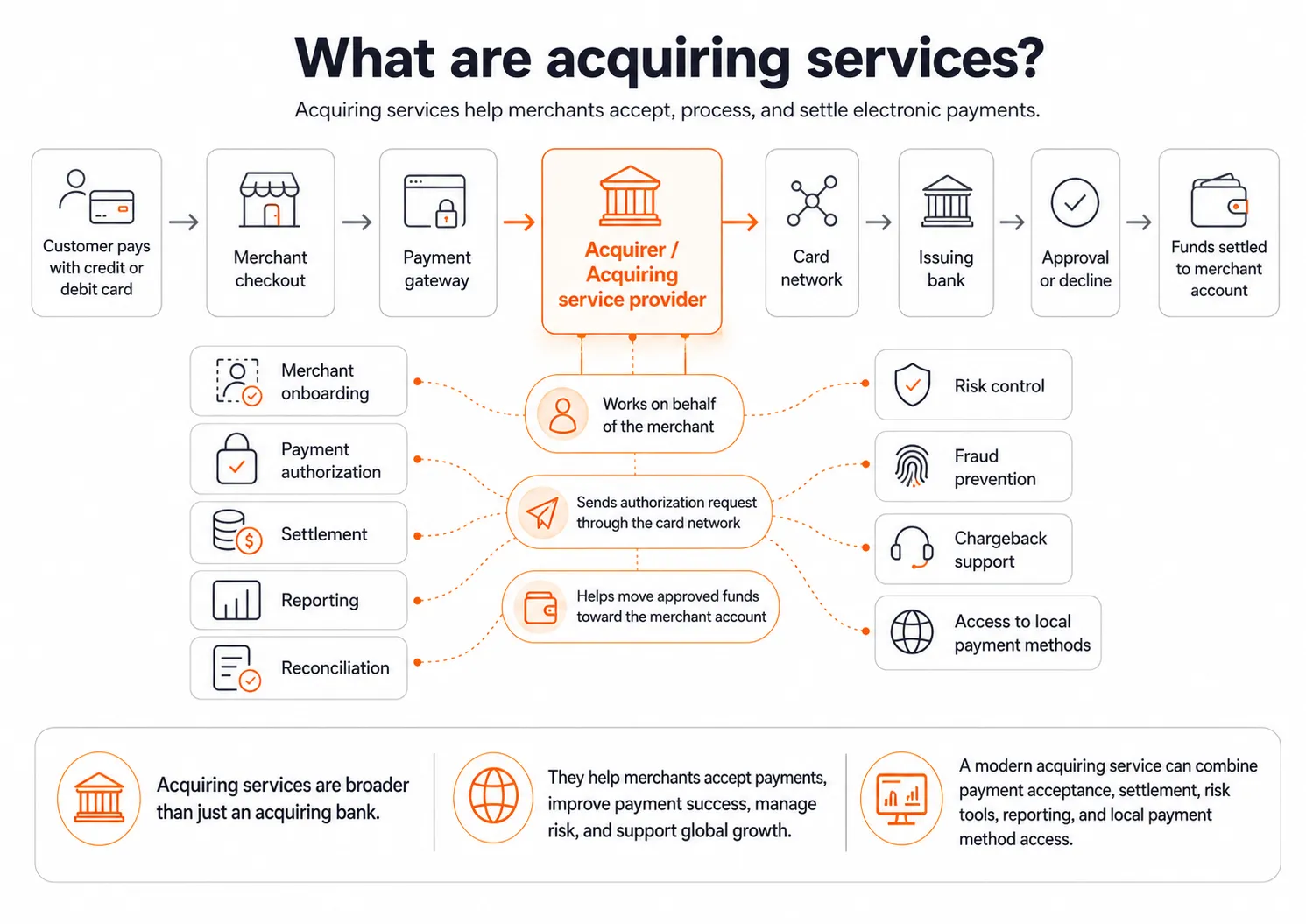
An acquiring bank is usually a licensed financial institution that enables merchants to accept card payments. Acquiring services are broader. A modern acquiring service may include:
- Merchant onboarding
- Payment authorization
- Transaction routing
- Clearing and settlement
- Merchant account or settlement account support
- Reporting and reconciliation
- Risk control and fraud prevention
- Chargeback and dispute support
- Local payment method access
- Multi-currency settlement
- Operational support across markets
In regulated payment environments, merchant processing is also closely connected to risk management, fraud exposure, and chargeback controls.
For a business selling in one country, acquiring may feel like a back-office function. For a merchant selling across regions, it becomes part of the revenue engine.
Why The Right Acquiring Setup Matters For Cross-Border Merchants?
A cross-border ecommerce merchant may attract strong traffic and high-intent customers, but still lose orders at checkout.
For example, a short-form drama or digital content platform expanding overseas may see users ready to top up their accounts, only to find that card payments are declined in certain markets. A travel merchant may receive bookings successfully, but later face delayed settlement, rolling reserves, or funds temporarily held because transaction patterns are flagged as risky.
At first, these may look like isolated problems:
- Payment failure
- Low checkout conversion
- Delayed payouts
- Frozen funds
- Rising chargebacks
- High cross-border fees
- Poor payment visibility across markets
In many cases, these issues often come back to how acquiring is configured behind the checkout.
Payment issues can occur across the acquiring flow. During authorization, issuing banks may decline transactions for funding, card, authentication, or risk reasons. During routing, cross-border payments may be flagged because of market, currency, merchant category, acquirer, or risk signals. After approval, fees, reserves, payout schedules, chargebacks, and compliance checks can still affect settlement.
This is why acquiring is not just a technical connection. It can affect whether a real customer successfully completes a purchase, whether the merchant receives funds on time, and whether payment operations remain stable as the business scales across markets.
How Do Acquiring Services Work?
A typical online payment flow includes six steps:
- Customer initiates a paymentThe customer chooses a payment method at checkout, such as a card, digital wallet, bank transfer, or another local payment option.
- Payment gateway captures payment detailsThe payment gateway securely collects and encrypts payment information before sending it forward.
- Acquirer sends the authorization requestThe acquiring bank or acquiring service provider submits the request through the relevant payment network.
- Card network routes it to the issuing bankFor card payments, networks such as Visa or Mastercard route the request to the bank that issued the customer’s card.
- Issuing bank approves or declinesThe issuing bank checks available funds, card status, authentication data, fraud signals, and other risk factors.
- Funds are cleared and settled
Once approved, the transaction is cleared, and funds are eventually settled into the merchant account, usually after agreed fees are deducted.
Understanding these factors helps merchants avoid assuming that payment failures or delayed payouts are always caused by a lack of customer purchase intent.
Acquiring Service vs Acquiring Bank vs Payment Processor vs Payment Gateway
Payment terms are often used interchangeably, but they do not mean the same thing.
Acquiring Terms Comparison | |||
|
|
|
|
Term | What it means | Main role | Merchant-facing value |
Acquiring services | A broad set of services that help merchants accept, process, manage, and settle payments | Connects merchants to acquirers, payment methods, risk tools, settlement, reporting, and sometimes local payment networks | Helps merchants accept payments across markets, improve payment success rates, manage risk, and receive funds |
Acquiring bank | A financial institution licensed to process card payments on behalf of merchants | Maintains the merchant acquiring relationship and helps move approved funds from the issuing bank to the merchant account | Enables card acceptance, settlement, merchant accounts, and acquiring agreements |
Payment processor | A technology provider that transmits and processes payment transaction data | Sends authorization requests between the merchant, acquirer, card network, and issuing bank | Helps process transactions quickly and reliably |
Payment gateway | The front-end technology that securely collects and sends payment information from checkout | Captures, encrypts, and forwards payment details | Helps merchants accept payments online, in apps, or through digital checkout pages |
A simple way to think about it is this:
The payment gateway is the checkout door.
The payment processor is the messenger.
The issuing bank represents the customer.
The acquirer represents the merchant.
The acquiring service brings these pieces together so the business can get paid.
What type of acquiring setup does a merchant need?
The right acquiring setup depends on the merchant’s business model, target markets, transaction volume, risk level, payment methods, and settlement needs.
A simple online merchant may need:
- A payment gateway to collect payment details
- A payment processor to process transaction data
- An acquiring bank or acquiring partner to accept card payments
- A merchant account or settlement account to receive funds
- Basic reporting and reconciliation
A global merchant may need more advanced capabilities, such as:
- Local acquiring in key markets
- Cross-border payment support
- Digital wallets and local payment methods
- Multi-currency processing and settlement
- Payment orchestration
- Smart routing
- Fraud prevention
- Chargeback management
- Unified reconciliation
- Market-specific compliance support
- Faster operational support during peak sales periods
For global merchants, acquiring is not only about accepting payments. It is also about improving conversion, controlling cost, protecting revenue, and creating a scalable payment operation across markets.
Why Acquiring Services Matter For Global Merchants
For global merchants, acquiring services directly influence checkout conversion, payment costs, settlement speed, and risk control.
Higher payment success rates
Every declined payment is a potential lost sale. Some declines are valid, such as insufficient funds or suspected fraud. Others are avoidable.
Cross-border transactions may be declined because of unfamiliar acquirers, unusual currencies, strict risk rules, or missing limited local acquiring coverage. A stronger acquiring setup can help merchants improve authorization rates through better routing, local processing, and payment method optimization.
For example, an online retailer entering Southeast Asia may find that card acceptance alone is not enough. Customers may expect e-wallets, bank transfers, or local QR payments. Without the right local payment options, the retailer may see lower conversion even when traffic is strong.
Lower and clearer payment costs
Acquiring costs can include transaction fees, interchange fees, scheme fees, acquiring service fees, FX fees, chargeback fees, refund fees, and additional service fees.
For international merchants, the cost of accepting payments can vary by market, card type, currency, payment method, and business model. A headline rate may not tell the full story. Merchants should understand whether fees are blended, passed through, or broken down in a more transparent way.
A good acquiring service should help businesses understand the real cost of payment acceptance across markets, not just the price of one transaction.
Faster settlement and better cash flow
Settlement speed matters because cash flow determines how quickly merchants can reinvest in operations.
If funds arrive too slowly, merchants may face pressure when paying suppliers, managing inventory, issuing refunds, or funding marketing campaigns. For global businesses, settlement can become more complex when multiple currencies, regions, entities, and payment methods are involved.
Acquiring services with clear settlement schedules, multi-currency settlement, reporting, and reconciliation reduce manual finance work and help teams understand where money is at each stage.
Fraud and chargeback management
Online payments create a balancing problem. Merchants need to block fraudulent transactions, but they also need to avoid blocking legitimate customers.
Modern acquiring services may support risk screening, 3D Secure, tokenization, fraud monitoring, dispute management, chargeback alerts, and reporting. These tools help merchants protect revenue while keeping checkout smooth.
This is especially important for industries such as travel, gaming, digital goods, marketplaces, and subscription businesses, where transaction patterns can be fast-moving and cross-border risk signals may be more complex.
Access to local payment methods
Cards are important, but they are not the only way customers pay.
In different markets, customers may prefer digital wallets, online banking, bank transfers, QR payments, buy now, pay later options, or other local payment methods. If a merchant enters a new market but only offers unfamiliar payment options, customers may abandon checkout.
Acquiring services that connect global and local payment methods help merchants meet customers where they already are.
A strong provider should help merchants do more than accept payments. It should help them understand payment performance, optimize operations, manage risk, and scale into new markets.
Before choosing a provider, merchants should also consider the quality of support. When payments fail during a peak sales period, waiting days for a generic response can mean lost revenue. For global businesses, responsive payment expertise is part of the product.
Why Basic Payment Tools May Not Be Enough for Global Sellers
Many new U.S. and international merchants default to standard payment aggregators. However, as your transaction volume scales globally, relying on these entry-level tools may start to limit growth
Why some sources say aggregators are enough?
Some guides suggest that standard domestic processors are sufficient for early-stage e-commerce. But once merchants sell across borders, payment costs can become more complex, with additional layers such as interchange fees, FX markups, and intermediary charges.
For cross-border sellers, professional acquiring services offer critical structural advantages:
- Intelligent Routing: Global acquirers utilize local acquiring licenses to route transactions domestically, which prevents false fraud flags and significantly boosts approval rates.
- Compliance and risk controls: Regulated acquirers hold transaction funds in dedicated reserve accounts, ensuring strict compliance with global financial oversight regulations.
- Account Stability: Unlike standard aggregators—which are notorious for sudden algorithmic account freezes—dedicated acquirers underwrite your specific business model upfront, can support more predictable cash flow.
How To Choose An Acquiring Service Provider
Choosing an acquiring service provider is not only a procurement decision. It is a revenue decision. Merchants can use the 6C framework to evaluate providers.
Provider Selection Factors for Acquiring Services | |||
|
|
|
|
Factor | Question merchants should ask | Potential benefits | Common challenge |
Coverage | Does the provider support my target markets, currencies, customer segments, and payment methods? | Better issuer recognition, higher authorization rates, local currency support, stronger local payment relevance | Requires local coverage and compliance capability |
Conversion | Can it help improve payment success rates and reduce avoidable declines? | Faster market entry and fewer direct local relationships | May involve higher decline risk, FX cost, or cross-border fees |
Cost | Are fees transparent, including FX, refund, and chargeback costs? | Balances reach, cost, approval rates, and operational control | Requires strong routing, reporting, and orchestration |
Cash flow | How fast and flexible is settlement? Can it support multi-currency operations? | Affects processing reliability and speed |
|
Compliance | Does it support KYC, payment security, risk control, and regulatory requirements? | Affects checkout experience and security |
|
Control | Can my team monitor payment performance, disputes, settlement, and reporting in one place? | Helps merchants simplify integration and operations |
|
Frequently Asked Questions
Why do global merchants need local acquiring?
Local acquiring can help transactions be processed closer to the customer’s market. This may support local payment preferences, reduce cross-border friction, improve issuer recognition, and increase payment acceptance in selected markets.
How do acquiring services affect payment success rates?
Acquiring services influence payment routing, issuer recognition, payment method availability, fraud checks, authentication, and settlement. These factors can affect whether a customer’s payment is approved or declined.
What is the difference between an acquirer and a payment processor?
An acquirer works on behalf of the merchant and helps authorize, clear, and settle payments. A payment processor mainly transmits transaction data between different parties in the payment flow.
Build the Right Acquiring Setup for Global Growth
As merchants expand across markets, acquiring services become more than a back-office payment function. They become part of customer experience, revenue strategy, and global growth infrastructure.
The right acquiring setup can help merchants improve payment acceptance, authorization rates, risk control, cost visibility, settlement efficiency, and market expansion.
Explore how Antom helps merchants accept, process, and manage payments across markets through one unified payment platform.