Share on
Rakuten Pay is a digital wallet and payment service in Japan that allows customers to complete online and in-store payments through the broader Rakuten ecosystem.
Japan is already a sizeable online consumer market. According to Japan's Ministry of Economy, Trade and Industry, the country's domestic B2C ecommerce market reached JPY 26.1 trillion in 2024, up 5.1% year over year. As a US, European or Asian business begins attracting Japanese customers, however, entering that market involves more than simply turning on international cards. Customers may arrive at checkout with payment habits, digital wallets and loyalty relationships that are already established locally.
Depending on the transaction, customers can use Rakuten Points, Rakuten Pay Balance, credit cards or Rakuten Bank Direct Debit as funding sources.
Understanding this distinction answers the basic question of what Rakuten Pay is. For merchants, however, the more practical question is where it fits within a Japan payment strategy. If you are selling into Japan, the more useful question is what role it should play in your checkout. Rakuten Pay does not need to replace cards or every other Japanese payment method. Its value depends on whether it matches the payment preferences of the customers you want to reach.
Contents
- What Is Rakuten Pay?
- How Does Rakuten Pay Work Online?
- How the Rakuten Ecosystem Works at Checkout?
- Where Rakuten Pay Fits in a Localized Checkout for Japan?
- Should Your Business Accept Rakuten Pay?
- Can International Merchants Accept Rakuten Pay?
- FAQs
What Is Rakuten Pay?
Rakuten Pay is part of the broader Rakuten ecosystem rather than an isolated payment product. Rakuten Group operates services across ecommerce, travel, banking, cards, mobile communications and digital content, linked through a common membership and loyalty structure. More than 100 million members in Japan can access services across that ecosystem through a single Rakuten member ID, according to Rakuten.
For a merchant, the important distinction is that Rakuten Pay is the payment experience, not the customer's underlying card or account.
A shopper may already have:
- a Rakuten ID
- a Rakuten Card
- money held in Rakuten Pay Balance
- Rakuten Points accumulated from other activity.
When that shopper selects Rakuten Pay at your checkout, those existing relationships can become part of the transaction.
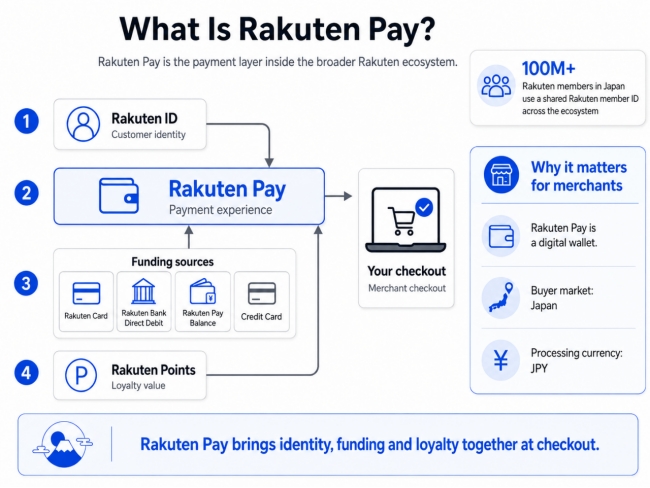
Through our current integration, Rakuten Pay is classified as a digital wallet.
Supported funding sources include:
- Rakuten Points
- Rakuten Pay Balance
- credit cards
- Rakuten Bank Direct Debit.
Japan is the supported buyer market and transactions are processed in JPY.
That makes Rakuten Pay different from both a standalone card and a simple QR-code feature. The wallet acts as the payment layer through which several parts of the Rakuten ecosystem can meet at checkout.
How Does Rakuten Pay Work Online?
Rakuten Pay also supports physical-store experiences, but international ecommerce merchants are more likely to care about what happens after a Japanese customer chooses it online.
In our current online flow, Rakuten Pay uses a redirect model:
- The customer selects Rakuten Pay in your checkout.
- Moves to the Rakuten Pay environment to log in.
- Reviews the purchase and selects an available funding source.
- After confirming the transaction, the customer returns to the merchant result page.
- If a card is selected as the funding source, additional card verification information such as the CVV may be required.
The journey can be understood simply as:
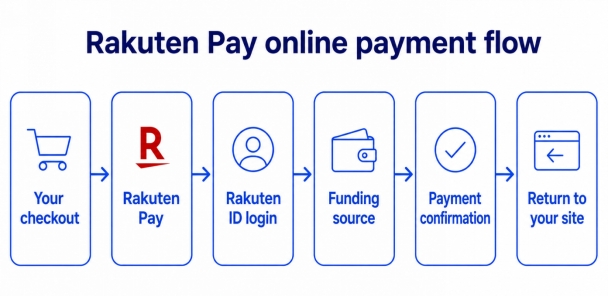
For the customer, the important part is familiarity. Instead of treating the purchase entirely as a new payment relationship with an overseas merchant, an existing Rakuten user can complete the authorization through an environment they may already know.
For your business, the flow has operational implications as well. The current integration returns payment results in real time and supports refunds and partial refunds. That means the decision is not only about showing a Rakuten Pay logo at checkout; your checkout, customer-service and post-payment processes also need to accommodate the way the method works.
How the Rakuten Ecosystem Works at Checkout
One reason Rakuten Pay can be confusing is that several related products appear around the same transaction. A simpler way to understand the ecosystem is to assign each one a job.
Suggested visual: Rakuten ecosystem at checkout
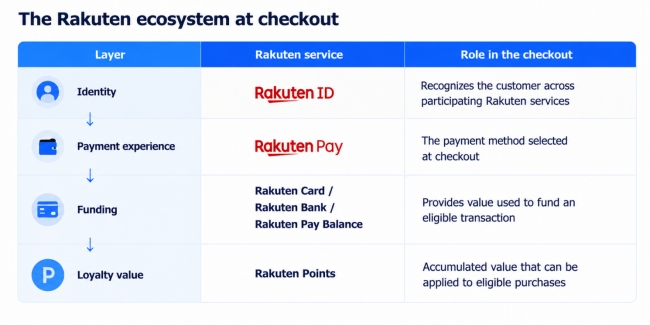
The map makes an important distinction clear: Rakuten Pay is neither simply a Rakuten Card nor simply a QR code. It is the payment experience connecting identity, available funding and loyalty value.
Rakuten Pay Balance also has a recent naming change worth knowing. In 2026, Rakuten began replacing the display name Rakuten Cash with Rakuten Pay Balance across the Rakuten Pay app and other group services. Rakuten stated that the underlying electronic-money functionality remains available; the change consolidates how the balance is presented across its ecosystem.
Why Rakuten Points matter at payment
Points are particularly relevant because they move loyalty value closer to the transaction itself.
Rakuten Points can be earned across participating Rakuten services and then spent on other eligible services and purchases. Rakuten describes its point program as an asset used to attract and retain customers and encourage cross-use across the ecosystem.
For a merchant, the mechanism is straightforward. If a customer already holds Rakuten Points, those points represent value they have accumulated before arriving at your checkout. Allowing eligible points to participate in the transaction can reduce the amount the customer needs to fund from another source and gives that existing loyalty balance somewhere to be used.
That may matter particularly in a price-conscious environment. PwC Japan's latest consumer research found price was the top purchase-decision factor across all product categories surveyed. That does not prove that Rakuten Points will increase your conversion rate, but it helps explain why the ability to redeem accumulated value during checkout can be meaningful to some Japanese shoppers.
For your business, the relevant signal is therefore not simply "Rakuten has a points program." It is whether customers you want to reach are already participating in that ecosystem and may value carrying those points into the purchase journey.
Where Rakuten Pay Fits in a Localized Checkout for Japan
A localized Japan checkout is unlikely to revolve around a single payment method.
Cards provide broad baseline coverage. Some customers may prefer other Japanese wallets. Others may use local payment flows such as konbini. Rakuten Pay occupies a more specific position within that mix: it gives customers already connected to the Rakuten ecosystem an account-based wallet experience that can also incorporate Rakuten Points.
Payment option | Role in a localized Japan checkout |
International cards | Broad baseline payment option for card users |
Rakuten Pay | Wallet-based checkout for customers connected to the Rakuten ecosystem |
Other Japanese wallets | Serve customers whose established payment relationship sits in another local ecosystem |
Konbini and other local methods | Support different local payment habits that cards and wallets do not fully replace |
This is why payment localization should not become a contest to display the largest possible number of logos.
Choosing the right payment methods is only one part of entering a new market. Before adding individual payment options, merchants also need to understand how local payment preferences, consumer behavior and market conditions differ across countries.
Our market guides help businesses evaluate payment landscapes before expanding, including local payment methods, checkout expectations and market-specific considerations across regions.
Explore Antom’s market guides to understand how payment strategies differ across Japan and other global markets.
If you run a US independent store and Japan has only recently become a buyer market, cards and a focused selection of local methods may be enough. As Japanese orders grow, your own checkout data and customer behavior can help determine whether Rakuten Pay deserves a more prominent role.
A larger digital business may reach the same question from the opposite direction. If you already operate in Japan, South Korea and Southeast Asia, you may have cards plus several different wallet and local-payment connections. At that point, the problem is no longer simply adding Rakuten Pay. It is managing an increasingly fragmented payment mix without creating a new integration and operating process for every market.
Gaming is a useful example of why the payment mix matters
Japan is also important for digital businesses. METI's ecommerce survey identifies online games as one of Japan's largest digital content ecommerce categories in 2024.
For game publishers, localization becomes particularly visible as monetization moves beyond an app-store-only model. Our 2026 Global Gaming & Payment Trends Report examines the growing role of DTC models and market-specific payment infrastructure in global gaming.
Our collaboration with NetEase Games provides a practical example of how global digital businesses approach payment localization in Japan. In 2024, we expanded our collaboration with NetEase Games in Japan, supporting a broader payment mix including mobile wallets such as PayPay, cards and konbini payments. NetEase Games described the need to understand the individual user journey for each payment method and reduce unnecessary friction during checkout.
It demonstrates is the decision logic relevant to this article: once a global digital business is serving Japanese consumers, payment-method selection becomes part of localizing the customer journey.
Rakuten Pay may be particularly relevant when these conditions align
Signal | Why it matters |
Japan is an important buyer market for your business | Japan already has a JPY 26.1 trillion domestic B2C ecommerce market. As Japanese revenue becomes material to your business, checkout localization deserves more attention than it would for occasional cross-border orders. |
Your shoppers are likely to participate in the Rakuten ecosystem | An existing Rakuten relationship can make Rakuten Pay more relevant because identity, funding sources and loyalty value may already exist before the shopper reaches you. |
You want a familiar Japanese wallet alongside cards | Rakuten Pay adds an account-based local wallet journey rather than asking every customer to rely on an international card experience. |
Rakuten Points matter to your customer segment | Eligible customers can apply accumulated loyalty value during payment, potentially reducing the amount they need to fund elsewhere. Rakuten itself uses Points to encourage engagement and cross-use across its ecosystem. |
You are localizing checkout across multiple Asian markets | Once every market introduces a different wallet or local flow, integration and operations can become a second problem alongside customer payment choice. |
These signals are more useful than assuming that a well-known local wallet belongs in every Japanese checkout.
A merchant can evaluate the decision through 2 layers.
Evaluation layer | Question behind it | Rakuten Pay example |
Customer fit | Does this method matter to the people you want to reach? | Are your Japanese customers likely to use the Rakuten ecosystem or value Rakuten Points? |
Operational fit | Can you add and operate it without creating disproportionate complexity? | Consider entity eligibility, redirect flow, refunds, integration method and how Rakuten Pay fits with the rest of your Japan payment stack. |
This framework also helps prevent a common mistake in payment localization. A local method can be well known and still be the wrong fit for a particular merchant if its customers, billing model or operating setup do not align with the payment experience.
Can International Merchants Accept Rakuten Pay?
This is where Rakuten Pay becomes particularly relevant to merchants researching the method from outside Japan.
You do not necessarily need to be a Japanese merchant entity to evaluate Rakuten Pay for Japanese customers. Under our current Rakuten Pay setup, Antom supports merchant entities located in:
Singapore · United States · United Kingdom · EEA · Hong Kong · Japan
Japan is the supported buyer market, transactions are processed in JPY, and availability remains subject to merchant eligibility and the applicable onboarding setup.
This gives international merchants a more practical way to frame the decision.
A US ecommerce business does not only need to ask whether Rakuten Pay exists in Japan. It can ask whether its existing merchant structure can support Rakuten Pay for customers in Japan, whether the one-time redirect flow fits its checkout and whether Rakuten Pay belongs alongside the other methods it plans to offer.
Once those pieces align, integration becomes the next step.
For eligible one-time payment scenarios, Antom currently supports Rakuten Pay through API-only integration, Hosted Checkout Page, Web Element and Mobile Element. Refunds and partial refunds are also supported.
For a merchant entering only Japan, that may mean adding a payment method relevant to a particular customer segment. For a business already expanding across Asia, the challenge can become broader: Japan introduces one payment mix, while Korea, Southeast Asia and other markets introduce their own.
For international merchants, the challenge is rarely adding one local payment method. The bigger challenge is building a payment mix that works across markets without creating separate operational complexity for every country.
This is where Antom can support the wider payment setup. We help global merchants connect to localized payment options based on the markets, customers and payment flows they actually need, rather than treating every local method as a separate market-entry project.
If Rakuten Pay looks relevant to your Japan checkout, you can talk with our team about whether the current setup fits your business.
FAQs
Is Rakuten Pay the same as Rakuten Card?
No. Rakuten Pay is the payment service customers select, while Rakuten Card is a credit card product that can act as a funding source within eligible Rakuten Pay transactions.
Can Rakuten Pay be used online?
Yes. Rakuten Pay supports online payment experiences. Through our current integration, buyers use a redirect flow to log in, select a funding source, confirm payment and return to the merchant page.
Is Rakuten Pay a digital wallet?
Yes. Through our current integration, Rakuten Pay is supported as a digital wallet payment method.
Can customers use Rakuten Points with Rakuten Pay?
Rakuten Points are one of the supported funding sources in our current Rakuten Pay integration.
Contact our payment experts to request a customized local payment guide for Japan.