

Share on
Payment security starts with a simple business question: can this transaction be trusted?
According to the 2026 AFP Payments Fraud and Control Survey Report, 76% of organizations experienced attempted or actual payments fraud in 2025, showing that payment risk remains a widespread business challenge.
For businesses that accept digital payments, payment security helps decide which transactions should be approved, verified, reviewed, or blocked. It helps protect payment data, reduces fraud exposure, supports compliance, and helps real customers complete payments with less unnecessary friction.
This guide focuses on payment security for businesses, including ecommerce merchants, marketplaces, SaaS platforms, and companies accepting payments across different regions and payment methods.
Key takeaways
- Payment security is not only about stopping fraud. It is also about protecting customer data, reducing chargebacks, supporting compliance, and maintaining payment success.
- A strong payment security strategy should match the business model, sales channels, payment methods, markets, and risk profile.
- Payment security is often most effective as a layered system covering data protection, identity verification, fraud detection, compliance, operations, and partner risk.
- Overly strict security can block legitimate customers. Effective payment security should reduce risk without creating unnecessary checkout friction.
- For global businesses, payment security should account for local payment behavior, regional fraud patterns, and different payment methods.
What is payment security?
In business payments, payment security is a set of controls designed to help protect payment data, customer accounts, and transactions against fraud, unauthorized access, misuse, and operational risk.
It covers the full payment journey, including how payment information is collected, transmitted, stored, verified, monitored, refunded, disputed, and reported.
A secure payment setup helps businesses answer four practical questions:
- Is the payment data protected?
- Is the customer or account legitimate?
- Does the transaction behavior look normal?
- Should this payment be approved, verified, reviewed, or blocked?
This is why payment security should not be treated as a single tool. It is a decision framework that combines technology, risk rules, compliance processes, and operational workflows.
Why payment security matters
Payment security is not just a technical control. It affects business performance in four key areas:
- Revenue: Weak payment security can lead to fraud losses, false declines, failed payments, and lost sales.
- Risk: It helps businesses reduce exposure to payment fraud, account takeover, data theft, chargebacks, and compliance issues.
- Customer trust: Customers are more likely to complete a payment when they feel their personal and financial data is protected.
- Business continuity: Strong payment security can help businesses accept payments more reliably, process transactions more smoothly, and reduce the likelihood or impact of disruptions caused by security incidents or compliance failures.
When payment security is weak, businesses may face fraud losses, account takeover, stolen payment data, chargebacks, refund abuse, compliance issues, and reputational damage. For online and global merchants, these risks can scale quickly across accounts, cards, devices, markets, and payment methods.
But security that is too rigid can create another problem: legitimate customers get blocked. False declines, repeated authentication steps, failed payments, and confusing checkout flows can reduce conversion and damage the customer experience.
Strong payment security helps businesses strike the right balance. It should help identify and block high-risk activity while keeping trusted payments moving.
Types of payment security
Payment security includes several layers. Each layer addresses a different area of risk across the payment journey.
Type of payment security | What it does | Why it matters |
Data protection | Protects payment and customer information | Reduces exposure to data theft and breaches |
Identity verification | Confirms whether the payer or account is legitimate | Helps prevent unauthorized transactions and account takeover |
Fraud detection | Identifies suspicious transaction behavior | Reduces fraud losses and chargeback risk |
Compliance controls | Supports payment industry and regulatory requirements | Helps businesses manage security obligations |
Network and access security | Protects internal systems and payment infrastructure | Reduces unauthorized access and system compromise |
Dispute and refund controls | Manages chargebacks, refunds, and evidence workflows | Reduces operational loss and abuse |
Monitoring and reporting | Tracks risk patterns, payment failures, and disputes | Helps teams improve security decisions over time |
This layered view is important because payment risk rarely comes from one source. A business may have secure data handling but weak refund controls. It may have strong authentication but too many false declines. It may have good fraud rules in one country but poor performance in another.
Core payment security methods
Encryption
Encryption helps protect payment data by converting it into unreadable information during transmission. It helps secure data moving between customers, merchants, payment gateways, processors, banks, and other payment parties.
For online payments, secure transmission protocols such as TLS are commonly used to protect information between browsers, websites, and payment platforms.
Pros | Cons |
Transit data protection Universal TLS compatibility | Computational overhead Only covers in-transit data |
Tokenization
Tokenization replaces sensitive payment information with a token that is not the original payment data and is typically usable only within a defined processing context. For example, a card number can be replaced with a token for processing or recurring payments.
This reduces the amount of sensitive data a business handles directly and limits the impact if a system is compromised.
Pros | Cons |
Reduce sensitive data exposure Minimize breach loss | Third-party integration needed Extra development cost |
Authentication
Authentication checks whether the person making the payment is authorized. Common methods include one-time passwords, two-factor authentication, multi-factor authentication, biometrics, device checks, and 3D Secure for card payments.
For many businesses, a stronger approach is risk-based authentication. Low-risk payments can move quickly, while higher-risk payments may require additional verification.
Pros | Cons |
Identity verification Risk-adaptive flow | Friction to users Device dependency |
Fraud detection and risk scoring
Fraud detection systems analyze signals such as transaction value, location, device, velocity, customer behavior, payment method, account history, and dispute patterns.
Risk scoring helps businesses decide whether to approve, challenge, review, or block a payment. This makes payment security more flexible than a simple allow-or-deny rule.
Pros | Cons |
Multi-dimension analysis Flexible risk control | High computing cost Continuous model tuning needed |
PCI DSS support
PCI DSS is an important security standard for businesses that store, process, or transmit cardholder data. For merchants, working with a PCI-compliant payment provider can help reduce direct exposure to sensitive card data and simplify parts of the security burden.
Pros | Cons |
Cut sensitive data exposure Ease security compliance burden | Dependent on qualified providers Ongoing compliance audit costs |
Network and access controls
Payment security is not limited to checkout. Internal systems, employee access, vendor connections, and operational tools can also create risk. Access controls, role-based permissions, system updates, and monitoring help reduce exposure.
Pros | Cons |
Multi-scenario risk coverage Granular access & monitoring control | Complex permission management Continuous O&M workload |
Common payment security risks
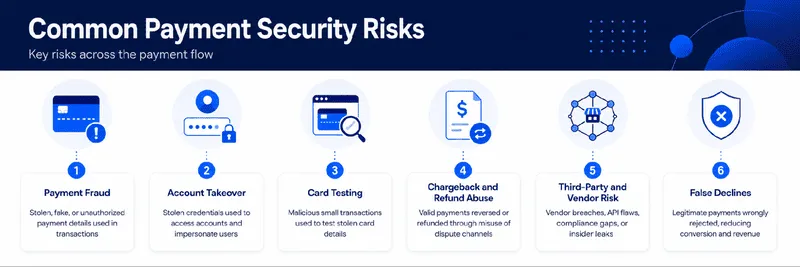
Businesses should look beyond stolen cards when building a payment security strategy.
Payment fraud
Payment fraud occurs when someone uses stolen, fake, or unauthorized payment details to complete a transaction. This can lead to lost revenue, lost goods or services, chargebacks, and higher operating costs.
Account takeover
Account takeover happens when fraudsters gain access to a real customer account. They may use saved payment methods, change account details, redeem balances, or make unauthorized purchases.
Card testing
Card testing happens when fraudsters use a merchant checkout page to test whether stolen card details are valid. These attacks often involve many small transactions and can increase dispute volume and processing risk.
Chargeback and refund abuse
Some customers or fraudsters may misuse chargeback or refund processes to reverse valid transactions. Without clear evidence and workflows, these cases can create significant operational pressure.
Third-party and vendor risk
Payment security also depends on connected vendors, plugins, service providers, and business partners. A weak third-party system can create exposure even if the merchant’s own payment process is well controlled.
False declines
False declines happen when legitimate payments are incorrectly rejected. This can lead to lost revenue and may push customers to competitors.
Payment security for global businesses
Payment security becomes more complex when businesses operate across markets.
A global business may accept cards, digital wallets, bank transfers, QR payments, and local payment methods. Each payment method may have different customer behavior, authentication flows, fraud patterns, settlement timing, and dispute rules.
This creates several challenges:
- A rule that works in one market may block good customers in another.
- A normal payment method in one region may look unusual to a global fraud model.
- Authentication expectations may differ by country.
- Refund and dispute behavior may vary by payment method.
- Local compliance and data handling requirements may change by market.
For this reason, cross-border payment security should not rely on one-size-fits-all controls. Businesses need localized risk understanding, secure payment processing, and visibility across markets.
How much does payment security cost?
Payment security does not usually have one fixed cost. For businesses, the total cost depends on payment volume, payment methods, markets, fraud exposure, compliance requirements, and the tools or providers used.
In practice, payment security costs may include fraud detection tools, authentication, PCI DSS compliance support, chargeback management, manual review, security monitoring, and payment infrastructure fees.
However, the larger cost often comes from weak payment security. Fraud losses, chargebacks, refund abuse, false declines, failed payments, and manual operations can reduce revenue even when the business is still processing payments.
Example
For an online merchant processing $500,000 in monthly payment volume:
Cost factor | Example calculation | Estimated monthly cost |
Fraud losses | 0.5% of $500,000 | $2,500 |
Chargeback fees | 100 chargebacks × $20 | $2,000 |
False declines | 0.8% of $500,000 (in estimated lost payment volume) | $4,000 |
Manual review cost | 200 reviews × $5 | $1,000 |
Estimated monthly impact | =$2,500+$2,000+$4,000+$1,000 | $9,500 |
In this example, weak payment security may cost the business $9,500 per month, or $114,000 per year.
This is why payment security should not be viewed only as a compliance or fraud-prevention expense. A stronger payment security setup can help businesses reduce avoidable losses, protect payment success, and improve the overall quality of payment operations.
Payment security best practices
1: Build a tailored payment security strategy
Payment security setups vary by business model, and a single approach rarely works equally well for every business. A marketplace, SaaS platform, travel company, gaming business, and retail merchant may all face different risk patterns.
Start by reviewing your business model, sales channels, payment methods, average order value, refund behavior, regions, and customer journey.
2: Reduce direct exposure to sensitive data
Avoid storing raw payment data unless necessary. Use tokenization, secure payment pages, and reliable payment infrastructure to reduce the amount of sensitive data your business handles directly.
3: Monitor fraud and payment success together
Fraud rate alone does not show the full picture. Track fraud, chargebacks, false declines, approval rates, failed payments, refund behavior, and manual reviews together.
A good payment security strategy should aim to reduce fraud while protecting payment success.
4: Use adaptive authentication
Apply stronger verification when risk signals justify it. Low-risk customers should be able to move through checkout with minimal unnecessary friction. Higher-risk transactions may require 3D Secure, one-time passwords, device checks, or other verification steps.
5: Strengthen dispute and refund workflows
Disputes and refunds are part of payment security. Businesses should maintain clear records, delivery evidence, refund policies, and response workflows so teams can manage claims efficiently.
6: Review third-party security
Check the security posture of vendors, plugins, platforms, and partners connected to your payment operations. Third-party weaknesses can become payment security weaknesses.
7: Keep systems and teams updated
Security changes over time. Businesses should update payment systems, checkout tools, APIs, plugins, access permissions, and internal procedures. Teams across support, finance, operations, and engineering should understand common payment risks.
What to look for in a secure payment provider
A secure payment provider should help businesses protect data, reduce fraud, manage compliance, and maintain a smooth payment experience.
Key questions to ask include:
Question | Why it matters |
Can the provider reduce direct handling of sensitive payment data? | Helps lower data exposure |
Can it support tokenization and secure processing? | Protects payment information across transactions |
Can risk controls adapt by market and payment method? | Reduces one-size-fits-all risk |
Can it support authentication without unnecessary friction? | Protects conversion and customer experience |
Can teams monitor fraud, chargebacks, refunds, and approvals together? | Improves operational visibility |
Can it support dispute management workflows? | Helps reduce chargeback pressure |
Can it support local payment methods securely? | Helps businesses expand across markets |
Can it provide reliable infrastructure and uptime? | Keeps checkout stable |
For global merchants, payment security should not be separated from payment performance. A suitable provider should help businesses reduce risk while supporting smoother payment experiences for legitimate customers.
FAQs
What does payment security mean?
Payment security means protecting payment data, transactions, customer accounts, and payment systems from fraud, unauthorized access, misuse, and operational risk.
Why is payment security important?
Payment security is important because it helps businesses reduce fraud, protect customer information, manage chargebacks, support compliance, and maintain trust during checkout.
What are the main types of payment security?
Common types of payment security include encryption, tokenization, authentication, fraud detection, PCI DSS support, network security, access controls, monitoring, and dispute management.
What is payment security on a credit card?
For card payments, payment security may include EMV chips for physical cards, CVV checks, 3D Secure, tokenization, encryption, fraud detection, and PCI DSS controls.
How can businesses improve payment security?
Businesses can improve payment security by reducing direct data exposure, using tokenization and encryption, applying risk-based authentication, monitoring fraud and false declines, strengthening dispute workflows, and choosing a secure payment provider.
Is payment security the same as fraud prevention?
No. Fraud prevention is one part of payment security. Payment security also includes data protection, authentication, compliance, secure infrastructure, partner risk, monitoring, and dispute management.
Can payment security affect checkout conversion?
Yes. Security that is too strict can create friction and false declines. A better approach applies stronger checks only to higher-risk transactions, so legitimate customers can pay smoothly.