


Share on
Mobility businesses rely on fast, reliable, and seamless payments to keep people moving. If you run a business in this industry or plan to start one, you must ensure that you have the right payment infrastructure in place. This is because payment friction can lead to abandoned transactions, dissatisfied customers, and lost revenue. But with mobility payments, you can avoid these challenges since they support secure, convenient payment experiences across different services, payment methods, and markets.
Whether you are growing your business locally and across the border, you will need a proper payment strategy. This guide explores common mobility payment methods, opportunities, and challenges you’re likely to encounter.
What are mobility payments?
As the global economies transition to cashless payments, consumers are increasingly embracing other forms of payment like digital wallets and mobile money to make payments. This change is also happening in the transportation industry, where more customers are opting for digital payment solutions to pay for services.
Thus, mobility payments refer to digital payments used to pay for mobility-related services across different channels and devices. They include common services like public transport and ride sharing as well as other services like parking, EV charging, tolls, and in-car purchases. Having the right payment structure can help your business support different payment models, local payment preferences, and high volumes of real-time transactions.
Mobility payments market size and trends
When integrating mobility payments into your system, you need to understand the demand and customer preferences. Market data can help you identify emerging opportunities across different mobility services and markets. These insights can support more informed decisions about market expansion, payment strategy, and the payment capabilities needed to compete in a rapidly changing mobility ecosystem.
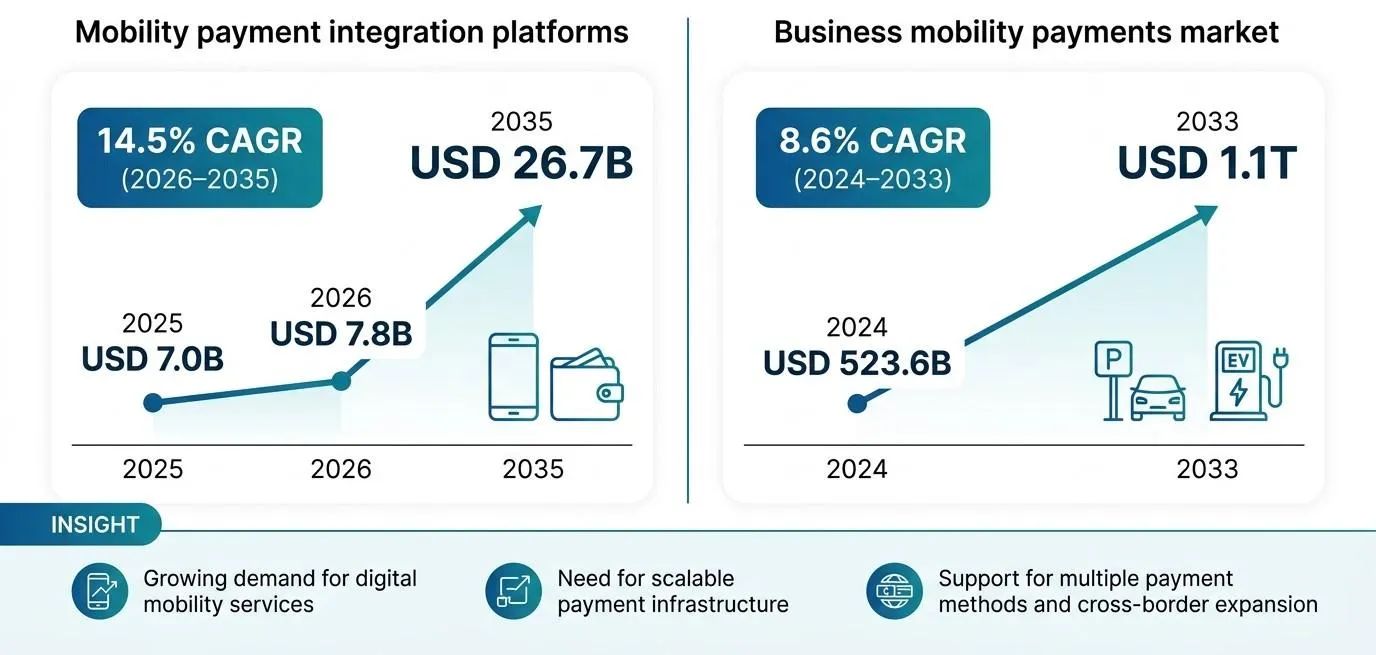
In 2025, the global market value of mobility payment integration platforms was approximately USD 7 billion. It will reach USD 7.8 billion in 2026 and continue growing at a compound annual growth rate (CAGR) of 14.5%, reaching USD 26.7 billion by 2035. This growth highlights the need for businesses to improve customer payment experiences and scale mobility services across new markets.
The global business mobility payments market will grow at a CAGR of 8.6% from USD 523.6 billion in 2024 to USD 1.1 trillion by 2033. This market involves payment solutions and services ecosystem designed to facilitate mobility-related transactions for businesses and consumers on mobile devices. It involves technologies such as contactless payments, mobile wallets, and digital payment platforms. For your business, this growth signals rising demand for payment infrastructure that can support digital mobility services, multiple payment methods, and higher transaction volumes across markets.
Common mobility payment models
Mobility payments should provide convenience and operational efficiency, and ensure secure transactions. The right mobility payment model for your business will depend on the services you offer, how frequently customers use them, and whether you need to support one-off journeys, recurring access, or business travel programmes.
Model | How it works |
Pay-per-use | Customers pay only for the mobility service they use, such as a single ride, parking session, or EV charging session. |
Subscription or mobility passes | Customers pay a recurring monthly or annual fee for continued access to mobility services or discounted travel benefits. |
Stored-value wallets | Customers preload funds into a digital wallet, and each journey or service charge is deducted from the available balance. |
Account-based payments | Customer securely link their payment details to an account, allowing the automatic processing of charges after each trip or service without requiring payment every time. |
Corporate mobility programmes | Businesses provide employees with managed mobility accounts or payment methods for approved business travel, with centralised billing and expense management. |
Opportunities for businesses using mobility payments
Mobility payments make transactions more convenient. But beyond facilitating transactions, mobility payments can improve customer experiences and support your expansion plans to other markets. Here are some opportunities you can leverage to grow your business:
Improve customer convenience and retention
Your target customers can use your services more frequently if you offer fast, reliable, and flexible payment experiences. In addition, having a system that can support multiple payment methods, one-click payments, and frictionless checkout can reduce transaction barriers. These benefits can help you build customer loyalty and repeat usage.
Support cross-border travellers
If you’re targeting cross-border travel customers, you need to offer payment options that enable them to pay for products and services with minimal or no friction. Leveraging mobility payments can allow you to offer localised payment methods that make processes like booking a ride, paying for parking, or charging an electric vehicle abroad feel easier and more familiar. In addition, offering multiple currencies and local payment options can help your business attract international customers while reducing payment friction.
You can achieve this by partnering with global payment providers like Antom. This unified platform is available in over 200 markets and supports more than 300 payment methods and 140 currencies. With such diversity, you can allow your customers to use familiar payment methods, which can increase conversion and retention rates.
Enable recurring revenue through subscriptions
Subscription plans and mobility passes benefit both you and your customers. For instance, customers benefit from convenient access to services while giving your business a more predictable revenue stream. Also, compared to one-off transactions, these options can strengthen customer retention by encouraging long-term engagement.
Generate operational insights from payment data
Digital payments can give you access to valuable insights like customer behaviour, travel patterns, and payment preferences. Your business can use these insights to optimise pricing, identify high-demand services, improve operational planning, and tailor customer offers.
Expand into new mobility services and markets
If you’re looking to expand into new markets and services, mobility payments can offer the best opportunity. For instance, you can launch a local transit app that integrates bus ticketing, e-scooter rentals, ridesharing, and station retail payments into a single platform. This can help you diversify your revenue streams, strengthen customer engagement, and create a more connected mobility ecosystem. Thus, you can leverage flexible mobility payments to capture the entire ecosystem surrounding a consumer's journey.
Challenges of mobility payments
While your business can benefit from scaling mobility payment services, it can also face multiple challenges that can make this process difficult. For instance, the mobility payment platforms operate at the intersection of physical movement and digital finance. This can lead to multiple operational, technical, and regulatory pressures.
Supporting multiple payment methods
Your customers expect to pay with their preferred methods. But this can significantly vary depending on location and demographics. For example, a customer in the Netherlands may prefer paying with iDeal while another in Brazil prefers Pix. Other customers may prefer digital wallets like Apple Pay, Google Pay, or WeChat Pay, while others opt for credit or debit cards. These fragmented integrations complicate the system and increase maintenance requirements.
Managing high transaction volumes
Mobility payments tend to be high-frequency and low-value. For example, your app will be dealing with millions of daily micro-transactions for subway taps, bike rentals, or toll roads. Since these are real-time transactions, your payment infrastructure needs to maintain fast processing speeds and high reliability during peak travel periods without affecting the customer experience. Therefore, a small delay can cause challenges for your business and its customers. Also, if you don’t strictly optimise the payment routing, the processing fees on small transactions can reduce your profit margins.
Fraud and account security
Digital mobility services can face various security challenges like payment fraud, account takeover, and unauthorised transactions. For example, some scammers can use stolen credentials to create accounts and book fraudulent rides and rentals. Others can steal customer financial data from their saved payment methods. Thus, you must invest in a system that supports fraud detection, secure customer authentication, and continuous transaction monitoring.
Regulatory and compliance requirements
If your business operates across multiple markets, there are various compliance and regulatory requirements you must meet. For example, different countries and regions implement varying payment regulations, data protection, and anti-money laundering (AML) obligations. For example, if your business operates within the European Union, you will need to comply with the Payment Services Directive 2 (PSD2) and Strong Customer Authentication (SCA). In Singapore, you must comply with the Payment Services Act (PSA) administered by the Monetary Authority of Singapore (MAS). Before expanding into any market, ensure that you understand all the laws that may affect your business because failure to comply can lead to fines, loss of operating licences, or even reputational damage.
Final takeaway
For a business in the travel and transportation industry, mobility payments are a great strategic tool for delivering convenient, connected, and scalable transportation services. But before you implement them, always ensure that you understand your target market. This will allow you to offer localised services that match customers’ specific needs and expectations. Also, ensure that you choose payment models that align with your business and invest in payment infrastructure that supports diverse payment preferences.
Simplify mobility payments with Antom. Contact us today.
FAQs
1. How can your business evaluate whether its current mobility payment system is meeting customer needs?
You should monitor key metrics such as payment success rates, transaction times, cart abandonment, and customer feedback. Also, paying attention to reviews can help identify friction points that may affect customer satisfaction and revenue.
2. How can your business compare mobility payment providers?
When looking for a payment provider, consider factors like pricing, market coverage, payment performance, scalability, security, and integration capabilities. Also, if you plan to expand in the future, ensure that their systems can support your expansion strategy.