

Share on
Videos are increasingly becoming one of the most effective methods of marketing products, engaging with customers, and building stronger brand experiences. A report shows that 91% of businesses consider video a crucial marketing tool, while 93% of marketers view it as an important part of their marketing strategy. Despite this huge adoption, most businesses struggle with converting viewer interest into complete purchases and sustainable revenue streams.
Video payment addresses this challenge by enabling businesses to generate revenue from video-driven experiences. For example, some businesses use subscription or pay-per-view models to generate income by giving customers access to premium content. Others pay creators and influencers to create video content that promotes their products and services. In this guide, we explore how businesses can leverage video payments to strengthen their competitive advantage.
The growing role of video payment in modern business
Rising demand for video-first digital experiences
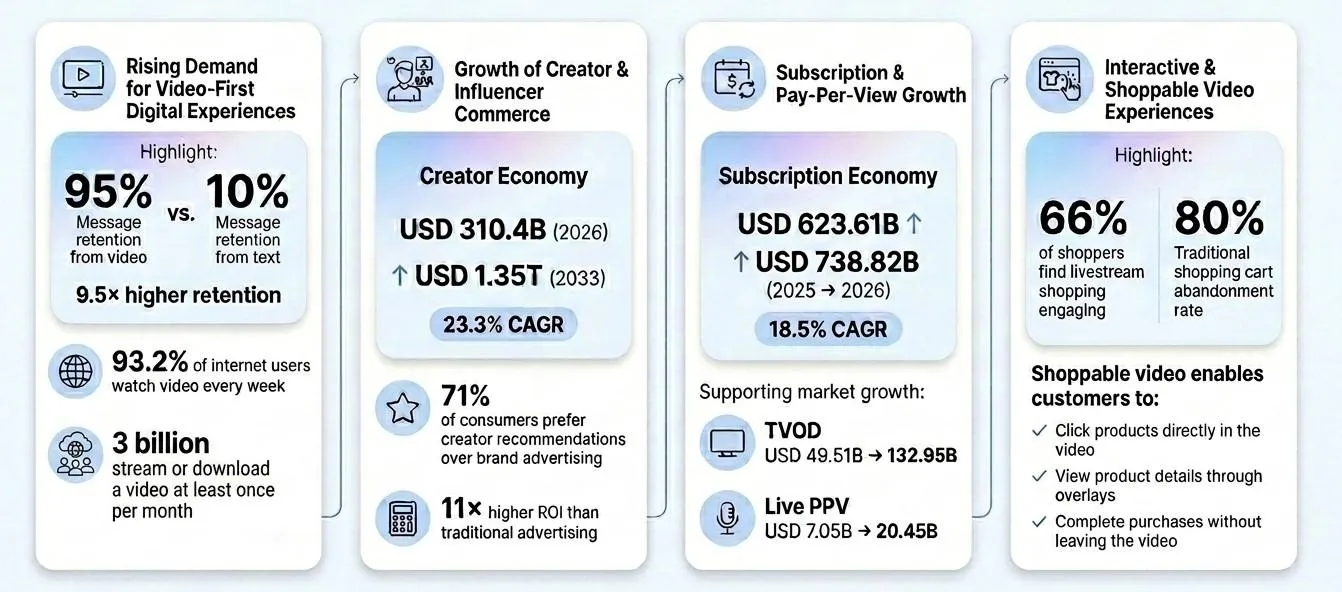
Global consumers are increasingly showing a preference for video content over traditional text- and image-based posts. When viewers watch videos, they retain 95% of the message compared to 10% when they read text, meaning that videos have a 9.5x better retention rate. In addition, 93.2% of internet users consume video content weekly, while over 3 billion stream or download a video at least once per month.
As a result, short-form videos, livestreams, product demonstrations, and interactive content have become key touchpoints throughout the customer journey. In this case, video payments enable cross-border businesses to convert this engagement into completed transactions by supporting seamless checkout experiences. They also support multiple payment methods and local currencies that reduce friction for customers across different markets.
Growth of creator and influencer commerce
One way that global businesses can leverage video payments is by partnering with influencers and creators. These digital creatives use social media to establish a dedicated following within a specific niche. As a result, they have the power to influence opinions, inspire trends, and directly influence purchasing decisions.
The growth of the global creator economy reflects the significance of incorporating influencer marketing in your overall business strategy. For instance, the market size of the global creator economy was USD 252.3 billion. However, it will reach USD 310.4 billion in 2026, and will continue growing at a compound annual growth rate (CAGR) of 23.3% to reach USD 1.3455 trillion by 2033. Besides, 71% of consumers prefer recommendations from creators over brand advertising, and influencer content has an ROI 11 times higher than traditional ads. Therefore, as a global merchant, paying creators and influencers to promote your business can lead to financial gain as well as improved brand awareness.
Subscription and pay-per-view business models
Subscription video services and pay-per-view content allow businesses to diversify their income sources and create sustainable revenue models. For example, if your business offers subscription plans, you can generate more predictable recurring revenue. This would allow you to take advantage of the growing subscription economy, which generated USD 623.61 billion in 2025 and will reach USD 738.82 billion in 2026, growing at a CAGR of 18.5%. Organisations can use these recurring subscriptions to provide exclusive educational content, fitness programmes, virtual events, online communities, and premium digital experiences.
However, subscription fatigue has become a major concern for most modern-day consumers. As a result, offering multiple video payment options is a strategic way of accommodating different consumer preferences. This can include options like pay-per-view (PPV) and transactional-video-on-demand (TVOD). For instance, the TVOD global market size will grow from USD 49.51 billion in 2025 to USD 132.95 billion by 2035, growing at a CAGR of 10.38%. At the same time, the live-streaming PPV market will grow from USD 7.05 billion in 2025 to USD 20.45 billion by 2035, growing at a CAGR of 11.21%. Cross-border businesses can use these models to generate revenue through one-time payments for webinars, product launches, live performances, or specialised training sessions.
Interactive and shoppable video experiences
Modern cross-border businesses are integrating technologies to convert passive watchers into active participants through interactive video experiences. These include clickable hotspots, branching narratives, shoppable links, and gamified checkpoints integrated into video players. They help increase audience engagement, knowledge retention, and conversion rates. For instance, 66% of shoppers find live-streamed shopping events interesting because they allow them to interact with the brand, get first access to new products, and grab deals.
The traditional shopping funnel had a cart abandonment rate of 80% because most consumers found the process frustrating. However, shoppable video experiences eliminate this friction by allowing customers to complete transactions without leaving the video experience. They allow customers to:
- Click on products and add them to the cart as they appear in the videos
- View product details through overlays
- Make purchases while continuing to watch the video
Challenges that businesses might encounter
Managing fragmented payment infrastructure
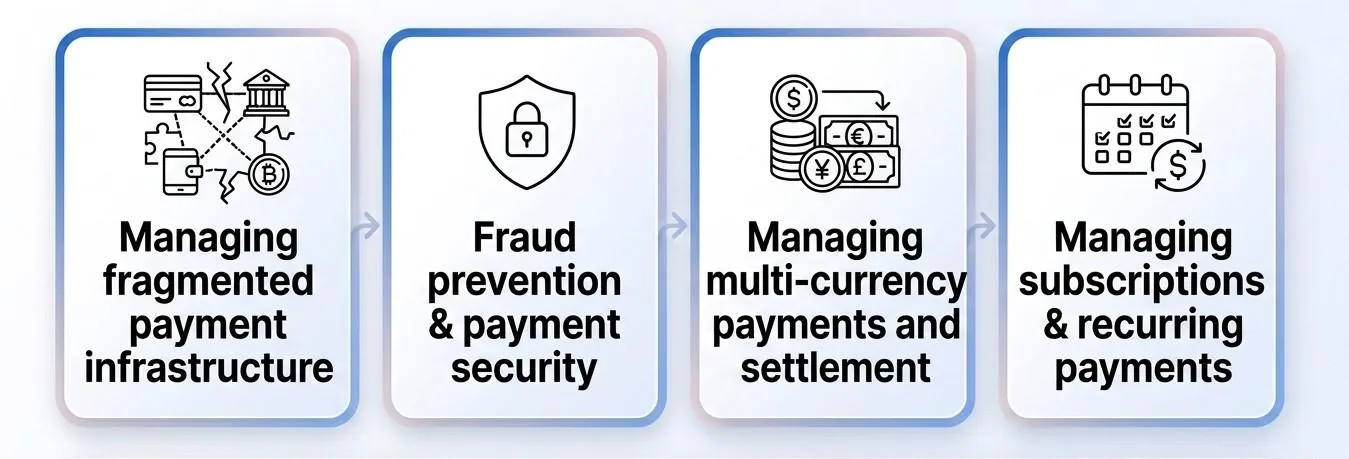
Cross-border businesses use video payments to support subscriptions, livestreams, premium content, and video-driven commerce across multiple markets. However, these payment scenarios often require different payment methods, currencies, and regional payment capabilities. This fragmentation increases operational complexity, maintenance costs, and the likelihood of inconsistent checkout experiences that interrupt the customer journey and reduce conversion rates.
For example, in the Asia Pacific region, digital wallets account for 77% of regional ecommerce. However, consumers in Europe and North America still prefer cards for their local and cross-border ecommerce spending. These differences indicate that cross-border businesses require a unified payment infrastructure to avoid relying on multiple payment providers or separate integrations to support customers in different regions.
Fraud prevention and payment security
Video payment introduces the same security risks associated with other digital payment channels. For example, businesses may encounter payment fraud, account takeover, unauthorised transactions, and chargebacks. Global merchants also need to protect sensitive customer and payment information while complying with relevant payment security standards. Thus, they must implement fraud detection tools, customer authentication measures, and secure payment processing. This can help reduce financial risk while maintaining customer confidence.
Managing multi-currency payments and settlement
Businesses serving customers across multiple markets often process payments in different currencies while settling funds into one or more merchant accounts. Managing exchange rates, settlement currencies, reconciliation, and cross-border transaction costs can increase operational complexity. Therefore, they must select a payment provider that supports flexible settlement options to simplify financial operations.
Managing subscriptions and recurring payments
Businesses offering subscription-based video services to consumers across the world must manage recurring billing, renewals, payment failures, cancellations, and refunds. This is because failed payments and inflexible subscription plans can increase customer churn and reduce recurring revenue. As a result, businesses should provide flexible billing options, transparent pricing, and automated payment management. These can help improve customer retention and operational efficiency.
Best practices for implementing video payment
Video payments enable customers to pay for content your business puts out as well as facilitate creator payments. However, if you want to get the maximum benefits of these payments, you will need a strategy that aligns with your business goals and consumer expectations.
Match the payment model to your business goals
What goals do you want to achieve by integrating video payments into your strategy? The answer to this question can help you select the best business model, payment methods, and overall approach. For example, if you want to increase your revenues, you might consider subscription-based models or pay-per-view. However, if the goal is to increase brand awareness, then creator partnerships might be a better option. Therefore, determine what you want to achieve and align it with your selected payment model.
Support customers' preferred payment methods
Customers are more likely to complete transactions when they can pay using familiar and trusted payment methods. For instance, a report indicates 99% of customers want to use their preferred, customary payment methods, while 94% expect to pay in their local currency. In addition, different regions use varying payment methods. For example, 60% of urban consumers in Indonesia use e-wallets like GoPay, OVO, Dana, and ShopeePay. In Thailand, K PLUS has about 23.1 million users. These regional differences in the use of digital wallets reflect the significance of offering localised payment methods as part of your video payment strategy.
One way you can achieve this is by partnering with global payment processing platforms like Antom. With Antom, you can offer localised video payments because it works in over 200 markets and supports over 300 payment methods and 140 currencies. This means that you can monetise your content in multiple markets and pay creators in their preferred methods to improve retention, satisfaction, and conversion.
Optimise for mobile and connected devices
Most internet users watch videos on smartphones, tablets, smart TVs, and other connected devices. For example, adults in Great Britain spend approximately 7.5 hours daily watching on all screen types, including phones and TVs. Therefore, businesses should offer video payment options that function across different screen sizes and operating systems. This diversity can help them accommodate different customer segments using different devices to consume video content.
Monitor performance and continuously improve
Once you implement video payments, you must continuously track their performance to understand how they impact your business. Were there any changes to your revenues? Did the payment options reduce the cart abandonment rate? How about customer engagement, retention, and satisfaction? These insights can help you identify opportunities for further improvements or challenges you need to rectify.
Final takeaway
Video payment is becoming an important part of how businesses monetise content, engage customers, and participate in the growing digital economy. With proper strategies, you can leverage video content to grow your income, increase brand experiences, and make it easy for your target customers to pay for products or services you offer. However, you need to first determine your business goals. This will help you identify the proper video payment model(s) that align with your organisational plans and customer expectations.
Ready to simplify your video payment strategy with Antom? Contact us today.
FAQs
1. How can businesses stay compliant when accepting video payments across multiple countries?
Businesses should choose a payment provider that supports regional payment regulations, data protection requirements, and local compliance standards. This helps reduce regulatory risks while simplifying cross-border payment operations.
2. How should businesses choose a payment provider for video payment?
When selecting a payment provider, cross-border businesses should look for factors such as global coverage, support for local payment methods, scalability, fraud prevention, integration capabilities, and the ability to manage payments efficiently across multiple markets.