

Share on
Many businesses across the world are integrating livestreams and virtual events into their strategies to increase customer engagement. These approaches allow organisations to showcase products and services, interact with audiences in real time, and build stronger customer relationships. However, some companies struggle with converting audience engagement into complete transactions. This is because consumers often face payment friction and lengthy checkout processes that interrupt their live experiences.
As a result, an increasing number of companies are embracing live payments to address this challenge. This online payment solution allows customers to complete transactions without leaving the live experience. It creates a smooth experience from engagement to transaction for businesses selling products during livestreams, monetising virtual events, or accepting bookings through live consultations.
Why live commerce is driving live payment adoption
Unlike traditional ecommerce, live commerce allows businesses to demonstrate products, answer questions instantly, and build trust through interactive experiences. For instance, a seller can demonstrate how a product works during a livestream, explain its features, benefits, and cost. This creates an opportunity for customers to ask for clarifications before committing to the purchase. As a result, this engagement can lead to higher conversion rates and grow the business’s overall performance.
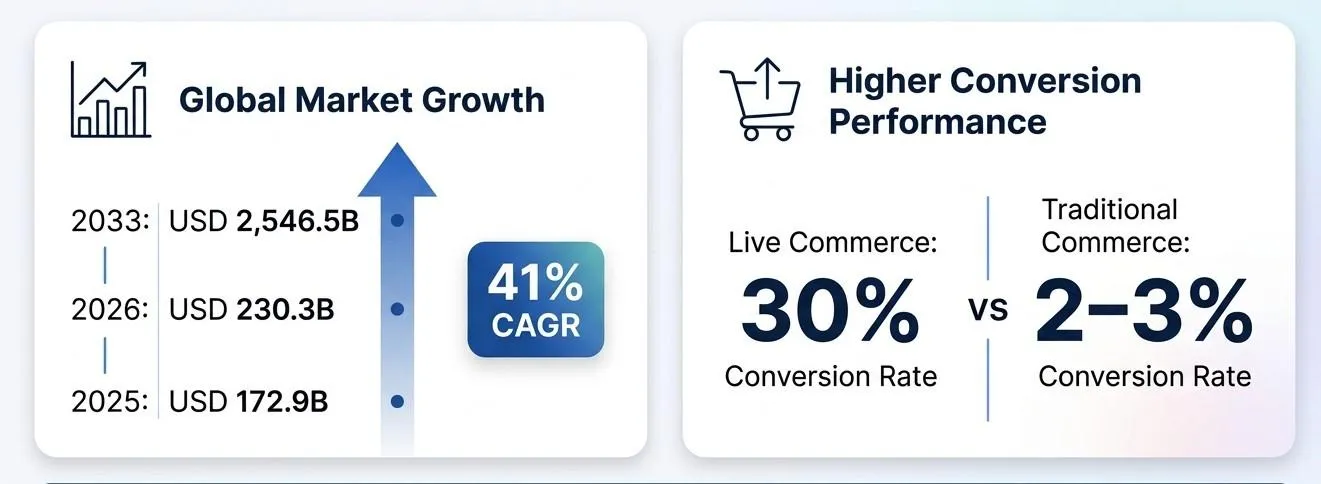
In 2025, the global value of the live commerce market was USD 172.9 billion. Projections show that this market size will reach USD 230.3 billion in 2026 and USD 2,546.5 billion by 2033, growing at a compound annual growth rate (CAGR) of 41%. In addition, live commerce has a higher conversion rate of 30% compared to traditional commerce’s 2-3%. These figures demonstrate the growing commercial value of live commerce and the increasing demand for payment experiences that support real-time customer interactions.
Live commerce drives live payment adoption in multiple ways, including:
- Integrating secure payment gateways directly into the video stream, so viewers can purchase via one‑click checkouts, mobile wallets, or saved cards without leaving the broadcast
- Capitalising on FOMO (fear of missing out) by featuring limited-time flash sales, exclusive discount codes, or limited-inventory drops that create a sense of urgency and prompt customers to make instantaneous live payments
- Building immediate trust by enabling viewers to see others comment and buy in real time, which encourages them to make purchases as well
Benefits of live payments for global merchants
Integrating live payments enhances how brands interact with customers and reduces payment friction. This leads to multiple benefits, including:
Shorten the path from engagement to purchase
Traditional commerce involves a long payment journey that creates multiple opportunities for the customer to abandon the cart. For example, in the case of an online ad, the customer will go through various steps: click the link, browse a site, add to cart, and enter shipping and billing information.
However, most live payment infrastructure eliminates this friction by embedding biometric authentication or digital wallets directly into the live experience. This allows consumers to complete the transaction within a few seconds without leaving the live event.
Improve customer engagement and participation
Live payments can turn global audiences from passive viewers to active participants. They can use features like live bidding and interactive polls to unlock instant purchase links, while real-time gamification keeps them locked in. Instead of just watching the screen, these customers actively compete, click, and participate due to the reduced barrier to financial entry.
Increase conversion opportunities
During a livestream, viewers connect with hosts and other customers due to its interactive nature. The host can read comments, acknowledge customers by their names, and respond to questions. This engagement builds trust and leads to higher conversion. For example, Tommy Hilfiger sold 1,300 hoodies in two minutes during a livestream shopping event that attracted 14 million viewers in China. This demonstrates how interactive live experiences can significantly increase conversion.
Support impulse purchasing
Impulse buying relies on momentum. If a customer has time to walk away, find their credit card, or rethink the shipping costs, the impulse evaporates. Live payments help businesses capture that exact micro-moment of high emotional intent. Thus, instant payments allow global consumers to act on their immediate desires before logic or hesitation kicks in.
Create richer shopping experiences
Live payments bridge the gap between entertainment and commerce by turning a transactional event into an experiential one. Global merchants can build ecosystems that combine real-time chat, live host demonstrations, and instant financial validation. For example, during China's Singles' Day presales, livestream host Li Jiaqi generated around USD 1.9 billion in sales in a single livestream. This demonstrates how working with trusted personalities can build richer shopping experiences that drive large-scale purchasing during live shopping events.
Risks associated with live payment
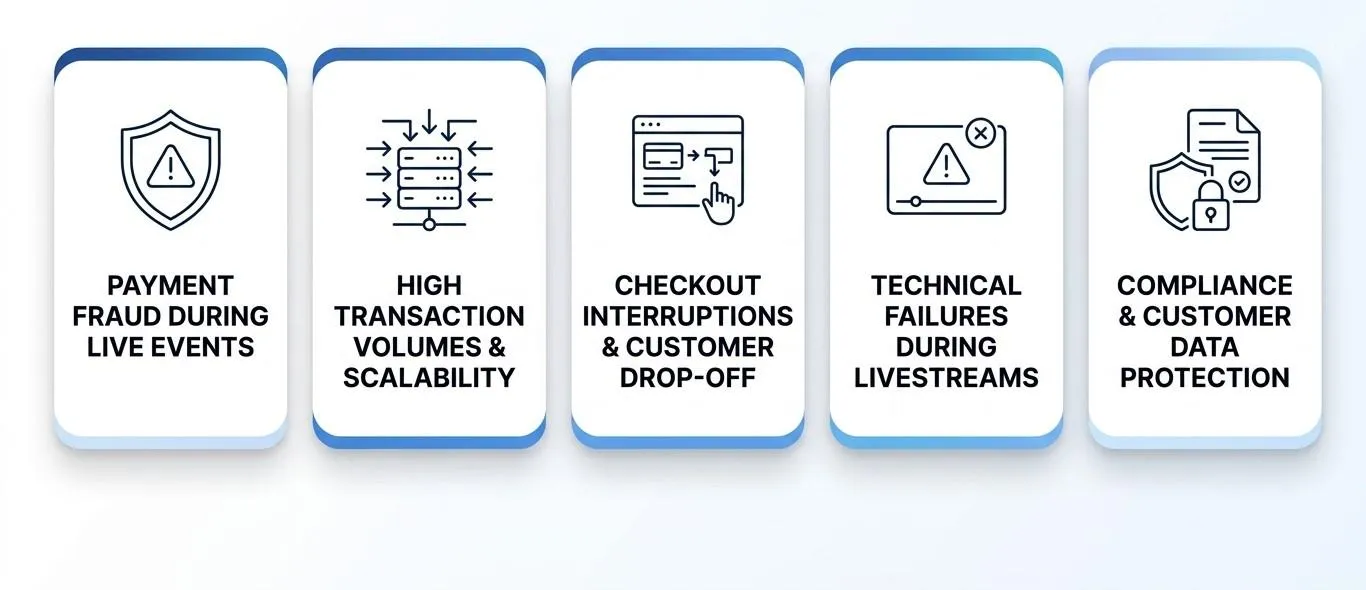
Payment fraud during live events
The high-velocity environment of a livestream can attract fraudsters. For example, they can weaponise the speed of the live checkout by deploying automated bots or using stolen credentials to buy limited-edition products before systems flag these anomalies. They can also take over other viewers' accounts or file fraudulent chargeback claims. Therefore, businesses should implement real-time fraud detection, customer authentication, and transaction monitoring to identify suspicious activity without interrupting the customer experience.
High transaction volumes and scalability
A livestream with multiple customers trying to pay for products at the same time can lead to a system failure. For example, a popular influencer telling 100,000 concurrent viewers to "click the link now" sends a violent spike of payment API requests hitting the gateway at the same second. If a merchant's payment infrastructure or their third-party processor cannot handle massive, sudden concurrency, the system can experience timeout errors and revenue loss during peak audience engagement.
Checkout interruptions and customer drop-off
In live payments, a delay of even two seconds can cause a customer to abandon their cart. For example, if your payment processor requires multi-factor authentication steps or suffers from slow loading times, the customer may decide to discontinue the payment due to the frustrating payment process. An interruption during checkout can kill the impulse and cause the buyer to drop off the stream.
Technical failures during livestreams
Live payment depends on the integration of multiple technologies that support both the livestream and the payment infrastructure. For example, poor internet connectivity, payment gateway outages, software bugs, server overloads, or integration failures can interrupt transactions or cause payments to fail during a live event. Therefore, businesses should test their payment systems, monitor performance in real time, and implement backup measures to minimise disruptions.
Compliance and customer data protection
Processing global payments in real time requires compliance with multiple cross-border regulations. For example, live payments integrate payment methods that collect and save customer financial data. In addition, businesses collect personal data like contact and home addresses for instant order fulfilment and deliveries. Therefore, merchants must ensure their live interfaces maintain strict PCI-DSS compliance while adhering to localised data privacy mandates like GDPR in Europe or CCPA in California.
Best practices for implementing live payment
When implementing live payment, you must consider various factors that can impact both your business and customers. For example, you need to partner with a payment processor that can support rapid, high-volume transactions.
Choose a payment platform built for scale
Before you select your payment platform, check whether it can support live commerce. Does it have the capability to process thousands of transaction requests per second without system failures? You can prioritise platforms that leverage cloud-native auto-scaling, feature redundant backup routing to prevent single points of failure, and offer real-time, AI-driven fraud detection.
Support customers' preferred payment methods
As a global merchant, your customer base is most likely to include customers from different countries or regions across the world. This means that they will have varying preferences for payment methods. Therefore, your live payment gateway should integrate local payment methods and digital wallets into the stream interface. These include Apple Pay and Google Pay globally, Pix in Brazil, iDEAL in the Netherlands, and dominant apps and mobile wallets across Asia and Africa.
An example of a platform you can work with is Antom. This unified global payment and growth platform is available in more than 200 payment markets worldwide and supports over 300 payment methods and 140 currencies. This capability allows global merchants to localise their payment methods, thus potentially increasing sales and conversion rates.
Keep checkout fast and frictionless
As a global merchant, always remember that every extra step in the payment process creates an opportunity for customers to change their minds. Therefore, your ideal live payment experience should happen entirely within the video overlay, while keeping the stream visible. Leverage native device features to minimise typing:
- Implement one-click checkouts for returning users.
- Utilise biometric authentication, such as Face ID or fingerprint scans, to instantly authorise payments.
- Auto-populate shipping details using saved account profiles or digital wallet data.
Final takeaway
Live payment allows your business to leverage the growth opportunities created by the rise and adoption of live commerce. With customers opting for interactive experiences, selling products on livestreams or hosting virtual events allows you to interact with customers. This helps build trust and customer confidence in your brand. However, you must ensure that you integrate a payment gateway that supports live payments and mitigates risks such as fraud and other issues that cause payment friction. The goal is to keep the payment process simple and leverage consumer impulses.
Ready to launch your live payment system? Contact us now.
FAQs
1. How can businesses prevent overselling during live payment events?
If your business hosts live payment events, you can avoid overselling by integrating real-time inventory management systems that automatically update stock levels. This helps ensure product availability remains accurate, even during high-demand livestreams or flash sales.
2. How can businesses reduce payment disputes during live payment events?
Businesses can minimise payment disputes by providing clear pricing, product descriptions, and purchase terms during live events. In addition, sending immediate payment confirmations and digital receipts after each transaction can reduce misunderstandings that may lead to disputes.