

Share on
If you are expanding your business across borders, you may encounter a four-digit number during merchant onboarding, acquiring setup, or payment-method activation: your Merchant Category Code, or MCC.
At first glance, MCC can look like a simple administrative field. In practice, it is how payment systems identify the type of business behind a merchant account. A fashion retailer, airline, restaurant, software provider, game operator, and live-streaming platform may all accept payments online, but they do not necessarily belong to the same merchant category.
Understanding MCC becomes more important as your business expands into new markets, adds new products, or connects to different payment networks. There is an international MCC standard, but not every payment ecosystem uses one identical code list in every situation. Some networks use additional private codes, while others must remain compatible with codes already used elsewhere.
At Antom, we use an MCC framework built around three code sets—A1, A2, and A3—to support merchant classification across different payment scenarios. This guide explains how the system works, what the three code sets are for, and what global merchants should check before onboarding or expanding their payment setup.
What are MCC codes and why do they exist?
A Merchant Category Code is generally a four-digit code used to classify a merchant according to the type of business, trade, goods, or services it provides.
The international baseline is ISO 18245:2023, which defines code values that enable merchants to be grouped into specific categories. Importantly, an MCC describes the merchant’s business category rather than every individual product in a customer’s basket.
Common examples in Antom’s ISO-based MCC list include:
- 4511 — Airlines, Air Carriers
- 5411 — Grocery Stores and Supermarkets
- 5812 — Eating Places and Restaurants
- 5816 — Digital Goods—Games
- 5817 — Digital Goods—Software Applications
- 7011 — Hotels, Motels and Resorts
Why does the payment ecosystem need this classification?
Two businesses can look similar at checkout while requiring different classifications. Selling downloadable games is not necessarily the same as selling virtual currency, operating an application platform, or providing live-streaming services.
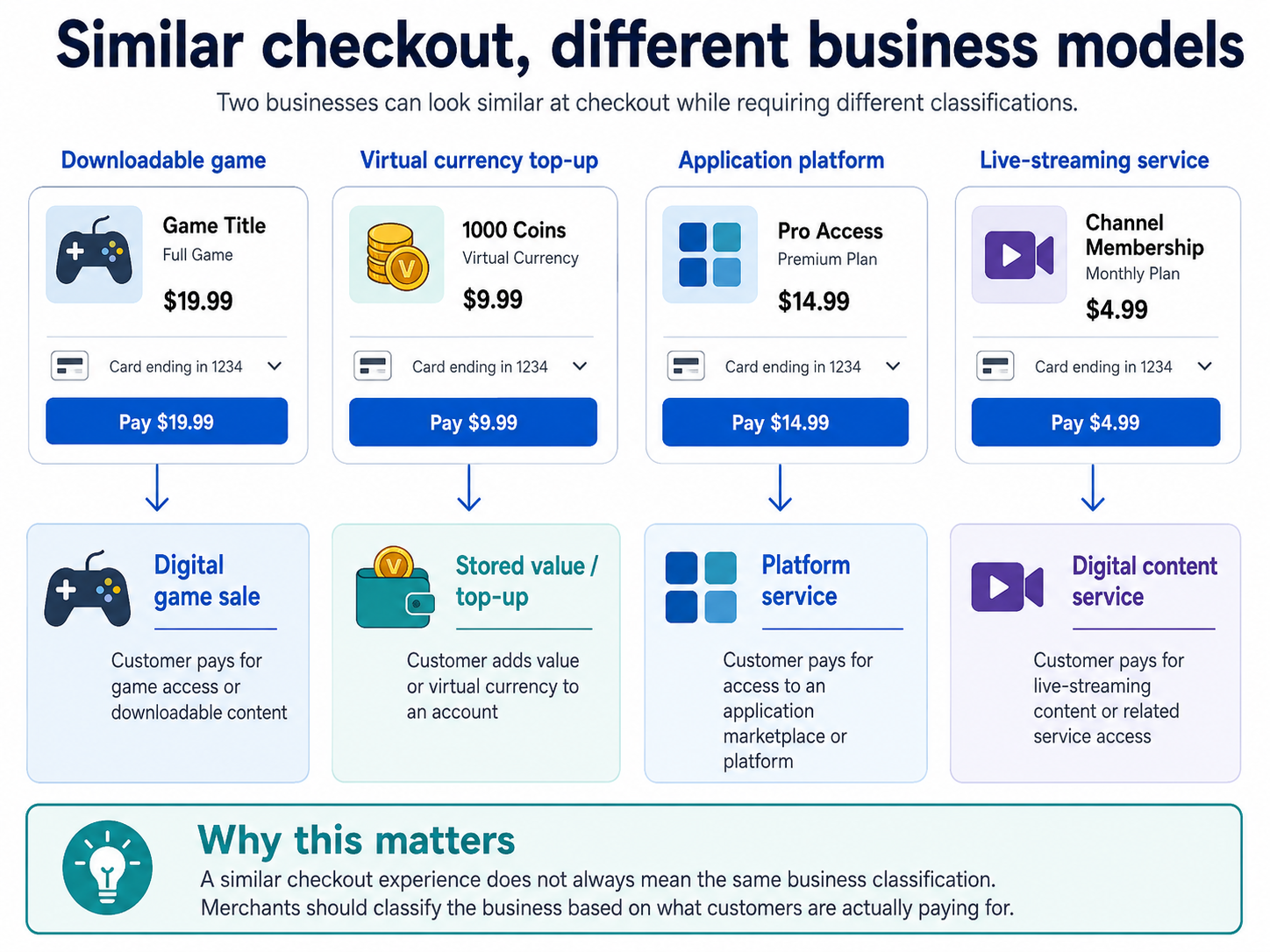
MCC gives acquirers, payment providers, payment networks, and other participants a standardized way to understand what type of business is being paid without relying on a product-by-product description for every transaction.
That classification may be relevant during:
- Merchant onboarding;
- Acquiring and merchant-account configuration;
- Payment-method eligibility and enablement;
- Risk and compliance review;
- Certain network or commercial rules.
MCC should therefore be treated as part of your payment setup rather than a code to complete once and forget.
Who assigns the MCC?
Merchants normally provide the business information needed for classification, including details about the legal entity, website, products or services, and operating model.
At Antom, we assign MCCs to merchants from our published MCC list. Institutions working with us are also required to assign MCCs according to the framework, and Antom reserves the right to correct misuse.
This means the practical question is not:
'Which MCC would I prefer?'
It is:
'Which classification most accurately represents the business my customers are actually paying?'
Why merchant category codes matter to your business?
1. Your MCC can affect your payment costs
Merchant Category Codes (MCCs) play a direct role in determining the fees you pay for card transactions. Some sectors, such as airlines and online gambling, are generally considered higher risk and may be subject to higher interchange rates. Others, including education and grocery businesses, may qualify for lower rates under certain card-network rules or regulations.
Understanding your MCC helps explain your cost structure and identify whether you may be paying more than necessary. If the code assigned to your business does not accurately reflect what you sell or provide, you could be missing an opportunity to reduce costs.
2. It helps payment partners assess risk
Issuers, card networks, and payment providers use MCCs as one input when evaluating merchant risk. For example, a subscription business processing recurring charges, such as MCC 5968, is assessed differently from a merchant selling products through one-time e-commerce transactions.
Higher-risk MCCs can lead to more intensive fraud monitoring, stricter underwriting, or transaction-volume limits. If your company expands into new products, verticals, or markets, it may be necessary to review whether your existing MCC still fits the business.

3. It can shape cardholder rewards and perception
Credit card rewards, including points, cashback, and category-based offers, are often determined by MCC. A cardholder may earn bonus rewards for spending at restaurants or travel merchants, but receive standard rewards if the same purchase is classified under another category.
That means your MCC can affect not only your payment economics, but also how customers experience the value of paying your business with a particular card.
4. It also supports compliance oversight
Certain industries are subject to greater regulatory attention. Financial institutions use MCCs to identify transactions that may require enhanced review, including those related to anti-money laundering (AML), consumer-protection requirements, or sector-specific rules.
Using the right MCC helps payment providers apply appropriate risk and compliance controls—and helps merchants avoid unnecessary operational or compliance issues caused by incorrect classification.
Why is there no single MCC list for every payment system?
It is easy to assume that because MCC is standardized, every payment network must use exactly the same codes in exactly the same way.
That is not quite how the ecosystem works.
ISO 18245 provides the international baseline for merchant classification. However, ISO explicitly does not mandate how merchant category codes must be used in every individual payment situation. Payment ecosystems may therefore implement the ISO codes while also supporting additional categories or codes required for their own networks or for interoperability.
A useful way to think about MCC is:
ISO provides the common foundation, while individual payment ecosystems may add or recognize other code sets for specific use cases.
This matters particularly for global merchants.
A merchant may sell the same underlying service across several markets but connect to different acquiring arrangements or payment systems. The relevant classification process can therefore depend not only on what the business sells, but also on the payment ecosystem through which the merchant is being onboarded.
Antom addresses this through three MCC groups: A1, A2, and A3.
How Antom’s A1, A2, and A3 MCC framework works
The three groups do not represent three competing versions of the same list. They perform different functions.
MCC group | Defined by | Primary role | Typical use |
|---|---|---|---|
A1 | ISO 18245 | Standard merchant classification | The primary code set for established merchant categories |
A2 | Alipay+ for private use | More specific categories for certain business models | Used where an Alipay+ private-use category applies |
A3 | Other payment systems | Interoperability | Recognizes certain codes already implemented in other payment systems |
A1: Codes defined by ISO 18245
A1 is the foundation of Antom’s MCC framework.
It covers established categories across areas such as:
- Retail;
- Transportation;
- Hospitality;
- Professional services;
- Digital goods;
- Utilities;
- Entertainment.
For example, the A1 list includes 4511 for airlines, 5816 for digital games, and 5817 for software applications.
For most merchants, an appropriate A1 category is the natural starting point.
What A1 is for: Classifying mainstream business activities using the internationally recognized ISO framework.
A2: Codes defined by Alipay+ for private use
Some business models require more granular categories than those available in the standard ISO list.
Antom’s A2 table contains private-use codes defined by Alipay+. Examples include:
- 4513 — Air Ticket Platform
- 5821 — Online application store or platform
- 7409 — Social Network Site
- 7410 — Casual Games
- 7411 — Online Literature
- 7414 — Video on Demand
- 7953 — Live streaming content or platform services
- 7958 — Online Games Operator
These examples show why a global merchant should not assume that a broad ISO category is always the only relevant classification.
A downloadable game, an online game operator, a casual-game platform, and a game point-card distributor may all belong to the wider gaming economy, but their operating models are different.
Similarly, a software seller is not necessarily the same business as an online application platform, and digital media is not necessarily the same as a live-streaming platform.
What A2 is for: Providing additional Alipay+ classifications where a more specific private-use category is available.
It is important not to interpret A2 as a 'better' MCC that merchants should choose in order to obtain lower fees or higher payment approval rates. Whether an A2 code applies depends on the actual business and payment scenario.
A3: Codes defined by other payment systems
A3 has a different purpose.
It is not another alternative code list for new merchants to choose from.
Alipay+ recognizes the codes in A3 for interoperability. Merchants that had already implemented an A3 code before accepting Alipay+ may continue operating without changing that MCC in the relevant circumstances. Other merchants should generally select an appropriate code from the ISO-based A1 table.
The A3 table also provides recommended ISO mappings for supported codes.
What A3 is for: Maintaining compatibility with merchant classifications already used in other payment systems.
The practical distinction is therefore:
A1 = international baseline
A2 = Alipay+ private-use extensions
A3 = interoperability with existing external codes
This is one of the most important concepts for global merchants to understand when reading an MCC list.
How to approach MCC classification for your business
The best place to begin is not the code table. Begin with your current business model.
Ask five questions:
- What are customers actually paying for?
- Which activity generates most of the business revenue?
- Is the product physical, digital, or service-based?
- How is the payment made—one-time, recurring, prepaid, or top-up?
- Has the business model changed since the merchant account was originally opened?

E-commerce merchants
A store primarily selling one category of physical goods may have a relatively straightforward classification.
The decision becomes more complex when the same business starts combining materially different activities—for example:
- Physical goods;
- Software;
- Digital content;
- Memberships;
- Subscription services.
A larger catalog alone does not automatically determine whether multiple MCCs or merchant accounts are necessary. The relevant structure depends on the actual business and acquiring setup.
Before onboarding, merchants should be ready to explain:
- Their primary product category;
- Main source of revenue;
- Legal entity operating the business;
- Websites and checkout flows;
- Any materially different digital or subscription activities.
Gaming and top-up
Gaming is a good example of why the commercial model matters more than the appearance of the checkout.
At Antom, we distinguish gaming from top-up:
- Gaming includes merchants directly selling games, game rights, skins, and items.
- Top-up refers to merchants providing direct recharge services, such as purchasing virtual currency.
We recommend confirming the specific merchant type with the Antom Business Development team when the distinction is relevant.
A gaming merchant may also need to consider whether its operating model is more accurately described by an ISO-based A1 category or a more specific Alipay+ A2 category such as Casual Games, Online Games Operator, or Online Games Point Card/Channel Agent.
Software and digital businesses
A digital merchant should clarify what customers actually receive after payment.
For example:
- Is the customer purchasing software?
- Paying for access to an application platform?
- Purchasing digital media?
- Paying for video-on-demand content?
- Accessing live-streaming services?
- Buying access to an online game?
These distinctions make the business easier to classify accurately and help keep the merchant’s onboarding information consistent with its real operating model.
Travel and platform businesses
The same principle applies outside digital goods.
For example, A1 includes a general airline category, while A2 includes more specific categories such as Air Ticket Platform and Airlines System Vendor.
That illustrates a broader principle:
MCC classification should reflect the merchant’s role in the commercial transaction, not simply the industry label that appears closest at first glance.
When should global merchants review their MCC?
A correctly assigned MCC is not necessarily something that must be changed simply because a company enters a new country.
However, global expansion is a useful trigger for reviewing whether the classification still reflects the business.
You should consider a review when:
- Your primary business activity changes;
- A new product line becomes a material source of revenue;
- You add digital goods, subscriptions, gaming, or top-up services;
- You change from direct selling to a platform-based model;
- You activate a new acquiring arrangement or payment method;
- Your current merchant information no longer matches the website or checkout.
Payment-method activation can involve KYC, risk, compliance, scheme, and acquirer review. Antom’s current enablement process also shows that some acquiring flows include an approved merchant account ID and MCC as part of merchant setup.
Before onboarding or launching a materially different business model, prepare:
- A clear business description;
- Legal-entity information;
- Website or application URLs;
- Product and service descriptions;
- Billing and fulfillment information;
- Main revenue sources;
- Relevant payment scenarios.
If an MCC submitted through Antom is invalid, the payment API may return 'INVALID_MCC'. In that situation, merchants should address the underlying classification or configuration issue rather than repeatedly retrying the same request.
The goal is not to keep changing MCCs. It is to keep the classification aligned with the business being operated.

How Antom supports global merchant classification
At Antom, we use the A1–A3 framework to support merchant classification across different payment ecosystems while connecting merchants to global and local payment methods.
Our global acquiring platform currently supports 300+ payment methods across 200+ payment markets, with capabilities serving merchants across North America, Europe, Asia, and other regions.
You do not need to memorize every MCC in A1, A2, and A3.
You do need to make sure that the payment provider understands what you sell, how customers pay, and what role your business plays in the transaction.
If you are entering new markets, adding a new digital business model, or unsure whether your current classification still fits your operations, Antom can review the relevant merchant and payment setup before launch.
Contact us to discuss your business model, MCC classification, onboarding requirements, and integration options before launch.
FAQs
Is there one universal MCC code list?
There is an international baseline: ISO 18245.
However, payment ecosystems may also use additional private-use codes or recognize codes from other payment systems. Antom therefore organizes its MCC framework into A1 ISO codes, A2 Alipay+ private-use codes, and A3 interoperability codes.
Can I choose my own MCC?
Not freely.
Merchants provide business information, while the applicable acquiring or payment arrangement determines the appropriate classification. At Antom, we assign MCCs from our published framework and reserve the right to correct misuse.
What is the difference between A1, A2, and A3?
A1 contains codes defined by ISO 18245. A2 contains Alipay+ private-use codes for additional classifications. A3 contains codes from other payment systems that Alipay+ recognizes for interoperability.
Do I need to change my MCC when expanding into a new country?
Not automatically.
Entering a new market is a good point to review the classification, especially if the expansion also introduces a new payment method, acquiring setup, product type, or business model.
How do I know which MCC applies to a gaming business?
Start by identifying what customers actually buy. Direct sales of game rights, skins, and items differ from account top-up or virtual-currency recharge. More specific A2 categories may also apply to certain gaming models. Antom recommends confirming the specific merchant type with our Business Development team.