

Share on
In Japan, Konbini (a transliteration of the Japanese word for "convenience store") payment is a highly localised payment method that integrates online and offline channels. After selecting products online, consumers can choose Konbini payments as the settlement method and then complete the transaction at an offline convenience store. This model leverages Japan's dense convenience store network and simple, intuitive process while accommodating consumer groups who prefer cash transactions, making it widely popular across Japanese society.
Survey data from 2024 indicates that 47.3% of Japanese consumers visit a convenience store at least once a week, while 4.5% visit almost every day. This frequency distribution has remained stable since 2011, reflecting the high reliance and recognition of Japanese consumers on convenience store services, as well as the persistent popularity of Konbini payment in the country.
Nonetheless, there were many initial challenges when promoting Konbini payment service. Take Antom's expansion experience in Japan as an example. Some e-commerce platforms initially believed that the "order online, pay offline" model might negatively affect payment success rates. Consequently, they placed Konbini payment at the bottom of the checkout page or even hid it behind an additional click. However, data showed that the user base for this payment method is stable, and changes in option positioning did not significantly affect its usage share.
As a mainstream cash-based payment method in Japan, Konbini payment is widely integrated into various online and offline scenarios. In a society where cash transactions are widely regarded as safe and reliable, Konbini payment effectively combines traditional payment habits with digital commerce, providing a seamless payment experience for consumers accustomed to cash usage.
Properties
The following table lists the product properties supported by Konbini payments:
Payment type | Cash payment | ||
Acquirer | AntomSG, AntomUS, AntomEU, AntomUK, AntomJP | Merchant entity location | SG, HK, US, EU, UK, JP |
Payment flow | Redirect | Supported brands | Lawson, FamilyMart, MINISTOP, Seicomart |
Buyer country/region | Japan | Refund | ❌ |
Processing currency | JPY | Partial refund | ❌ |
Minimum payment amount | JPY 1 | Chargeback/Dispute | ❌ |
Maximum payment amount | JPY 300,000 | Time to return payment result | Real-time |
Default timeout | 7 days | ||
User experience
Note: The following payment flows on different terminals are for reference only. For supported merchants' terminal types, consult Antom Technical Support.
The following screenshots show the journey of paying with Konbini payments:
Online payment (on the Antom page)
By default, buyers are redirected to the Antom page for information collection during each transaction.
Lawson
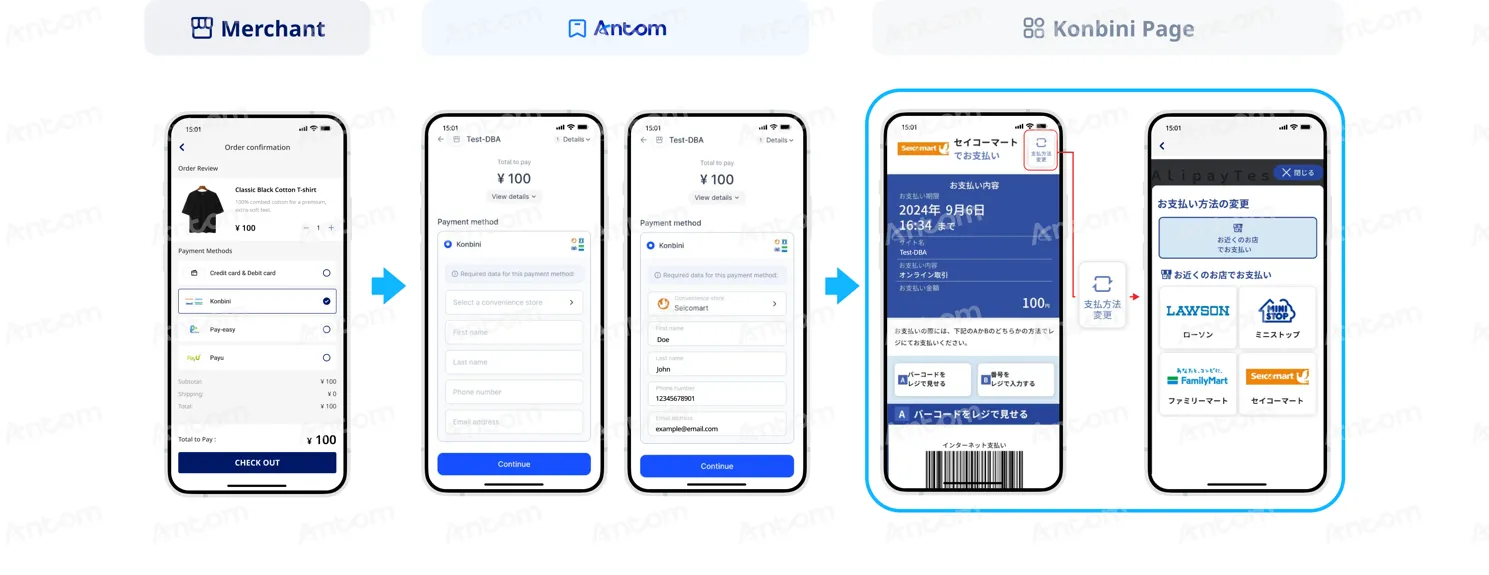
Seicomart
MINISTOP
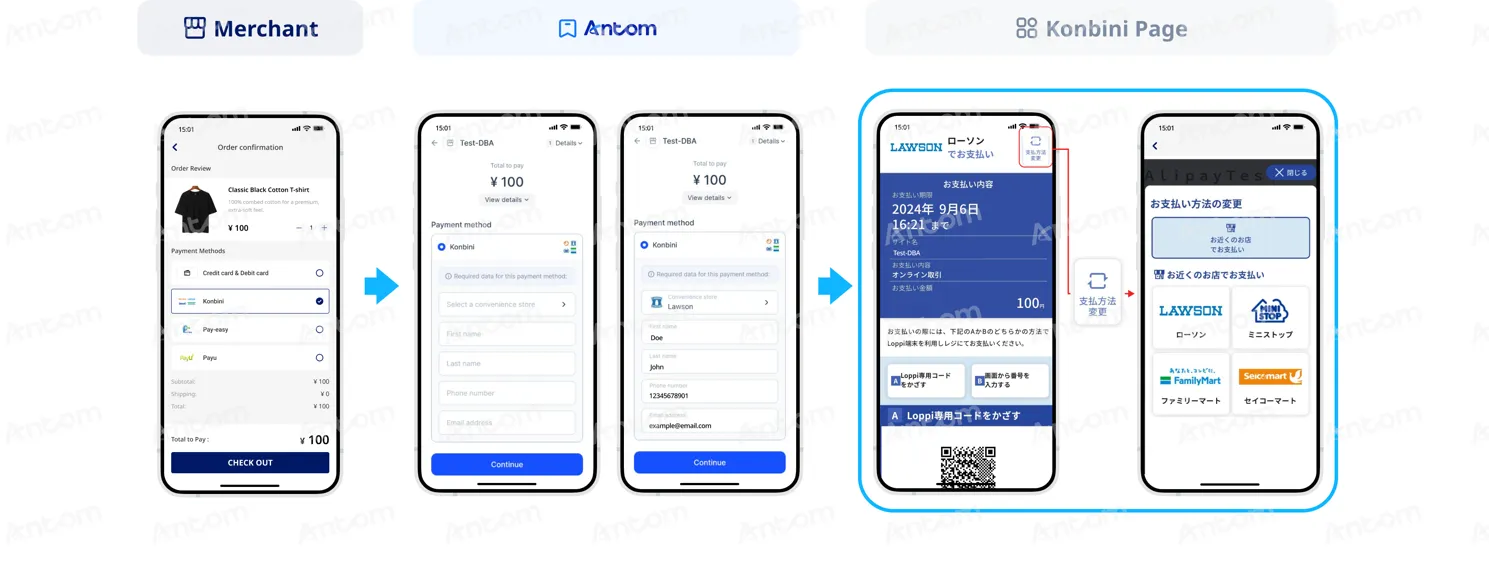
FamilyMart
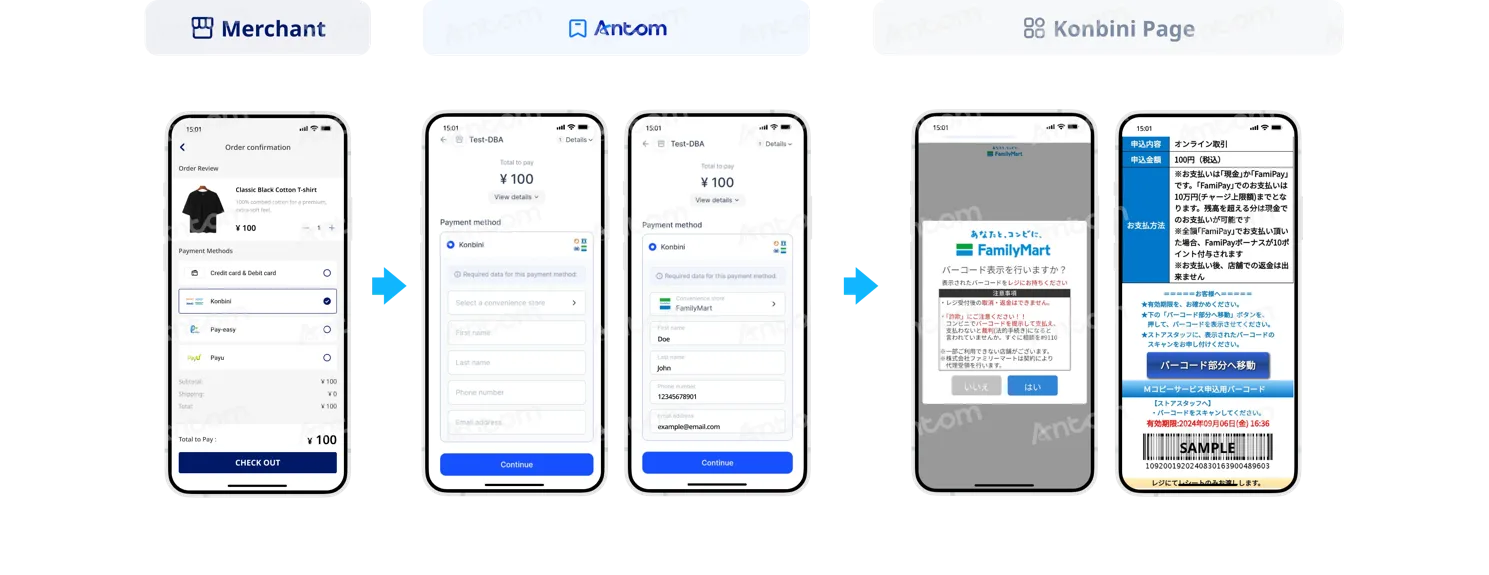
- The buyer selects Konbini to pay.
- The buyer is redirected to the Antom page.
- The buyer provides the required information and taps Continue.
- The buyer is redirected to the selected convenience store's payment page and proceeds to the store to complete the payment offline.
- (Optional) The buyer may tap Change Payment Method in the top right corner to select a different convenience store.
Figure 1. Payment process with Konbini (on the Antom page)
Online payment (bypass the Antom page)
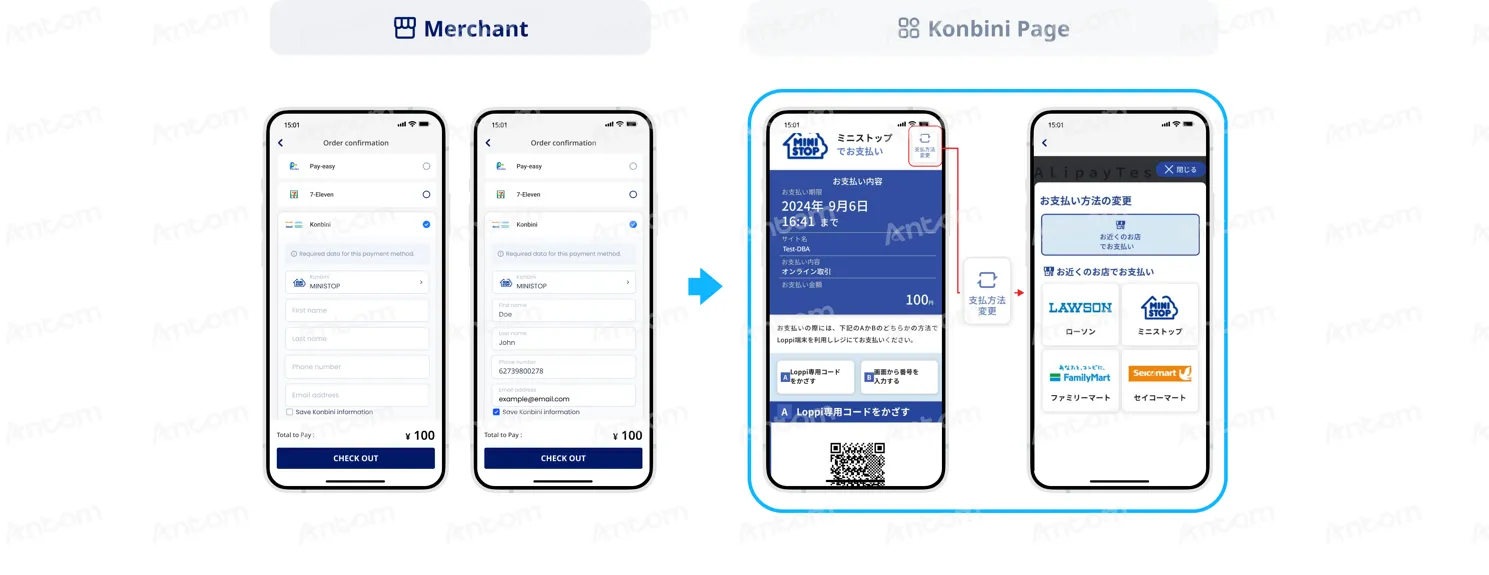
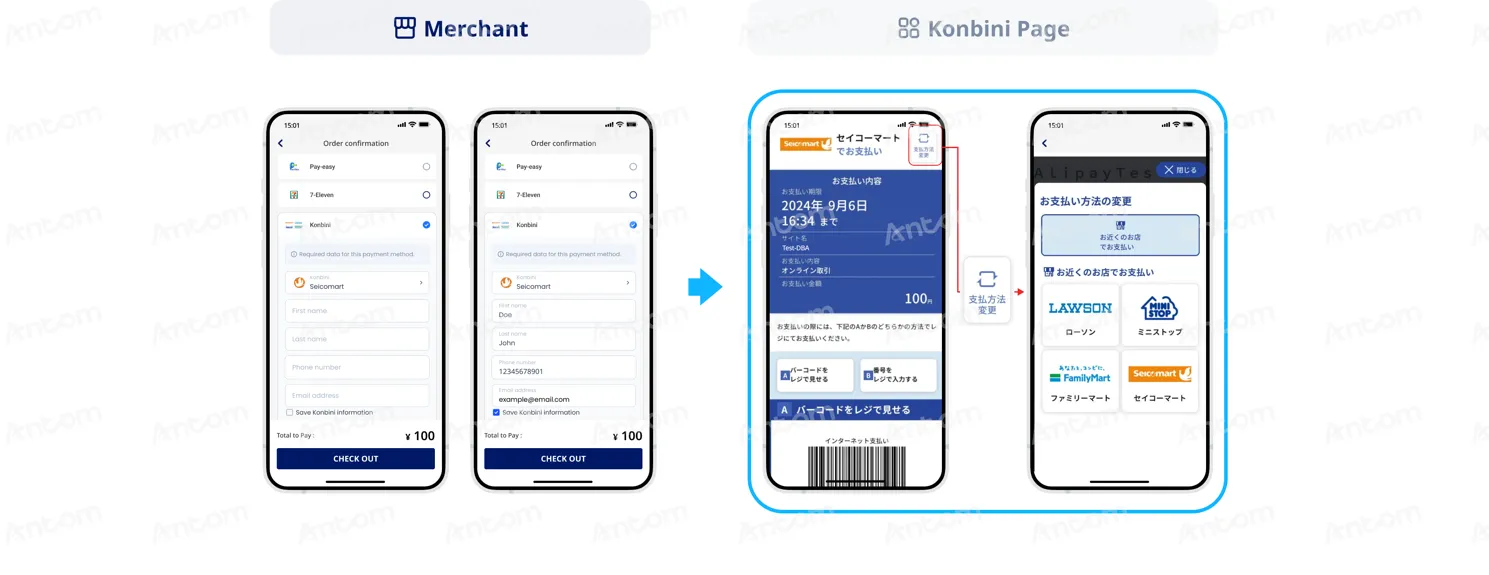
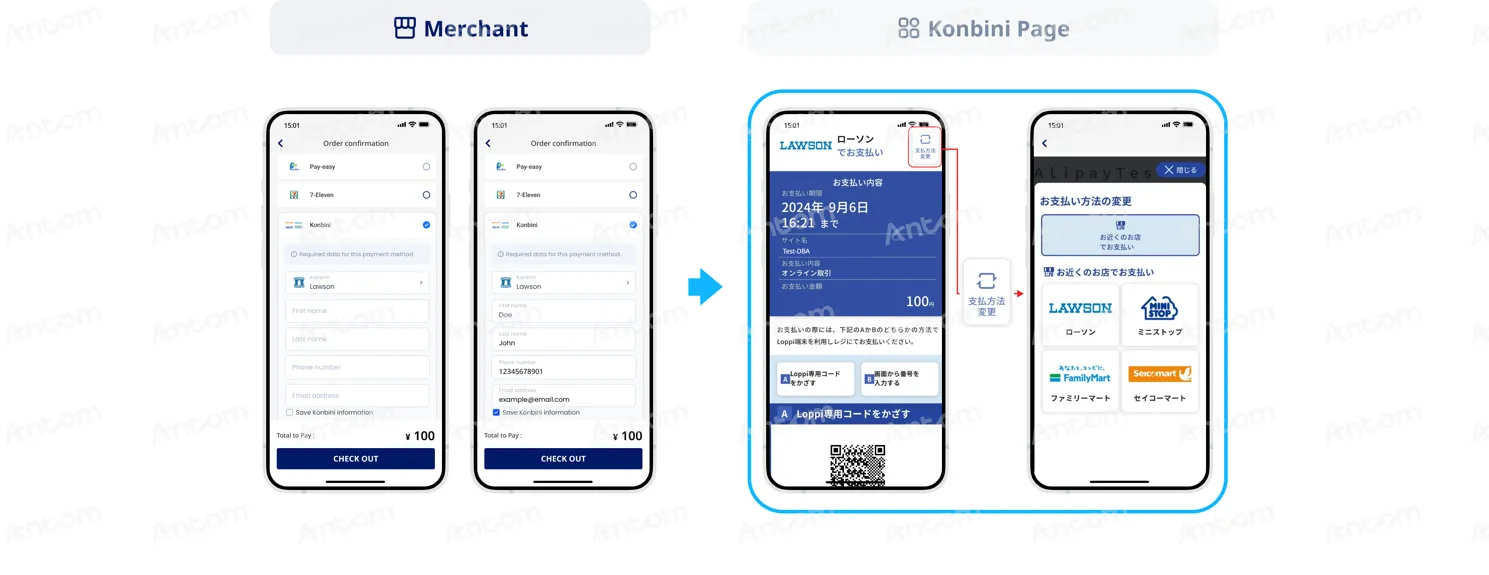
In this scenario, the buyer can opt to complete the payment process outside the Antom page. During the first-time payment, the buyer provides the required information on the merchant page and can save the information for subsequent payments.
First-time payment
The buyer is redirected to the merchant page for information collection.
Lawson
Seicomart
MINISTOP
FamilyMart
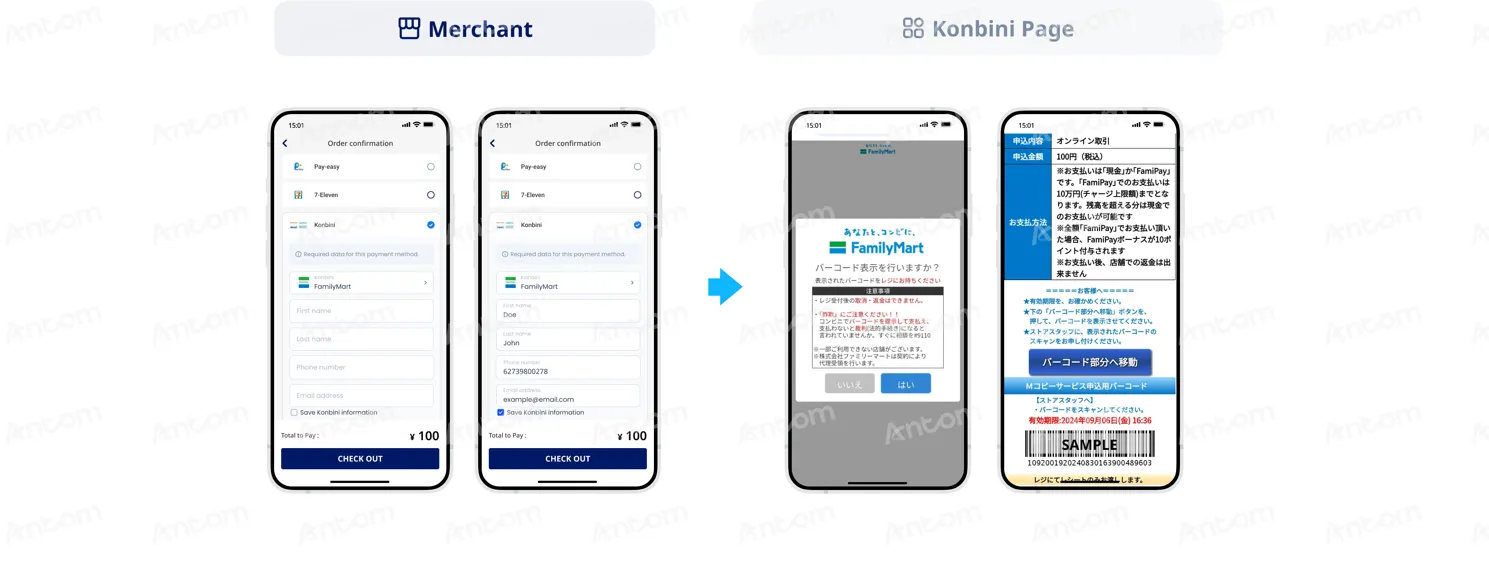
- The buyer selects Konbini to pay.
- The buyer provides the required information and saves it for subsequent payments.
- The buyer is redirected to the selected convenience store's payment page and proceeds to the store to complete the payment offline with the barcode.
Figure 2. Payment process with Konbini (First-time payment)
In-store payment
After the online payment process is complete, the buyer needs to complete the following in-store payment flow to finalise their payment.
Lawson & MINISTOP
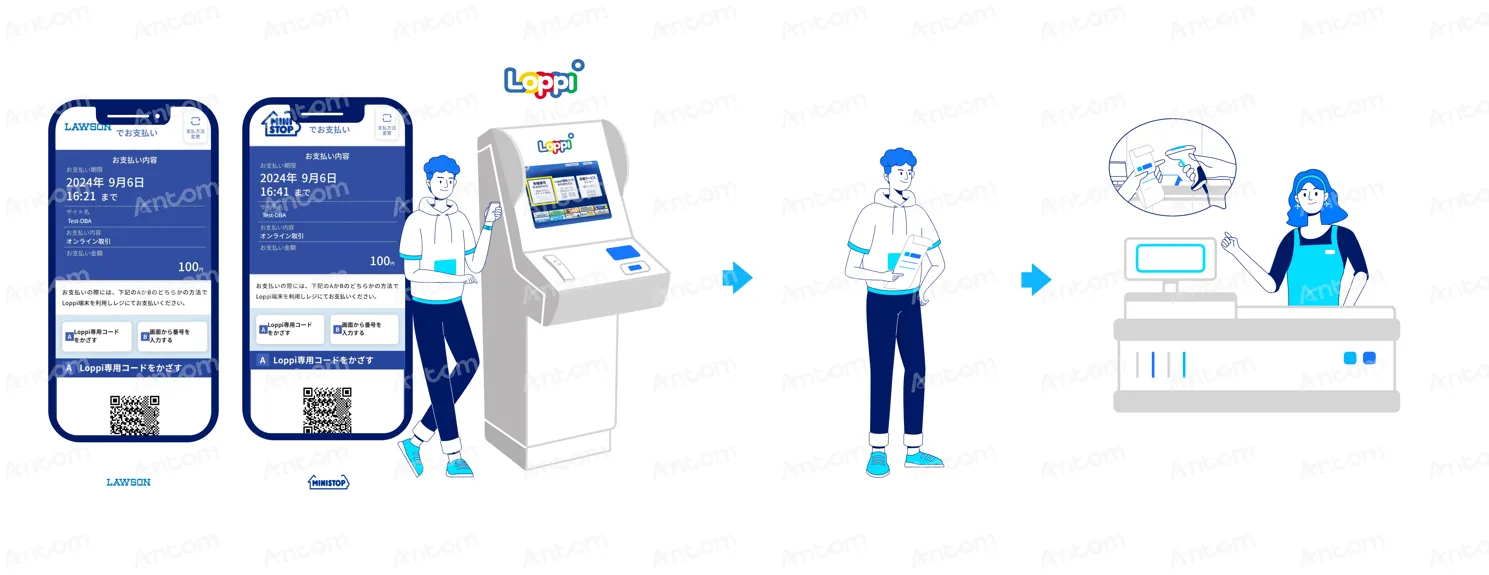
- The buyer goes to the selected convenience store and locates a Loppi machine.
- The buyer displays the QR code to the Loppi machine to print an application ticket.
- The cashier scans the ticket provided by the buyer, and the buyer proceeds with the payment.
Figure 4. Payment process with Konbini (In-store payment)
Seicomart & FamilyMart
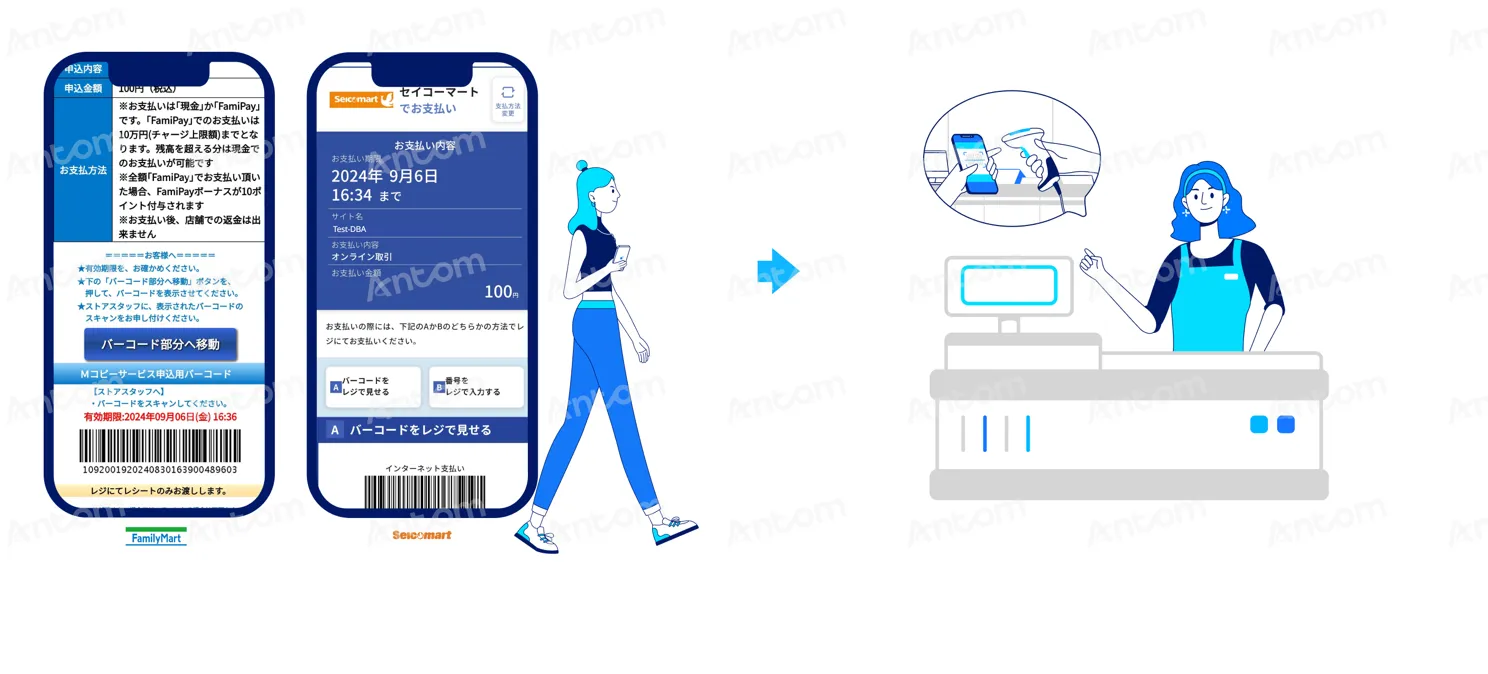
- The buyer goes to the selected convenience store and displays the barcode to the cashier.
- The cashier scans the barcode provided by the buyer, and the buyer proceeds with the payment.
Figure 4. Payment process with Konbini (In-store payment)
FAQs
1. What are the most popular payment methods in Japan?
Popular payment methods in Japan include local bank cards, digital wallets, Konbini payments, and bank transfers.
Despite the rapid growth of cashless payments, cash remains a deeply rooted habit among Japanese consumers. According to data released in 2024, cashless payment accounted for 39.3% of transactions in Japan in 2023. Therefore, Konbini payment continues to be one of the most popular payment methods among Japanese consumers.
Antom's experience in the Japanese market indicates that consumers still prefer Konbini payment when purchasing cross-border products or services, as it does not require sharing credit card information and is perceived as more secure. Therefore, we recommend that cross-border merchants retain and optimise the option positioning of Konbini payment so as to adapt to the local payment culture.
2. What services does Konbini payment provide to customers?
Konbini payment offers flexible payment solutions for domestic and international customers, while also serving global merchants targeting the Japanese market.
For domestic consumers, Konbini payment is particularly favoured by users who prefer cash transactions or find cash more convenient. While accommodating cash-based habits, this method is also regarded by many consumers as a payment option that protects privacy and reduces the risk of data breaches.
For international customers, Konbini payment provides convenience for tourists shopping on Japanese e-commerce platforms, allowing them to complete transactions without a local Japanese credit card or bank account. Besides, international merchants targeting Japan can broaden their payment channels and reach a wider Japanese consumer base by integrating Konbini payments.
3. Which convenience stores support Konbini payment, and how extensive is the coverage?
Konbini payment is primarily supported by Japan's four major convenience store chains: 7-Eleven, FamilyMart, Lawson, and MINISTOP. With over 50,000 partner stores, Konbini payment offers extensive coverage across both major cities and rural areas across Japan. Its strong offline accessibility, combined with widespread consumer familiarity, makes it one of the most convenient and easy-to-use payment methods in the Japanese market.