


Share on
If you’re investing in ads, content, email, events, and partner campaigns to reach buyers in different markets, here’s the most important thing you should know: digital marketing platforms only create real growth when your potential buyer moves from interest to checkout without friction.
If you’re a global B2B merchant, your marketing, checkout, and payments must work together. A campaign may bring you traffic, but payment issues can still block the sale. You should ensure buyers see their preferred payment option, the checkout page feels local, and a payment doesn’t fail when the buyer wants to complete the order.
McKinsey’s 2025 Global Payments Report suggests the payments industry generated $2.5 trillion in revenue from 3.6 trillion transactions worldwide. Payment systems are becoming more regional, fragmented, and platform-driven.
So how do you ensure you market your business to the global audience and the transaction goes through smoothly?
This article will explain how global businesses like yours can connect campaign tools, checkout experience, and payment setup so marketing demand turns into completed transactions.
Why digital marketing platforms should connect more than campaigns
Digital marketing platforms help you plan, launch, track, and optimise campaigns across markets. Choosing the right platform, message, or channel based on the region brings the right traffic and leads. But campaign data alone might not be enough for global merchants.
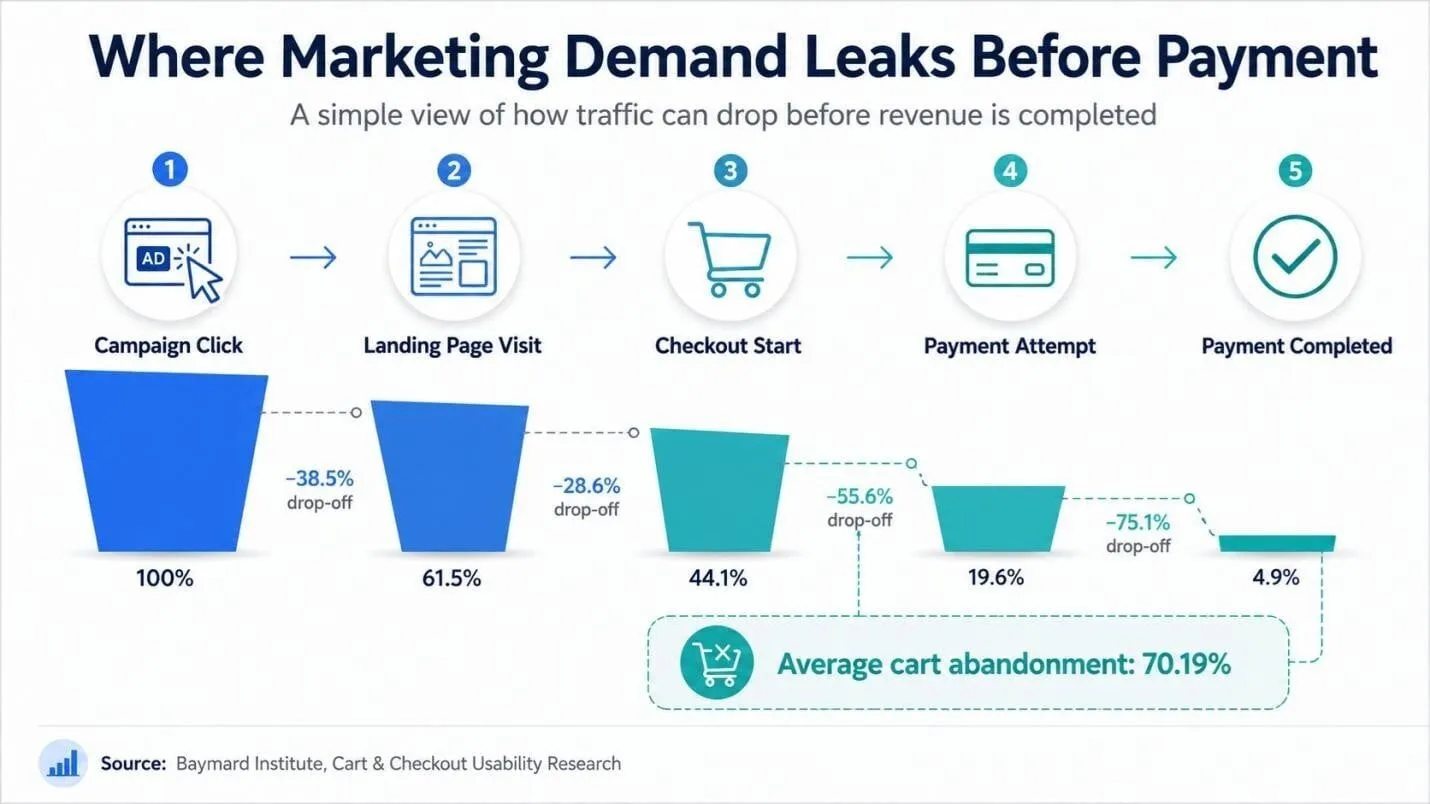
The buyer journey does not end with a click or visit. It continues through product pages, forms, checkout, payment selection, payment approval, and follow-up. If any of these steps fail, marketing performance will suffer.
For example, a merchant may run a strong campaign in Southeast Asia, Europe, or the Middle East. The traffic looks healthy, and the audience matches the target customer. But the checkout page may only support payment options that are common in the merchant’s home market. This will cause local buyers to leave because the payment step does not match their normal buying behaviour.
This creates a gap between marketing success and revenue success.
Marketing teams often ask:
- Which channel brought the buyer?
- Which campaign created the lead?
- Which message drove the click?
- Which audience segment converted best?
But as a global business, you also need to ask:
- Could the buyer pay in a familiar way?
- Did the checkout support local payment needs?
- Did the payment fail after the buyer chose to pay?
- Did cross-border payment friction reduce campaign return?
These questions should be connected to fix the real revenue leak.
How to connect your digital marketing platforms with checkout and payment data
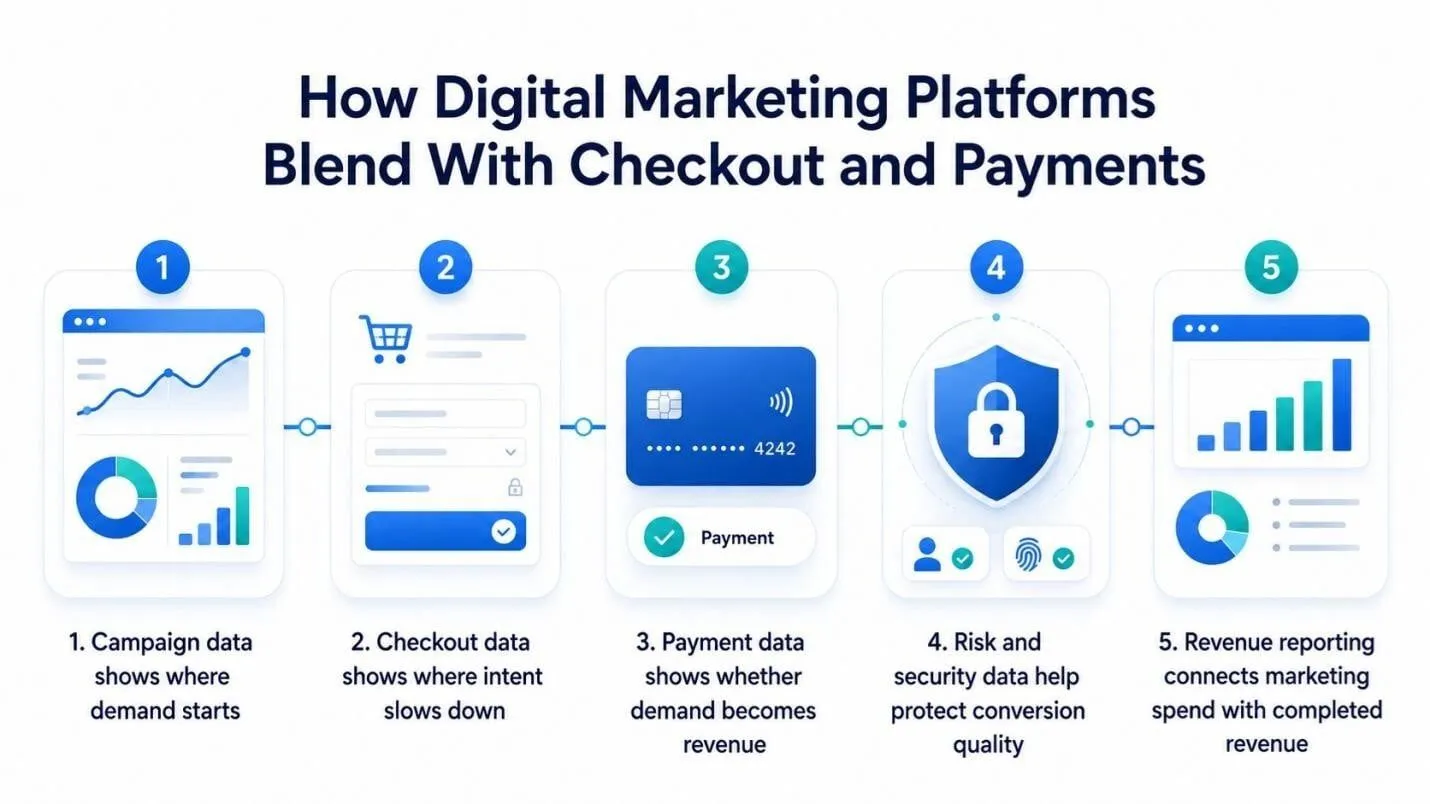
To connect digital marketing platforms with checkout and payments, treat the full buyer journey as one system.
Start with the campaign source, then follow the buyer through each key step. You want to see where demand is created, where it slows down, and where it turns into revenue.
A simple journey map may include:
- Campaign impression
- Click or lead form action
- Landing page visit
- Product or pricing page view
- Checkout start
- Payment method selection
- Payment approval or failure
- Order confirmation
- Repeat purchase or renewal
Once you are clearly aware of this path, allow your teams to share their metrics and take the whole process as one. For instance, the marketing team tracks clicks and leads, the commerce team tracks orders, and the payment team tracks approval rates. Connect these metrics so it can see the full revenue journey.
Let’s compare two campaigns. The first campaign has a lower click-through rate but higher payment completion while the second one brings more traffic but more failed checkouts. Without payment data, the second campaign may look stronger. When you add payment data, the first campaign looks more valuable.
You may enter a new market and see weak conversion. Your first response may be to change the campaign message. But the better response is to review local payment options, checkout language, currency display, payment success rate, and risk settings.
When marketing and payment data work together, teams can make better decisions.
What a connected campaign-to-payment setup should include
A connected setup does not need to be complex in the beginning. It needs to give teams enough clarity to act. You want to understand what happens after marketing creates demand.
Include four core parts in your setup.
1. Local checkout fit
It’s important that your global checkout doesn’t look and feel the same in every market. Buyers in each region may expect local payment methods, currencies, flows, and trust signals.
Local fit can heavily affect order completion. If the checkout does not support the way buyers prefer to pay, your campaign will most likely lose value at the last step.
Local checkout fit includes:
- Relevant local payment methods
- Clear currency display
- Simple form fields
- Fast page loading
- Local language support where needed
- Clear confirmation after payment
This helps make the payment step feel natural to the buyer.
2. Payment performance visibility
Payment data should be visible enough for your team to understand what is happening. The key is not to flood teams with technical data. Showing the signals that affect growth is what’s more important.
Useful payment signals may include payment completion rate, failed payment rate, approval rate by market, payment method performance, and checkout drop-off by region.
These signals can help your marketing teams understand why some campaigns perform better than others after the click.
3. Risk control and transaction security
Global campaigns can bring traffic from many regions, devices, and buyer types. That is good for growth, but it also means you, as a merchant, need strong payment risk control and transaction security.
One of your top priorities is to reduce fraud and protect transactions without blocking good buyers. If checks are too loose, your business will face losses. If checks are too strict, real buyers may be declined. A balanced setup helps protect revenue and improve payment success.
4. Feedback loops between teams
A connected system helps teams learn from each market. Marketing, product, payments, finance, and risk teams should review shared data and decide what to fix first.
For example, if a campaign brings strong checkout starts but low payment completion, the payment team can review local payment coverage. If many buyers drop before checkout, the marketing and product teams can review the landing page, offer, or pricing message.
Use this feedback loop to turn data into action.
How global businesses can use payment insights to improve marketing ROI
Marketing ROI is not just about lowering ad cost. It’s also about improving the number of buyers who complete the journey after they click.
When payment data is added to marketing analysis, you can make stronger decisions about budget, markets, and customer experience.
Let’s suppose you want to compare two different regions in which your business operates. One region has higher traffic costs but stronger payment completion. In contrast, another region has cheaper traffic but weaker checkout performance. Without payment data, the cheaper market may look better. With payment data, however, you'll clearly see that the higher-cost market creates better revenue.
Payment insights can also help teams decide which markets need better local payment support before campaign spend increases.
A practical review process could look like this:
- Review campaign traffic by country or region.
- Compare checkout starts against completed payments.
- Identify where payment failures or drop-offs are high.
- Check whether local payment options match buyer expectations.
- Improve the checkout or payment setup before increasing spend.
This way, you can avoid waste. You also get a clearer report of your marketing performance.
Common mistakes global merchants should avoid
Many global businesses invest heavily in campaign tools but treat checkout and payments as a separate issue. This can limit growth.
The first mistake is judging a campaign only by clicks or leads. These numbers matter, but they do not show whether the buyer could complete payment. For global merchants, completed payment is one of the strongest signs of real demand.
The second mistake is using one checkout setup for every market. This may be easier to manage, but it can hurt conversion. Different countries often have different payment habits, trust signals, and checkout expectations.
The third mistake is adding payment options without measuring results. More options are not always better. The right options should match the market, buyer type, and business model.
The fourth mistake is not sharing payment insights with marketing teams. If payment failures stay inside finance or operations reports, marketing teams may keep changing campaigns when the real issue is checkout friction.
The fifth mistake is seeing risk control only as a defensive task. Risk control also affects conversion. Good risk rules should protect the business while allowing trusted buyers to complete their orders.
Your path to building a better global conversion
Your next stage of digital growth should focus not only on improved campaigns but also on helping buyers complete the action each campaign asks them to take.
You need checkout and payment systems that support preferred payment methods, reduce avoidable payment failures, and give teams clear performance data.
To help your business match local checkout expectations and connect marketing-led demand with completed payments, you need a payment platform like Antom that supports over 300 payment methods across more than 200 markets and 140 currencies.
The bottom line is: campaigns create attention, but checkout and payments complete the journey. When these parts work together, you can understand demand more clearly and build stronger conversion paths across markets.
FAQ
How can merchants tell if low conversion is caused by marketing or payments?
Merchants should compare campaign traffic, checkout starts, payment attempts, payment approvals, and failed payment reasons to understand the reason behind low conversions. If traffic and checkout starts are strong but payment completion is weak, the issue may sit in checkout or payment performance.
Why should payment data be connected to marketing performance?
Payment data shows what happens after a buyer clicks, visits, or starts checkout. It helps businesses see whether low conversion is caused by campaign quality, checkout friction, payment failure, or local payment mismatch.
How can global merchants use digital marketing platforms to find payment friction?
Global merchants can use digital marketing platforms to compare traffic, checkout starts, payment attempts, and completed payments by market. Campaigns bringing strong traffic but weak payment completion in one region indicate the possible issue with local payment gaps, checkout friction, or currency mismatch rather than poor campaign demand.