

Share on
Split payment settlement is the process of dividing one player transaction among multiple business participants and then settling eligible balances to their agreed accounts. It is commonly used by gaming platforms and publishers that need to allocate funds to game studios, the platform itself, distributors, creators, licensing partners, or other designated service providers.
It does not mean that a player pays with two cards or several funding sources. In this guide, “split payment” refers to how one completed player payment is distributed among multiple business recipients.
Split payment is also becoming relevant beyond revenue sharing in gaming and digital-content platforms.Brazil is preparing a phased rollout from 2027 of a statutory split-payment mechanism designed to separate IBS and CBS tax amounts during financial settlement. This regulatory model is different from the commercial fund allocation covered in this guide, but it highlights the same underlying challenge: a payment may need to be divided accurately before the funds reach their final destinations.
This article focuses primarily on how gaming platforms and publishers distribute transaction proceeds among game studios, developers, creators, distributors, licensing partners, and other business participants.
What is split payment settlement?
Split payment settlement connects two related but different processes:
- Split: Determining how much of a transaction belongs to each participant.
- Settlement: Calculating the net amount for an eligible settlement batch and transferring the corresponding funds on the predefined settlement date.
This distinction matters. A successful customer payment does not automatically mean that the split has been completed, the settlement has been processed, or every recipient has received funds in a bank account.
Split payment settlement connects several related but different stages of the payment lifecycle.
Stage | What it means |
Payment authorization | where applicable — Checks whether the payment can proceed before capture or final confirmation |
Payment confirmation | Confirms that the payment reached the required status |
Fund allocation | Determines how much belongs to each participant |
Settlement | Processes eligible balances under agreed settlement terms |
Bank credit | Confirms that funds reached the destination account |
Reconciliation | Matches orders, payments, splits, reports, and bank records |
Split payment settlement is most relevant when a gaming business collects one player payment but the transaction proceeds need to be shared among several parties under the relevant commercial agreements. Common examples include game marketplaces, mobile game publishers, live-service games, cloud gaming platforms, esports and tournament platforms, and other digital-content ecosystems.
The main actors can include:
- Player: Pays for the game, downloadable content, subscription, virtual currency, virtual item, or other digital content.
- Gaming platform or publisher: Calculates the commercial split and manages the relationships with participating studios, creators, distributors, and other partners.
- Game studio or developer: Creates or operates the game or digital content and receives its agreed share.
- Designated participant: Receives a fee, commission, or revenue share, such as a distributor, creator, influencer, licensing partner, or technology service provider.
- Payment provider: Connects the gaming platform to payment processing and, where supported, manages fund-allocation and settlement capabilities.
- Acquirer, for applicable card payments: Processes card acceptance and participates in authorization, clearing, and settlement.
How does split payment settlement work?
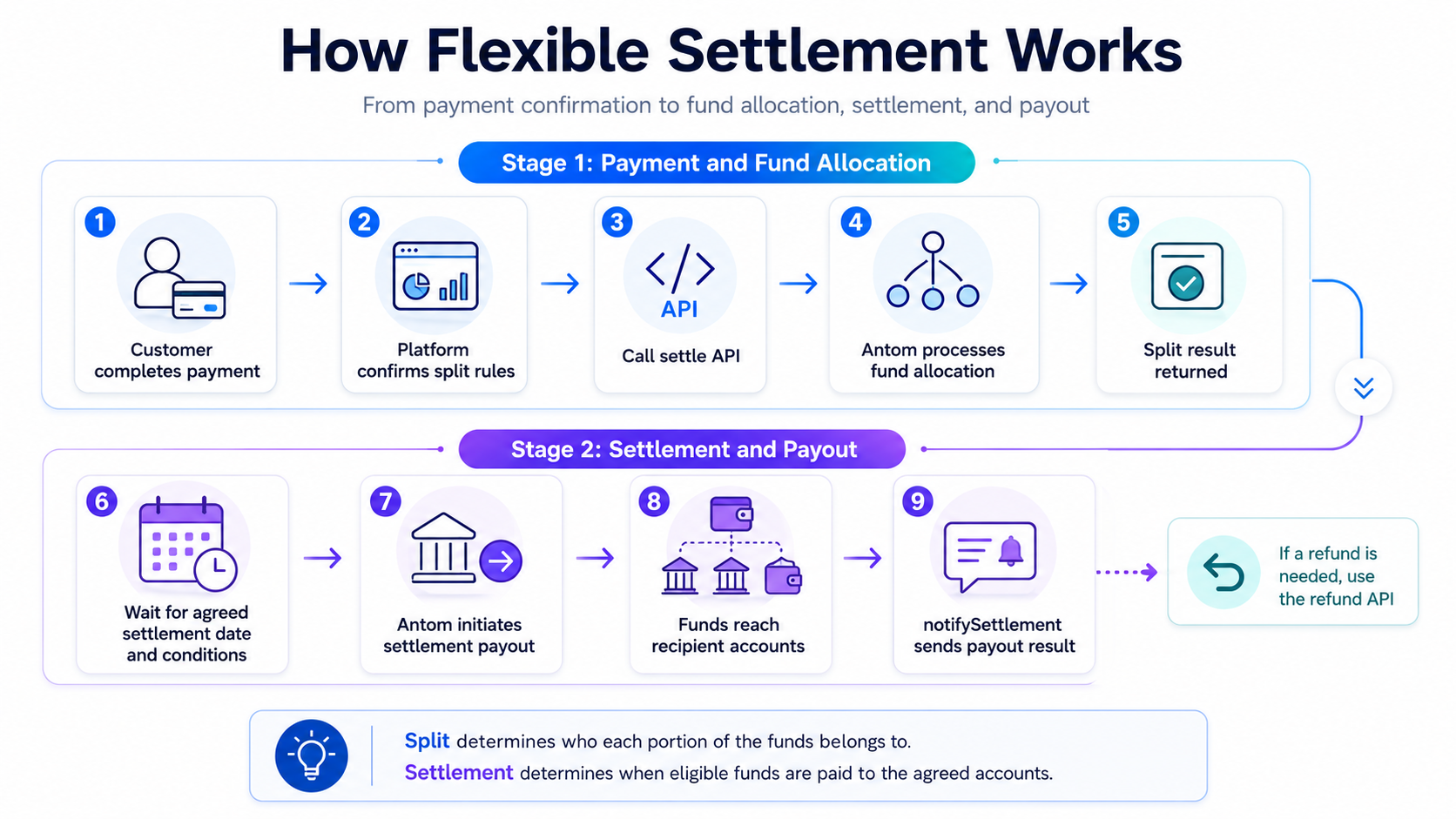
The exact design varies by provider and payment method, but the operating flow usually contains seven stages.
1. The player completes one payment
The player pays the total purchase amount for a game, subscription, downloadable content, virtual currency, virtual item, or another digital product using a supported card, wallet, bank-based method, QR payment, or other payment option.
2. The gaming platform confirms the payment result
The gaming platform should confirm that the payment has reached the required final status before marking the purchase as paid, unlocking the game content, crediting virtual currency, granting an in-game item, or initiating any fund-allocation or settlement-related action that depends on the payment result.
For asynchronous methods, a browser return page alone may not provide a reliable final result. Payment notifications and, where needed, an active inquiry help keep the platform’s transaction database aligned with the provider’s payment status.
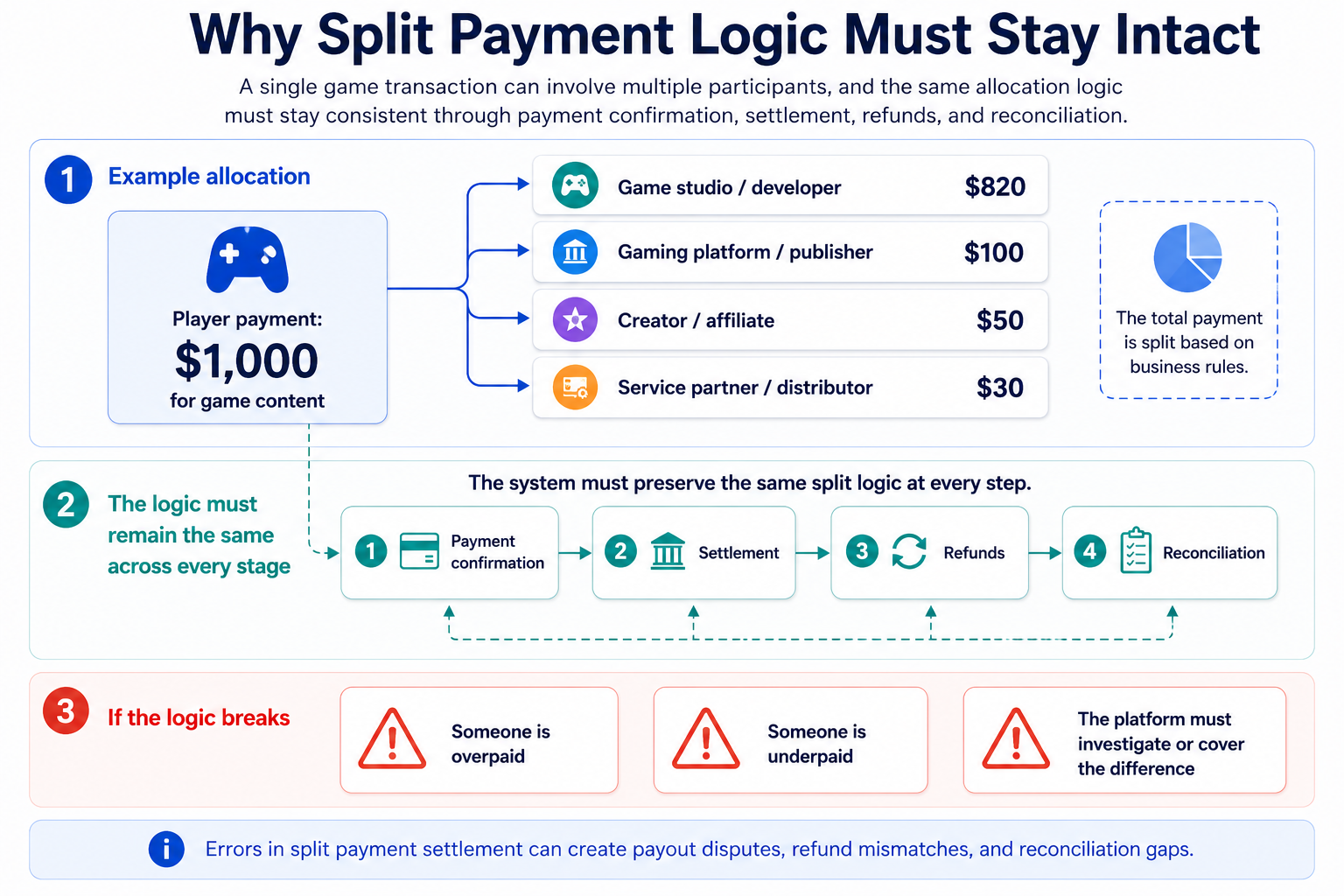
3. The gaming platform calculates the split
The gaming platform applies its revenue-sharing and commercial-allocation rules.
The total allocation should match the amount available for splitting after any relevant fees, taxes, or adjustments.
4. The gaming platform submits the split instruction
The instruction identifies the original game transaction, each participant, the amount or percentage allocated, and the relevant game, campaign, content, or business reference.
The timing depends on the product design. In our Flexible Settlement workflow, you submit the fund-splitting instruction after the player completes the payment.
5. Funds are allocated
The provider records the relevant share for each participant.
At this stage, the system has recorded the amount allocated to each participant. It should not yet be described as guaranteed bank receipt.
6. Eligible balances enter settlement
Settlement depends on the applicable arrangement. Conditions can include:
- The contractual settlement period
- The minimum settlement amount
- The settlement currency
- The available account balance
- Business days and holidays
- Valid recipient-account information
Under a T+4 arrangement, T is the transaction day and settlement is scheduled for the fourth working day, subject to the contract and settlement prerequisites. Under our settlement rules, a settlement batch is formed only when the applicable minimum settlement amount is met and the account balance is sufficient.
7. Settlement and transaction records are reconciled
Finance teams should be able to connect:
Game purchase → Payment → Split instruction → Participant allocation → Settlement batch → Bank record
A clear reference chain makes it easier to explain why the amount received in a participant’s account differs from the original player payment.
We provide transaction details, settlement details, and settlement summary reports to support transaction review, settlement-batch reconciliation, bank-statement matching, and audit preparation.
Common models and why gaming businesses use them
Fixed-amount splits
A participant receives a predefined amount, such as a fixed distribution fee, content-service fee, or promotional fee for each eligible transaction.
Percentage-based splits
The payment is divided according to an agreed ratio. For example, a gaming platform might retain 20%, allocate 70% to the game studio, and allocate 10% to a creator, distributor, or licensing partner.
Dynamic splits
The allocation changes by transaction. It may depend on:
- Game title or game studio
- Content type, such as a base game, downloadable content, subscription, virtual currency, or in-game item
- Campaign or creator-attribution terms
- Distribution channel
- Tax treatment
- Commercial agreements
Multi-party game purchases
A single player purchase may include a base game, downloadable content, virtual items, subscription benefits, or other digital content connected to different studios, creators, distributors, or licensing partners. Each purchase line should remain connected to the correct participant, revenue share, refund responsibility, and settlement record.
Post-payment splits
Some gaming businesses calculate or submit the final allocation only after the payment succeeds or another business condition is met. For example, the final split may depend on confirmed campaign attribution, content activation, or another agreed event.
The business value is not simply “faster payouts.” A well-designed model can give gaming businesses clearer visibility into expected balances, reduce manual revenue-share calculations, make developer and creator agreements easier to audit, and help finance teams reconcile transactions at scale.
Without a reliable split process, gaming platforms may face:
- Incorrect or duplicated allocations
- Delayed payments to game studios, developers, creators, or other partners
- Missing platform or publisher revenue
- Refunds that cannot be traced to the original participants
- Finance records that do not match settlement reports
- Disputes over which participant should carry a loss or fee
- Shortfalls that the gaming platform may need to cover

Refunds, chargebacks, and common risks
Split settlement becomes more difficult when the original transaction changes.
Full and partial refunds
A refund should remain connected to the original payment and split.
Suppose half of a $1,000 game-content purchase is refunded. The gaming platform must determine whether to reverse:
- Game studio or developer revenue
- Platform or publisher revenue
- Creator or affiliate commissions
- Licensing-partner royalties
- Distribution or technology-service fees
- Other participant fees
A simple proportional reversal may be wrong if part of the digital content has already been consumed, virtual items have already been delivered or used, or some promotional, licensing, or service obligations have already been completed.
Chargebacks and negative balances
If a player disputes a card transaction after funds have been allocated or settled, the gaming platform needs clear rules for:
- The game studio, developer, creator, or other participant responsible for the loss
- The treatment of the platform or publisher share
- Chargeback and processing fees
- Negative balances
- Recovery from future settlements
- Any amount the gaming platform must temporarily cover
Data and integration risks
Incorrect participant IDs, duplicate requests, currency rounding, missing references, or split totals that do not match the available amount can create incorrect payouts and reconciliation gaps.
Split instructions should use unique request references and appropriate idempotency controls. Notifications should also be verified, deduplicated, and processed without moving a final status backward.
Failed settlement payments
A settlement process may be completed on the provider side while the destination account has not yet received the funds.
Bank-side failures and account errors can still require investigation. Gaming businesses should therefore distinguish between:
- Split result
- Settlement result
- Payout initiation
- Bank credit
What changes in cross-border split settlement?
Cross-border operations add more variables than a domestic, single-currency model.

Payment methods and confirmation timing
Cards, wallets, QR payments, and bank-based methods may not reach a final state in the same way.
A provider may support a local payment method and split settlement as separate capabilities, but the gaming business should confirm that the required combination works for the relevant game, market, participant structure, and payment method.
This includes:
- Payment confirmation
- Split timing
- Full and partial refunds
- Settlement currency
- Receiving-account type
- Reporting
Supporting a payment method at checkout does not automatically mean that every split, refund, and settlement configuration is available for that method.
Payment and settlement currencies
The player may pay in a local currency while the gaming platform, game studio, creator, distributor, or other participant settles in another currency.
Businesses should confirm:
- Supported payment currencies
- Supported settlement currencies
- Whether currency conversion is required
- How the exchange rate is determined
- Which account types can receive funds
- Whether several payment methods can be consolidated into one settlement arrangement
Participant onboarding and accounts
Game studios, developers, publishers, distributors, creators, licensing partners, and technology service providers may require different identity checks, business information, account details, or receiving-account types.
The gaming business should understand:
- Who completes participant onboarding
- Who verifies game studios, developers, creators, and other participants
- Which KYC or KYB requirements apply
- How account changes are managed
- What happens when participant bank or receiving-account details are incorrect
For US or European gaming companies expanding into Asia or Southeast Asia, local payment acceptance should therefore be evaluated together with game-revenue allocation, settlement, refunds, and reconciliation—not as an isolated checkout feature.
How to choose a split payment settlement provider
A provider should be evaluated on the complete operating model, not only on whether its API contains a “split” field.
Evaluation area | What to ask |
Payment flow | At which stage can split instructions be submitted? |
Payment methods | Does the required split and refund flow work for each local method? |
Participants | Which game studios, developers, publishers, distributors, creators, licensing partners, service providers, and receiving-account types are supported? |
Onboarding | What KYC or KYB information is required for game studios, developers, creators, distributors, and other participants, and who collects it? |
Settlement | What periods, minimum amounts, holidays, and balance conditions apply? |
Currencies | Which payment, split, and settlement currencies are available? |
Refunds | Can full and partial refunds remain linked to the original allocation? |
Disputes | Who carries chargebacks, fees, and negative balances? |
Integration | Are notifications, inquiries, retries, and idempotency supported? |
Reporting | Can reports link orders, payments, splits, settlements, and bank entries? |
Expansion | Can the same model support the next market, game title, distribution channel, participant structure, and payment method? |
A suitable solution should be evaluated by how well it supports the gaming business’s actual operating model, rather than by feature count alone. The provider should be able to keep payment status, participant allocation, settlement conditions, refunds, and finance records connected across the markets, game titles, distribution channels, and payment methods the business actually serves.
How we help manage split payment settlement
When a player payment for a game, subscription, downloadable content, virtual currency, virtual item, or other digital content needs to be distributed among the gaming platform, game studio, publisher, distributor, creator, and other designated participants, the gaming business is required to manage both the allocation of transaction funds and the related settlement process.
This operating model may also involve multiple participants, different currencies, various receiving-account types, refund applications, settlement terms, and financial records.
Depending on the applicable product setup and signed contract, we can support:
- Different gaming business scenarios: including gaming-platform commission splitting, creator-promotion splitting, and service-fee splitting for designated participants.
- Multiple participant structures: including game studios, developers, publishers, distributors, influencers, creators, and other designated participants.
- Different currencies: allowing transaction funds to be allocated to participants in supported currencies.
- Multiple receiving-account types: including applicable Antom accounts, bank accounts, e-wallets, and WorldFirst accounts.
- Post-payment operations: including fund splitting, settlement-result notifications, refund requests for split or settled transactions, and reconciliation reports.
This enables a gaming platform or publisher to submit fund-splitting instructions for multiple recipients within the payment and settlement workflow.
The availability of currencies, receiving-account types, participant structures, and settlement arrangements depends on the signed contract and product setup, so the required gaming configuration should be confirmed before implementation.
How the workflow is implemented
At the integration level, you submit fund-splitting instructions through the 'settle' interface after the player completes the payment.
We return the splitting result, and 'notifySettlement' provides the final settlement-payment result after the related transfer reaches a success or failure state.
If a split or settled transaction needs to be refunded, the 'refund' interface can be used to submit the refund request.
Settlement is automatically initiated according to the settlement period and conditions defined in the signed contract.
The account balance must meet the applicable minimum settlement amount, and settlements are not processed on holidays.
Available payment and settlement currencies—including eligible US dollar settlement—depend on the signed contract.
Transactions using the same settlement currency and settlement period may be included in a consolidated settlement arrangement, subject to the contract.
The applicable exchange rate for cross-currency settlement should also be confirmed with our team.
Our Dashboard provides Transactions, Settlement summary, and Settlement details reports.
The Transactions report records payment-lifecycle status, while Settlement summary and Settlement details reports provide settlement-batch information and transaction-level settlement details.
Finance teams can use the payout batch ID and detailed entries to compare settlement records with bank statements, support financial booking, and investigate discrepancies.
Assess whether flexible settlement fits your operating model
If you are evaluating Flexible Settlement for a gaming platform, game publisher, game marketplace, or digital-content ecosystem, contact our team to confirm the applicable product setup, participant structure, payment and settlement currencies, receiving-account requirements, settlement terms, consolidated settlement arrangements, and cross-currency exchange rates.
FAQs
Is split payment settlement the same as split tender?
No. Split tender means that the player uses several funding sources to complete one purchase. Split payment settlement divides one completed player transaction among multiple business recipients, such as the gaming platform, game studio, creator, distributor, or licensing partner.
Is settlement the same as payout or bank receipt?
Not always. Settlement includes calculating the net settlement amount and transferring the corresponding funds on the predefined settlement date. However, a successful settlement status does not always mean that the receiving bank has completed the final credit, as bank-side failures or account errors may still occur.
How long does split payment settlement take?
Timing depends on:
- The payment status
- The contractual settlement period
- The minimum settlement amount
- Business days and holidays
- The currency arrangement
- Bank processing
It should not automatically be described as instant.
How are partial refunds handled?
The refund should remain linked to the original game purchase and participant allocation.
The reversal may follow purchase lines, participant amounts, digital-content delivery or usage, completed promotional or licensing obligations, and the applicable business rules rather than a simple percentage.