

Share on
Digital wallets are software-based tools that allow users to store, access, and use payment credentials for electronic transactions. They can connect to credit cards, bank accounts, stored balances, or other payment systems, enabling payments across ecommerce, mobile apps, and physical stores.
Unlike a traditional wallet, a digital wallet does not always store money. Some wallets store tokenized payment credentials, while others maintain balances or connect users to local payment ecosystems.
For merchants, accepting digital wallets involves more than adding a checkout option. Different wallet models can affect payment processing, authorization, settlement, refunds, and reconciliation.
What is a digital wallet?
A digital wallet is a software application or digital service that stores, manages, or accesses payment credentials and allows a user to initiate electronic transactions.
Depending on the product, a digital wallet may contain or connect to:
- Credit and debit cards
- Bank accounts
- Stored wallet balances
- Prepaid accounts
- Loyalty cards
- Coupons
- Transportation passes
- Event tickets
- Identification documents
In simpler terms, a digital wallet works like a digital keychain.
It remembers how the customer can pay, helps verify that the customer is authorized to use the selected payment method, and sends the payment request to the relevant payment system.
However, the word “wallet” can be misleading. A digital wallet does not always store actual money.
For example, a card-backed wallet may hold a tokenized payment credential linked to an external credit card. A stored-value wallet may hold a balance that the user funds before making a purchase.
Digital Wallet vs. Mobile Wallet: Key Differences
Type | Definition | Common Examples | Main Use |
Digital Wallet | A software-based wallet that stores or accesses payment credentials and supports electronic transactions. | Apple Pay, Google Pay, PayPal, Alipay | Making digital payments using cards, bank accounts, or stored balances |
Mobile Wallet | A type of digital wallet designed for smartphones, tablets, or wearable devices. | Apple Pay, Google Wallet, Samsung Wallet | Making convenient mobile and contactless payments |
Crypto Wallet | A wallet that manages cryptographic keys used to access and transfer blockchain-based digital assets. | MetaMask, Coinbase Wallet | Managing cryptocurrencies and blockchain assets |
Note: Crypto wallets are a separate category focused on blockchain assets rather than traditional payment transactions.
How do digital wallets work?
Digital wallet transactions follow different flows depending on the wallet model and payment infrastructure involved.
The customer experience may appear simple:
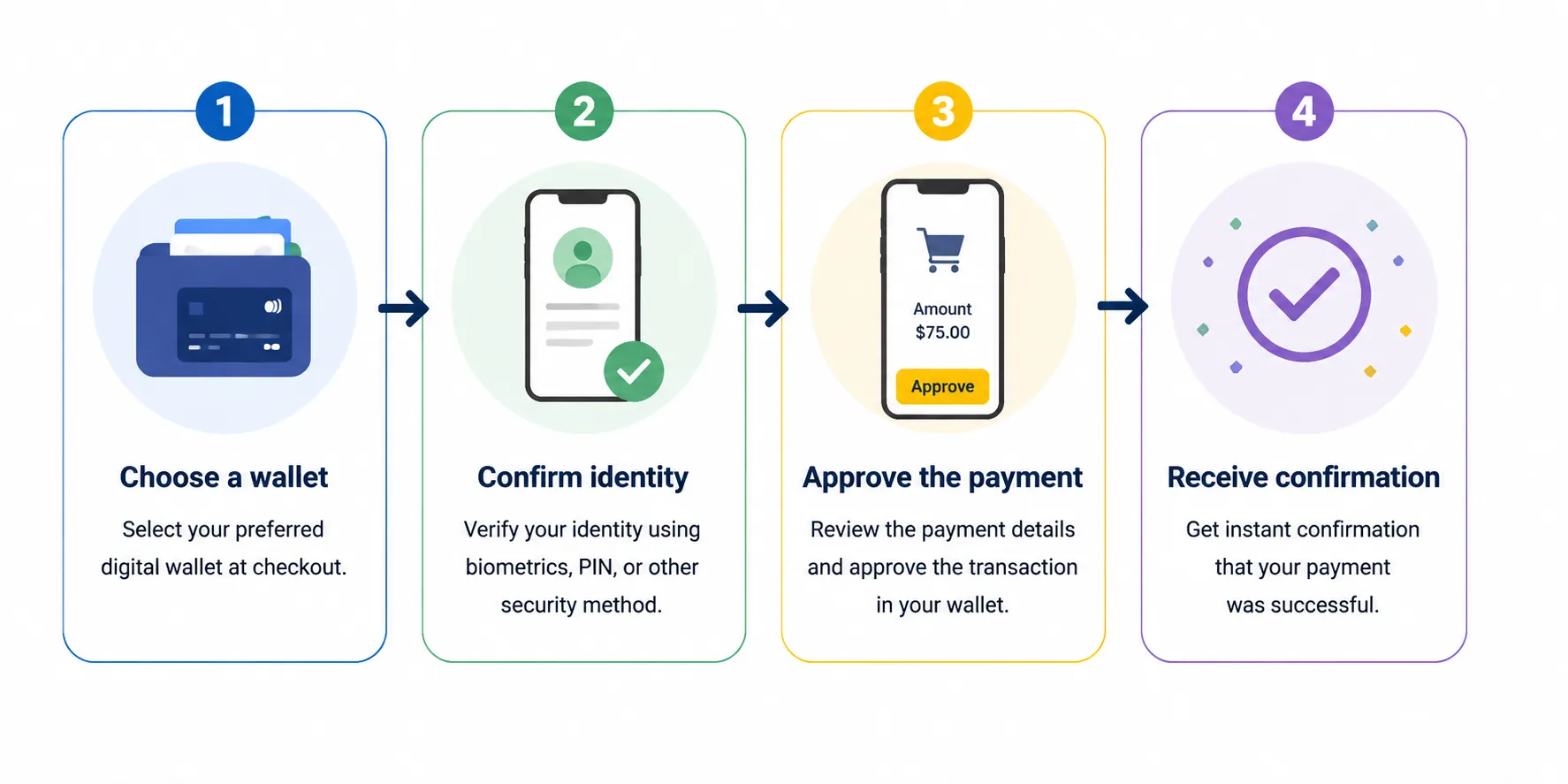
Other wallet models may use different payment rails, such as bank transfer networks, stored-value systems, or local payment infrastructures.
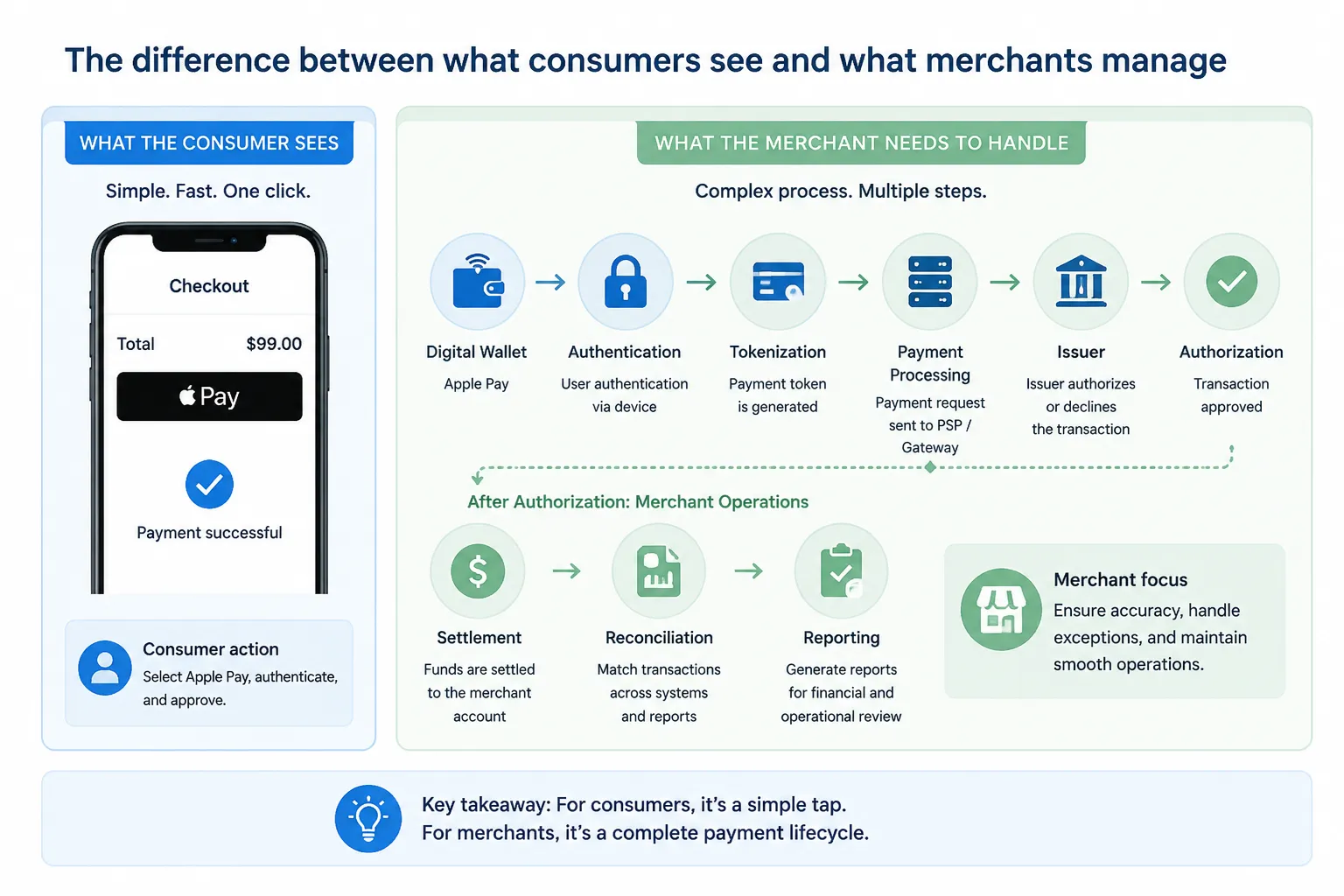
The underlying transaction involves several technical and financial steps.
1 Customer selects a wallet
The customer chooses a digital wallet during checkout.
This may happen:
- On an ecommerce website
- Inside a mobile application
- At a physical store using contactless payment
- Through a QR payment experience
2 The wallet authenticates the customer
Authentication confirms that the person initiating the payment is authorized to use the wallet.
Common methods include:
- Device passcode
- Password
- Fingerprint recognition
- Facial recognition
- Multi-factor authentication
Authentication helps reduce unauthorized use, although it does not eliminate risks such as account takeover or phishing.
3 The wallet uses payment credentials
Many card-based wallets use payment tokenization.
Payment tokenization replaces sensitive card information, such as the primary account number (PAN), with another value called a payment token.
Tokenization does not encrypt the original card number. Instead, it replaces it with a separate payment token that can be controlled within a specific payment environment.
According to EMVCo, payment tokens can be limited to specific merchants, devices, or payment environments, helping reduce the exposure of sensitive card data.
Instead of sharing the customer’s actual card number, the wallet can use a restricted digital substitute during payment.
However, tokenization is only one part of payment security. Merchants still need appropriate fraud controls, authentication processes, and compliance practices.
Card-backed digital wallets often use payment tokenization.
4 The payment is authorized
After authentication, the payment request moves through the relevant payment infrastructure.
For card-linked wallets, this may involve:
- Payment gateway or PSP
- Acquirer
- Card network
- Issuer
The issuer or relevant payment provider then approves or declines the transaction.
Different wallet models may use different payment rails. A card-linked wallet may follow a card-processing flow, while an account-based wallet may rely on bank transfers, wallet balances, or local payment systems.
Types of digital wallets
Consumers often recognize digital wallets by brand names. For businesses, a more practical way to classify them is by how money moves through the payment process.
1 Card-linked wallets
Card-linked wallets connect customers with existing credit or debit cards.
Examples include:
- Apple Pay
- Google Wallet
- Samsung Wallet
The wallet improves the checkout experience while the underlying payment may still follow traditional card-processing infrastructure.
2 Stored-value wallets
Stored-value wallets maintain a balance that customers can use for payments.
The balance may come from:
- Customer top-ups
- Bank transfers
- Card funding
- Refunds
- Rewards
These wallets may require different approaches for balance management, settlement, and reporting.
3 Account-linked and local wallets
These wallets connect payments through local financial accounts or regional payment ecosystems rather than relying only on traditional card networks.
These models are common in markets where local payment preferences differ from traditional card-based payments.
Examples include various wallet ecosystems across Asia and Southeast Asia.
Global merchants need to evaluate wallet adoption alongside payment processing, settlement, and operational requirements. Businesses also need to understand how each wallet processes payments, settles funds, and integrates with their existing payment operations.
Digital wallet adoption varies by market
Digital wallet adoption is highly regional. While Apple Pay and Google Wallet are widely recognized in North America and Europe, many Asian markets have developed their own wallet ecosystems, QR payment networks, and local payment preferences.
Supporting digital wallets across markets requires merchants to understand local customer preferences and payment behaviors. A payment method that is widely used in one country may have limited adoption in another, making local payment coverage an important consideration for international expansion.
Digital wallet security: What merchants should know
Digital wallets commonly use multiple security technologies, including:
Tokenization
Tokenization can reduce the need to expose raw card information during payment.
Authentication
Biometric verification and device authentication help confirm customer identity.
Encryption
Encryption protects sensitive information during storage and transmission.
Fraud monitoring
Payment providers may evaluate:
- Device signals
- Transaction patterns
- Account activity
- Payment behavior
However, digital wallets are not risk-free.
Potential risks include:
- Account takeover
- Lost or compromised devices
- Phishing attacks
- Fraudulent wallet registration
- Unauthorized transactions
Wallet security is influenced by the provider, integration design, customer behavior, and the surrounding payment environment.
Benefits and challenges of digital wallets for merchants
Benefits
Faster checkout experiences
Digital wallets can reduce manual payment entry and make mobile checkout easier.
Access to local payment preferences
Customers in different markets may prefer different wallets.
Supporting relevant local wallets can help merchants reduce payment friction when expanding internationally.
Potentially simpler payment-data handling
Some wallet integrations reduce the merchant’s direct exposure to sensitive payment credentials.
Better mobile payment experiences
Wallets are particularly important for mobile-first customers and app-based commerce.
Challenges
Different wallet ecosystems
A wallet popular in one country may have limited adoption elsewhere.
Integration complexity
Different wallets may require different:
- APIs
- Payment flows
- Refund processes
- Reporting formats
Settlement and reconciliation
Wallet payments may create additional operational requirements.
Merchants may need to reconcile:
- Order records
- Wallet transaction IDs
- Payment status
- Provider records
- Settlement reports
- Refunds
- Fees and currency conversion
Payment acceptance is only one part of managing digital wallet transactions. Merchants also need to consider settlement, reporting, and reconciliation after authorization.
What should merchants consider when accepting digital wallets?
Before adding digital wallets, businesses should evaluate:
Customer demand
Which wallets do customers already use in target markets?
Market coverage
A global merchant may need different wallets for:
- North America
- Europe
- China
- Southeast Asia
- Other local markets
Integration approach
Businesses can connect wallets through:
- Direct integrations
- Payment gateways
- Payment service providers
- Unified payment platforms
A unified integration can help merchants manage multiple payment methods while reducing technical complexity.
Payment operations
Merchants should consider:
- Authorization rates
- Refund support
- Settlement timing
- Reporting
- Reconciliation
- Fraud management
Adding a wallet is not only a checkout decision. It is also an operational decision.
How Antom helps merchants support digital wallets
For businesses expanding across markets, supporting digital wallets requires more than connecting a payment button.
Merchants need access to relevant payment methods while managing different:
- Market preferences
- Payment flows
- Settlement processes
- Reporting requirements
- Operational workflows
Antom provides merchants with access to global and local payment methods through a unified payment infrastructure, helping businesses manage different payment options across markets.
For merchants entering Asia and Southeast Asia, this can be especially important because payment preferences vary significantly by country. Customers may rely on different local wallets, QR payments, and alternative payment methods depending on their market.
When evaluating digital wallet acceptance, businesses typically need to balance three areas:
1. Offering payment methods customers recognize
2. Maintaining reliable payment processing
3. Managing payment operations after authorization
Digital wallets should be evaluated as part of a broader payment acceptance and operations framework.
Building a branded stored-value wallet
Beyond accepting existing digital wallets, some businesses may also need to build their own branded wallet experience.
This is a different use case from accepting third-party wallets such as Apple Pay or local payment wallets.
Antom’s Digital Wallet Solution supports this different use case through a white-label wallet model.
This may be relevant to platforms or businesses that want to create:
- A stored-value customer account
- A branded wallet experience
- An embedded payment ecosystem
- A wallet connected to rewards or platform services
It should not be treated as the same decision as adding third-party wallet payment methods.
FAQs
What is a digital wallet?
A digital wallet is a software application or digital service that stores or accesses payment credentials and helps a user initiate electronic transactions.
It may connect to a card, bank account, stored balance, or another payment system.
Do digital wallets store actual money?
Some do, but not all.
Stored-value wallets can hold a balance. Card-backed wallets may instead access a tokenized payment credential connected to an external card account.
Are digital wallets safer than physical cards?
Digital wallets may reduce certain risks through tokenization, customer authentication, encryption, and device-based controls.
However, security depends on the wallet, device, account-recovery process, customer behavior, merchant integration, and underlying payment method.
It is more accurate to say that digital wallets can reduce or change certain risks rather than eliminate them.
What are examples of digital wallets?
Examples include Apple Pay, Google Pay, PayPal, Alipay, WeChat Pay, GCash, DANA, GrabPay, OVO, Touch ’n Go eWallet, TrueMoney, Maya, and MoMo.
Availability and features vary by provider and market.
Is PayPal a digital wallet?
PayPal can function as a digital wallet because it allows users to store or connect payment methods and use them for online transactions.
Its merchant relationship and payment model may differ from a pass-through card wallet.
What is the difference between a digital wallet and a mobile wallet?
A mobile wallet is designed primarily for mobile devices.
Digital wallet is the broader term and may also include web-based, browser-based, embedded, or multi-device wallet services.
Do digital wallets use card networks?
Some do.
Card-backed wallets may use card networks for authorization and settlement. Other wallets may use bank-transfer systems, stored-value accounts, local payment rails, or internal wallet infrastructure.
Can merchants refund digital wallet payments?
Many digital wallet payments support refunds.
However, the refund process, timing, destination, and support for partial refunds depend on the wallet and payment model.
Can merchants accept multiple digital wallets through one integration?
Many merchants use payment platforms or PSPs to connect with multiple wallets instead of building separate integrations for each payment method.