Share on
Buy Now, Pay Later (BNPL) is a payment option that allows customers to complete a purchase immediately while paying over time through installment or deferred-payment plans offered by a BNPL provider.
BNPL has become one of the payment options merchants consider as Southeast Asia’s digital commerce ecosystem continues to expand. According to the e-Conomy SEA 2025 report by Google, Southeast Asia’s digital economy is expected to surpass $300 billion in gross merchandise value (GMV) by 2025, reflecting the continued growth of online commerce and digital payments across the region.
For merchants entering Southeast Asia, this growth also means that payment expectations are becoming increasingly localized. Customers in different markets may prefer different combinations of cards, digital wallets, bank payments and BNPL options.
A US or European ecommerce business may begin with international cards, then find that customers in different markets are accustomed to local payment methods and Buy Now, Pay Later options.
That is where a Southeast Asia BNPL comparison becomes useful. Atome, Kredivo, BillEase and Akulaku all appear in the region’s Pay Later landscape, but they do not necessarily serve the same customer base or carry the same relevance in every market.
For you, the practical decision is therefore not which provider has the strongest brand recognition. It is which option is relevant to the customers you want to reach, how it fits alongside the payment methods you already offer and what happens operationally when one local payment option becomes several.
Table of Contents
- BNPL vs card installment: What is the difference?
- How Atome, Kredivo, BillEase and Akulaku differ?
- Southeast Asia BNPL comparison at a glance
- Atome vs Antom: What is the difference?
- How BNPL fits into a Southeast Asia payment strategy?
- Why multiple payment methods increase integration complexity?
- When payment orchestration becomes relevant?
- FAQs
BNPL vs card installment: What is the difference?
For merchants entering Southeast Asia, BNPL may sound similar to traditional card installment payments. Both allow customers to spread payments over time, but they are designed around different payment experiences and customer access models.
Card installment payments usually depend on a customer already having an eligible credit card issued by a bank. The installment plan is connected to the customer’s existing banking relationship and available credit limit.
BNPL, on the other hand, is provided through a BNPL provider. Customers may be able to use installment-based payment options without relying on a traditional credit card, depending on the provider’s eligibility requirements and local market conditions.
This distinction is particularly relevant in Southeast Asia, where payment behaviors vary significantly across markets. Compared with some developed card markets, several Southeast Asian countries have historically had lower credit card penetration, while digital wallets, mobile payments and alternative payment methods have become important parts of everyday commerce.
For merchants, this means accepting only traditional card payments may not always cover the payment preferences of local customers. BNPL can become one additional option alongside cards, wallets and other local payment methods.
| Card installment | BNPL |
Provider | Banks and card issuers | BNPL providers |
Customer access | Usually requires an eligible credit card | May not require a traditional credit card |
Payment experience | Linked to existing card accounts | Designed around installment or deferred payments |
Merchant consideration | Useful where card usage is strong | Useful where customers prefer alternative payment options |
For a merchant expanding into Southeast Asia, the decision is therefore not necessarily whether to choose cards or BNPL. In many cases, the more practical question is how different payment options can work together to match local customer preferences.
How Atome, Kredivo, BillEase and Akulaku differ
The four providers are easier to understand when you look at them through a merchant’s expansion plan rather than trying to rank them from first to fourth.
Atome
Atome is a Singapore-based BNPL provider and part of Atome Financial. It allows eligible shoppers to divide purchases into installments at participating merchants, with a presence across several Southeast Asian markets.
For a cross-border merchant, Atome may become relevant when customers in a target market already recognize it as part of their shopping experience. The merchant question is therefore not simply how Atome works for consumers, but whether it belongs in the local checkout mix you are building.
Kredivo
Kredivo is an Indonesia-founded digital consumer finance platform offering BNPL and credit products, with operations extending into other Southeast Asian markets.
If Indonesia is one of your priority markets, Kredivo may appear relatively early in your local payment research. As you expand into additional Southeast Asian markets, however, the decision can move beyond choosing Kredivo itself and toward understanding how several local payment providers will coexist within the same payment setup.
BillEase
BillEase is a Philippines-focused BNPL and installment-payment provider. It gives eligible consumers another way to spread payments without depending entirely on a traditional credit card.
For this regional comparison, its main relevance is its Philippine market focus. If the Philippines is one of your priority markets, BillEase may enter your shortlist alongside wallets and other local payment methods.
The detailed checkout, repayment and implementation process is a separate merchant decision and does not need to be resolved at the initial regional-comparison stage.
Akulaku
Akulaku is an Indonesia-based digital finance platform offering ecommerce and consumer-finance services, including Akulaku PayLater. Its broader ecosystem includes ecommerce and consumer-credit services, with Akulaku PayLater providing installment-based payment options for eligible users.
For merchants, this means Akulaku may enter the evaluation when PayLater is connected to a wider local consumer-finance ecosystem rather than being treated as an isolated checkout feature.
Southeast Asia BNPL comparison at a glance
There is no useful universal ranking for these four providers. Their relevance depends on where you are entering, who your customers are and how your current payment infrastructure is structured.
Provider | Practical market context | Role in checkout | Why a merchant may evaluate it |
Atome | Regional Southeast Asia context | Installment-based BNPL | When customers in the target market already recognize Atome as a way to pay |
Kredivo | Particularly relevant to Indonesia, with wider regional activity | BNPL and digital consumer credit | When Indonesia or nearby regional expansion is a priority |
BillEase | Philippines | BNPL and installment payments | When localizing checkout for Philippine consumers |
Akulaku | Indonesia and parts of Southeast Asia | PayLater within a broader consumer-finance ecosystem | When evaluating PayLater as part of a wider local digital-finance environment |
This table is better used as a shortlist than as a final integration decision. Current availability, merchant eligibility, commercial terms and technical requirements still need to be confirmed for the specific market in which you operate.
Atome vs Antom: What is the difference?
Atome and Antom are easy to confuse in search because their names differ by only one letter, but they sit at different layers of the payment ecosystem.
Atome is a BNPL provider. It gives eligible consumers an installment-based way to pay when shopping with participating merchants.
Antom is not another BNPL brand. We provide merchant payment infrastructure that helps businesses manage payment acceptance across markets.
For you, that distinction matters because Atome and Antom are not two versions of the same product. Atome may appear while you are deciding which BNPL options matter to customers in a particular market. Antom becomes relevant when the broader problem is how multiple payment methods and provider connections are managed as your business expands.
BNPL is only one part of a Southeast Asia checkout
Once you move from provider research into actual market entry, the BNPL comparison begins to expose a broader payment question.
Understanding Southeast Asia’s diverse payment landscape
Unlike some mature card-focused markets, Southeast Asia’s payment ecosystem has developed through a combination of cards, digital wallets, bank payments and alternative payment methods.
The adoption of these payment methods varies significantly by country. Digital wallets, for example, have become an important part of everyday payments in several Southeast Asian markets, especially as smartphone adoption and digital commerce continue to expand.
According to the e-Conomy SEA 2025 report by Google, Temasek and Bain & Company, Southeast Asia’s digital economy continues to grow rapidly, with digital payments becoming an increasingly important foundation for online commerce across the region.
Different payment methods also serve different customer needs:
Payment method | Why customers use it | Examples in Southeast Asia |
Digital wallets | Convenient mobile payments and everyday transactions | GCash, Maya, GoPay, GrabPay, TrueMoney |
Cards | Familiar payment option for customers with access to banking services | Visa, Mastercard, local card networks |
BNPL | Flexible installment options, especially for certain purchase categories | Atome, Kredivo, BillEase, Akulaku |
Bank payments | Direct account-based payments supported by local banking infrastructure | Local bank transfer methods |
For merchants, this means payment localization is not simply about adding more options. It is about understanding which payment methods match customer behavior in each market.
A payment method that is widely used in one Southeast Asian country may not have the same relevance in another. This is why merchants expanding across the region often need to evaluate a combination of local payment methods rather than relying on a single global checkout approach.
Suppose a US independent ecommerce store enters the Philippines. It may consider GCash and Maya as wallet options alongside a BNPL provider such as BillEase. Indonesia may introduce GoPay and Kredivo, while Thailand may require another combination of locally familiar payment methods.
These are illustrative examples rather than a prescribed checkout configuration. Their purpose is to show that BNPL rarely exists on its own.
In markets where wallets are already familiar to customers, it is useful to understand how digital wallets for merchants and BNPL can sit alongside each other rather than treating one category as a replacement for the other.
As the number of markets grows, the business question also changes. A merchant that initially wanted to know which BNPL provider to consider may later need to understand how many local payment connections it is prepared to build and operate.
Five markets can turn provider selection into an integration problem
Imagine that the same US independent store eventually expands across five Southeast Asian markets.
Depending on local customer preferences and the payment methods selected, its payment setup might eventually look roughly like this:
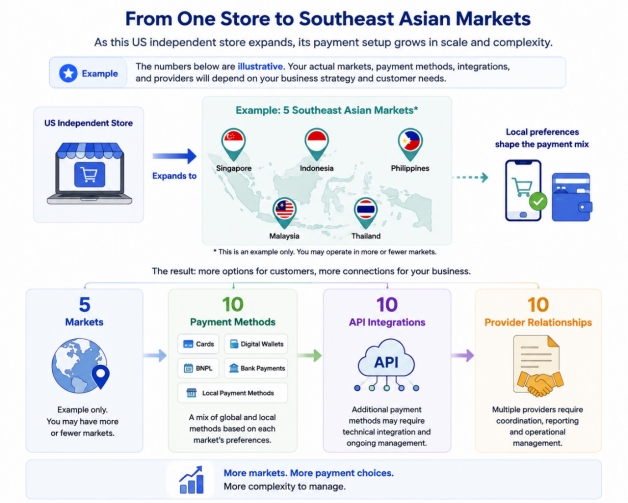
These numbers are a hypothetical business scenario rather than a standard requirement for every merchant. A business may ultimately manage fewer or more connections depending on its target markets and provider choices.
The example matters because each separately integrated payment method can create another technical and operational relationship. A new method may involve implementation, testing, maintenance, reporting and ongoing provider coordination.
At that stage, payment gateway integration becomes more than a developer topic. For the business, each separate integration can also affect how quickly a new payment option is launched and how much infrastructure the team needs to maintain afterwards.
The complexity is no longer coming from BNPL itself. It is coming from the accumulation of payment connections.
When payment orchestration becomes relevant
A merchant testing one market may not need complex payment infrastructure. A smaller Shopify or WooCommerce independent store might begin with only the payment methods most relevant to its first customer base.
The situation changes as more countries and providers are added. What began as a few local integrations can gradually become a network of payment methods, APIs and provider relationships that need to be operated together.
This is where payment orchestration becomes relevant. Payment orchestration provides a management layer for coordinating multiple providers, payment methods and related payment operations rather than treating every connection as a completely separate payment project.
With Antom Payment Orchestration, we help merchants manage payment providers and payment methods across markets through a more coordinated payment infrastructure.
For your business, that does not mean every merchant needs orchestration from day one. You may initially need only a few locally relevant payment methods. As your footprint grows, however, a more centralized payment architecture can become useful because the operational problem has changed.
The first decision may have been whether Atome, Kredivo, BillEase or Akulaku belongs in your local checkout.
The later decision is whether every new market and payment method should create another standalone integration, or whether your payment infrastructure should be able to expand alongside the business.
Still evaluating the right BNPL and payment setup for your Southeast Asia expansion? Our team can help you understand the payment options, integration requirements and infrastructure needed for your target markets.
Frequently Asked Questions About Southeast Asia BNPL
What is BNPL in Southeast Asia?
Buy Now, Pay Later, or BNPL, allows eligible customers to complete a purchase while paying over time according to the provider’s repayment terms.
In Southeast Asia, BNPL sits alongside cards, digital wallets, bank-based payments and other local payment methods. Merchants therefore usually need to evaluate it as part of a broader checkout strategy rather than as an isolated payment category.
Which BNPL providers operate in Southeast Asia?
Merchants researching Southeast Asia may encounter providers including Atome, Kredivo, BillEase and Akulaku.
Their relevance varies by market. Kredivo is particularly associated with Indonesia, while BillEase is primarily relevant to the Philippines. Atome and Akulaku also operate within different parts of the Southeast Asian payment and consumer-finance ecosystem.
For merchants, the useful comparison is therefore based on target market, customer profile and payment setup rather than a universal provider ranking.
Which BNPL provider may fit a Southeast Asia merchant?
There is no single provider that fits every Southeast Asian market.
The appropriate option depends on where your customers are located, which providers they already use, your business model and how the BNPL method fits with the rest of your checkout.
A merchant focused on the Philippines may evaluate a different provider mix from one entering Indonesia or several Southeast Asian markets at the same time.
Do merchants need BNPL in every Southeast Asian market?
Not necessarily.
BNPL may be useful for some customer segments and purchase types, but merchants do not need to add every available payment method.
A smaller independent store may begin with a limited set of locally relevant methods and expand its checkout as customer demand becomes clearer. Larger cross-border merchants may need a broader payment mix because they operate across more countries and customer segments.
How does BNPL fit with digital wallets and cards?
BNPL, digital wallets and cards can serve different payment preferences.
A customer may prefer a wallet for convenience, a card for an international purchase or BNPL when an installment option better fits the purchase.
For merchants entering Southeast Asia, checkout localization therefore often involves selecting a combination of payment methods rather than choosing one category to replace another.
When does payment orchestration become useful?
Payment orchestration becomes more relevant as a merchant adds more markets, payment methods and provider relationships.
For example, a business operating across several markets might hypothetically manage multiple payment methods, API integrations and provider relationships. If each connection is handled independently, technical maintenance and payment operations can become more complex.
A payment orchestration layer can help merchants coordinate multiple providers and payment methods through a more centralized payment infrastructure.
Build a payment setup that can grow with your Southeast Asia business
Choosing between Atome, Kredivo, BillEase and Akulaku may be one of the first payment decisions you make when entering Southeast Asia. As your business expands, the larger challenge may become managing those choices alongside cards, wallets and other payment methods across several markets.
Antom helps merchants manage these connections through payment infrastructure built for cross-market growth — start with what matters today, and expand as your footprint grows.
Ready to add BNPL to your Southeast Asia setup? Contact our payment experts to find the right fit.