
Share on
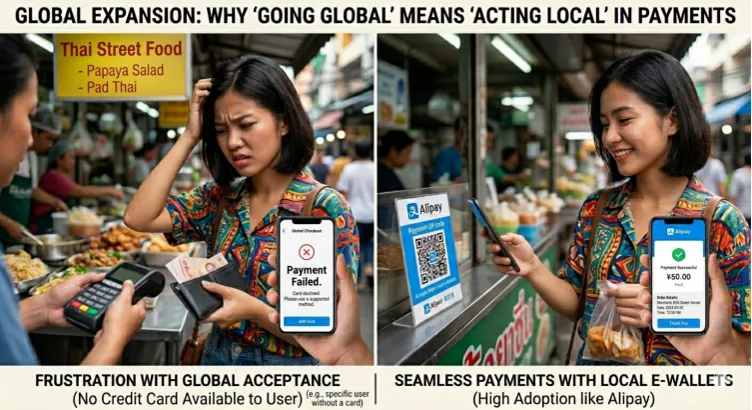
For global merchants, e-commerce platform local payment methods integration is no longer a backend setup task. It is a conversion, market expansion, and payment operations decision. Customers in different countries expect different ways to pay. A shopper in the Netherlands may look for iDEAL. A buyer in Brazil may expect Pix. A customer in Mexico may prefer OXXO Pay or SPEI. A shopper in Southeast Asia may choose a wallet, QR payment, or online banking method. A customer in Germany may prefer bank-based payments, wallets, or flexible payment options.
If an e-commerce platform only supports global card payments, it may still process international orders, but it may not deliver a truly localized checkout experience. Local payment methods help merchants reduce friction, increase trust, support international buyers, and enter new markets with a payment experience that feels familiar.
Definition Box: E-commerce platform local payment methods integration means connecting an online store, marketplace, app, or headless commerce system to region-specific payment options such as wallets, bank transfers, QR payments, direct debit, BNPL, cash vouchers, domestic cards, mobile money, and local real-time payment rails.
The question is not only “How do we add more payment methods?” The better question is: How can an e-commerce business integrate, manage, test, route, reconcile, and optimize local payment methods across multiple markets without creating operational complexity?
Key Takeaways
- Local payment methods can improve checkout relevance for international buyers.
- E-commerce platforms need more than payment buttons; they need APIs, plugins, routing, settlement, reporting, risk controls, and reconciliation.
- The best e-commerce payment provider for local payment methods in 2026 should be evaluated by market coverage, method depth, integration model, orchestration, fraud management, and finance operations.
- Marketplace platforms with local payment methods need additional capabilities, including split payments, sub-merchant onboarding, payouts, dispute workflows, and compliance controls.
- Forex prop trading firms and other high-risk or regulated verticals need careful payment provider evaluation because local payment access depends on risk, compliance, licensing, and chargeback exposure.
- Antom helps businesses access global and local payment options across 200+ payment markets, 300+ payment methods, and 140+ currencies through one integration.
Why Local Payment Methods Matter for E-commerce Platforms
Payment behavior is deeply local. A single online store can serve customers in many countries, but customer expectations change by region. Cards may dominate in one market, while bank transfers, wallets, real-time payments, QR codes, domestic card schemes, or cash vouchers dominate in another.
Local payment methods matter because they can help merchants:
- reduce checkout abandonment;
- increase buyer trust;
- reach non-card users;
- improve mobile checkout completion;
- support local currency payment experiences;
- reduce friction for international buyers;
- increase payment success in specific markets;
- expand into regions where local wallets or bank rails are common.
For e-commerce platforms, the challenge is scalability. Adding one payment method is easy. Managing dozens or hundreds of local payment methods across markets, currencies, providers, and risk rules is much harder.
Common Types of Local Payment Methods in E-commerce
Payment Method Type | Examples | Common E-commerce Use Cases |
Digital wallets | Alipay, WeChat Pay, GCash, Mercado Pago, PayPay | Mobile commerce, repeat buyers, APAC and LATAM expansion |
Bank transfers | iDEAL, SPEI, FPX, SEPA, local bank redirects | High-trust checkout, B2B, high-value purchases |
QR payments | Pix QR, QRIS, PromptPay, PayNow QR | Mobile-first checkout and instant payment flows |
Direct debit | SEPA Direct Debit, ACH Direct Debit | Subscriptions, SaaS, recurring billing |
Domestic cards | Elo, Hipercard, RuPay, Carnet | Local card acceptance and domestic cardholder reach |
BNPL and installments | Klarna, Aplazo, card installments | Retail, fashion, travel, higher-value purchases |
Cash vouchers | OXXO Pay, Boleto, convenience store payments | Cash-preferred and underbanked customer segments |
Mobile money | M-Pesa and similar systems | Emerging markets and mobile-first economies |
Local payment methods should be chosen by buyer behavior, not by general popularity. A method that improves conversion in Brazil may be irrelevant in Japan. A method that matters for a marketplace may not matter for a SaaS subscription business.
E-commerce Platform Local Payment Methods Integration Models
1. Native E-commerce Platform Payment Settings
Platforms such as Shopify, WooCommerce, Magento, BigCommerce, Wix, and other storefront systems often support payment provider plugins or native payment integrations.
This model is useful when:
- the merchant wants fast setup;
- the business sells through one storefront;
- local payment needs are limited to supported markets;
- the team has limited engineering resources;
- the store does not require advanced routing or custom checkout logic.
However, native settings may become restrictive as merchants expand into more regions or use more complex business models.
2. Payment Provider Plugin
A payment provider plugin connects an e-commerce platform to a payment provider. Plugins can reduce development time, but they are not the same as a full payment strategy. Merchants still need to evaluate settlement, refunds, disputes, fraud, reporting, method availability, and market coverage.
3. Payment API Integration
A local payment methods API gives merchants more control over checkout design, payment method display, redirects, QR flows, wallet handoffs, status updates, and refunds.
API integration is useful for:
- custom websites;
- mobile apps;
- headless commerce;
- SaaS checkout;
- marketplaces;
- subscription platforms;
- multi-region payment optimization;
- merchants that need deeper reporting or routing control.
4. Payment Orchestration
Payment orchestration connects multiple payment providers, acquirers, methods, and risk tools under one operating layer. This model is useful when merchants need multiple gateways, local payment methods, provider failover, tokenization, routing, and centralized reporting.
5. White-label Payment Integration
White-label payment providers are relevant for platforms, SaaS ecosystems, marketplaces, and fintech products that want to offer payment capabilities under their own brand. A white-label model may support embedded onboarding, merchant-level reporting, local payment method access, and platform-controlled user experience.
This model can be powerful, but it requires strong compliance, risk, and operational governance.
How to Integrate Local Payment Methods Into an E-commerce Platform
Step 1: Prioritize Markets
Start with the countries that matter commercially. Use traffic, sales, failed payments, abandoned carts, customer support messages, paid media performance, and search demand to rank markets.
Questions to ask:
- Where are customers visiting from?
- Which countries have high checkout abandonment?
- Where are payment failures concentrated?
- Which markets have strong paid traffic but weak conversion?
- Which markets are strategic for expansion?
Step 2: Map Payment Preferences
For each market, identify the payment methods customers expect.
Market | Local Payment Methods to Evaluate |
Netherlands | iDEAL, cards, wallets |
Belgium | Bancontact, cards, wallets |
Germany | Klarna, bank-based payments, wallets, cards |
Brazil | Pix, local cards, installments, Boleto |
Mexico | OXXO Pay, SPEI, Mercado Pago, local cards |
Singapore | PayNow, cards, wallets |
Indonesia | QRIS, wallets, bank transfers |
Japan | PayPay, local cards, Konbini, bank methods |
India | UPI, RuPay, wallets, cards |
Philippines | GCash, Maya, cards |
Step 3: Choose the Right Integration Layer
The integration layer should match business complexity.
Business Need | Best Integration Model |
Simple store launch | Plugin or native platform integration |
Custom checkout | API integration |
Multiple PSPs | Payment orchestration |
Marketplace | Platform payment infrastructure |
Multi-country scaling | Global payment platform |
Embedded payment product | White-label or platform API |
High-risk vertical | Provider with strong risk, compliance, and underwriting controls |
Step 4: Localize Checkout UX
Local payment method integration is not only technical. The user experience must be localized.
Checkout should localize:
- payment method order;
- currency display;
- language;
- payment instructions;
- QR code or redirect flows;
- pending payment status;
- expiration times;
- refund expectations;
- customer support messaging;
- confirmation emails.
Step 5: Configure Webhooks and Payment Status
Many local payment methods are asynchronous. A cash voucher, bank transfer, or redirect method may not confirm instantly. Merchants must support payment status updates such as:
- initiated;
- pending;
- authorized;
- captured;
- paid;
- expired;
- failed;
- canceled;
- refunded;
- disputed.
Good webhook design prevents order fulfillment mistakes and customer support confusion.
Step 6: Test by Market and Device
A payment method may work technically but still fail commercially. Merchants should test:
- desktop vs mobile checkout;
- payment method order;
- default method display;
- local currency;
- payment instructions;
- app redirects;
- QR code flows;
- checkout speed;
- failed payment recovery.
Step 7: Monitor Performance
Track payment performance by market, method, device, currency, customer segment, and order value.
Useful metrics include:
- checkout conversion rate;
- payment selection rate;
- payment success rate;
- authorization rate;
- decline rate;
- abandonment after payment selection;
- refund rate;
- dispute rate;
- fraud rate;
- settlement accuracy;
- support ticket rate.
Best E-commerce Payment Provider for Local Payment Methods in 2026
The best e-commerce payment provider for local payment methods in 2026 is not simply the provider with the longest payment method list. It is the provider that supports the right methods, in the right markets, with the right operational tools.
Use this evaluation framework:
Criteria | Why It Matters |
Market coverage | Determines whether priority countries are supported |
Payment method depth | Ensures support for locally preferred options |
API quality | Reduces integration and maintenance burden |
Plugin support | Helps teams launch faster on common e-commerce platforms |
Local acquiring | May improve local card acceptance and reduce cross-border friction |
Payment orchestration | Helps manage multiple providers, routing, and failover |
Fraud controls | Protects revenue and reduces chargebacks |
Reconciliation | Helps finance teams match payments, refunds, fees, and settlements |
Multi-currency support | Supports local pricing and settlement strategy |
Reporting | Enables performance optimization by market and method |
Compliance support | Reduces operational and regulatory risk |
Scalability | Supports future expansion without rebuilding checkout |
A good provider should help the merchant accept payments, but a great provider should help the merchant manage payments.
Marketplace Platforms With Local Payment Methods
Marketplace platforms have more complex payment needs than standard e-commerce stores. They may need to accept payments from buyers, split funds between sellers, manage payouts, onboard sub-merchants, handle disputes, and reconcile transactions across multiple parties.
Marketplace platforms with local payment methods should evaluate:
- buyer payment method coverage;
- seller onboarding and KYC;
- split payments;
- escrow or delayed settlement where applicable;
- payout methods;
- refund flows;
- dispute allocation;
- seller-level reporting;
- fraud monitoring;
- country-level compliance;
- tax and invoice requirements;
- platform-level reconciliation.
Local payment methods can help marketplaces grow internationally, but they also increase operational complexity. A marketplace should avoid adding methods that cannot be reconciled or supported at the seller level.
Best Local Payment Methods for Forex Prop Trading Firms
Forex prop trading firms have specific payment requirements because they often operate in a high-risk or compliance-sensitive vertical. Payment providers may treat forex, trading, investment-related services, funded trader programs, or prop trading evaluation fees differently from standard retail e-commerce.
The best local payment methods for forex prop trading firms depend on jurisdiction, licensing, customer location, chargeback risk, refund policy, and provider underwriting.
Important considerations include:
- whether the payment provider supports the business category;
- KYC and KYB requirements;
- customer country restrictions;
- card chargeback exposure;
- refund and dispute rules;
- local payment method availability;
- risk monitoring;
- payout and settlement restrictions;
- sanctions screening;
- clear terms and customer disclosures.
For prop trading firms, local payment methods may improve customer access, but the business should not prioritize payment coverage over compliance. A provider must understand the vertical and approve the business model before launch.
Headless Commerce and Local Payment Methods
Headless commerce platforms separate frontend experience from backend commerce logic. This gives merchants more flexibility but also requires stronger payment architecture.
A headless e-commerce business may need:
- payment API flexibility;
- multiple payment gateways;
- region-specific checkout logic;
- localized payment method display;
- payment status webhooks;
- custom order state management;
- frontend control over wallet, QR, and redirect flows;
- provider abstraction for future expansion.
Modern commerce stacks need payment flexibility rather than a single fixed checkout provider.
Payment Orchestration for Local Payment Methods
Payment orchestration is useful when merchants need to manage multiple providers, methods, currencies, and acquirers.
Benefits include:
- connecting multiple PSPs;
- activating local payment methods by region;
- routing transactions based on rules;
- improving resilience during provider outages;
- managing tokens;
- centralizing reporting;
- reducing integration duplication;
- supporting future market expansion.
Payment orchestration becomes more important when a merchant operates across several regions or when one payment provider cannot support every required method.
Common Mistakes in Local Payment Method Integration
Mistake 1: Adding Methods Without Strategy
More payment options do not always increase conversion. Irrelevant methods can create checkout clutter and operational burden.
Mistake 2: Ignoring Payment Status Complexity
Many local methods are asynchronous. If order systems cannot handle pending or delayed confirmation, fulfillment errors may occur.
Mistake 3: Treating Plugins as a Full Payment Strategy
Plugins simplify integration, but merchants still need routing, reporting, refunds, disputes, fraud controls, and settlement management.
Mistake 4: Not Involving Finance Early
Finance teams need clean settlement and reconciliation data. Adding local methods without finance input can create reporting problems later.
Mistake 5: Underestimating High-risk Vertical Requirements
Businesses such as forex prop trading firms may face stricter underwriting, compliance checks, and payment provider restrictions.
Mistake 6: Not Testing by Market
A method that performs well in one country may underperform in another. Testing should be country-specific.
How Antom Helps Businesses Integrate Local Payment Methods
Antom helps businesses access global and local payment options through one integration. Antom’s website describes access to 200+ payment markets, 300+ payment methods, and 140+ currencies through a single gateway.
For e-commerce platforms, marketplaces, SaaS companies, and international merchants, Antom can support:
- global and local payment method acceptance;
- digital wallets and online banking;
- local cards and international cards;
- one-time payments;
- subscription and recurring payment scenarios;
- payment orchestration;
- smart routing and custom routing;
- payment risk management;
- transaction operations;
- reconciliation and billing downloads;
- multi-currency payment acceptance;
- cross-border expansion across APAC, LATAM, Europe, and other regions.
Antom’s value is not only payment method access. It helps merchants manage local payment methods as part of a scalable payment operation: activation, routing, risk, reporting, reconciliation, and market growth.
Decision Framework: E-commerce Platform Local Payment Methods Integration
Use this framework before selecting a payment provider or integration model.
Decision Area | Key Question | Recommended Action |
Market priority | Which countries drive traffic or failed payments? | Rank markets by revenue potential and payment gaps |
Method fit | Which local methods do customers trust? | Map payment preferences by country |
Platform model | Is the business on Shopify, WooCommerce, Magento, headless, or custom? | Choose plugin, API, or orchestration accordingly |
Business model | Is this e-commerce, marketplace, SaaS, trading, or digital goods? | Match payment methods to industry requirements |
Risk | Does the vertical require special underwriting? | Confirm provider acceptance before integration |
Checkout UX | Will customers understand the payment flow? | Localize currency, instructions, method order, and confirmation |
Payment status | Are methods instant or asynchronous? | Configure webhooks and order states |
Settlement | Can finance reconcile funds and fees? | Standardize reporting before scaling |
Scalability | Can the provider support future markets? | Choose a platform with broad coverage and operational tools |
Practical Example: Marketplace Expanding Across Europe and LATAM
Imagine a marketplace platform that sells consumer products across Europe and Latin America. The platform starts with cards and PayPal. As traffic grows, it sees:
- Dutch buyers asking for iDEAL;
- Belgian buyers expecting Bancontact;
- Brazilian buyers preferring Pix and local cards;
- Mexican buyers using OXXO Pay and SPEI;
- sellers requesting faster payout visibility;
- finance teams struggling with reconciliation across payment providers.
A better local payment method integration strategy would be:
1. Prioritize markets by demand and failed payment data.
2. Add local payment methods in countries with high buyer intent.
3. Use API or orchestration instead of isolated one-off integrations.
4. Support seller-level reporting and reconciliation.
5. Configure payment status logic for asynchronous methods.
6. Apply risk controls by country and payment method.
7. Monitor payment success and refund rates.
8. Expand payment coverage based on measurable performance.
This turns local payment methods from a technical feature into a marketplace growth engine.
Summary
E-commerce platform local payment methods integration is a strategic requirement for global growth. Merchants need more than card acceptance and a few payment buttons. They need a payment setup that supports local buyer preferences, market-specific checkout flows, APIs, webhooks, risk controls, settlement, reconciliation, and long-term scalability.
The best e-commerce payment provider for local payment methods in 2026 should support the right mix of market coverage, local payment depth, plugin or API integration, orchestration, reporting, and compliance. Marketplace platforms with local payment methods need even stronger capabilities, including sub-merchant onboarding, split payments, payouts, and seller-level reconciliation.
For specialized verticals such as forex prop trading firms, local payment method integration must be handled carefully because provider approval, compliance, chargeback risk, and jurisdictional restrictions matter.
Antom helps businesses integrate and manage local payment methods across global markets through one scalable payment platform, supporting payment acceptance, orchestration, routing, risk management, and operational visibility.
Explore Antom’s local payment methods to see how your business can support international buyers with familiar ways to pay across regions: https://www.antom.com/payment-methods
FAQ
1. What is e-commerce platform local payment methods integration?
E-commerce platform local payment methods integration means connecting an online store, marketplace, app, or commerce system to country-specific payment options such as wallets, bank transfers, QR payments, domestic cards, BNPL, direct debit, and cash vouchers.
2. Why do e-commerce platforms need local payment methods?
E-commerce platforms need local payment methods because customers in different markets prefer different ways to pay. Local methods can improve trust, reduce checkout friction, and help merchants serve international buyers.
3. What is the best e-commerce payment provider for local payment methods in 2026?
The best provider depends on target markets, platform type, business model, and operational needs. Merchants should evaluate market coverage, payment method depth, API quality, plugin support, orchestration, fraud controls, reconciliation, and compliance.
4. What are marketplace platforms with local payment methods?
Marketplace platforms with local payment methods are platforms that let buyers pay with region-specific options while also supporting seller onboarding, split payments, payouts, refunds, disputes, and reconciliation.
5. How do I integrate local payment methods into Shopify, WooCommerce, or Magento?
Merchants can use native payment settings, payment provider plugins, APIs, or orchestration platforms. The right model depends on target markets, engineering resources, checkout needs, and payment operations complexity.
6. Are plugins enough for local payment method integration?
Plugins can be enough for simple stores, but growing merchants may need APIs, orchestration, routing, reporting, and reconciliation tools to manage local payments across multiple markets.
7. What are the best local payment methods for forex prop trading firms?
The best local payment methods for forex prop trading firms depend on jurisdiction, compliance approval, customer location, chargeback risk, and provider underwriting. Firms should work only with payment providers that explicitly support their business model.
8. How does payment orchestration help local payment method integration?
Payment orchestration helps merchants connect multiple providers, activate local payment methods, route transactions, manage failover, centralize reporting, and expand into new markets with less integration duplication.
9. What should finance teams check before adding local payment methods?
Finance teams should check settlement timing, payout currencies, fee reporting, refund handling, dispute rules, tax implications, and reconciliation data before local payment methods are launched.
10. How does Antom support e-commerce platform local payment methods integration?
Antom supports global and local payment method acceptance through one platform, with access to 200+ payment markets, 300+ payment methods, and 140+ currencies. It also supports payment orchestration, routing, risk management, transaction operations, and reconciliation.