

Share on
Smart routing is usually better for payment conversion when a merchant uses multiple processors, markets or payment methods because it can select a route using factors such as geography, issuer, cost, historical approval performance and availability. Static routing can be better for a simple, stable setup because it is easier to operate and test. The right choice depends on transaction volume, data quality, provider diversity and whether routing decisions are measured against a clear baseline.
For SaaS platforms expanding globally, embedded finance capabilities — from payments to payouts — are no longer optional. Yet most businesses struggle with fragmented PSPs, declining authorization rates, and reconciliation chaos. Antom's Payment orchestration infrastructure solves this by unifying global and local payment methods through a single API, turning your payment stack into a growth engine rather than a technical burden. Processing massive annual payment volumes across 100+ markets, it is the commerce foundation built for scale.
Smart routing and static routing: definitions
Static routing sends every transaction through a predetermined path. For example, all Visa transactions go to Processor A, all Mastercard to Processor B. The route never changes based on performance.
Smart routing evaluates each transaction and selects the optimal route from multiple options. So, a transaction from Indonesia might route to Processor A for GoPay, but to Processor B for cards, based on historical approval rates, cost, and availability.
Example: A 50 USD card payment from Singapore could route to Processor A (2.5% fee, 92% approval) or Processor B (2.8% fee, 96% approval). Smart routing selects B because the 4% approval gain outweighs the 0.3% cost increase.
How smart routing can improve payment conversion
Smart routing improves conversion through several mechanisms:
Local acquiring optimisation
Route to processors with local acquiring in the card-issuing country. Domestic transactions typically have 5-15% higher approval rates.
Issuer affinity
Some processors have better relationships with specific issuers. Routing by issuer BIN can improve approvals.
Method availability
Route based on what each processor actually supports. Avoid routing to a processor that will decline a method.
Route performance
Use real-time and historical data to avoid routes with recent outage or high decline rates.
Outage avoidance
Automatically route around failed processors without manual intervention.
Fallback automation
When one route fails, smart routing automatically tries the next-best option.
Note: Authorisation rate is different from end-to-end checkout conversion. A higher auth rate still requires a smooth checkout experience.
When smart routing may not help
Smart routing is not always the answer. Consider static routing when:
- You have only one processor. No alternative routes exist to choose from.
- All processors perform identically. No meaningful difference in approval rates or costs.
- Transaction volume is too low. Insufficient data makes routing decisions unreliable.
- Added latency is unacceptable. Routing decisions take milliseconds, but some use cases are time-sensitive.
- Rules are unstable. Frequently changing rules can cause more problems than they solve.
- Compliance constraints apply. Some regulations require consistent routing for audit trails.
What Is Payment Orchestration? A Definition for Global Businesses
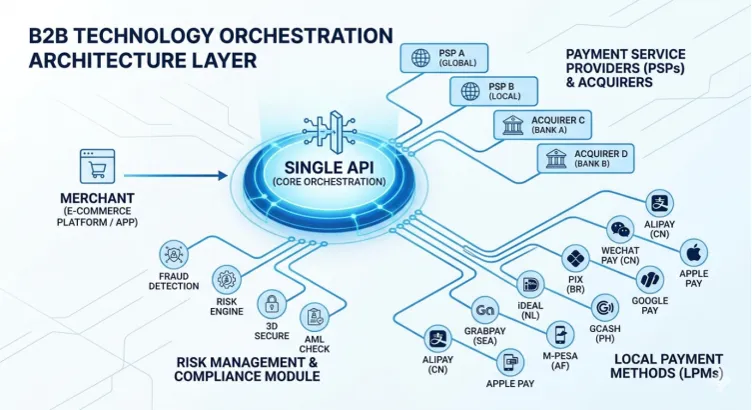
Payment orchestration is the core foundational layer of a global payment infrastructure. It acts as a unified platform layer that manages multiple Payment Service Providers (PSPs), intelligent routing logic, and diverse payment methods.
Core Components of a Payment Orchestration Platform
A true orchestration platform goes beyond basic processing. It consists of several integrated engines working seamlessly:
- A Unified API: Connects merchants to hundreds of global and local payment methods through one integration.
- A Smart Routing Engine: Dynamically routes transactions to the best-performing acquiring bank or PSP based on real-time data.
- Embedded Finance Modules: Integrates financial services natively, offering capabilities from payouts to FX management.
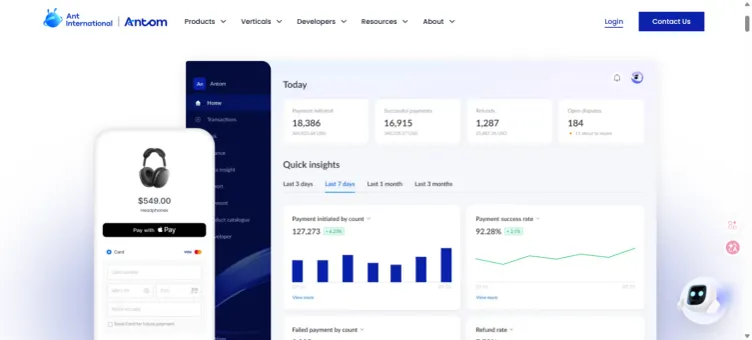
- Consolidated Reporting: Aggregates data from all connected channels into a single, standardized dashboard.
Component | Primary Function | Core Business Benefit |
Unified API | Connects to 300+ global & local methods | Eliminates multiple individual integrations |
Smart Routing Engine | Analyzes sub-second issuer health data | Maximizes authorization rates in real time |
Embedded Finance | Natively handles payouts and FX workflows | Keeps multi-currency funds in one ecosystem |
Consolidated Reporting | Aggregates multi-channel payment data | Cuts month-end reconciliation time by 70% |
Why SaaS Companies and Global Merchants Need Payment Orchestration
Operating across multiple markets with a subscription model transforms Payment orchestration from a luxury into an absolute necessity. In our experience powering payments for global SaaS platforms, the average merchant connects 3–5 PSPs before realizing they need an orchestration layer — by then, they've already lost months of engineering time and millions in failed transactions.
The True Cost of Managing Multiple Payment Providers
Market analysis reveals that the average global SaaS merchant connects 3–5 separate PSPs before realizing the need for an orchestration layer—by which point they have typically lost months of engineering time and millions in revenue from failed transactions. On average, SaaS teams spend three months per provider on this integration workload; this strains engineering resources and distracts teams from core product development as it creates technical debt that increases linearly with global expansion.
By implementing a centralized Payment orchestration layer instead, teams can reduce this workload down to a single unified API connection, freeing valuable engineering resources to focus on core product development rather than infrastructure maintenance.
How Payment Failures Drive Involuntary Churn in Subscriptions
Subscription operations often fail because platforms treat them like simple recurring deductions rather than dynamic operational systems, necessitating an effective subscription suite with pricing, cycle management and deduction guarantee guarantees to address it effectively. Offering free trials, first-N-period discounts or "buy one get N" promotions may actively acquire users while customizable billing cycles (single month, bimonthly or longer) give flexibility. When failure occurs due to insufficient funds or network errors an intelligent retry strategy must be in place in order to salvage revenue and prevent involuntary churn.
Consolidated Payments — Unifying Your Global Payment Stack
Consolidating all multi-channel payment data onto one platform has the power to reduce reconciliation time by more than 70% - this makes consolidated payments an urgent priority for FinOps teams.
From CSV Chaos to One Source of Truth
Handling separate data sets can lead to manual errors and delayed reporting. An integrated Global Payment Manager (APO) back-office connects global payment gateways, acquiring institutions, and e-wallets via one integration; this reduces development costs by 70%. Furthermore, APO automatically converts currencies based on set exchange rates; deducts channel fees accordingly; synchronizes refund and dispute statuses real-time; increasing reconciliation efficiency by 90%.
Unified Reporting for Finance and Operations Teams
Finance teams using a unified dashboard report cutting month-end reconciliation from 5 days to under 8 hours — a shift that compounds as transaction volume grows. By eliminating the 20+ hours per month many teams spend on manual reconciliation, finance operations become infinitely more scalable.
How Consolidated Data Enables Smarter Business Decisions
A centralized platform gives management real-time insight into revenue performance across regions and product lines. Once lagging historical reports become live engines supporting immediate strategic business decisions.
Global Payment Orchestration for APAC and Emerging Markets
Deep local payment coverage in Asia-Pacific and emerging markets is the definitive factor for successful global expansion.
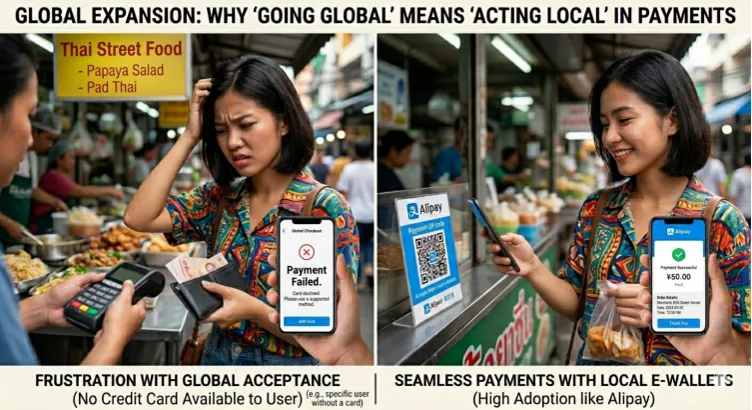
Why "Going Global" Means "Acting Local" in Payments
According to the McKinsey Global Payments Report (2024), cross-border payment volumes are growing rapidly, driven heavily by emerging markets. To capture this audience, the checkout experience must adapt to regional habits. Displaying familiar, trusted local payment methods is the most direct way to increase user conversion rates.
APAC Payment Landscape — E-Wallets, Bank Transfers, and Beyond
The APAC region is highly fragmented. Statista and WorldPay data confirm that alternative payment methods, particularly e-wallets, dominate the landscape. Credit card penetration in many Southeast Asian markets remains low, making e-wallets and bank transfers the primary currency of digital commerce.
Connecting You to 100+ Local Payment Methods Across Asia-Pacific
An effective global cashier aggregates over 300 local payment methods and supports over 140 transaction currencies, automatically matching and prioritizing the most commonly used options based on the user's location. This means connecting to dominant local players like Alipay+, GCash, Dana, KakaoPay, and UPI. When a Southeast Asian e-commerce platform integrated Antom's APAC payment capabilities, their checkout conversion in Indonesia rose 22% within 30 days — simply by activating local e-wallet options their previous PSP didn't support.
Reducing Cross-Border Fees Through Local Acquiring
By routing transactions through local acquiring entities rather than processing them cross-border, businesses avoid hefty interchange markups and international processing fees, drastically improving profit margins on global sales.
Embedded Finance and Payments — Building a Complete Commerce Infrastructure
Payment orchestration is just the starting point; embedding payments seamlessly into business workflows to create an end-to-end commerce infrastructure is the next generation of competitive advantage.
From Payment Processing to Embedded Financial Services
True embedded finance moves beyond accepting money; it provides complete commerce infrastructure including payments, payouts, FX, and compliance. Platforms can natively manage multi-currency funds, directly exchange currencies within the platform, and execute payouts to global suppliers without leaving the ecosystem.
Enabling Embedded Payments for Platforms and Marketplaces
Frictionless payment experiences define modern embedded finance.
- Tokenization: By substituting single-use credentials with long-term encrypted tokens, buyers skip repeated identity verifications. This supports 19 different payment methods and enables multi-currency settlements (24 currencies) across 31 countries/regions, with flexible settlement cycles from T+2 to T+25.
- Scan to Link: To eliminate cross-device friction, users triggering a payment on a PC, console, or smart TV simply scan a QR code with their mobile device. This shifts authorization to the mobile device with zero page redirects, compressing a clunky 40-second process into an average of 6 seconds.

The Convergence of Payments, Payouts, and Financial Infrastructure
As transactions scale, so does risk. An AI-based real-time decision model performs millisecond-level risk scanning and precision scoring. It blocks malicious card testing and high-risk refunds while minimizing false positives for genuine users. Platforms can utilize basic built-in protections or rely on premium expert-managed services to achieve "loss prevention as revenue generation."
How to Choose a Payment Orchestration Platform — Buyer's Checklist
Evaluating providers requires analyzing routing flexibility, regional coverage depth, integration complexity, and total cost of ownership (TCO).
7 Must-Have Features for Global SaaS Businesses
According to Gartner's Market Guide for Payment Processing, leading solutions must include robust global coverage, smart routing logic, comprehensive tokenization, embedded finance capabilities, flexible subscription management, unified reporting, and stringent security standards like PCI DSS Level 1 and GDPR compliance.
Questions to Ask During Vendor Evaluation
- Does the platform offer native access to deeply localized APAC payment methods?
- Can the routing engine make dynamic, sub-second decisions based on issuer health?
- Does the provider offer an end-to-end commerce infrastructure (payouts, FX), or just standard gateway routing?
Red Flags That Signal a Platform Won't Scale
Avoid vendors that require extensive developer time for every new regional integration, lack native subscription operational tools (like AI smart retries), or provide fragmented, non-consolidated financial reporting.
Payment Orchestration Use Cases and ROI Benchmarks
Different business models experience distinct ROI paths, but the data consistently proves the value of orchestration.
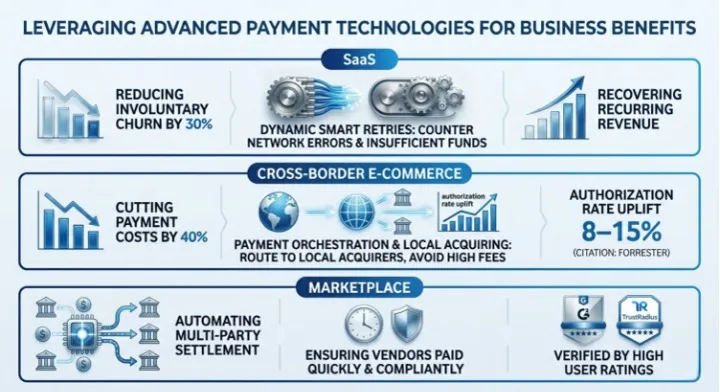
SaaS — Reducing Involuntary Churn by 30% with Smart Retry
By utilizing dynamic smart retries that counter network errors and insufficient funds, SaaS platforms dramatically recover recurring revenue, actively lowering involuntary churn rates.
Cross-Border E-Commerce — Cutting Payment Costs by 40% via Local Acquiring
Merchants using orchestration consistently see an 8–15% uplift in authorization rates, as noted by Forrester research. Furthermore, by routing transactions to local acquirers, they avoid high cross-border processing fees.
Marketplace — Automating Multi-Party Settlement
Marketplaces benefit from automated multi-party settlement, ensuring vendors are paid quickly and compliantly, verified by high user ratings on G2 and TrustRadius.
Frequently Asked Questions About Payment Orchestration
1. What is Payment orchestration?
It is a unified platform layer that connects businesses to multiple PSPs, payment methods, and embedded finance tools through a single API.
2. How does Payment orchestration improve authorization rates?
By using dynamic smart routing, it evaluates real-time data to send transactions to the acquirer most likely to approve them, and uses failover logic to retry failed payments instantly.
3. Why do SaaS companies need Payment orchestration?
SaaS businesses need it to manage recurring subscriptions, recover failed payments via smart retries, and scale globally without adding massive engineering debt.
4. Can Payment orchestration reduce cross-border payment costs?
Yes, by routing transactions through local acquirers in the buyer's region, merchants bypass high international processing fees.
5. What are the benefits of global Payment orchestration for cross-border ecommerce?
It provides access to hundreds of local payment methods (like APAC e-wallets), optimizes conversion rates, and reduces transaction friction through features like Scan to Link.
6. What is static payment routing?
Static routing sends a defined class of transactions to a predetermined processor or acquirer using fixed rules. It is simple and predictable but does not automatically adapt to changing route performance.
7: What is smart payment routing?
Smart routing evaluates available routes using transaction attributes, business rules and performance data, then selects a processor or acquirer. It may also use fallback logic when the first route is unavailable or fails under permitted conditions.
8: Does smart routing always increase payment conversion?
No. It is most useful when there are genuinely different routes and enough transaction data to make reliable decisions. Poor rules, limited data or extra latency can reduce or erase the benefit.
9: What data does smart routing use?
Common inputs include market, currency, payment method, issuer or card range, historical approvals, route cost, latency, outage status, risk rules and contractual constraints. The exact inputs depend on the payment stack and applicable regulation.
10: How should merchants compare smart and static routing?
Compare them using approved transactions, end-to-end payment conversion, cost per successful payment, latency and operational stability. Use the same transaction segments and a controlled test or holdout where feasible.
Simplify Global Payments with Antom
Whether you're scaling into Asia-Pacific, optimizing authorization rates, or consolidating a fragmented payment stack, Antom gives you the infrastructure to grow without complexity.
By unifying embedded finance capabilities, subscription operations, and intelligent risk management into a single platform, you eliminate technical friction and unlock global revenue.
One integration. 300+ payment methods. Global reach with local precision.
Explore Antom's Payment orchestration → Visit antom.com
Written by the Antom Team — payment infrastructure specialists supporting global merchants and SaaS platforms across 100+ markets. With deep expertise in cross-border commerce, smart routing, and Asia-Pacific payment ecosystems, the Antom team publishes research-backed guides to help businesses optimize their payment stack for growth. Learn more at antom.com.