


Share on
In the competitive gaming market, revenue performance hinges on checkout efficiency, fraud resilience, and payout reliability. For enterprise operators, selecting the right payment gateway is a scalability and risk-management decision that directly impacts player lifetime value (LTV) and long-term revenue efficiency.
If you run a game marketplace, publisher platform, social gaming product, or cross-border digital goods business, payments shape both conversion and retention. Strong providers support localized checkout, enterprise risk controls, high uptime, and scalable routing. Weak providers turn simple purchases into abandoned carts.
This guide explains how to evaluate the best global payments for gaming, which criteria matter most, and how Antom can support enterprise-grade payment infrastructure.
The Critical Role of Payment Infrastructure in Gaming Revenue
Checkout is not a back-office step in gaming. It is part of the player journey. If a user cannot pay with a trusted method in seconds, the sale may disappear.
Digital goods purchases happen at moments of intent. A player may want currency, a battle pass, or a limited-time offer. Any friction can break momentum. Payment performance is as important as storefront design.
Gaming payments also create special complexity. They often involve frequent low-to-mid value transactions, global audiences, and high fraud pressure. Virtual goods are delivered instantly, so recovery after fraud is harder.
A global mobile game may need card payments in North America, e-wallets in Southeast Asia, and bank-based methods in Europe. A generic gateway may process some flows. A gaming-ready stack optimizes them across regions.
Assessing Payment Impact on Player Conversion
Players expect speed and familiarity at checkout. A slow or confusing flow creates doubt. That doubt often leads to abandonment.
Trust also matters. Players are more likely to complete a purchase when they see familiar payment brands, local currency, and a clean interface. A reliable payment gateway for gaming industry audiences removes hesitation at the final step.
Identifying Unique Gaming Payment Complexities
Gaming is not standard ecommerce. Transactions are often smaller, faster, and more frequent. Demand can spike during launches, promotions, and live events.
Fraud pressure is also higher because goods are delivered instantly. Once virtual value reaches an account, recovery is difficult. That makes prevention more important than reaction.
Core payment terms enterprise teams should know
Three concepts are important:
Payment Gateway: A payment gateway securely transmits payment data and routes a transaction for authorization. It connects the player, your platform, and financial networks. A strong payment gateway for gaming industry platforms acts as a strategic lever for operational agility, security, and acceptance.
Payment Orchestration: Payment orchestration routes transactions across multiple acquirers, processors, and methods through one control layer. If one route underperforms, traffic can move to another provider. That matters when your traffic is global and uneven.
Local Payment Methods: Local payment methods are regionally preferred ways to pay. They include bank transfers, e-wallets, QR payments, or domestic card rails. Familiar options increase trust and often improve conversion.
Key Features to Look for:Global Payments for Gaming Success
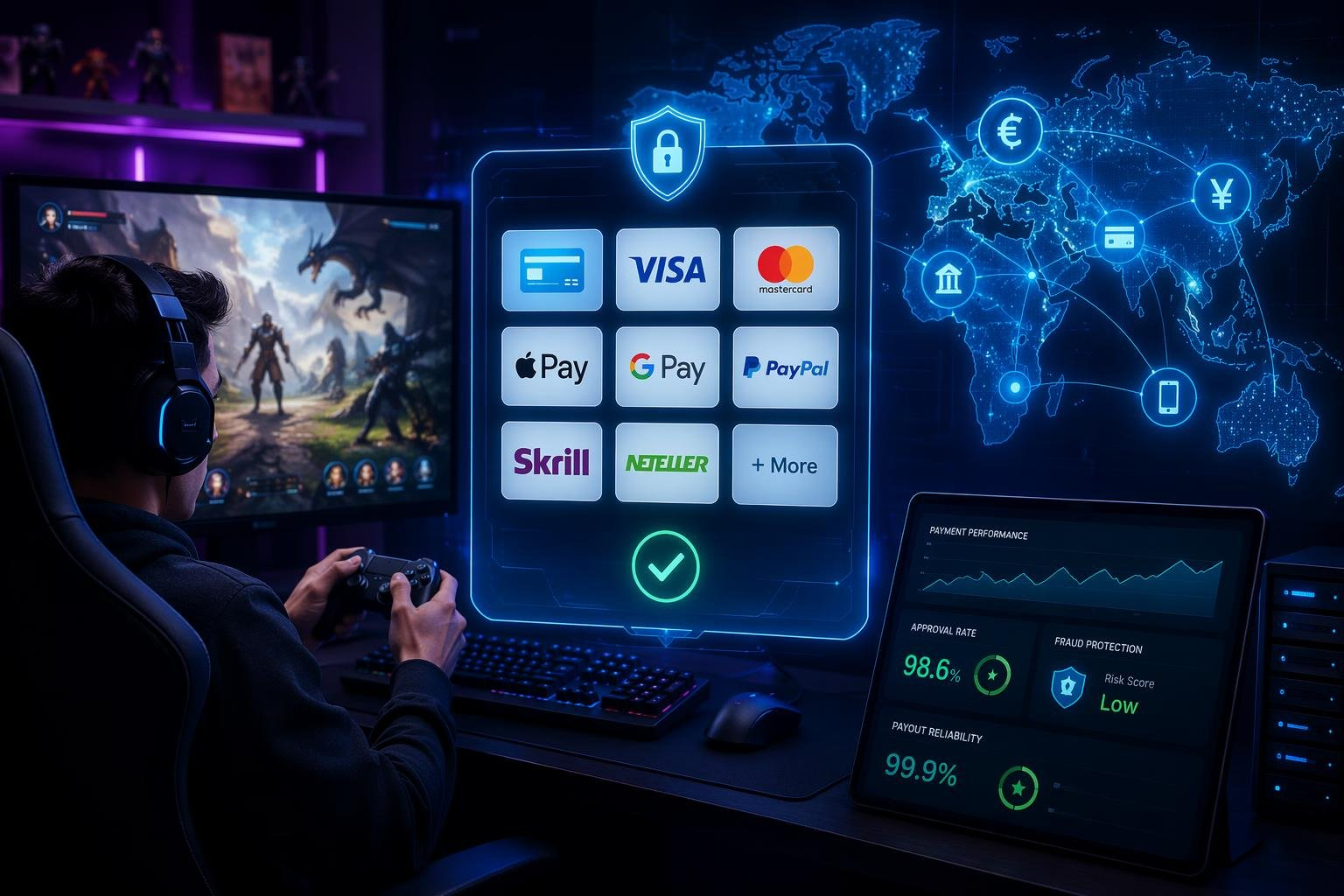
Use the framework below when comparing providers in the payment gateway for gaming industry category.
Criterion | What To Look For | Common Pitfalls | Impact On Decision |
Global coverage | Broad country support, multi-currency settlement, local acquiring, regional methods | Coverage claims without local depth | Determines expansion speed and conversion in new markets |
Authorization performance | Smart routing, retries, local optimization, decline analytics | Only reporting approvals at aggregate level | Directly affects revenue and customer acquisition efficiency |
Risk tools | Fraud scoring, velocity checks, device signals, rules engine, chargeback workflows | One-size-fits-all filters that block good players | Balances fraud loss with player experience |
Integration quality | APIs, SDKs, hosted checkout, tokenization, recurring billing support | Long implementation cycles and weak documentation | Shapes launch speed and operational costs |
Reporting and reconciliation | Real-time dashboards, settlement reporting, finance exports | Manual reconciliation across entities and providers | Improves financial control and cash visibility |
Service and compliance | Dedicated support, PCI alignment, regulatory readiness | Limited enterprise support in key regions | Reduces legal, technical, and operational risk |
A basic gateway can process transactions. An enterprise gaming gateway should do more. It should support local methods, routing, fraud rules, centralized reporting, and traffic spikes.
Capability | Basic Gateway | Enterprise Gaming-Focused Gateway |
Card processing | Yes | Yes |
Local payment methods | Limited | Extensive |
Multi-acquirer routing | Rare | Common |
Fraud customization | Basic | Advanced |
Virtual goods support | Partial | Purpose-built |
Cross-border optimization | Limited | Strong |
Unified reporting | Often fragmented | Centralized |
Scalability for spikes | Variable | Designed for peak events |
Coverage and localization
It is not enough to have a global reach. You must have a strong presence in every market. This includes local acquiring and settlement support as well as regionally preferred methods.
It is possible for a provider to claim a wide coverage, but perform poorly in certain countries. You should ask for specific market information, and not an overall global view.
Authorization and routing performance
The approval rate has a direct effect on revenue. Even small improvements at scale can lead to significant gains. This is particularly true for platforms with high volumes of gaming.
Be on the lookout for intelligent routing, decline recovery and strong reporting. The aggregate approval numbers don't tell the whole story. Performance by market, method and issuer type is needed.
Reporting, Service, and Enterprise Support
Payment data should be simple to understand and act upon. Dashboards in real-time, settlement files and finance exports can reduce the amount of manual work. These dashboards also enhance visibility between regions.
Support is important. The launch of large gaming releases can cause a sudden spike in transactions. During these high-pressure times, enterprise teams require responsive support.
Prioritize orchestration, local methods and risk control for large international platforms. The lowest headline processing costs is not always the best measure. For mid-scale gaming companies entering new markets, they should concentrate on coverage and integration. High-growth publishers must focus on uptime, routing flexibility and fraud automation.
When evaluating a payment gateway for gaming industry deployment, the key question is not whether or not it can process payment. It is more important to ask if it can support global growth in gaming with less friction and fewer checkout failures.
Digital Goods: Risk Management and Fraud Prevention
Digital goods, which are delivered instantly, attract fraud in gaming. Margin pressure is created by a number of factors, including account takeovers and thefts, fraud in promotions, refund manipulations, friendly fraud, and the abuse of stolen cards.
There is no buffer for shipping, unlike physical goods. Recovery becomes more difficult once value is added to a player's account. The provider's risk profile is as important as the pricing.
Fraudulent gaming practices
There are many forms of gaming fraud. Card fraud is the most obvious. Account takeovers are also common, particularly when valuable inventory or stored payment methods are involved.
Promo abuse can slowly erode margins. Fraudsters can create multiple accounts in order to take advantage of welcome offers or rewards. Abuse of refunds and friendly fraud can increase the number of disputes over time.
What are the key elements of a strong fraud control?
Buyers of enterprise-level products should expect multiple layers of controls including:
Signals from devices and behavior
Controls of the speed by account, device, card and IP
Geolocation consistency checks
Authentication options and 3DS where applicable
Review tools for edge cases
Chargeback monitoring workflows and disputes
Segmentation based on game title, payment method, and region
Top-tier gateways employ dynamic risk-routing to filter bad actors while minimizing friction for high-value players. A rigid set of rules may reduce the conversion rate and lifetime value.
How to balance fraud protection with conversion
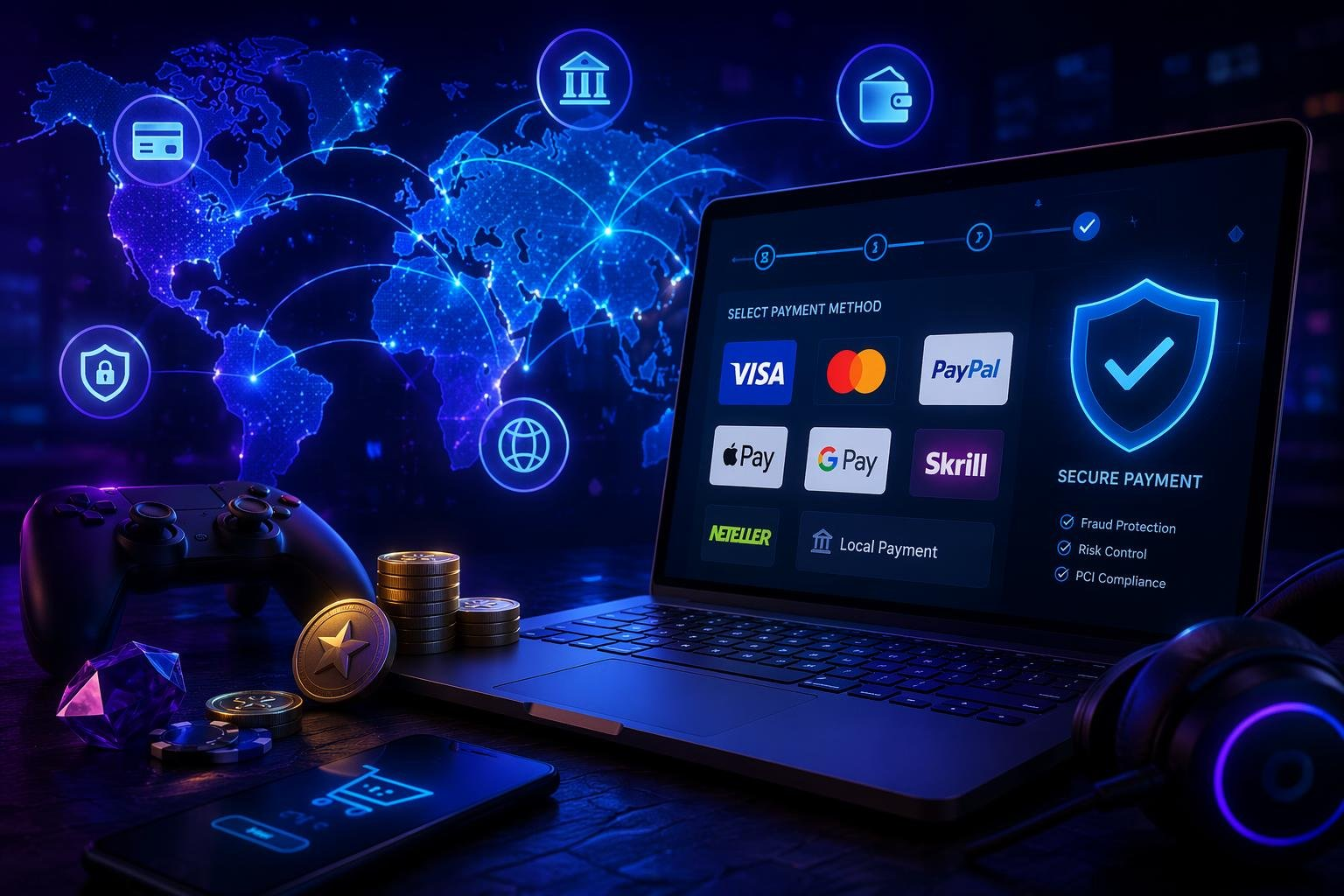
A major launch of a game may cause a sudden spike in purchases. A rigid system could treat this velocity as fraud. A risk model that takes into account gaming can distinguish between expected event demand and attack patterns.
The goal isn't maximum blocking. Smarter approval is the goal. Risk controls that are effective protect revenue and preserve the experience of trusted players.
Risk Area | Low-Maturity Approach | Strong Enterprise Approach |
Account takeover | Password checks only | Behavioral signals and device intelligence |
Promo abuse | Manual monitoring | Automated rules and user segmentation |
Card fraud | Basic AVS/CVV checks | Layered scoring, routing, and authentication |
Chargebacks | Reactive handling | Proactive alerts and dispute workflows |
False positives | Broad declines | Fine-tuned thresholds by market and cohort |
External references such as Coda’s gaming payments page, Nuvei’s online gaming solutions, and Xsolla show how providers position gaming payment infrastructure. Buyers should still validate approval rates, fraud controls, and service models in their own markets.
Optimizing Conversion Rates:Local Payment Methods vs. Global Reach
When players see familiar checkout flows, they are more likely complete a purchase. This is especially important in cross-border markets, where the penetration of international cards is uneven.
Local relevance is what closes sales, not a global footprint. The best global payment for gaming strategy combines both.
Local payment methods can increase trust
They reduce friction by making payment options familiar. The checkout process is made easier and safer. Local wallets and bank-based methods tend to be more trusted in many regions than international cards.It is also helpful to use local currency. This reduces the perception of conversion fees and hidden charges.
What methods should you launch?
Add payment methods only if you are convinced that the provider is a good one. Match each payment method with the market demand, ticket sizes, risk levels, and user behaviors.
Use this plan to roll out your project:
1. Audit using dashboards for analytics and cohort reports in order to identify the top markets and payment drop off points.
You will find out if conversion losses are related to method gaps, or authorization patterns that fail.
2. Map using regional analysis and provider coverage lists, to match each market's preferred local methods.
Expected result:You will create a list of payment options that are likely to be adopted by the local community.
3. Compare method mix performance using A/B checkout flow and approval rate reporting.
You measure the payment combinations that increase conversion without causing fraud to be excessive.
4. Use routing rules and risk segmentation for refinement of acceptance based on country, channel and player type.
Expected result:You will improve approvals, decrease false declines and create a scaleable launch model.
Why a hybrid vehicle makes sense
Tip: Begin with your three top-performing markets and then add one new market. This allows for rapid learning without adding unnecessary complexity to the operation.
A hybrid model often works best for larger platforms. This hybrid model combines global acceptance of cards with local methods on important markets. This helps with both conversion and scale.
Approach | Strengths | Limitations | Best For |
Global card-first | Fast initial rollout, simpler operations | Lower conversion in local-first markets | Early international expansion |
Local method-led | Better trust and approvals in specific regions | More integration and reconciliation complexity | Mature regional growth |
Hybrid model | Balance of scale, trust, and resilience | Requires stronger orchestration | Large gaming platforms |
For international growth, reviewing Antom’s payment methods is a useful starting point for localized payment coverage.
Integration Strategies for Seamless User Experience
Selecting an integration model balances immediate launch speed against long-term operational autonomy. Enterprise gaming companies often choose between hosted payment pages, embedded components, or full API integration.
Hosted options reduce implementation work. API-led models offer more control and customization. The best choice depends on whether speed or ownership is the priority.
Hosted checkout vs. API integration
Hosted checkout can speed up deployment. It can also reduce compliance burden for internal teams. This model works well when launch speed matters most.
API integration offers greater control over UX, logic, and payment routing. It is often better for mature teams with custom product requirements.
UX details that improve payment completion
A high-quality integration should support:
- Responsive checkout across mobile and desktop
- Secure tokenization
- Subscription or recurring support if relevant
- Real-time payment status updates
- Refund and dispute APIs
- Sandbox and test documentation
- Monitoring hooks for failures and latency
Small UX details can create measurable gains. These include saved payment methods, fewer fields, early local currency display, and clear failure messages. Fast retries also matter when temporary declines occur.
Cross-functional questions to ask before launch
If a player’s first card attempt fails, an intelligent fallback can preserve the transaction. Without that fallback, the user may abandon the purchase.
Workstream | Key Questions |
Product | Which checkout flow creates the least friction for our player base? |
Engineering | Do we need API flexibility, hosted speed, or orchestration control? |
Finance | How will settlement, reconciliation, and refund reporting work across markets? |
Risk | Can rules be customized by game, region, and player segment? |
Operations | Is enterprise support available during launches and seasonal peaks? |
Consult with an Antom architect to design a payment flow customized to your specific gaming architecture and growth needs. You can also review the main Antom platform for broader solution context.
FAQ
Q: What defines an effective payment gateway for gaming industry operations?
A gaming-suitable gateway supports digital goods, global payment methods, strong fraud controls, high uptime, and conversion-focused checkout.
Q: Why is a payment gateway for gaming industry needs different from standard ecommerce?
Gaming involves instant digital fulfillment, frequent cross-border transactions, and elevated fraud pressure. It needs specialized routing, risk controls, and localization.
Q: How many payment methods should a gaming platform offer?
Start with methods that match your top markets and user preferences. More options are not always better if they add complexity without conversion lift.
Q: Do local payment methods really improve gaming conversion?
Yes. In many markets, familiar wallets, bank-based options, or domestic methods increase trust and reduce checkout abandonment.
Q: What should enterprises ask providers during evaluation?
Ask about approval rates by region, fraud tooling, local acquiring, integration timelines, settlement models, service levels, and reporting depth.
Q: How should we compare Antom with other providers?
Compare coverage, local methods, integration quality, fraud controls, reporting, and support responsiveness. The right fit depends on your market mix and technical needs.
Strategic Next Steps: Building a Resilient Payment Architecture
The right payment gateway for gaming industry growth should do four things well. It should increase payment acceptance, reduce fraud loss, support local preferences, and scale globally without adding operational drag. For large platforms, that usually means enterprise infrastructure, not basic processing.
If your team is evaluating the best global payments for gaming, start with a structured comparison. Review market coverage, payment methods, fraud tooling, and integration flexibility. Then pressure-test each provider against real launch scenarios and regional growth plans.
Explore Antom’s global payment methods, learn more about the Antom platform, or contact Antom to discuss a payment strategy for enterprise gaming growth.