


Share on
Launched by Apple Inc. in 2014, Apple Pay is a leading global mobile payment and digital wallet service that has gained widespread adoption worldwide. Apple Pay is deeply integrated into the Apple ecosystem, allowing users to link credit, debit, and prepaid cards, enabling quick payments online and offline with a single tap. This streamlined payment experience significantly reduces friction at checkout and helps improve conversion rates for e-commerce merchants. Apple Pay is fully compatible with iPhone, Apple Watch, iPad, and Mac. Powered by Near Field Communication (NFC) technology, it delivers a secure, efficient, and seamless contactless payment experience while supporting a wide range of online and in-app payment scenarios.
Apple Pay is reinforcing its position as a leading digital wallet brand in the UK, France, and Italy, the three major European online payment markets. Data shows that in the UK, by 2030, nearly 60% of online transactions will be completed via digital wallets, with Apple Pay ranking alongside Google Pay and PayPal among the top three. In France, the digital wallet market share is expected to rise to 46% by 2030, with Apple Pay also remaining among the most popular choices. Italy's digital wallet market is also expanding rapidly, with Apple Pay's share of online transactions steadily increasing.
In the U.S. market, adoption of digital wallets is growing rapidly. By 2024, the number of e-commerce users is expected to reach about 274 million, with a user penetration rate of 84.5%, the highest worldwide. By 2023, digital wallets made up nearly 40% of online transactions, and this figure is expected to exceed 54% by 2025. Apple Pay is now supported in nearly 100 countries and regions worldwide, with 74 of the top 100 U.S. retailers backing it, covering 65% of the retail market. Over 50% of iPhone users rely on Apple Pay for everyday payments, bringing its global user base to over 500 million.
Properties
The following table lists the product properties supported by Apple Pay:
Availability | Acquirer | AntomSG | AntomHK | AntomUK | AntomEU | AntomUS |
Merchant entity location | SG, HK | HK | UK | EU | US | |
Buyer country/region | Global | Global | Global | Global | Global | |
Product features | Payment type | Digital wallet | Digital wallet | Digital wallet | Digital wallet | Digital wallet |
Card brand | Visa, Mastercard | Visa, Mastercard | Visa, Mastercard | Visa, Mastercard | Visa, Mastercard, American Express, Discover, JCB | |
Currency | Processing currency | AUD, CAD, CHF, EUR, GBP, HKD, JPY, NZD, SGD, USD | AUD, CAD, EUR, GBP, HKD, JPY, NZD, SGD, USD, CZK, DKK, HUF, IDR, MXN, NOK, PEN, PLN, ZAR, SEK, CHF, THB | EUR, GBP, USD, HKD, SGD, JPY, AUD, CAD, NZD | EUR, PLN, CHF, USD, GBP, HKD, SGD, JPY, AUD, CAD, NZD | USD |
Others | 3D Secure | ❌ | ❌ | ❌ | ❌ | ❌ |
Authorisation validity period | 7 days. To reduce costs, we recommend that you initiate a request to capture or cancel the authorisation within 3 days. | |||||
Minimum payment amount | The smallest unit of the currency multiplied by 2. (That is, if the currency is USD, the minimum is 2 cents, based on the smallest unit of 1 cent) | The smallest unit of the currency multiplied by 2. (That is, if the currency is USD, the minimum is 2 cents, based on the smallest unit of 1 cent) | The smallest unit of the currency multiplied by 2. (That is, if the currency is USD, the minimum is 2 cents, based on the smallest unit of 1 cent) | The smallest unit of the currency multiplied by 2. (That is, if the currency is USD, the minimum is 2 cents, based on the smallest unit of 1 cent) | 0.01 USD or equal amounts | |
Maximum payment amount | Unlimited | Unlimited | Unlimited | Unlimited | 9,999,999.99 USD | |
Recurring payments (MIT) | ✔️ | ✔️ | ✔️ | ✔️ | ✔️ | |
Multiple partial captures | ❌ | ❌ | ❌ | ❌ | ❌ | |
Partial capture | ✔️ | ✔️ | ✔️ | ✔️ | ✔️ | |
Refund | ✔️ | ✔️ | ✔️ | ✔️ | ✔️ | |
Partial refund | ✔️ | ✔️ | ✔️ | ✔️ | ✔️ | |
Refund period | 365 days | 365 days | 365 days | 365 days | 365 days | |
Chargeback/Dispute | ✔️ | ✔️ | ✔️ | ✔️ | ✔️ | |
Advanced AVS check | ✔️ | ✔️ | ✔️ | ✔️ | ✔️ | |
Note: AVS is an anti-fraud service provided by credit card issuers, primarily used to verify the cardholder's identity during online or card-not-present transactions.
User experience
Note: The following payment flows on different terminals are reference only, and represent this payment method's flow on different terminal types. For supported merchants' terminal types, consult Antom Technical Support.
The following screenshots show the journey of paying with Apple Pay:
Web (Checkout)
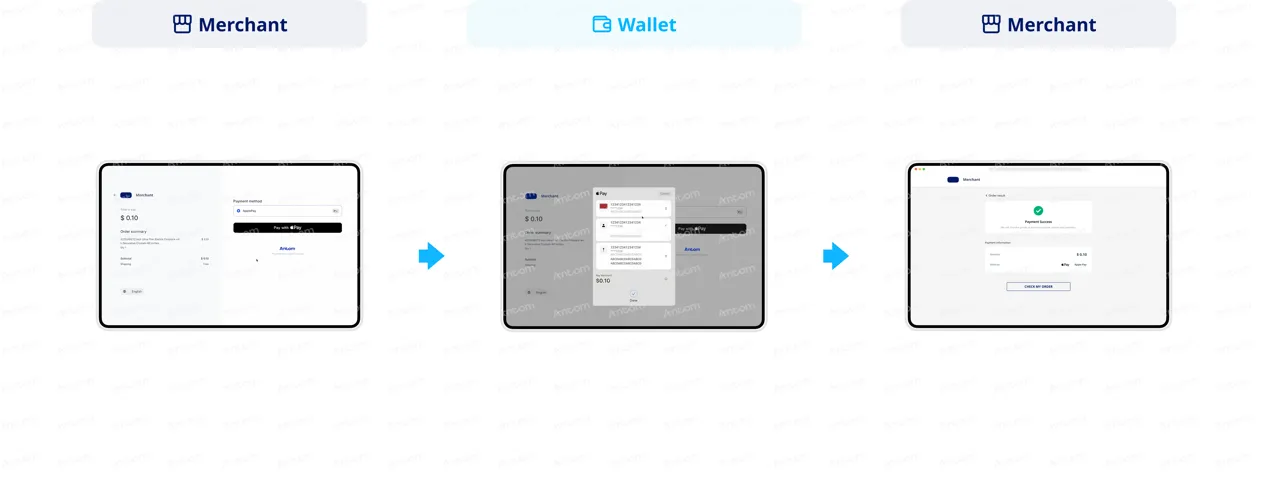
Web
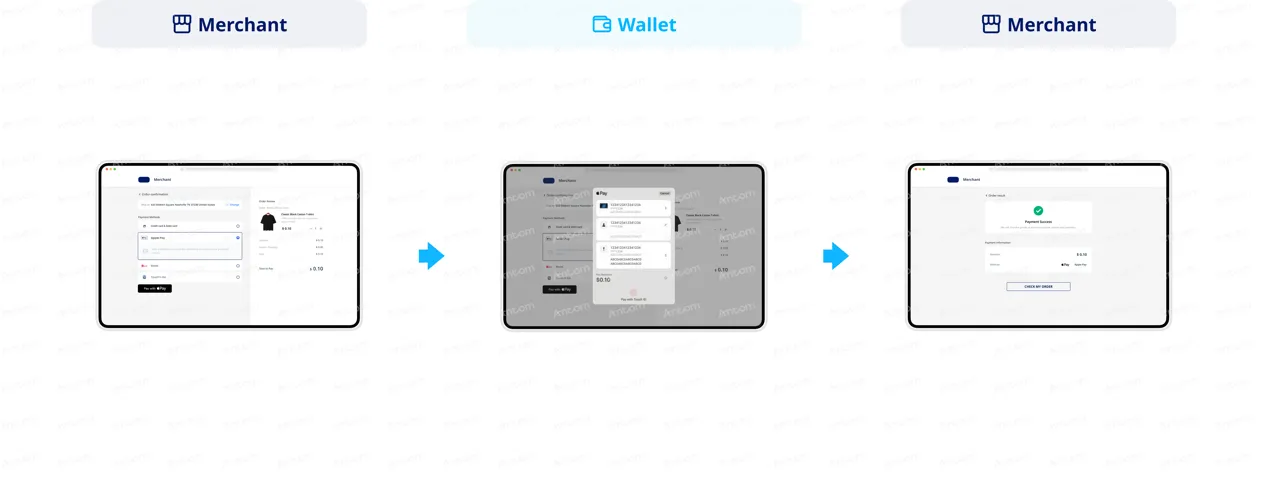
App
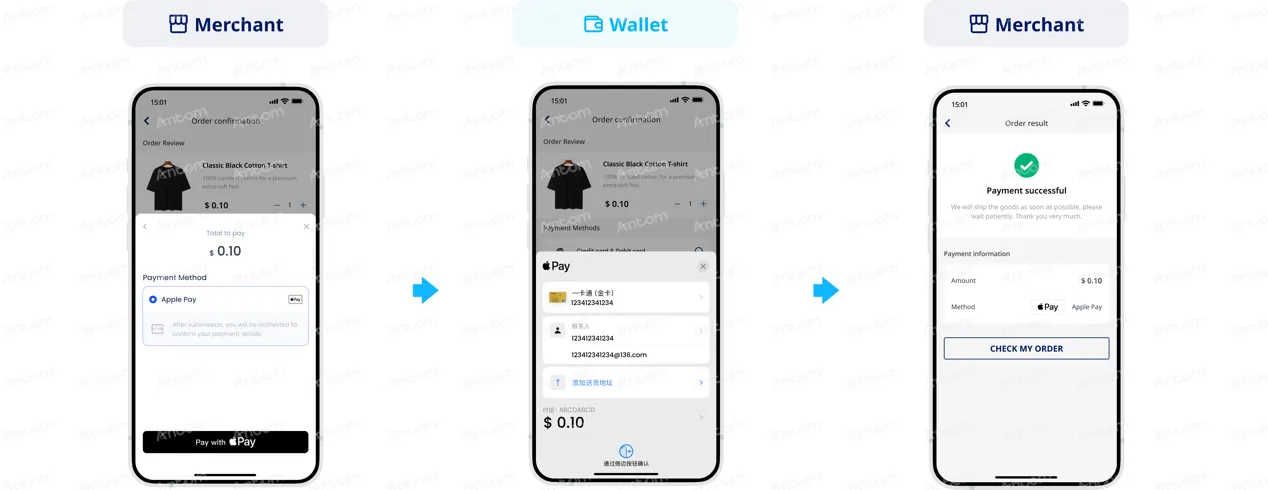
1. The buyer selects Apple Pay to pay.
2. The buyer is directed to the Apple payment sheet and completes the authentication.
3. The buyer is redirected to the merchant result page.
FAQs
1. How secure is Apple Pay?
Apple Pay is one of the most secure digital wallets available, offering stronger protection than physical credit, debit, or prepaid cards. Making payments with this digital wallet on an iPhone, Apple Watch, or iPad requires authentication via Face ID, Touch ID, or a passcode. Your card number and identity are never shared with merchants, and your actual card number is not stored on your device or Apple's servers, which is one of the key advantages of this digital wallet in terms of privacy protection.
When you use Apple Pay digital wallet in-store, neither Apple nor your device will send your real card number to the merchant. When making online payments using your Apple Pay digital wallet on Safari or other apps, merchants will only receive the information you authorise to complete the order, such as your name, email address, billing address, and shipping address.
If you make a payment using a debit or credit card through Apple Pay digital wallet, Apple also does not store transaction information that could be used to track you.
2. In which countries and regions is Apple Pay available?
Apple Pay is available in nearly 100 countries and regions, including Asia-Pacific countries such as China (including Hong Kong, Macau, and Taiwan), Singapore, South Korea, Japan, and Malaysia; European countries such as France, Germany, the UK, and Italy; as well as North America, the Middle East, and Latin America.
3. What features do global users value most in digital wallets?
Studies show that 66% of consumers prefer using biometric technology over traditional passwords to ensure transaction security. Transaction transparency is another key priority for digital wallet users. Approximately 80% of consumers want to be able to view past transaction records to help manage their budgets effectively, so features of digital wallets such as instant transaction notifications, full transaction history, budget limits, and alert functions are appealing to users. In addition, digital wallet features like one-click payment, tap/scan to pay, simplified card linking and login, cross-platform compatibility, integration of rewards and discounts, and support for multi-currency or travel-friendly transactions all drive the adoption and ongoing use of digital wallets.