

Share on
Relying solely on in‑store or online payments is no longer a sustainable strategy for a cross-border e-commerce business. About 84% of customers are multichannel buyers, meaning that they shop across both physical and digital spaces. Some customers discover brands in person but make online purchases, while others use online platforms to search for information before making in-store purchases.
This customer behaviour highlights the need for a unified commerce platform. With this platform, you can connect your payment systems, sales channels, customer data, inventory, and order management into a single ecosystem. This can help you deliver consistent shopping experiences regardless of where customers choose to interact with your business.
What is a unified commerce platform?
A unified commerce platform is an integrated system that consolidates all customer interactions and activities from all channels. It shows you a customer’s transactions, subscriptions, payments, promotions, and loyalty activity from online, in-store, mobile, and third-party partners. Rather than operating as disconnected, standalone systems, these functions operate as a single ecosystem through one connected platform.
These platforms allow customer data to flow across every customer touchpoint in real time. They also unify the shopping journey and break technological barriers. As a result, this unification allows businesses to:
- Reduce manual processes and data silos between business systems
- Streamline payment processing and order fulfilment
- Scale more efficiently as the business adds new sales channels and markets
- Generate more accurate insights to support operational and strategic decision-making
- Deliver consistent customer experiences across every sales channel
Omnichannel vs. unified commerce
Omnichannel and unified commerce both aim to improve customer experiences across multiple channels. However, they employ different strategies. Omnichannel strategies emerged as a response to consumers' use of multiple channels throughout their purchasing journey. Businesses looked for solutions that could integrate these touchpoints to provide consistent experiences across siloed channels. They connected the systems through APIs, but data remained fragmented. Unified commerce addressed this data fragmentation by introducing a consolidated system, where businesses can access all the data in a single platform.
The table below compares these two systems:
Feature | Omnichannel Commerce | Unified Commerce |
Customer experience | Consistent across customer touchpoints | Seamless experience powered by shared data |
Customer data | Stored across multiple connected systems | Centralised in a single, real-time customer profile |
Business systems | Connected through integrations or APIs | Managed through one unified platform |
Inventory | Synced between separate systems | Updated from one central inventory source |
Payments | May use different payment systems across channels | Managed through one connected payment ecosystem |
Order management | May handle orders separately by channel | Orders managed through a single workflow |
Reporting | Data consolidated from multiple sources | Real-time insights from one source of truth |
Scalability | Expanding channels often requires new integrations | New channels can be added more efficiently |
Why businesses need a unified commerce platform
Businesses are expanding across more sales channels
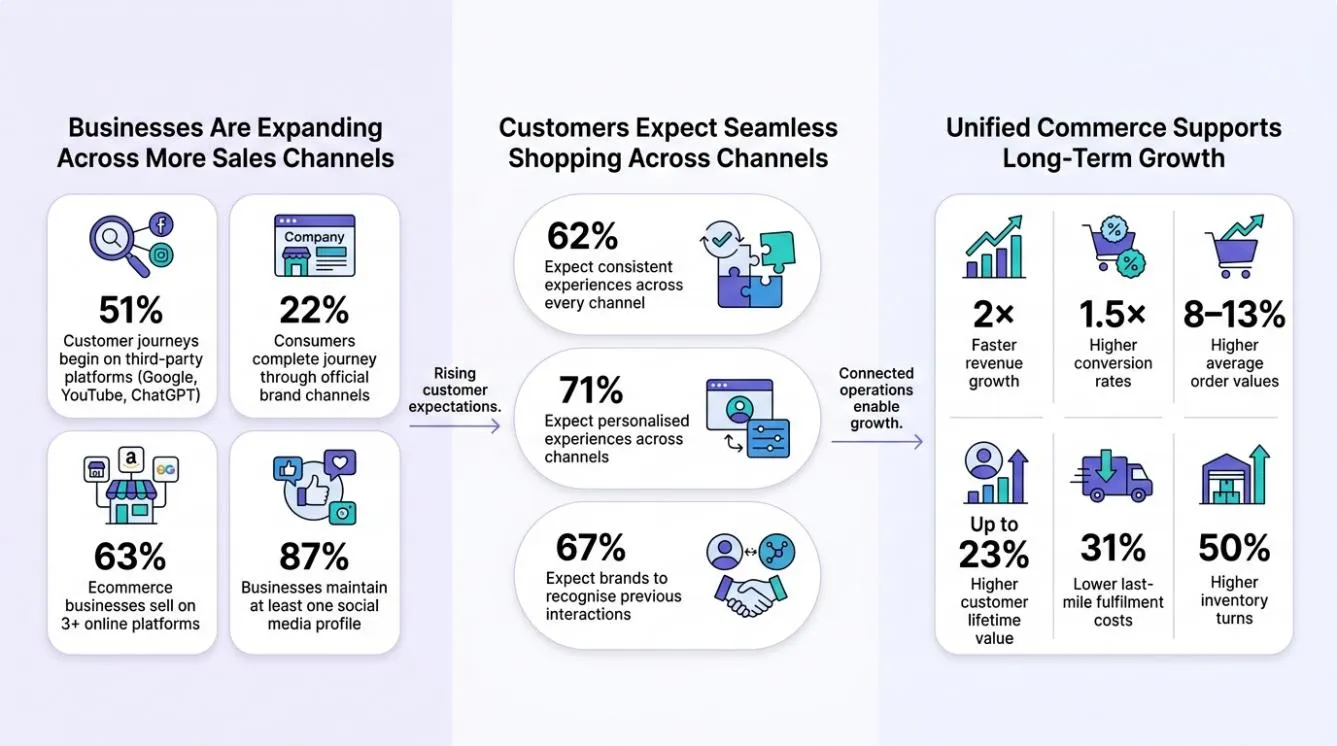
Modern-day customers interact and transact with businesses through various channels. A report indicates that 51% of customer journeys start on third-party platforms like Google, YouTube, and ChatGPT before reaching a company’s official platform. Only about 22% of consumers start, stay, and handle issues from the official channels. This highlights how fragmented modern customer journeys have become, making it increasingly important for businesses to deliver a seamless experience regardless of where customers begin or continue their interactions.
The channels customers use include e-commerce websites, mobile apps, physical stores, online marketplaces, and social commerce platforms. As a result, brands are expanding across more channels to ensure they maintain consistent operations and improve customer experiences. For example, 63% of global e-commerce businesses sell on at least 3 online platforms and 87% maintain at least one social media profile. This expansion makes it increasingly important for businesses to manage every sales channel through a connected platform rather than a collection of separate systems.
Customers expect seamless shopping across channels
If a customer’s experience on one of the brand’s channels feels different from another, it can create confusion and friction throughout the shopping journey. 62% of consumers expect brands to deliver consistent experiences regardless of the channels they use. In addition, 71% expect personalised experiences across channels while 67% expect businesses to understand their needs based on previous interactions. These insights indicate that customers increasingly expect businesses to recognise them and provide a connected experience across every touchpoint, rather than treating each channel as a separate interaction. Using different messaging, tone, and information across touchpoints can negatively affect consumer trust and conversion rates.
Unified commerce supports long-term growth
Business growth often brings greater operational complexity. Expanding into new markets, launching additional sales channels, or introducing new fulfilment options can quickly expose the limitations of disconnected commerce systems. Without a unified approach, these challenges can make expansion more difficult.
However, a unified commerce platform supports sustainable growth by increasing end-to-end visibility and allowing businesses to manage their operations from a single platform. Retailers embracing these platforms experience 2x faster revenue growth, 1.5x higher conversion rates, and 8–13% higher average order values globally. Brands in North America also record up to 23% higher customer lifetime value, 31% lower last-mile fulfilment costs, 50% higher inventory turns, and 24% higher customer satisfaction. These statistics indicate that businesses investing in unified commerce have better chances to grow revenue, improve operational efficiency, and deliver sustainable long-term value.
Is a unified commerce platform right for your business?
Does your business need a unified commerce platform?
A unified commerce platform can benefit businesses of all sizes, but it becomes more valuable as your business’s operations become more complex. It can be a good choice if your business sells through multiple channels, manages large volumes of customer and inventory data, or plans to expand into new markets. In this case, adopting a unified commerce platform can help improve efficiency and deliver more consistent customer experiences.
Here are some considerations to help you make that decision:
- Are your business systems disconnected? For example, if you manage payments, inventory, customer data, and order management using separate systems, scaling your operations and maintaining consistent customer experience can be challenging.
- How often do your customers switch between offline and online channels? Consider the number of customers who order products online but pick them up in-store.
- Are you planning to expand? If you’re targeting new markets or sales channels, a unified commerce platform will make scaling easier.
How to implement a unified commerce platform
Assess your existing commerce ecosystem
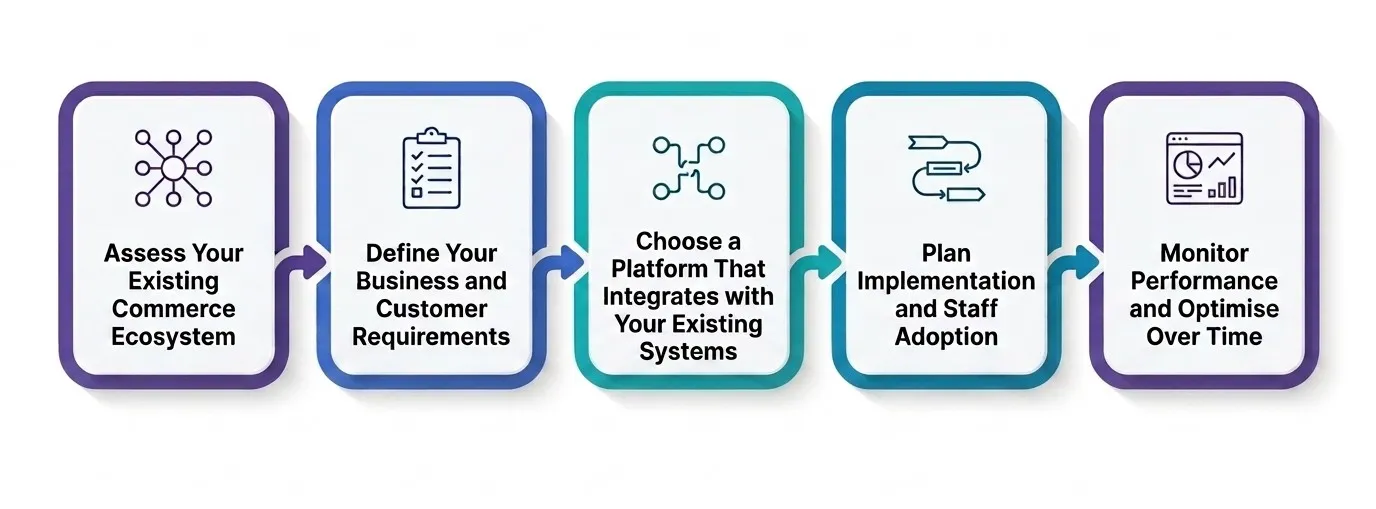
What is your current infrastructure like? What technologies do you currently use for various operations? When doing this assessment, you can consider systems like payments, e-commerce, point-of-sale, inventory management, customer relationship management (CRM), fraud prevention tools, and order fulfilment.
How do they interact with one another? Are there data silos or manual processes? These insights will help you know what to look for when planning your unified commerce strategy.
Define your business and customer requirements
What goals do you want the unified commerce platform to achieve?
Consider your growth plans, preferred sales channels, customer expectations, reporting needs, and operational challenges. Defining these requirements helps you prioritise the features and integrations that will deliver the greatest value.
Choose a platform that integrates with your existing systems
At this point, you know your current technology stack, what you want to achieve, and the features to look for in a platform. Use this information to select a platform that meets your expectations and business needs. Remember to evaluate the platform’s integration capabilities with your ERP, CRM, inventory management, e-commerce platform, and other critical business applications.
The platform should also easily integrate with your payment gateway. Consider whether it supports payment partners that offer payment localisation. For example, Antom is a unified merchant payment and digitalisation platform available in more than 200 markets and supports over 300 payment methods and 140 currencies. Integrating these capabilities into your unified commerce strategy can help create more seamless customer experiences while supporting efficient global operations.
Plan implementation and staff adoption
The unified commerce platform will affect your company’s frontline workflows. Therefore, how you roll out the technology and train your team will determine whether the technology succeeds or fails. Since switching over all your systems at once can be risky, consider phased implementation where you start with system configuration, data migration, and testing, followed by staff onboarding and change management to encourage adoption of the tools.
Monitor and optimise performance
At this point, operational readiness stops being the focus, and you shift to long-term growth and ensuring that the system helps you achieve the intended goals. So, assess its performance and determine what’s working and what needs improvement. Keep refining it to reduce inefficiencies, improve customer experience, and boost revenues.
Final takeaway
As your cross-border business grows, managing disconnected commerce systems becomes increasingly difficult. The visibility decreases, operational complexity increases, and delivering consistent customer experiences across every market becomes more challenging. A unified commerce platform addresses these challenges by providing an integrated platform that features all your key functions. This means that you can manage orders, payments, inventory, and reporting in a single platform. However, before investing in a unified platform, ensure you understand your business goals and infrastructure because not every platform offers the same integrations, capabilities, or scalability.
Scale your cross-border business with Antom. Click here to get started now
FAQs
1. What challenges should businesses expect when implementing a unified commerce platform?
During implementation, businesses are likely to encounter challenges with integrating legacy systems and migrating customer and inventory data. The new technology might also lead to disruptions during the transition and employee frustration.
2. How does a unified commerce platform help businesses comply with payment and data regulations?
A unified commerce platform can simplify compliance by centralising payment processing and customer data management. Many platforms support features such as PCI DSS compliance, data encryption, tokenisation, and role-based access controls to help businesses protect sensitive information.