

Share on
Fragmented international payments once meant lost revenue and significant time losses. When unified commerce entered the picture, it solved these issues by merging online and in-person transactions into one system. This brought higher conversion rates for merchants across the world.
Handling both local and international payment methods while dealing with diverse compliance requirements often means juggling multiple disconnected platforms. This guide takes a deeper look into the global payment landscape, and the key market insights it provides can help B2B merchants design a practical framework for choosing payment service providers. When done right, it can help businesses achieve seamless cross-border growth.
An Introduction to Unified Commerce
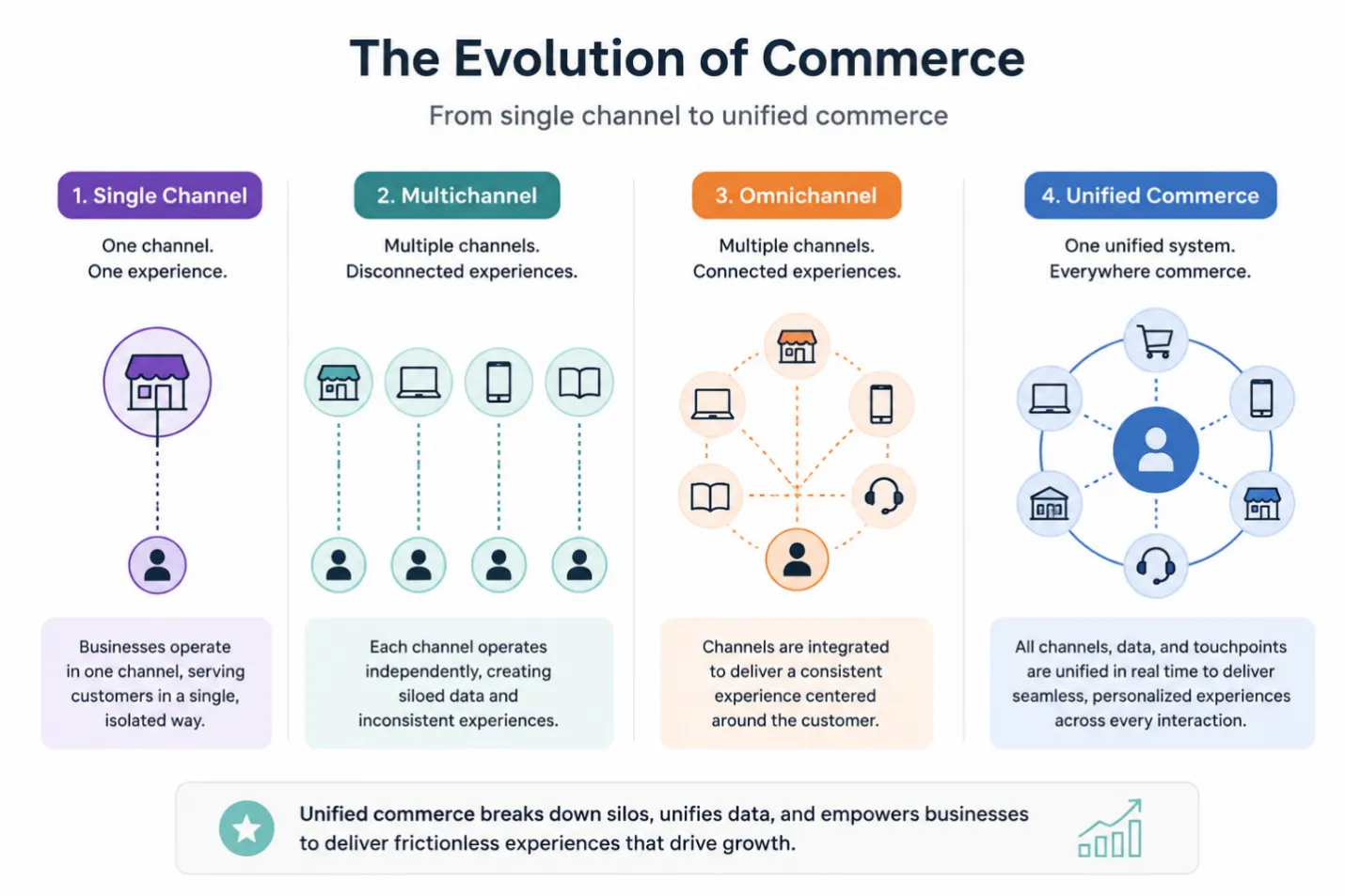
At its core, unified commerce goes far beyond simply offering multiple sales channels. In fact, an overarching unified commerce strategy consolidates all customer touchpoints and transaction data. It combines these with back-end infrastructure (including inventory management, CRM systems, and payment processing) into a centralised engine.
Today's robust unified commerce solutions are quite the opposite of the traditional setups that stitched disparate systems together. They establish a single channel that covers web, mobile apps, social commerce, and physical storefronts.
Merchants can benefit from two distinct operational advantages when they establish a solid unified e-commerce structure:
- 360-Degree Customer Insights: They can track cross-channel buying behaviours and then deliver personalised shopping journeys and targeted promotions to prospects.
- Streamlined Back-End Control: They get real-time visibility into inventory levels and global sales metrics. This can help reduce operational friction and stockouts.
These perks are proof that a unified commerce framework isn't a minor tweak to a checkout page. Businesses can now build a tech stack that supports international growth. To achieve this, merchants can use solutions like Antom, which provides access to 200+ payment markets and over 300 payment methods. Merchants will find they perform better in international markets when their payment infrastructure is well-designed.
Why Modern Commerce Is Moving Beyond Omnichannel
Both omnichannel and unified commerce tend to serve cross-channel shoppers. Comparing the two reveals some core differences in their architectural design.
Omnichannel
It is a front-end strategy meant for short-term conversion. It connects separate sales channels (e-commerce, mobile app, store POS) with custom APIs and surface-level integrations. Considering how every channel has its own database, customer and transaction data remain fragmented.
Unified Commerce
It's a structural strategy focused on maximising Customer Lifetime Value (LTV). It replaces distinct channel silos with a centralised core database. This is where it unifies payments, order fulfilment, inventory, and customer loyalty into a single source of truth.
The benefits of a unified system can be seen in revenue. According to industry benchmark data from a report, merchants who implement unified commerce experience an average 8% boost in revenue. This represents a $1.5 trillion growth opportunity for the global retail market.
The table below shows how the two payment structures differ in some core areas:
Strategic Dimension | Omnichannel | Unified Commerce |
Data structure | Fragmented across separate channel databases | Single database for all channels |
System integration | Complex API layers linking disparate software stacks | Single-platform engine natively handling all channels |
Customer profiling | Isolated account histories per channel (in-store vs. online) | 360° real-time profile updated for every transaction |
Cross-channel loyalty | Points restricted or requiring complex manual reconciliation | Automatic card-linked rewards across web, mobile, and store |
Operation effort | High overhead for multi-system reconciliation and audit | Automated real-time inventory and unified financial reporting |
Unified Commerce Example: A Quick View of How It Works in Real Life
The way a global equipment supplier manages customer interactions across websites, sales teams, and payment channels could be the perfect unified commerce example. Rather than using disconnected systems, the business uses unified commerce solutions to view customers, orders, and transactions from a single unified interface.
The steps that go into this process are as follows:
Step 1: A buyer researches products online and later contacts a sales representative. Unified commerce allows the sales team to access the customer's order history and preferences without switching between platforms.
Step 2: When the customer places an order, they can choose the payment method they like. For example, they can choose card payments, bank transfers, or local payment options. Unified commerce brings these transactions together. Payment tracking and reconciliation become quite easy with this.
Step 3: A single profile stores data about orders, payments, and all interactions for each stakeholder. If there's an issue, support teams quickly access the full transaction history and work on resolving it.
Fragmented processes turn into seamless buying journeys when sales and prospect data work together. This paves the way for constant business growth.
Who Should Invest in Unified Commerce Solutions?
Every business in today's economy can benefit from unified commerce solutions, regardless of the markets they operate in or the channels they use to generate revenue. Typically, companies that rely on online stores, physical locations, marketplaces, mobile apps, or international sales are more likely to use a connected approach.
On a general note, a business should opt for investing in unified commerce if it aims to:
· Meet local payment preferences without building separate systems for each region.
· Bring the buyer information together to make fast and data-driven decisions.
· Replace fragmented integrations with a scalable infrastructure that supports growth.
· Manage multiple payment providers and transactions with a single connected platform.
A study by Bain & Company and Aptos surveying over 300 retail executives across the US, UK, and Canada revealed that 3 out of 4 (75%) retail leaders consider investing in unified commerce to be important or very important to their organisation's growth.
Furthermore, an overwhelming 99% of executives confirmed that a well-executed unified commerce framework directly drives profitability. A figure like this shows that enterprises investing in retail B2B unified commerce solutions can no longer treat unified architecture as a technical upgrade. They need it to stay competitive and drive long-term profitability.
How to Build a Unified Commerce Strategy?
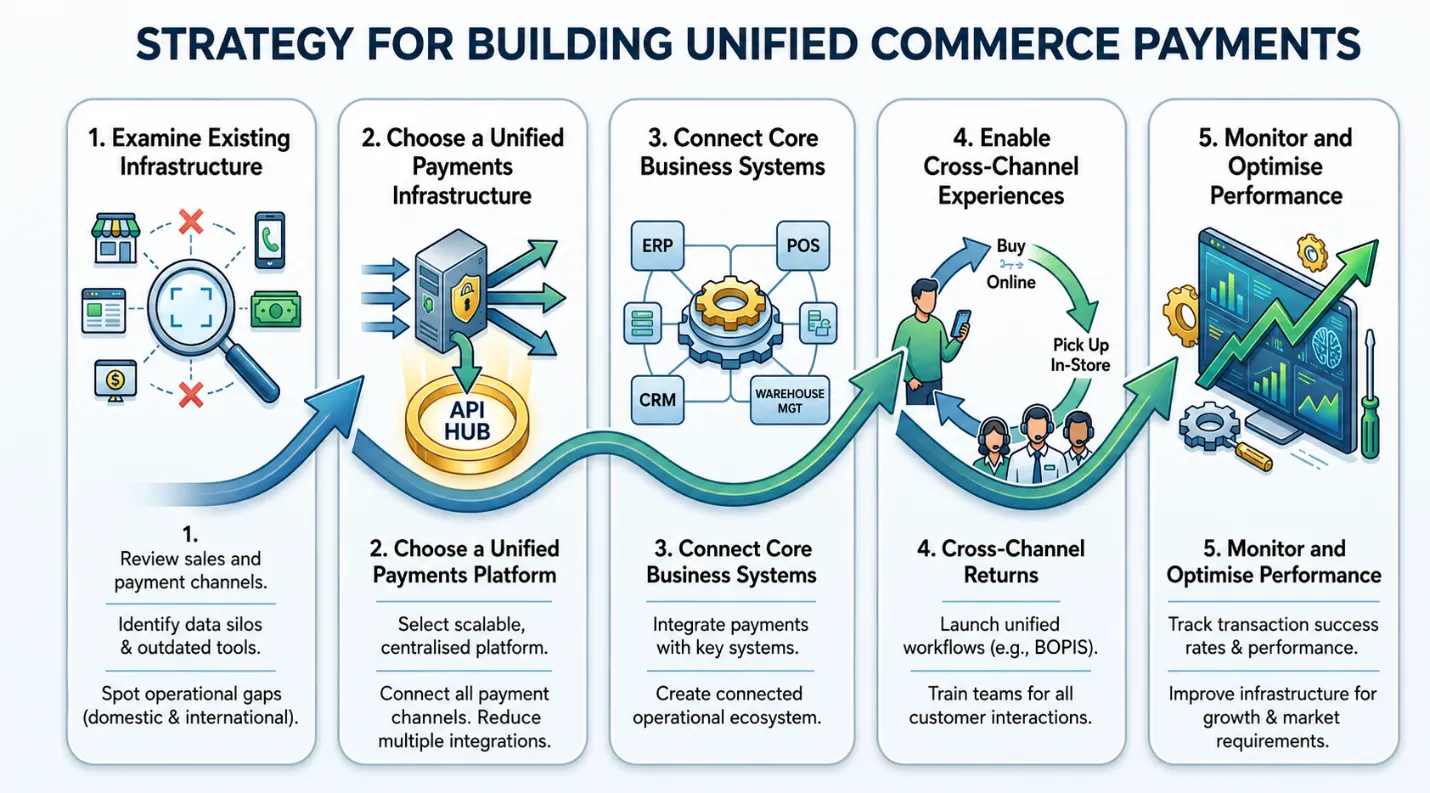
Implementing a unified commerce strategy requires alignment across all departments of a business. However, switching the entire system overnight isn't practical. Forward-thinking merchants follow a well-designed roadmap to unify their channels.
In most cases, their strategy looks like this:
Review Existing Infrastructure
Review current sales and payment channels. This allows merchants to identify data silos, outdated tools, and operational gaps across domestic and international markets.
Choose a Unified Payments Infrastructure
Select a scalable platform that connects all payment channels in a centralised system of APIs. This can reduce the need for multiple payment integrations.
Connect Primary Systems of the Business
Integrate the payment platform with key systems. This could be an ERP, POS, and CRM. Also integrate warehouse management tools to create a connected operational ecosystem.
Enable Cross-Channel Experiences
Implement unified workflows such as buy online, pick up in-store (BOPIS), cross-channel returns, and centralised order management. Train teams to manage customer interactions across every channel.
Monitor and Optimise Performance
Track transaction success rates. Then, improve the unified commerce infrastructure (if needed) to support growth and changing market requirements.
Transitioning to a unified platform is more than a retail or direct-to-consumer play. It is rapidly becoming mandatory for B2B enterprises.
Data from Grand View Research states that the global B2B e-commerce market was valued at USD 24.1 trillion in 2025 and is expected to reach USD 105.9 trillion by 2033, which represents a 20.9% compound annual growth rate (CAGR) between 2026 and 2033.
In light of these findings, it's fair to say that unified commerce is driving global trade today. Establishing unified data structures now prepares merchants to capture high-value enterprise transactions across every digital and sales touchpoint. Enterprise-grade platforms like Antom can provide them the tools to manage cross-border payments while maintaining a unified payment infrastructure. This will allow businesses to capture high-value enterprise sales across every digital touchpoint.
Conclusion
Doing business with fragmented payment systems in the current hyper-connected market is a risk no merchant can afford. A unified commerce system will help a business eliminate global friction.
As international commerce continues its trillion-dollar expansion, the line between online, mobile, and in-person transactions will eventually fade away. Breaking down data silos and partnering with modern infrastructure providers can help merchants build a futuristic foundation for their businesses. Relying on platforms like Antom could set them up for success. Its optimised payment orchestration, coupled with a fraud management system like Antom Shield, brings efficient experiences for all.
All in all, the merchants that connect the dots today will define the commerce experiences of tomorrow.
Frequently Asked Questions (FAQs)
1. How can B2B merchants measure the ROI of a unified commerce platform?
B2B merchants can track some basic metrics to understand the performance of a unified commerce platform. They can evaluate payment success rates, order processing times, and production or service costs. Comparing these KPIs lets them understand if the platform is worth the investment.
2. How does unified commerce help B2B merchants to achieve buyer retention?
Unified commerce creates a consistent buying experience across every sales channel. A close look at the data can help B2B merchants gain accurate order information and offer personalised experiences to their buyers.
3. How does unified commerce handle complex B2B pricing?
Unified commerce syncs contract terms and volume-based discounts from a central ERP. It then updates pricing instantly across all channels and removes inconsistencies between online portals and manual quotes.