

Share on
International shoppers can reach checkout and still abandon the purchase when prices appear in an unfamiliar currency, expected payment methods are missing, or a completed wallet or bank payment remains pending in your order system.
Digital payments are already mainstream—McKinsey found that roughly nine in ten consumers in the US and Europe used one in the prior year—yet payment behavior remains local. Payment localization closes that gap by adapting both checkout and the systems behind it.
This guide explains what to localize, where to start, how local flows work, and what to evaluate before choosing infrastructure.
What is payment localization?
Payment localization is the process of adapting your customer-facing payment experience, transaction-processing setup, and payment operations to the preferences, infrastructure, and requirements of each target market.
In short, it means you do not ask customers in every country to pay the way customers do in your home market. You give them a checkout they recognize, a payment method they already use, and clear information in a familiar currency. You also make sure your systems can confirm the payment, update the order, issue refunds, receive settlement data, and reconcile the transaction.
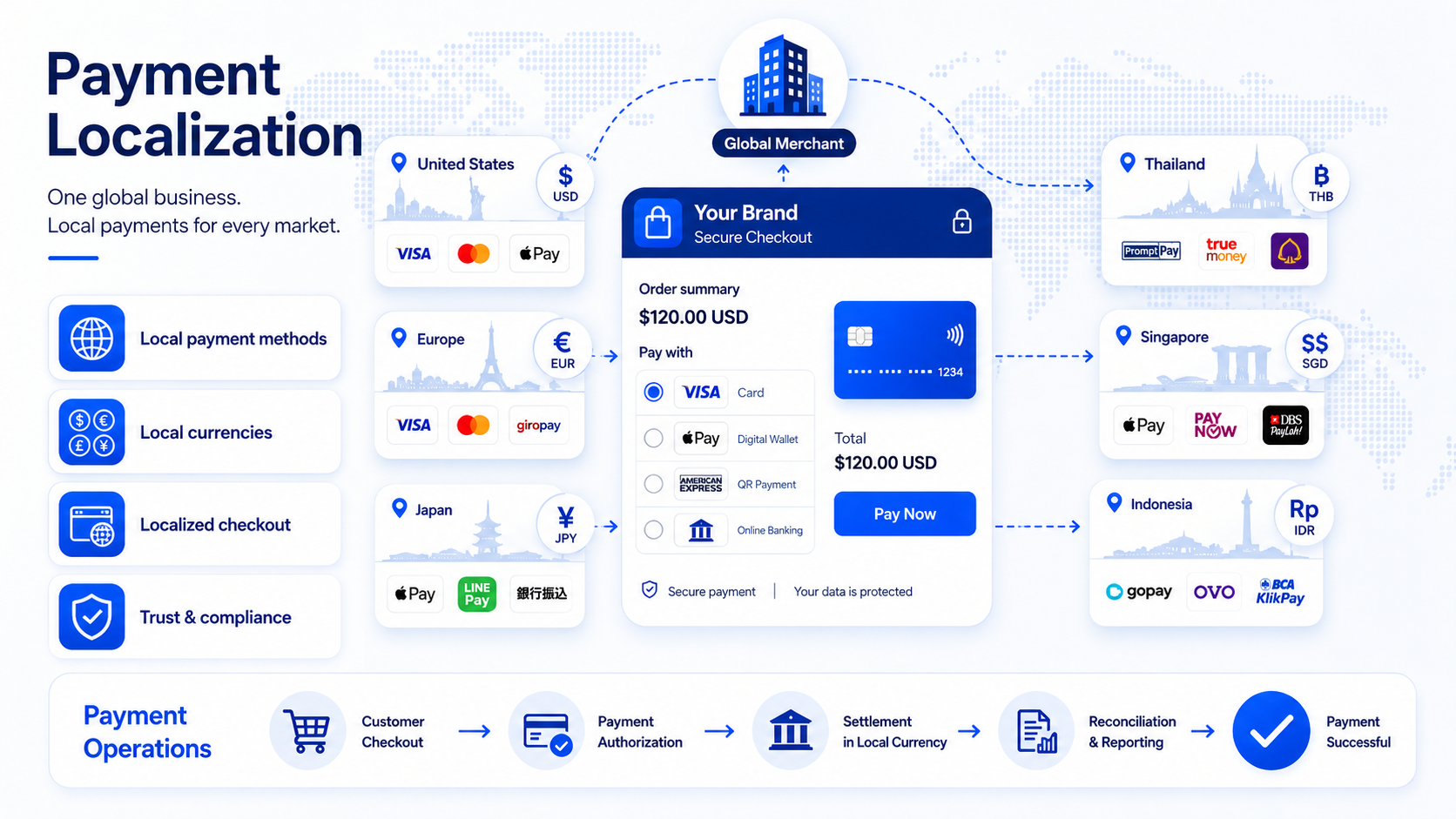
The difference becomes clearer when you look at what happens to a merchant entering a new market without a complete localization strategy.
A practical example: expanding from Europe into Thailand
Consider a European online retailer that begins attracting customers in Thailand. Its product pages are translated into Thai, and customers can browse the site without difficulty. At checkout, however, prices are still shown in euros and the only available options are Visa and Mastercard.
A Thai customer adds a product to the cart but cannot find the wallet or QR payment method they normally use. They decide to try a card instead, but the cross-border transaction is declined by their bank. Another customer completes a bank- or QR-based payment, but the transaction remains pending in the merchant’s order system because the business relies only on the browser return page to confirm the result.
The retailer now faces several problems at once:
- Customers abandon checkout because familiar payment methods are missing.
- Card payments may perform differently when processed through a cross-border setup.
- Customer service cannot tell whether some pending orders have actually been paid.
- The operations team must manually investigate payment results.
- The finance team struggles to match orders, transactions, refunds, and settlement reports.
The website has been translated, and technically it can accept payments from Thailand. But the payment experience and the systems behind it have not been localized.
A more complete payment localization strategy could show prices in Thai baht, present payment methods relevant to the target customers, support the required wallet, QR, card, or bank flows, and use server-side notifications and payment inquiries to keep the merchant’s order records aligned with the final transaction result. It would also define how refunds, settlement, and reconciliation should work before the payment method goes live.
This example shows why payment localization is broader than adding a local payment logo to checkout. It connects the customer experience with payment processing and the operational work required after the customer clicks Pay.
This is why payment localization is broader than any single checkout feature:
Concept | What it changes |
Checkout localization | What the customer sees |
Local payment methods | How the customer chooses to pay |
Local acquiring | How eligible card payments are acquired |
Payment orchestration | How providers, routes, and operations are managed |
Payment localization | How the full payment model adapts to a market |
A local wallet button can improve checkout relevance, but it does not complete the job if your order system cannot handle its payment status or your finance team cannot match it to settlement.
What should you localize first?
Start with the points that remove the clearest customer friction and solve a measurable business problem.
- Relevant payment methods. Offer the methods customers in that market actually use, not every option your provider supports. The right mix depends on country, device, order value, and whether you sell one-time or recurring products.
- Currency and price clarity. Show the currency customers expect and explain any conversion clearly. Keep display currency, transaction currency, and settlement currency separate in your planning; they are not always the same.
- Checkout and authentication. Localize language, address and phone formats, error messages, mobile layouts, and required bank or wallet handoffs. Remove avoidable steps, but do not hide an authentication flow that customers must complete.
- Payment operations. Decide how your system will handle pending results, cancellations, refunds, disputes, settlement files, and reconciliation before you launch.
A simple test is to ask three questions:
Customer question | Your operational question |
Can I pay in a familiar way? | Can we support the full method flow? |
Do I understand the amount and next step? | Can we confirm the final result? |
What happens if I need a refund? | Can support and finance manage it? |
How should you prioritize markets and payment methods?
Do not begin with a global list of wallets. Begin with your own commercial data.
Start with markets where intent is already visible
Look for countries with strong product-page engagement, repeat visits, checkout starts, or customer inquiries but weak payment completion.
Separate checkout abandonment from payment failure. A customer who never selects a method has a different problem from one who selects a method but receives a decline or remains pending.
Identify the specific payment gap
For each priority market, ask:
- Are customers missing a familiar method?
- Is foreign currency creating uncertainty?
- Is the flow poorly adapted to mobile devices?
- Are card authorizations underperforming?
- Are successful wallet or bank payments reaching your order system late?
- Are refunds or settlement reports creating manual work?
Score each method by business fit
A popular method is not automatically right for your business. Check whether it supports:
- Your average order value;
- One-time or recurring payments;
- Refund requirements;
- Target devices;
- Settlement needs;
- Risk controls.
Consider a hypothetical US retailer receiving growing traffic from Thailand. Adding every available wallet would be expensive and difficult to maintain. A better pilot would identify the two methods most relevant to its target segment, test their visibility and completion rate, and then compare incremental revenue with integration, support, refund, and reconciliation effort.
Launch narrowly and measure the full result
Track:
- Checkout conversion;
- Payment success;
- Authorization rate where relevant;
- Pending duration;
- Refunds and disputes;
- Support contacts;
- Settlement accuracy;
- Cost per successful payment.
Expand only when the data supports it.
How does payment localization work across the payment lifecycle?
The visible checkout is only the first part of a localized payment.
- Presentation: Your checkout displays relevant methods, currency, language, and instructions.
- Initiation: Your server creates the payment request through a gateway or PSP.
- Customer action: The customer may authenticate a card, approve a wallet, scan a QR code, or complete a bank flow.
- Result confirmation: Your backend receives or retrieves the final payment status.
- Order update: Your merchant order database moves the order to the correct final state.
- Post-payment operations: Settlement, refunds, disputes, reporting, and reconciliation follow.
This matters because a browser return page is not always a reliable source of truth. A customer may close the page, lose connectivity, or complete a wallet or bank payment before the final result reaches your system.
With Antom, client-side result events can support page navigation and status display, while your backend should use notifyPayment or inquiryPayment to update the order status.
For supported payment scenarios, notifyPayment may also indicate that the customer has completed the payment action while the transaction is still awaiting a final result.
Payment localization must extend into your order-state logic. Displaying a local payment method is not enough if your system cannot distinguish between pending, successful, and failed transactions.
For a deeper view of the technical connections among checkout, gateways, processors, and financial institutions, explore our online payment gateway integration guide.

Why does Asia-Pacific require a market-by-market approach?
Asia-Pacific is not one payment market. A card-first checkout may remain important, but it often sits alongside wallets, QR payments, real-time transfers, online banking, and domestic payment systems.
PwC’s Singapore report illustrates this coexistence: digital-payment adoption reached 92% in 2025 across tokenized-card wallets, PayNow and FAST transfers, and SGQR acceptance.
The difference is not only the payment logo. It is the flow:
- A card may require authentication, authorization, and capture.
- A wallet may move the customer into an app and return an asynchronous result.
- A QR payment may remain pending while the customer scans and confirms elsewhere.
- A bank-based method may require bank selection, authentication, and delayed confirmation.
Suppose a European SaaS company enters Singapore and Thailand. It should not assume that the method with the highest consumer awareness also supports its recurring-payment model. It may need one mix for subscriptions and another for one-time purchases. It must also plan how failed renewals, pending payments, refunds, and customer instructions will work.
Country-level payment behavior, infrastructure, settlement processes, and operational requirements vary significantly across APAC. A phased strategy is therefore more practical than launching every available wallet at once.

What trade-offs should you evaluate before launch?
Payment localization can remove customer friction while adding operational complexity. Evaluate both sides.
Approach | Main advantage | Main trade-off |
Direct local integrations | Potentially deeper access to market-specific features | More contracts and maintenance |
One global PSP | Simpler starting point | Coverage and depth vary by market |
Multiple PSPs | Broader flexibility | Fragmented routing and reporting |
Orchestration layer | More unified control | Adds another architecture layer |
You should also evaluate four operational trade-offs that may not be visible at checkout.
Local acquiring is not the whole strategy
Local acquiring can change the acquiring path for eligible card payments. It does not automatically localize wallets, QR flows, currency display, refunds, or reconciliation.
More methods can make checkout worse
Too many irrelevant options can create choice overload and increase testing, support, and maintenance work. The objective is not the largest possible payment-method list. It is a focused set of payment methods that covers meaningful customer demand that solves meaningful customer demand.
Payment success is not settlement
A successful transaction confirms the payment outcome. Settlement determines when and in which currency funds are transferred, while settlement reports record the amounts, fees, refunds, and adjustments involved.
A localized front end can hide a fragmented back end
If every market adds a separate provider, file format, refund process, and dashboard, your finance and operations costs may rise faster than revenue.
How should you evaluate a payment localization provider?
Do not select a provider only by the number of payment logos on its website. Ask how the provider supports your complete operating model.
Evaluation area | Question to ask |
Market coverage | Does it cover the markets you will enter next? |
Payment method suitability | Does it support methods relevant to your customers and model? |
Integration | Can you use hosted, embedded, SDK, or API options as needed? |
Status management | Are server notifications and active inquiries available? |
Acquiring and routing | Can you use appropriate acquirers and routing controls? |
Refunds and disputes | Can your teams manage method-specific exceptions? |
Settlement | Which currencies, cycles, and reports are available? |
Reconciliation | Can transaction and settlement data be standardized? |
Measurement | Can you compare results by market, method, device, and provider? |
How Antom supports this model
Antom helps you localize payments without building a separate payment stack for every market.
Through one integration, you can access more than 300 global and local payment methods across over 200 markets and support transactions in more than 140 currencies. Coverage includes credit and debit cards, digital wallets, online banking, bank transfers, real-time payments, and Buy Now, Pay Later options, subject to market availability and your commercial setup.
For businesses managing multiple markets, payment methods, or providers, Antom Payment Orchestration
provides a unified layer for payment connectivity and operations. With Antom, you can:
- Connect to more than 100 acquirers and access over 300 payment methods through Antom Payment Orchestration;
- Activate relevant acquirers and payment methods once the required agreements and configurations are in place;
- Choose from API, SDK, hosted checkout, embedded checkout, and plugin-based integration options;
- Apply AI-powered smart routing or configure custom routing rules across payment providers;
- Search and manage transactions, retrieve payment status, and initiate eligible cancellations and refunds;
- Standardize settlement and reconciliation reports for supported acquirers;
- Reconcile payment-provider settlement details against transaction records through a more consistent operational workflow.
You may not need the same setup in every market. A business entering one country with a limited payment-method mix may start with a simpler integration, while a company expanding across Asia and other regions may need broader method coverage, multiple acquiring connections, routing controls, and standardized financial operations.
Contact our payment experts to discuss your payment localization plan. Our payment experts can review your priority markets, customer payment preferences, business model, integration requirements, and settlement and reconciliation needs. We can then help you identify a relevant shortlist of payment methods and recommend an integration approach for your multi-market expansion.
FAQs
Is payment localization the same as adding local payment methods?
No. Local methods are one part of payment localization. A complete strategy also considers currency, checkout UX, authentication, transaction status, acquiring, refunds, settlement, and reconciliation.
What is the difference between payment localization and local acquiring?
Payment localization adapts the overall payment model to a market. Local acquiring focuses mainly on how eligible card transactions are acquired and processed. It can support a localization strategy, but it does not replace it.
How many local payment methods should you add?
Add the smallest set that covers meaningful customer demand. Prioritize by market usage, business-model fit, payment completion, operational cost, and measurable revenue impact.
How do you know whether payment localization is working?
Measure more than checkout conversion. Track payment completion, authorization where relevant, pending duration, refunds, disputes, support demand, cost per successful payment, settlement accuracy, and reconciliation effort.