


Share on
A business plan for payment service provider is not a generic startup document. A payment service provider, or PSP, operates in a highly regulated, technically complex, and trust-sensitive industry. A strong payment service provider business plan must explain not only the market opportunity, but also the payment service provider business model, compliance strategy, merchant onboarding process, payment service provider software, settlement operations, fee and commission logic, risk controls, and key performance indicators.
Many teams start with a simple idea: “We want to process payments for merchants.” But a PSP business is more than payment acceptance. It involves merchant acquisition, payment method coverage, gateway infrastructure, acquiring partnerships, fraud monitoring, chargebacks, reconciliation, settlement reporting, fee calculation, customer support, compliance operations, and long-term scalability.
Definition Box
A payment service provider business plan is a strategic and operational document that explains how a PSP will acquire merchants, process payments, generate revenue, manage risk, build or buy payment software, handle settlements, comply with regulations, and scale transaction volume profitably.
A payment service provider business plan should answer a practical question: how will the company create value for merchants while operating a secure, compliant, and scalable payment infrastructure?
Key Takeaways
- A payment service provider business plan should cover business model, target merchants, market positioning, payment methods, software architecture, compliance, operations, settlements, pricing, and KPIs.
- Payment service provider software is the operational core of a PSP. It should support merchant onboarding, payment processing, transaction monitoring, fee calculation, commission rules, settlements, reporting, and risk controls.
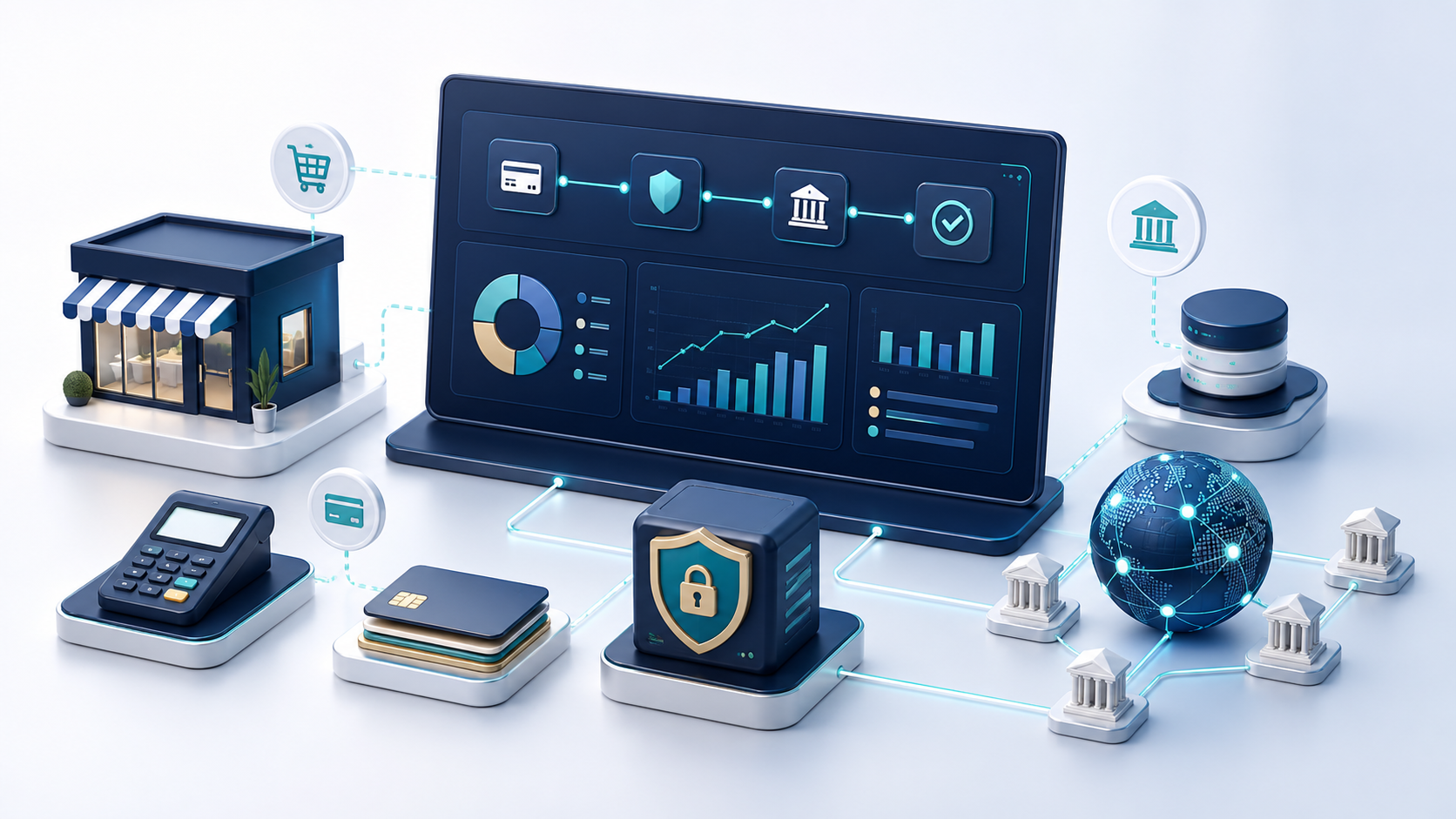
- A payment service provider architecture diagram should show how merchants, checkout, gateway, processors, acquirers, payment methods, risk tools, ledger, settlement engine, and reporting systems connect.
- The payment service provider merchant onboarding process steps should include KYB, business verification, risk review, contract setup, pricing configuration, technical integration, testing, and go-live approval.
- Payment service provider settlements require accurate ledgers, payout rules, fee deduction, refund handling, chargeback tracking, and reconciliation.
- Rules-based fee and commission software for payment service providers is important when PSPs manage multiple merchants, pricing plans, sales agents, ISOs, partners, or sub-merchants.
- Key performance indicators for payment service providers should measure payment volume, authorization rate, merchant activation, churn, fraud, chargebacks, settlement accuracy, uptime, and profitability.
- Antom helps global businesses access local and global payment methods across 200+ payment markets, 300+ payment methods, and 140+ currencies through one integration.
What Is a Payment Service Provider Business Plan?
A payment service provider business plan is a structured plan for building, launching, or scaling a PSP business. It explains what type of merchants the PSP will serve, how it will process payments, what software it will use, how it will make money, how it will manage risk, and how it will compete in the payment market.
A PSP business plan may be used for:
- internal strategy;
- investor fundraising;
- bank or acquiring partner discussions;
- license preparation;
- software vendor selection;
- partnership planning;
- product roadmap alignment;
- operational readiness;
- board or management review.
Unlike a standard e-commerce or SaaS business plan, a PSP plan must include payment-specific components: compliance, transaction flow, settlement logic, chargeback management, fee and commission structure, merchant onboarding, risk monitoring, and payment method coverage.
Why a PSP Business Plan Is Different From a Standard Business Plan
The U.S. Small Business Administration notes that business plans can be traditional or lean and should be adapted to the business need. A PSP plan should follow that principle, but it must go deeper into regulated operations, infrastructure, and financial flows.
A standard business plan may include market analysis, products, marketing, operations, management, and financial projections. A payment service provider business plan should also include:
- payment flow design;
- acquiring and processor relationships;
- payment method coverage;
- regulatory requirements;
- AML and KYB controls;
- merchant risk policies;
- technical architecture;
- settlement and reconciliation processes;
- transaction fee and commission calculations;
- dispute and chargeback operations;
- platform uptime and security requirements;
- data protection and PCI DSS considerations;
- partner and ISO management;
- merchant support model.
This makes the PSP business plan both a strategic document and an operating blueprint.
Payment Service Provider Business Model
The payment service provider business model explains how the PSP creates value and earns revenue.
A PSP can make money through several revenue streams:
Revenue Stream | How It Works | Notes |
Transaction fee | Percentage or fixed fee per transaction | Most common PSP revenue model |
Gateway fee | Fee for gateway access or payment API use | May be monthly or transaction-based |
Merchant monthly fee | Recurring platform fee | Useful for SaaS-style PSP models |
Setup or onboarding fee | One-time setup fee | Less attractive for small merchants |
FX margin | Margin on currency conversion | Relevant for cross-border PSPs |
Chargeback fee | Fee for handling disputes | Must be transparent |
Payout fee | Fee for settlement or withdrawal | Common in marketplace or wallet models |
Value-added services | Fraud tools, analytics, invoicing, subscription billing, reporting | Can improve margins |
White-label fee | Fee charged to platforms using PSP infrastructure | Relevant for embedded payments |
Partner commission | Revenue sharing with agents, ISOs, platforms, or affiliates | Requires accurate commission software |
The business model should not rely only on high transaction fees. In competitive payment markets, merchants compare fees, reliability, payment method coverage, and support quality. A PSP must create enough operational and revenue value to justify its pricing.
Target Market and Positioning
A PSP business plan should define the target merchant segment clearly.
Possible target segments include:
Segment | PSP Opportunity |
Small businesses | Simple onboarding, payment links, invoicing, low fixed cost |
E-commerce merchants | Checkout, cards, wallets, local payment methods, refunds |
Marketplaces | Sub-merchant onboarding, split payments, payouts, reconciliation |
SaaS companies | Subscriptions, recurring billing, retries, tokenization |
Cross-border merchants | Multi-currency, local payment methods, FX, regional coverage |
High-risk verticals | Specialized underwriting, fraud controls, chargeback management |
B2B platforms | Invoices, bank transfers, settlement tracking |
Travel and ticketing | High-value transactions, fraud controls, refund complexity |
Gaming and digital goods | Wallets, instant confirmation, risk monitoring |
Financial platforms | Embedded payments, white-label payment infrastructure |
A PSP should not try to serve every merchant type at launch. Narrow positioning improves product design, risk control, sales messaging, pricing, and operational focus.
Market Opportunity
The market opportunity section should explain why merchants need this PSP now.
Common market drivers include:
- growth of digital commerce;
- demand for local payment methods;
- cross-border expansion;
- merchant dissatisfaction with existing PSPs;
- need for faster onboarding;
- need for better settlement reporting;
- need for lower payment failure rates;
- demand for embedded payments;
- need for payment orchestration;
- platform businesses wanting white-label PSP capabilities;
- merchants wanting better fraud tools and transaction visibility.
For emerging markets and merchant payment digitization, CGAP has noted that payment value often extends beyond the payment itself, including data, customer relationships, merchant tools, and ecosystem development. A PSP business plan should therefore explain both transaction revenue and broader merchant value.
Product Scope: What the PSP Will Offer
A PSP should define its product scope carefully. Building everything at once creates complexity and risk.
A practical PSP product scope may include:
Core Payment Services
- online payment acceptance;
- card payments;
- digital wallets;
- local payment methods;
- payment links;
- hosted checkout;
- API checkout;
- refunds;
- transaction dashboard;
- settlement reporting.
Advanced Payment Services
- recurring billing;
- tokenization;
- subscription retries;
- smart routing;
- multi-acquirer support;
- payment orchestration;
- fraud rules;
- chargeback management;
- merchant analytics;
- multi-currency settlement;
- split payments;
- marketplace payouts.
Operational Tools
- merchant onboarding;
- KYB workflow;
- risk scoring;
- fee configuration;
- commission calculation;
- settlement engine;
- reconciliation reports;
- support ticket integration;
- compliance monitoring.
The business plan should define what will be built in Phase 1, Phase 2, and Phase 3.
Payment Service Provider Software
Payment service provider software is the technology backbone of a PSP business. It determines how merchants are onboarded, how transactions are processed, how fees are calculated, how risk is monitored, how settlements are generated, and how finance teams reconcile funds.
A PSP can build software internally, buy software from a vendor, use white-label payment service provider software, or combine internal systems with third-party modules.
The business plan should answer:
- Will the PSP build or buy the core platform?
- Which modules are required at launch?
- Which payment methods must be supported first?
- How will APIs, webhooks, and dashboards work?
- How will merchant pricing be configured?
- How will fee and commission rules be calculated?
- How will settlements and ledgers be managed?
- How will reconciliation reports be generated?
- How will risk and AML tools be integrated?
- How will uptime and security be monitored?
Software for Payment Service Provider: Core Modules
A complete software stack for a payment service provider usually includes several modules.
Software Module | Purpose |
Merchant onboarding | Collects business information, documents, KYB data, contracts |
Risk review | Scores merchants, flags restricted industries, monitors risk |
Payment gateway | Processes payment requests and responses |
Payment method management | Configures cards, wallets, bank transfers, and local methods |
Routing engine | Routes transactions by provider, acquirer, method, cost, or risk |
Ledger system | Records transaction, fee, refund, chargeback, and settlement entries |
Settlement engine | Calculates payouts and generates settlement batches |
Fee engine | Applies merchant pricing rules |
Commission engine | Calculates partner, ISO, sales agent, or platform commissions |
Reconciliation engine | Matches transactions, settlements, fees, and bank reports |
Fraud monitoring | Detects suspicious transactions and patterns |
Chargeback management | Tracks disputes, evidence, outcomes, and fees |
Reporting dashboard | Provides merchant, finance, risk, and management views |
API and webhook layer | Connects merchants and internal systems |
Compliance module | Supports audit trails, monitoring, reporting, and controls |
A PSP should not underestimate the importance of back-office software. Many payment businesses fail operationally not because they cannot process payments, but because settlement, reconciliation, risk, and support become unmanageable.
Build vs Buy vs White-Label PSP Software
A PSP business plan should include a technology sourcing decision.
Option | Advantages | Risks |
Build from scratch | Full control, custom architecture, differentiated product | High cost, long timeline, engineering risk |
Buy core software | Faster launch, vendor support, proven modules | Vendor dependency, customization limits |
White-label PSP software | Fastest path for embedded or regional PSPs | Branding/control trade-offs, vendor reliance |
Hybrid model | Build differentiating layers, buy commodity modules | Requires strong system integration |
SDK.finance notes that a payment processing company can be started by building software from scratch or using a white-label solution. For many early-stage PSPs, the decision should depend on funding, team capability, time-to-market, compliance burden, and product differentiation.
Merchant Onboarding Process Steps
The payment service provider merchant onboarding process steps should be detailed in the business plan because onboarding affects sales conversion, compliance, risk, and time to revenue.
A standard merchant onboarding process may include:
Step | Purpose |
1. Lead qualification | Confirm business type, country, volume, and payment needs |
2. Application submission | Collect company, owner, product, website, and bank details |
3. KYB verification | Verify business registration, ownership, address, and directors |
4. Risk screening | Review industry, chargeback risk, fraud exposure, sanctions, and prohibited activity |
5. Pricing setup | Configure MDR, fixed fees, FX fees, chargeback fees, payout fees, and commissions |
6. Contract approval | Sign merchant agreement and service terms |
7. Technical integration | Provide API keys, plugins, test environment, and webhook setup |
8. Payment method activation | Enable cards, wallets, local methods, or bank payments |
9. Test transactions | Validate authorization, capture, refund, webhook, and settlement flows |
10. Go-live approval | Approve production processing after risk, compliance, and technical checks |
11. Post-launch monitoring | Monitor transaction volume, declines, disputes, refunds, and fraud signals |
The onboarding process should balance speed and risk. Faster onboarding improves merchant acquisition, but weak onboarding can create fraud, chargebacks, and regulatory exposure.
Payment Service Provider Settlements
Payment service provider settlements are one of the most important operational areas of a PSP business. Settlement is the process of calculating how much money each merchant should receive after successful payments, fees, refunds, chargebacks, reserves, adjustments, and payout rules.
A PSP settlement system should support:
- transaction-level ledger entries;
- gross payment amount;
- payment method fees;
- PSP fees;
- acquirer fees;
- partner commissions;
- refunds;
- chargebacks;
- reserves;
- rolling reserve release;
- payout schedules;
- multi-currency settlement;
- merchant payout reports;
- reconciliation with bank statements;
- correction and adjustment entries.
The business plan should define settlement timing, payout rules, reserve policy, reconciliation process, and finance controls.
Fee and Commission Calculation Software
A growing PSP needs payment service provider fee and commission calculation software because manual spreadsheets become risky as merchant count and partner networks grow.
A fee and commission engine may need to calculate:
- merchant discount rate;
- fixed transaction fee;
- tiered pricing;
- interchange-plus pricing;
- blended pricing;
- minimum monthly fees;
- refund fees;
- chargeback fees;
- FX markup;
- payout fees;
- partner commissions;
- ISO commissions;
- sales agent commissions;
- platform revenue share;
- reseller margin;
- campaign-specific pricing;
- merchant-specific exceptions.
Without reliable fee software, PSPs can lose money through pricing errors, commission disputes, incorrect settlements, or delayed finance close.
Rules-Based Fee and Commission Software for Payment Service Providers
Rules-based fee and commission software for payment service providers lets PSPs configure different pricing and commission rules without rebuilding code each time.
A rules-based system should support:
Rule Type | Example |
Merchant pricing rule | 2.9% + fixed fee for small merchants |
Volume-based rule | Lower rate above a monthly TPV threshold |
Country rule | Different fee for domestic vs cross-border transactions |
Payment method rule | Different fee for wallet, card, bank transfer, or local method |
Currency rule | FX markup by currency pair |
Partner rule | Revenue share for ISO or platform partner |
Agent hierarchy rule | Commission split across sales manager and agent |
Risk rule | Reserve or fee change for higher-risk merchants |
Promotion rule | Reduced fee for first three months |
Exception rule | Custom pricing for strategic merchants |
The rule engine should be auditable. Finance and compliance teams should know which rule applied to which transaction and why.
Risk, Compliance, and Licensing
A PSP business plan must include risk and compliance from the beginning. Payment businesses cannot treat compliance as a late-stage legal task.
Important compliance areas may include:
- payment license or registration;
- AML and counter-terrorist financing;
- KYB and merchant due diligence;
- sanctions screening;
- PCI DSS where card data is involved;
- data privacy and cybersecurity;
- safeguarding of funds;
- fraud monitoring;
- chargeback management;
- operational resilience;
- outsourcing risk;
- complaint handling;
- regulatory reporting;
- consumer protection;
- local payment method rules.
The exact requirements depend on jurisdiction, business model, whether the PSP holds funds, whether it provides regulated payment services, and whether it operates directly or through licensed partners.
Operations Plan
The operations plan should describe how the PSP runs day to day.
Key operational functions include:
Function | Responsibilities |
Merchant support | Integration help, payment issues, payout questions |
Risk operations | Merchant monitoring, fraud alerts, chargeback review |
Compliance | KYB, AML, sanctions, regulatory reporting |
Finance operations | Settlement, reconciliation, billing, fee review |
Technical operations | Uptime, incidents, APIs, webhooks, platform monitoring |
Sales operations | Pipeline, pricing approval, partner commission tracking |
Product operations | Feature rollout, payment method activation, roadmap |
Customer success | Merchant activation, payment optimization, churn reduction |
A PSP business plan should assign ownership for each function before volume grows.
Go-to-Market Strategy
A PSP go-to-market strategy should focus on the merchants most likely to benefit from the product.
Possible channels include:
- direct sales;
- e-commerce platform partnerships;
- SaaS platform partnerships;
- agency and developer partnerships;
- ISO or sales agent channels;
- regional payment consultants;
- marketplaces;
- app store integrations;
- industry events;
- content marketing;
- referral programs;
- bank or fintech partnerships.
The sales message should be specific. For example:
- “Fast onboarding for small online merchants.”
- “Local payment methods for cross-border e-commerce.”
- “White-label PSP software for platforms.”
- “Better settlement and reconciliation for marketplaces.”
- “Multi-acquirer payment routing for enterprise merchants.”
A focused message converts better than a broad claim that the PSP can serve everyone.
Financial Plan
The financial plan should model both revenue and cost.
Revenue Assumptions
- number of merchants;
- merchant activation rate;
- average monthly processing volume;
- take rate;
- gateway fees;
- monthly platform fees;
- setup fees;
- value-added service revenue;
- FX margin;
- partner commission structure.
Cost Assumptions
- processor and acquirer cost;
- payment method cost;
- fraud losses;
- chargeback costs;
- compliance staff;
- risk operations;
- support team;
- engineering team;
- cloud infrastructure;
- software vendors;
- licensing and legal;
- sales commissions;
- partner commissions;
- reserves and working capital needs.
The PSP business plan should model gross margin after payment costs and operating margin after platform, risk, sales, and compliance costs.
Key Performance Indicators for Payment Service Providers
Key performance indicators for payment service providers should measure growth, reliability, risk, operations, and profitability.
KPI | Why It Matters |
Total payment volume | Measures processed transaction value |
Number of active merchants | Shows merchant base quality |
Merchant activation rate | Measures onboarding success |
Authorization rate | Tracks payment success |
Payment success rate | Measures checkout performance |
Decline rate | Helps identify payment friction |
Chargeback rate | Measures dispute and risk exposure |
Fraud loss rate | Shows payment risk effectiveness |
Refund rate | Helps understand merchant behavior |
Settlement accuracy | Protects merchant trust |
Settlement delay rate | Measures payout reliability |
Reconciliation match rate | Measures finance efficiency |
Gross take rate | Shows revenue per transaction volume |
Net revenue retention | Measures merchant expansion |
Merchant churn | Shows retention health |
API uptime | Measures platform reliability |
Incident response time | Measures operational maturity |
Support ticket resolution time | Affects merchant satisfaction |
Payment method adoption | Shows product-market fit |
Cost per merchant onboarded | Measures sales and onboarding efficiency |
A PSP should review KPIs by merchant segment, payment method, country, currency, channel, and partner.
Payment Service Provider Business Plan Template
A practical PSP business plan can follow this structure:
1. Executive Summary
Summarize the PSP opportunity, target merchants, product scope, revenue model, market strategy, and financial goals.
2. Company Overview
Explain the company background, ownership, management team, regulatory position, and strategic purpose.
3. Market Opportunity
Describe target markets, merchant pain points, payment trends, competitor gaps, and growth potential.
4. Target Merchant Segments
Define merchant types, industries, transaction volume, risk profile, countries, and payment needs.
5. Product and Service Offering
Explain payment acceptance, gateway, local payment methods, settlement, reporting, risk tools, onboarding, and value-added services.
6. Payment Service Provider Software
Describe software modules, build-vs-buy strategy, APIs, dashboard, architecture, security, and operational systems.
7. Merchant Onboarding and Compliance
Define KYB, AML, risk review, documentation, prohibited industries, approval rules, and go-live process.
8. Payment Processing Architecture
Include a payment service provider architecture diagram and explain transaction, risk, routing, ledger, settlement, and reporting flows.
9. Settlement and Reconciliation
Explain payout timing, fee deductions, reserves, refunds, chargebacks, reconciliation, and reporting.
10. Pricing, Fees, and Commission Model
Define merchant fees, partner commissions, agent commissions, pricing exceptions, and rules-based calculation software.
11. Sales and Go-to-Market Plan
Explain acquisition channels, partnerships, sales process, pricing approval, and merchant success strategy.
12. Operations Plan
Define teams, processes, support model, risk operations, compliance, finance, and technical operations.
13. Risk Management
Explain fraud controls, chargebacks, merchant monitoring, sanctions, incident response, and reserves.
14. Financial Projections
Include transaction volume, revenue, cost, gross margin, operating cost, cash flow, and break-even analysis.
15. KPIs and Management Reporting
Define KPIs, reporting cadence, dashboards, and management review process.
16. Roadmap
Show launch plan, payment method expansion, software development phases, country expansion, and partnership strategy.
How Antom Helps Businesses Build Scalable Payment Operations
Antom helps businesses accept global and local payments through one integration. Its website describes access to 200+ payment markets, 300+ payment methods, and 140+ currencies through a single gateway.
For businesses building or evaluating a payment service provider strategy, Antom can support:
- global and local payment method acceptance;
- cards and local cards;
- digital wallets and online banking;
- one-time payments;
- subscription and recurring payment scenarios;
- payment orchestration;
- smart routing and custom routing;
- payment risk management;
- transaction operations;
- reconciliation and billing support;
- multi-currency payment acceptance;
- cross-border expansion across APAC, LATAM, Europe, the Middle East, and other regions.
Antom is especially relevant for businesses that need scalable payment acceptance across countries without building every local payment connection from scratch. For merchants and platforms, Antom can help turn payment infrastructure into a growth and operations layer rather than a disconnected set of integrations.
Decision Framework: Business Plan for Payment Service Provider
Decision Area | Key Question | Recommended Action |
Business model | How will the PSP make money? | Define transaction fees, platform fees, FX, value-added services, and commissions |
Target merchants | Who is the PSP built for? | Focus on a specific segment before expanding |
Software strategy | Build, buy, white-label, or hybrid? | Match technology path to budget, timeline, and differentiation |
Architecture | How will payments flow? | Map checkout, gateway, routing, risk, ledger, settlement, and reporting |
Onboarding | How will merchants be approved? | Build KYB, risk review, pricing setup, and go-live controls |
Settlements | How will payouts be calculated? | Implement ledger, settlement engine, fee deduction, and reconciliation |
Fee calculation | How will pricing rules be applied? | Use rules-based fee and commission software |
Compliance | What licenses and controls are needed? | Map regulatory, AML, PCI, and data requirements |
KPIs | How will performance be measured? | Track TPV, activation, authorization, fraud, settlement, uptime, and churn |
Scalability | How will the PSP grow? | Plan market, payment method, partner, and software roadmap |
Practical Example: Launching a PSP for Cross-Border E-commerce Merchants
Imagine a fintech company wants to launch a PSP focused on cross-border e-commerce merchants selling into APAC, Europe, and LATAM. The founding team initially wants to offer card payments, wallets, and local payment methods.
A strong business plan would define:
- target merchants: mid-market e-commerce brands and marketplaces;
- value proposition: one integration for global and local payment methods;
- business model: transaction fee, FX margin, value-added fraud tools, and reporting fees;
- payment service provider software: hosted checkout, API, merchant dashboard, risk engine, ledger, settlement engine, and fee engine;
- onboarding process: KYB, website review, product risk check, pricing approval, and test transactions;
- architecture: checkout, gateway, risk, routing, acquirers, wallets, ledger, settlement, reporting;
- settlements: weekly merchant payouts with transaction-level reports and fee deduction;
- commission model: partner revenue share for agencies and platform referrals;
- KPIs: TPV, active merchants, authorization rate, fraud loss, chargeback rate, settlement accuracy, API uptime, and merchant churn;
- Roadmap: launch with selected markets, then add more payment methods and orchestration.
This kind of plan is practical because it links strategy to operations, technology, revenue, and risk.
Common Mistakes in PSP Business Plans
Mistake 1: Treating PSP as Only a Software Business
A PSP is also a compliance, risk, operations, settlement, and trust business.
Mistake 2: Ignoring Settlements
Processing payments is only half the job. Merchants care deeply about accurate and timely payouts.
Mistake 3: Underestimating Fee Complexity
Manual fee and commission calculations may work for a few merchants, but they break down when volume, partners, and pricing exceptions grow.
Mistake 4: Building Too Much Too Early
A PSP should define a focused launch scope and expand based on merchant demand.
Mistake 5: Weak Merchant Onboarding
Poor onboarding can create fraud exposure, chargebacks, compliance failures, and reputational damage.
Mistake 6: Missing KPI Discipline
Without clear KPIs, a PSP cannot know whether growth is healthy, risky, profitable, or operationally sustainable.
Mistake 7: No Architecture Plan
A PSP needs a clear payment service provider architecture diagram before software development begins.
Summary
A business plan for payment service provider should be more than a funding document. It should be a practical operating blueprint for how the PSP will acquire merchants, process payments, manage risk, calculate fees, settle funds, support compliance, and scale profitably.
A strong payment service provider business plan should include the PSP business model, target merchant segments, payment service provider software, architecture diagram, merchant onboarding process steps, settlements, fee and commission calculation software, rules-based commission logic, and key performance indicators.
The most successful PSPs are not only payment processors. They solve merchant problems: easier payment acceptance, better checkout, more local payment methods, reliable settlement, clearer reporting, stronger risk controls, and scalable global expansion.
Antom helps businesses accept local and global payments across 200+ payment markets through one integration, with support for payment orchestration, smart routing, risk management, transaction operations, and reconciliation.
Explore Antom’s payment service provider capabilities to see how your business can support customers with scalable global and local payment options.
FAQs
1. What is a business plan for payment service provider?
A business plan for payment service provider is a strategic and operational document that explains how a PSP will serve merchants, process payments, manage risk, calculate fees, handle settlements, comply with regulations, and generate revenue.
2. What should a payment service provider business plan include?
It should include market opportunity, target merchants, business model, software strategy, architecture diagram, onboarding process, compliance, settlements, fees, commissions, operations, financial projections, and KPIs.
3. What is payment service provider software?
Payment service provider software is the platform used to onboard merchants, process payments, manage payment methods, route transactions, calculate fees, monitor risk, settle funds, and generate reports.
4. What software for payment service provider operations is needed?
A PSP typically needs merchant onboarding, risk review, payment gateway, payment method management, routing, ledger, settlement engine, fee engine, commission engine, reconciliation, reporting, and compliance modules.
5. What should a payment service provider architecture diagram show?
It should show how merchants, checkout, gateway, risk engine, routing layer, processors, acquirers, wallets, banks, ledger, settlement engine, fee engine, commission engine, reporting, and compliance systems connect.
6. What are payment service provider merchant onboarding process steps?
Typical steps include lead qualification, application, KYB verification, risk review, pricing setup, contract approval, technical integration, payment method activation, test transactions, go-live approval, and post-launch monitoring.
7. What are payment service provider settlements?
Payment service provider settlements are the process of calculating and paying out funds to merchants after deducting fees, refunds, chargebacks, reserves, commissions, and adjustments.
8. Why do PSPs need fee and commission calculation software?
PSPs need fee and commission calculation software to apply complex pricing rules, partner commissions, agent commissions, FX fees, chargeback fees, payout fees, and merchant-specific exceptions accurately.
9. What are key performance indicators for payment service providers?
Important KPIs include total payment volume, active merchants, merchant activation rate, authorization rate, payment success rate, fraud loss, chargeback rate, settlement accuracy, API uptime, support resolution time, churn, and gross take rate.
10. How does Antom support scalable PSP and payment operations?
Antom supports global and local payment acceptance through one integration, with access to 200+ payment markets, 300+ payment methods, and 140+ currencies. It also supports payment orchestration, smart routing, risk management, transaction operations, and reconciliation.