

Share on
A digital entertainment merchant may start with one-time purchases: a game pass, a video download, or a paid online event. As the audience grows, the business may want a more predictable way to keep customers engaged. A monthly membership, premium content plan, or recurring top-up package can turn occasional purchases into an ongoing customer relationship.
That is where subscription payments come in. Subscription payments are recurring payments where a customer authorizes a merchant to charge a saved payment method at regular intervals, such as monthly, quarterly, or annually. For merchants, they can support recurring revenue, retention, and long-term planning.
That shift also reflects how customers think about subscriptions. PwC’s Global Consumer Insights Pulse Survey found that convenience was the leading reason consumers chose subscriptions, cited by 51% of respondents, followed by cost-effectiveness at 47% and lifestyle fit at 42%. For many customers, a subscription can feel less like repeating a purchase and more like keeping a useful service switched on.
But compared with one-time payments, subscriptions also bring new payment questions. Merchants need to think about first authorization, saved payment credentials, renewal failures, local payment preferences, cancellation experience, payment security, and reconciliation.
What Are Subscription Payments?
Subscription payments are recurring transactions for products, services, or access that are billed over time. Instead of asking customers to complete a new checkout every time, a business charges them according to an agreed schedule or usage rule.
A simple way to think about it:
A one-time payment is like buying a movie ticket.
A subscription payment is like having a streaming membership that renews while the customer keeps access.
Common examples include:
Subscription scenario | How payment may work |
Streaming service | A customer pays monthly for video, music, or digital media access. |
SaaS platform | A business pays per seat, per month, or per usage tier. |
Online gaming | A player pays for a monthly membership, premium pass, or recurring content access. |
Digital education | A learner pays for ongoing access to classes or course materials. |
Subscription box | A customer receives products such as coffee, pet supplies, or cosmetics on a schedule. |
Creator or fan platform | Fans pay monthly for exclusive content or community access. |
Utility or recurring service | The amount may vary, but payment happens on a repeated billing cycle. |
Subscription payments are often grouped with recurring payments, but there is a slight difference. Recurring payments describe repeated payment transactions. Subscription payments usually connect those payments to an ongoing product, service, membership, or account relationship.
Why Subscription Payments Are Growing
Subscriptions have become more familiar because many customers now pay for access, convenience, and flexibility rather than only ownership. Music, movies, software, games, cloud tools, meal kits, and premium communities have all helped shape this habit.
The broader subscription economy has continued to show growth in recent research. Grand View Research estimated the global subscription economy market at USD 492.34 billion in 2024 and expected it to reach USD 555.92 billion in 2025, with a projected CAGR of 13.3% from 2025 to 2033.
For merchants, this creates both opportunity and pressure. Subscriptions can help build recurring revenue, but customers may expect clear value, flexible plans, familiar payment methods, and easy control over what they pay for. McKinsey’s subscription e-commerce research similarly suggests that consumers are more likely to stay when the subscription experience delivers clear benefits such as convenience, value, or personalization.
Subscription Payments vs. One-Time Payments
Subscription payments and one-time payments solve different business problems.
Feature | One-time payments | Subscription payments |
Customer action | Customer pays each time | Customer authorizes repeated payments |
Revenue pattern | Transaction-based | Recurring or usage-based |
Payment credential | May not need to be saved | Often saved securely for future payments |
Main business goal | Complete the current sale | Maintain access, renewal, and retention |
Common examples | Single purchase, event ticket, product order | SaaS, streaming, memberships, gaming, subscription boxes |
Key payment challenge | Checkout conversion | Renewal success and failed payment recovery |
A one-time payment is like opening a door once. A subscription payment is like setting up a key card that can keep working while the customer remains a member.
How Subscription Payments Work
Most subscription payment flows follow a similar pattern.
Step 1: The customer chooses a plan
The customer selects a subscription option, such as monthly, annual, free trial, usage-based, or tiered pricing. At this stage, merchants may want to make the price, billing cycle, renewal date, cancellation process, and trial terms easy to understand.
Step 2: The customer authorizes payment
The customer enters a payment method and agrees to future charges. This first authorization matters because the customer is not only paying for the first cycle. They are also giving the merchant permission to collect future payments according to the subscription terms.
Step 3: The payment method is saved securely
For future payments, the business usually does not ask the customer to enter the same payment details again. Instead, the payment credential can be saved in a secure form.
This is where tokenization comes in. Tokenization is like replacing a passport with a check-in number. The system can recognize the payment method without exposing the full sensitive details every time.
Step 4: Future payments are initiated automatically
After the first authorization, later payments may happen without the customer being present at checkout. In card payments, this is often called a merchant-initiated transaction, or MIT.
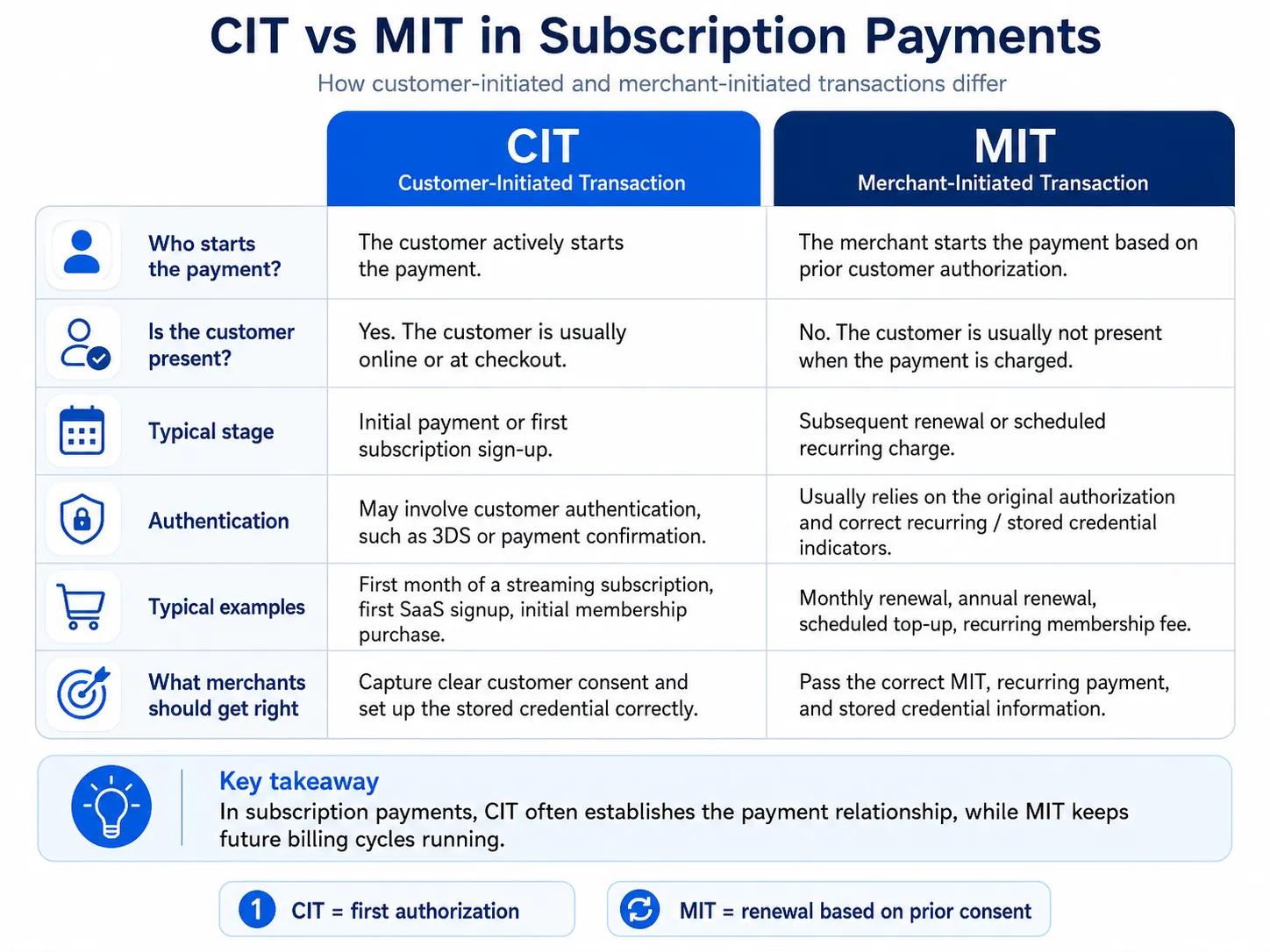
A merchant-initiated transaction is similar to a gym membership renewal. The customer signs up once. The gym does not ask the customer to sign a new contract every month. Instead, the business charges according to the agreement.
MIT can be understood as a pre-authorized card transaction initiated without the buyer’s active participation at checkout. The buyer’s prior authorization remains important before the merchant initiates future renewal payments.
Step 5: The business receives payment results
After each renewal attempt, the business needs to know what happened. Was the payment successful? Did it fail? Does the customer still have access? Should the business send a reminder?
This is where notifications, payment status updates, and reconciliation become important. For subscription businesses, payment data needs to connect to customer accounts, invoices, refunds, access status, and settlement records.
Common Subscription Payment Models
Subscription payments are not limited to fixed monthly fees. Businesses may use fixed recurring, tiered, usage-based, hybrid, freemium, trial-to-paid, or prepaid models depending on how they deliver value.
Model | How it works | Example |
Fixed recurring | Same price every cycle | $12.99 per month for streaming |
Tiered pricing | Different plans at different prices | Basic, Pro, Enterprise |
Usage-based | Customer pays based on usage | API calls, storage, data volume |
Hybrid | Base fee plus usage charges | $20 per month plus extra usage |
Freemium | Free access with paid upgrades | Free account plus premium features |
Trial-to-paid | Trial converts to paid subscription | 7-day trial then monthly billing |
Prepaid subscription | Customer pays upfront for a period | Annual membership or 12-month access |
Common Subscription Payment Methods
The right payment method can vary by region, customer segment, and business model.
Payment method | Where it may fit | What to consider |
Credit and debit cards | SaaS, streaming, digital services, gaming | Card expiry, issuer declines, 3DS, chargebacks |
Digital wallets | Mobile-first markets and digital commerce | Wallet support for recurring payments may vary |
Bank debit | Utilities, B2B, larger recurring payments | Processing speed and refund rules may differ |
Local payment methods | Cross-border merchants entering new markets | Local familiarity can affect conversion |
Online banking apps | Markets with strong bank-based payment habits | User flow and recurring support may differ |
Virtual accounts or bank transfer | B2B or invoice-based subscriptions | Reconciliation may matter more |
ACH Direct Debit | US recurring or larger transactions | ACH can be described as a reusable payment method often used for large or recurring transactions that may not need instant payment. |
For global businesses, subscription payments can become more complex because payment preferences differ across markets. A customer in the US may expect cards. A customer in Southeast Asia may prefer a local wallet or banking app. A customer in Europe may be more familiar with direct debit in some categories.
Antom states that merchants can access more than 200 payment markets, 300+ payment methods, and 100+ currencies through its payment method coverage.
How Businesses Can Improve Subscription Payment Performance
Use clear authorization and billing communication
Customers may feel more comfortable when they know what they are agreeing to. Businesses can make the billing amount, renewal date, billing cycle, cancellation terms, and trial conversion rules easy to find.
This can be especially useful for annual subscriptions, free trials, and variable usage-based pricing.
Support payment methods customers recognize
A customer may be more likely to complete checkout when they see a familiar payment option. This can matter in cross-border commerce, where cards may be common in one market and local wallets may be more familiar in another.
Save credentials securely
Tokenization can support repeat payments without repeatedly exposing sensitive payment details. For subscription businesses, this can reduce the need for manual customer action during every renewal.
Apply smarter retry strategies
Not every failed payment should be treated the same way. If a payment fails because of insufficient funds, a later retry may work better. If authentication is required, the customer may need a prompt. If the credential is outdated, the customer may need an update flow.
Retry logic may be more effective when it responds to the reason for failure rather than treating every decline as identical.
Make payment updates easy
A customer who wants to stay subscribed may still lose access if they cannot update a card, wallet, or bank account quickly.
A simple payment update page can act like a spare key. It gives the customer a way back into the subscription before the relationship is lost.
Keep cancellation easy to find
A clear cancellation flow may support trust. When customers cannot cancel easily, they may contact their bank instead, which can create disputes and operational costs.
Connect payments to reconciliation
Subscription payments create many records: customer ID, subscription ID, invoice ID, payment ID, refund ID, dispute ID, settlement record, and tax information.
If those records do not connect clearly, finance teams may spend more time resolving exceptions. Reconciliation tools can help match what was billed, what was paid, what was refunded, and what was settled.
What to Look for in a Subscription Payment Platform
Businesses evaluating a subscription payment platform may want to look beyond whether it can charge customers every month. A stronger question is:
Can the platform support the full subscription payment lifecycle, from first authorization to renewal, retry, settlement, and reconciliation?
Useful capabilities may include:
Capability | Why it matters |
Recurring payment support | Helps collect payments on a schedule after authorization |
Multiple payment methods | Let's customers pay with familiar options |
Local payment coverage | Can support international expansion and regional preferences |
Tokenization | Helps support future payments with reduced sensitive data exposure |
MIT support | Supports merchant-initiated renewals after customer authorization |
Authentication handling | Helps manage 3DS and verification requirements |
Smart retry logic | May recover selected failed payments |
Billing notifications | Helps keep customers informed |
Webhooks and payment status updates | Helps update subscription access automatically |
Reconciliation tools | Helps finance teams match invoices, payments, refunds, and settlements |
Fraud and dispute support | Helps manage risk across repeat transactions |
The best fit may depend on business model, geography, customer payment habits, and internal technical resources.
Example Scenario: A Gaming Platform Expanding Across Asia
A gaming company based in North America offers a monthly premium membership. In its home market, most customers pay by card. As the company expands into Asia, it notices a different pattern.
Some customers prefer local wallets. Some want to pay through banking apps. Some cards are declined during renewals because the issuer treats the cross-border payment as unusual. Some customers still want the membership but lose access because their renewal payment fails.
A more localized subscription payment setup could help the platform improve several parts of the journey:
1. Customers can choose familiar payment methods when they subscribe.
2. The first payment can confirm authorization and activate membership.
3. Tokenization can support future renewals with less repeat input.
4. Smart retry logic can help recover selected failed payments.
5. Payment notifications can update access status.
6. Reconciliation can help finance teams match subscriptions, payments, refunds, and settlements.
To the player, the experience may feel like one simple membership. To the merchant, subscription payment infrastructure is helping manage many small steps that affect conversion, renewal, and operations.
FAQs About Subscription Payments
What are subscription payments?
Subscription payments are recurring payments where a customer authorizes a business to charge a payment method at regular intervals. They are commonly used for SaaS, streaming, gaming, memberships, online education, digital content, and subscription commerce.
Are subscription payments the same as recurring payments?
They are closely related. Recurring payments describe payments that happen repeatedly. Subscription payments usually refer to recurring payments tied to an ongoing product, service, or membership.
How do subscription payments work?
A customer chooses a plan, authorizes a payment method, and agrees to future charges. The payment system stores the credentials securely, often through tokenization, and future payments are collected according to the subscription schedule.