


Share on
Payments that feel fast, local and trustworthy are more likely to be accepted by enterprise marketplaces. Platform operators must recognize that mastering global payments for marketplaces directly impacts conversion, seller onboarding, settlement speed, and compliance. For large platforms and B2B trading companies, the challenges are clear. Buyers want familiar payment methods, transparent prices, and reliable acceptance. Sellers expect predictable settlements, multi-currency and operational issues. Platforms need to support both sides while maintaining control. Antom simplifies cross border payments for marketplaces through a unified infrastructure operating across 50+ global markets. It aggregates 300+ local payment methods (including 140+ in Asia), supports 140+ transaction currencies, and processes hundreds of billions of dollars in FX volume annually, ensuring deep local compliance and acquiring capabilities in 16 countries.
Visit Antom to explore localized payment methods, or contact us to discuss a tailored rollout plan for your target regions.
Global Online Marketplace Payments: The Evolution
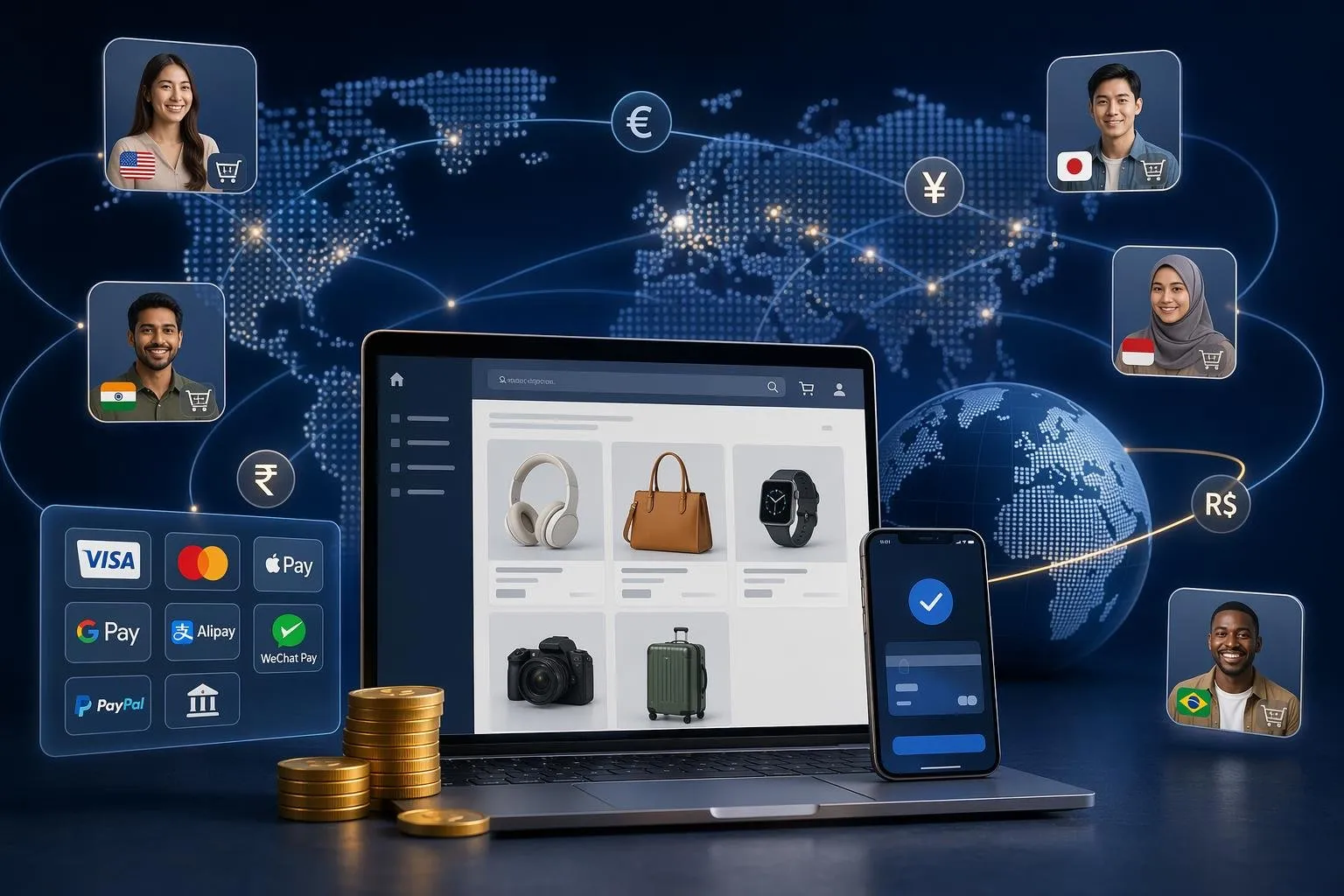
From Single-Market Checkouts to Multi-Region Operation
Historically, global online marketplace payments used to be simple. Platforms accepted cards only in a single market, settled payments in a single currency and served fewer sellers. In global commerce, this model is quickly discarded. Today's enterprise platforms are used by buyers and sellers in many different countries. Each market has its own payment patterns, currencies, rules and fraud patterns. Payment preferences are deeply localized; while Western markets heavily rely on international credit cards, regions like Southeast Asia and Latin America are predominantly driven by digital wallets and real-time bank transfers (e.g., PIX). Furthermore, risk teams require dynamic, machine-learning-driven fraud engines to detect abnormal cross-border behaviors without relying on rigid, hardcoded rules. Marketplaces need to have localized acceptance and currency management. They also require split settlement logic, support for reconciliation, and risk controls. These functions might seem like operational tasks, but they have a direct impact on revenue.
Three core concepts that all marketplace teams should know
Local Payment Methods: Customers prefer to pay in a certain way depending on the country or region. Bank transfers, digital wallets and domestic card schemes are examples. In Southeast Asia, a buyer may be more likely to trust a local wallet than he would rely on an international credit card. Familiar methods improve authorization and reduce abandonment.
Transparent Currency Conversion: For B2B marketplaces charging in EUR but settling in USD, poor foreign exchange (FX) management erodes profit margins and complicates reconciliation. Platforms need real-time, transparent conversion logic to protect margins.
Flexible Split Settlement: Marketplaces require automated workflows to accurately separate platform fees from seller funds. Clean, conditional settlement—such as releasing funds only upon delivery confirmation—is critical for maintaining seller trust and compliance. Slow settlement can harm seller confidence and cash planning.
Why Infrastructure Matters
The standard for global payments for marketplaces has been raised to a new level by international commerce, mobile purchasing, and embedded finance. Platforms handling cross border payments for marketplaces require partners who can manage regional complexity without building local connections in-house. Industry research from Statista and Worldpay highlights that payment behaviors differ widely across global markets. Payment localization is crucial to expansion, and not just catalog localization.
The challenges of cross-border payments for marketplaces

Fragmented Preferences & Lower Conversion
A marketplace may attract traffic from around the world, but still lose money at the checkout. Friction drives cart abandonment. Antom solves this by adapting the flow to the user's scenario: For cross-device users, Scan to Link shifts authorization to their mobile device, compressing a 40-second checkout into 6 seconds with zero redirects. For e-wallet users, EasySafePay cuts a 9-step flow to just 2 steps, raising initial payment success rates from 43% to 66%. Whether operating a consumer fashion marketplace or a B2B sourcing platform, the same rule applies: payment fit drives confidence. Leading platforms show that digital commerce success depends on a smooth, localized checkout experience.
Settlement Complexity across Multiple Parties
Platforms are often used to route funds between buyers, sellers and service providers. This creates complexity around platform fees, reserves, delayed releases, refunds, chargebacks, and reconciliation.Manual reconciliation across disparate systems increases errors. Managing diverse platform fees and seller funds requires strict operational boundaries. Antom’s Global Payment Orchestration (APO) centralizes multi-currency accounts via a single integration, reducing development costs by 70% and boosting reconciliation efficiency by 90%. Additionally, tokenized payments support settlement in 24 currencies across 31 countries, with highly configurable payout cycles ranging from T+2 to T+25 days to match your cash flow needs.
Fraud, compliance, and regional rules
Data security, local regulatory expectations, KYC, AML and sanctions screening must be considered when calculating cross-border flows. Risk teams must balance fraud prevention with avoiding false declines. Effective risk management must distinguish genuine buyers from global fraud rings without relying on rigid rules. Antom Shield performs millisecond-level dynamic 3D scanning using 1,000+ risk features and 100 million+ external data points. Marketplaces can choose between a basic built-in tier for essential blocking, or a Premium fully-managed service led by a team of 100+ risk analysts to maximize approved revenue.
Checklist for Common Payment Risks
Local payment coverage is incomplete in the target regions
Conversion costs are unpredictable and poor FX visibility is a result.
Manual reconciliation between currencies and sellers
False declines high from generic risk rules
Merchants frustrated by delayed settlement
Audit trails are weak for compliance reviews
Comparison Table:Common Payment Models for Marketplaces
Model | What To Look For | Common Pitfalls | Best Fit |
Single PSP, card-heavy setup | Fast initial launch, simple integration | Weak local payment coverage, lower conversion abroad | Early-stage or single-region expansion |
Multiple local providers | Strong local relevance by market | Operational fragmentation, reporting gaps, higher maintenance | Large teams with regional payment ops |
Unified global payment partner | Centralized orchestration, local methods, consolidated reporting | Requires careful enterprise rollout planning | Large marketplaces and B2B platforms |
How Antom Simplifies Global Settlement and Currency Conversion
A Practical Framework for Evaluating Partners in Global Payments for Marketplaces
Enterprise teams should evaluate more than acceptance rates. The best partner must support regional growth, operational control, and clear finance workflows. Use the checklist below when assessing providers for global payments for marketplaces.
Evaluation Criterion | What To Look For | Pitfalls To Avoid | Impact On Decision |
Local payment method coverage | Breadth in target regions and buyer segments | Overreliance on international cards only | Direct effect on conversion and market entry |
Currency and settlement flexibility | Multi-currency processing and transparent settlement options | Hidden FX costs and limited payout configurations | Protects margin and simplifies finance operations |
Marketplace-specific fund flows | Support for split payments, platform fees, and seller settlement | Generic merchant-first setup that ignores platform logic | Critical for scalable marketplace operations |
Reporting and reconciliation | Unified dashboards, exports, and clear transaction states | Siloed reports across providers or entities | Reduces manual work and audit risk |
Compliance and security controls | Strong standards, monitoring, and governance capabilities | Treating compliance as a separate add-on | Lowers legal and operational exposure |
Enterprise support and rollout readiness | Technical guidance, account management, and phased deployment support | Limited support during migration or regional onboarding | Improves time to value and launch reliability |
How Antom Supports Cross-Border Marketplace Operations
Antom helps enterprise platforms manage cross-border payments with minimal operational friction. Teams can avoid connecting multiple regional providers by using a more unified system for payment acceptance and settlement management.
A wide range of payment options are available locally
Support for cross-border payments and transactions
Infrastructure for international business growth
Improved alignment between localization of checkouts and settlement operations
Review our globally supported options on Antom payment methods .
Preparing Global Payment Expansion: A Step-by-Step Guide
1. Analyze and order data to map buyer markets
You can use payment analytics, past orders, and demand signals in order to rank countries. It is important to prioritize the expansion list according to real buyer potential.
2. Research regionally to match local payment methods
Map each market's preferred options using provider documentation and research. The plan should be based on the local behavior and trust.
3. Design settlement flows with Finance and Platform Rules
Use a matrix for settlement to determine who is paid, what currency they are paid in, and the conditions of release. It is important to have a model that's cleaner for sellers, fees and reconciliation.
4. Launch with Antom through a phased integration
Use Antom’s payment infrastructure to pilot a rollout in a specific region or segment of merchants. It is important to reduce migration risks and learn faster before full deployment. Pro Tip. Start by focusing on a high-demand area where localizing payments can result in conversion gains visible within a quarter.
Ensure compliance and security in international transactions
Why compliance must be a part of the payment stack
Compliance is not a separate entity from the flow of transactions. In marketplace models funds are often transferred across parties, currencies, and borders. It is important to have a strong governance built into payment operations. This is particularly useful when entering into new markets or servicing regulated merchant categories.
Security and Trust Signals That Count
Enterprise marketplaces must assess payment providers against these core controls:
Standards for data protection and secure payment processing.
Monitor suspicious activities and risks with these tools.
Reporting that is audit-friendly for Finance and Compliance Teams.
As regulations change, regional adaptability is required.
For broader context, review guidance from the Bank for International Settlements and security resources from the PCI Security Standards Council.
Comparison Table:In-House Build vs Unified Partner Approach
Factor | In-House Multi-Region Build | Unified Partner Like Antom |
Time to market | Slower due to regional integrations | Faster with existing infrastructure |
Compliance overhead | High internal burden | More centralized support model |
Payment method expansion | Manual provider onboarding | Easier method expansion through one partner |
Reconciliation complexity | Often fragmented | More consolidated |
Operational scalability | Resource intensive | Better suited for leaner expansion teams |
Optimizing the Checkout Experience for Global Buyers
Local Relevance Builds Trust
The checkout is the place where global ambitions become local realities. Even if a marketplace has a strong product-market match, buyers may hesitate to purchase if the payment process is unfamiliar. A localized checkout builds trust, but smart marketplaces turn payments into a growth engine. Beyond offering local methods, platforms can leverage tools like Smart Routing to lift success rates by an extra 5%, or tap into Antom's A+ Rewards network—reaching 250 million digital wallet users with targeted coupons that see a 70%+ claim rate. This seamless, rewarding experience is crucial for both B2C and B2B platforms, especially when cart values are high or purchasing decisions involve multiple stakeholders.
Decision Criteria for an Improved Global Checkout
Paying Methods that Fit. Display the methods that buyers use and know in each market. Currency Clarity. Before confirmation, display the prices and charges clearly. Mobile Readiness. Optimize for markets that are mobile-first and where wallets have become common. Risk Balance. Stop fraud without increasing friction for genuine buyers. Fallback Logic. If your preferred method fails, offer alternative methods.
Recommendations according to Use Case
Start with simple settlement reporting and local methods if you're entering just one or two markets nearby. Choose a partner such as Antom if you manage a multi-regional platform that supports broader orchestration and operational consistency. Focus on FX transparency and acceptance rates if margins are limited. Even small gains can have a significant impact on the enterprise.
FAQs
Q: What is a global payment system for marketplaces?
A payment system designed to help online platforms seamlessly accept, route, and settle multi-currency transactions across different jurisdictions.
Q: Why is it important to use local payment methods for growth across borders?
Customers prefer to use familiar payment methods, which can improve their conversion rates.
Q: What is the Antom payment solution for marketplaces?
Antom provides a unified Global Payment Orchestration (APO) infrastructure that aggregates 300+ local payment methods. By leveraging tools like Tokenization, Smart Routing, and the AI-driven Antom Shield, it maximizes cross-border conversion while streamlining multi-currency reconciliation.
Q: When choosing a partner for payment, what should businesses prioritize?
Businesses should prioritize platforms offering extensive local coverage (like 300+ methods), configurable T+2 to T+25 settlement cycles, unified reporting, and dynamic compliance.
Q: Can better checkout design improve global payment performance?
Yes, a localized and transparent checkout significantly reduces cart abandonment and boosts conversion.
Sources
This article draws on Antom’s product positioning and public resources, plus general market context from:
- Worldpay Global Payments Report
- Statista
- PCI Security Standards Council
Why Antom Is a Strong Fit for Enterprise Marketplaces
For large platforms and B2B trade companies, scaling global online marketplace payments is not only about transaction volume. It is about entering markets with confidence, offering localized buyer experiences, and reducing operational drag across settlement, risk, and reporting.
Antom supports these needs through a unified approach to global payments for marketplaces. If your business is evaluating expansion, modernization, or payment partner consolidation, Antom is worth a closer look.
Visit Antom to explore capabilities, review Antom payment methods for localization options, and connect through contact us to discuss your marketplace growth plan.
Glossary
Term | Definition |
Acquirer | A financial institution or payment partner that helps process card or payment transactions for merchants. |
Authorization Rate | The percentage of payment attempts approved successfully by the payment ecosystem. |
Cross-Border Payment | A payment where the buyer, seller, or financial institutions are located in different countries. |
Currency Conversion | The process of exchanging one currency into another for payment display, processing, or settlement. |
Local Payment Method | A regionally preferred payment option such as a domestic wallet, transfer method, or card scheme. |
Reconciliation | The process of matching payment records across systems to confirm accuracy and completeness. |
Settlement | The transfer of cleared funds to the platform, merchant, or other receiving party after payment processing. |
Transaction Monitoring | The review of payment activity to detect suspicious patterns, fraud, or compliance concerns. |