

Share on
In South Korea, the future of the payment market will be defined by two major forces: increasingly popular e-wallets and deeply rooted local card networks. The former represents trends and imagination, while the latter is about the present and reality, with transaction volumes accounting for 58% of the total and a solid consumer base of over 50 million. For any merchant seeking to build a foothold in this market, understanding and integrating into the local card payment ecosystem that consists of nine South Korean cards—Shinhan, BC, Samsung, KB Kookmin, Hyundai, Lotte, NongHyup, Hana and Woori—is not optional, but a fundamental localisation requirement.
What makes South Korea's payment ecosystem distinctive is its high maturity and self-containment. Here, 95% of the population has bank accounts, and credit card penetration exceeds 60%. Yet, of the over 110 million cards in circulation, about 45% are single-branded cards that can only be used within South Korea. This means a BC or KB Kookmin card without a Visa or Mastercard logo will be unusable at a checkout that only supports international card schemes. This is not only a technical compatibility issue but a cultural divide. These card brands carry South Korean consumers' financial trust and memories over the past half century.
For merchants, integrating with the local card networks offers multi-layered value from market access to operations optimisation and trust building.
1. A key to unlocking the full market scale.
Ignoring local cards is forfeiting nearly half of the potential card users. Behind almost every mainstream card brand is a large and loyal user community. For instance, Samsung Card is deeply entrenched in the digital lifestyles of users within the Samsung ecosystem, Hyundai Card is closely tied to Hyundai Motor Group and its related retail ecosystem, while KB Kookmin Card and NongHyup Card have accumulated broad customer bases spanning urban and rural areas through inclusive financial services. Integrating with them means directly embedding your business into multiple core circles of South Korea's mainstream consumer society.
2. An operational toolbox for navigating complex business scenarios.
Local card payments in South Korea are far more than a simple "swipe". They are instead a suite of sophisticated commercial tools:
- Instalment payments: This capability can significantly improve conversion rates and average order values for high-ticket categories, including consumer electronics and premium beauty products.
- Industry-specific risk control: Each card network implements differentiated limits and rules by industry. In the gaming top-up sector, for example, BC Card, Samsung Card, and Hyundai Card set limits for single and daily cumulative transactions. Rather than being constraints, these limits are anti-fraud safeguards built on local data. Understanding and adapting to these rules is a prerequisite for stable operations for merchants in high-risk industries.
- Dual payment mode: Support for both non-authenticated payments and issuer-authenticated payments, with the latter providing higher levels of transaction security and reliability for industries with greater dispute risks, such as gaming and digital content.
3. A shortcut to building brand trust at the moment of payment.
For South Korean consumers, a familiar issuing bank's logo on the checkout page offers silent reassurance. This perception conveys merchants' respect for and understanding of the local market, rather than a narrow focus on payment functionality alone. When consumers shop on a cross-border e-commerce platform using a Lotte Card, they get more than payment convenience, but an implicit endorsement of credibility from the local commercial giant, Lotte Group. This subtle psychological reassurance is something that any international card brand or emerging e-wallet can hardly provide in the short term.
4. A moat for future payment competition.
With the rapid rise of e-wallets in South Korea, a fact, however, often neglected is that most e-wallets, such as Kakao Pay, Toss Pay and NAVER Pay, require a linked local credit or debit cards. Local card networks, therefore, constitute part of the infrastructure for digital payment innovation. Integrating with local card networks not only serves current card users but also ensures a smooth and optimised payment experience for these potential future e-wallet users.
For this reason, "supporting card payments" is an overly simplistic concept in South Korea. The real question is: Do you support a complete local payment ecosystem that comprises nine major card brands and the intricate networks behind them? The answer determines whether your business just skims the surface or takes root in the soil of local consumer culture.
With Antom, you can skip the technical and commercial burdens of integrating with dozens of financial institutions to directly obtain this crucial "market access map". We do more than just facilitate transactions; we help you interpret the rules and potential behind every channel, ensuring every revenue stream you generate is built on the broadest and most solid foundation of local trust.
Properties
The following table lists the product properties supported by South Korean cards:
Availability | Product type | Non-authenticated payment | Issuer-authenticated payment |
Acquirer | AntomSG, AntomUS, AntomUK, AntomEU, AntomHK | AntomSG, AntomUS, AntomUK, AntomEU, AntomHK | |
Merchant entity location | SG, HK, US, UK, EEA | SG, HK, US, UK, EEA | |
Buyer country/region | South Korea | South Korea | |
Merchant business type | Non-high-risk businesses (E.g., general e-commerce) | All businesses (High-risk industry merchants including gaming and top-up need to integrate this type of product) | |
Properties | Payment type | Card | Card |
Card brand | All local card brands in South Korea are supported. For details, refer to Card Brands. | ||
Card type | No limit | No limit | |
Processing currency | KRW | KRW | |
Others | 3D | ❌ | ❌ |
Authorisation validity period | 7 days | 7 days | |
Minimum payment amount | For default transaction limits, refer to the table of Transaction Limits. | ||
Maximum payment amount | |||
Recurring payments (MIT) | ❌ | ❌ | |
Multiple partial captures | ❌ | ❌ | |
Partial capture | ❌ | ❌ | |
Refunds | ✔️ | ✔️ | |
Partial refunds | ✔️ | ✔️ | |
Chargeback/Dispute | ✔️ | ✔️ | |
Refund period | 365 days | 365 days | |
Advanced AVS check | ❌ | ❌ | |
Special payment element | Refer to Special Payment Elements for Cards for more details. | ||
Instalment | ✔️ | ✔️ | |
Instalment interest payer | Users Card issuers | Users Card issuers | |
Interest-free plan | Refer to Instalment Payment Information. | Refer to Instalment Payment Information. | |
Instalment amount limit | Amount > 50,000 KRW | Amount > 50,000 KRW | |
Supported instalment plan | 2-12 months | 2-12 months | |
[1] For the two payment flows for South Korean Cards, refer to User Experience for more details.
Transaction limit
Card brands | Single transaction limit | No. of daily transactions | Daily limit | Monthly limit | ||||
Top-up | Gaming | Top-up | Gaming | Top-up | Gaming | Top-up | Gaming | |
Kookmin | N/A | N/A | N/A | N/A | N/A | 200,000 | 1,000,000 | N/A |
BC | N/A | 50,000 | N/A | 4 | N/A | 200,000 | N/A | 10,000,000 |
NongHyup | 100,000 | 100,000 | 10 | 10 | 500,000 | 500,000 | N/A | N/A |
Lotte | N/A | N/A | N/A | N/A | 500,000 | 500,000 | N/A | N/A |
Hana | N/A | 100,000 | N/A | 6 | N/A | 300,000 | N/A | N/A |
Samsung | N/A | 500,000 | N/A | N/A | 500,000 | 500,000 | N/A | N/A |
Shinhan | N/A | N/A | N/A | N/A | 50,000 | 50,000 | N/A | N/A |
Hyundai | N/A | 110,000 | N/A | 5 | N/A | 550,000 | N/A | N/A |
Woori | 50,000 | 50,000 | 4 | 4 | 200,000 | 200,000 | N/A | N/A |
[1] Note that card issuers might change this limit according to different internal policies.
User experience
Note: The following payment flows on different terminals are for reference only. For supported merchants' terminal types, consult Antom Technical Support.
Antom offers two types of payment flows for South Korean Cards:
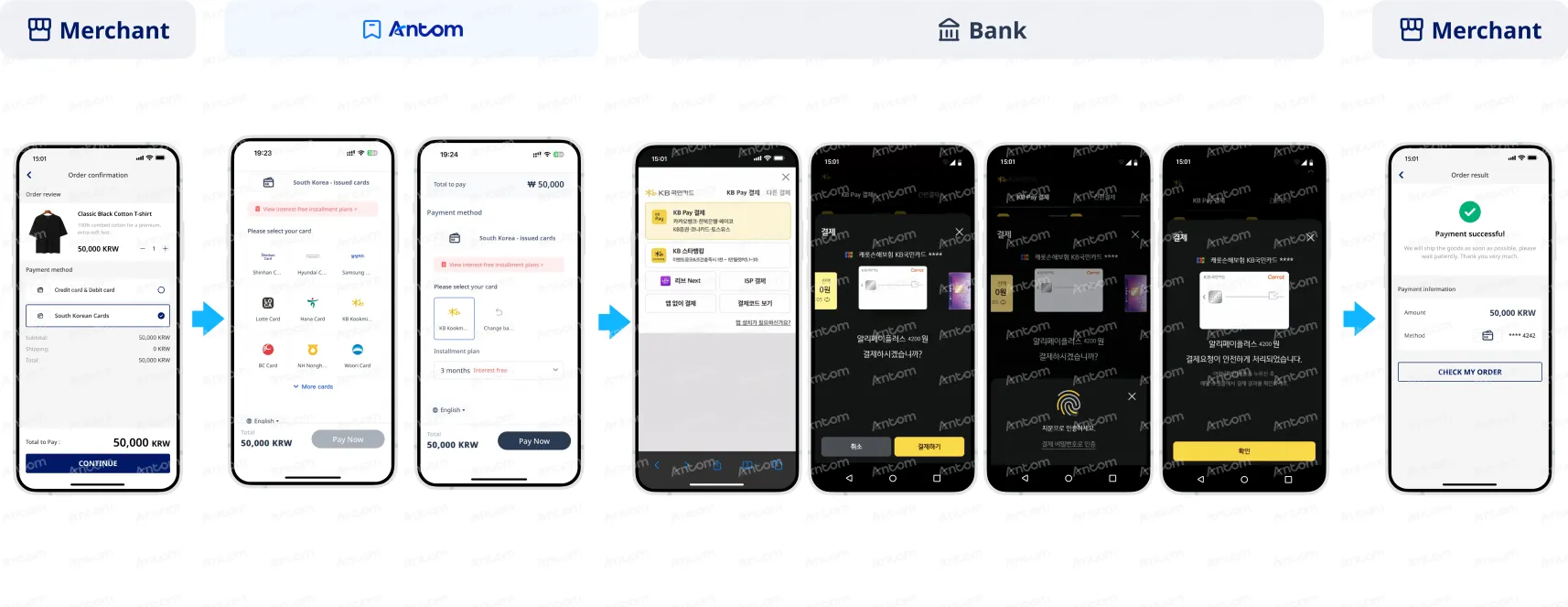
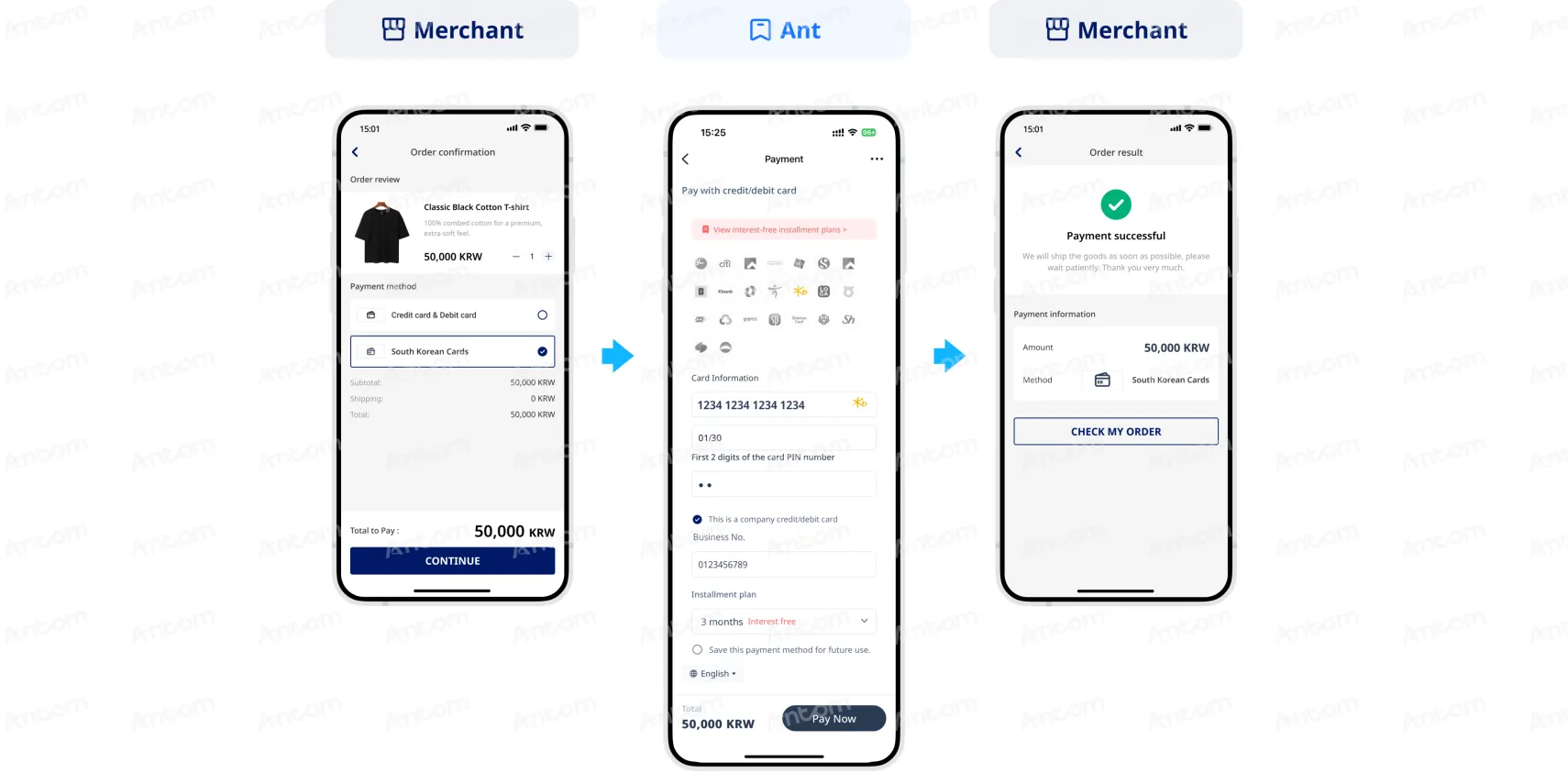
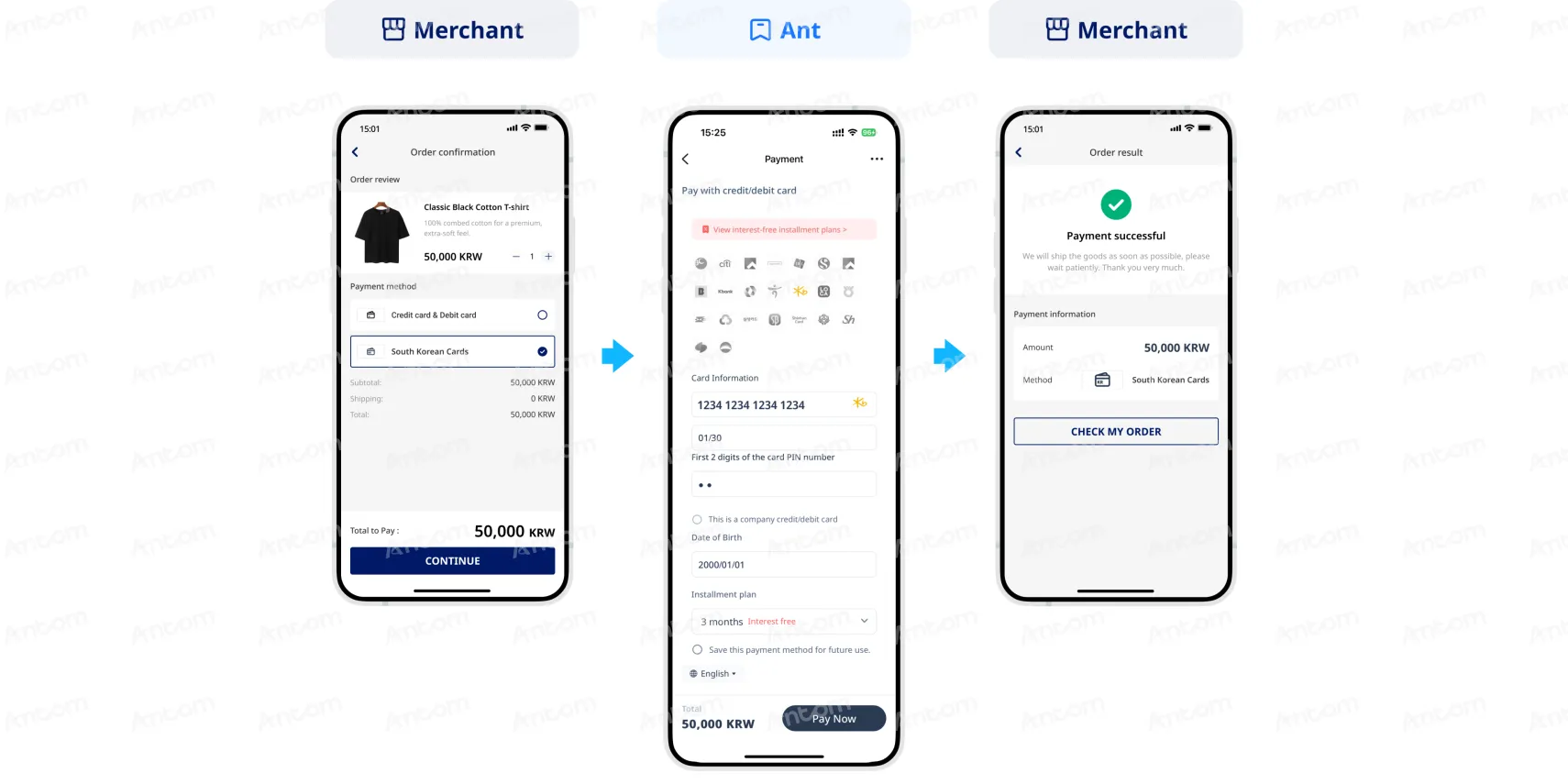
- Issuer-authenticated payment: The buyer is redirected to the bank page of the chosen issuer to complete the payment. Payment is completed via different processes, such as scanning a QR code, or inputting card or bank account information, depending on the particular bank's capabilities. You are required to provide these payment flows for merchant industries such as gaming and top-up services.
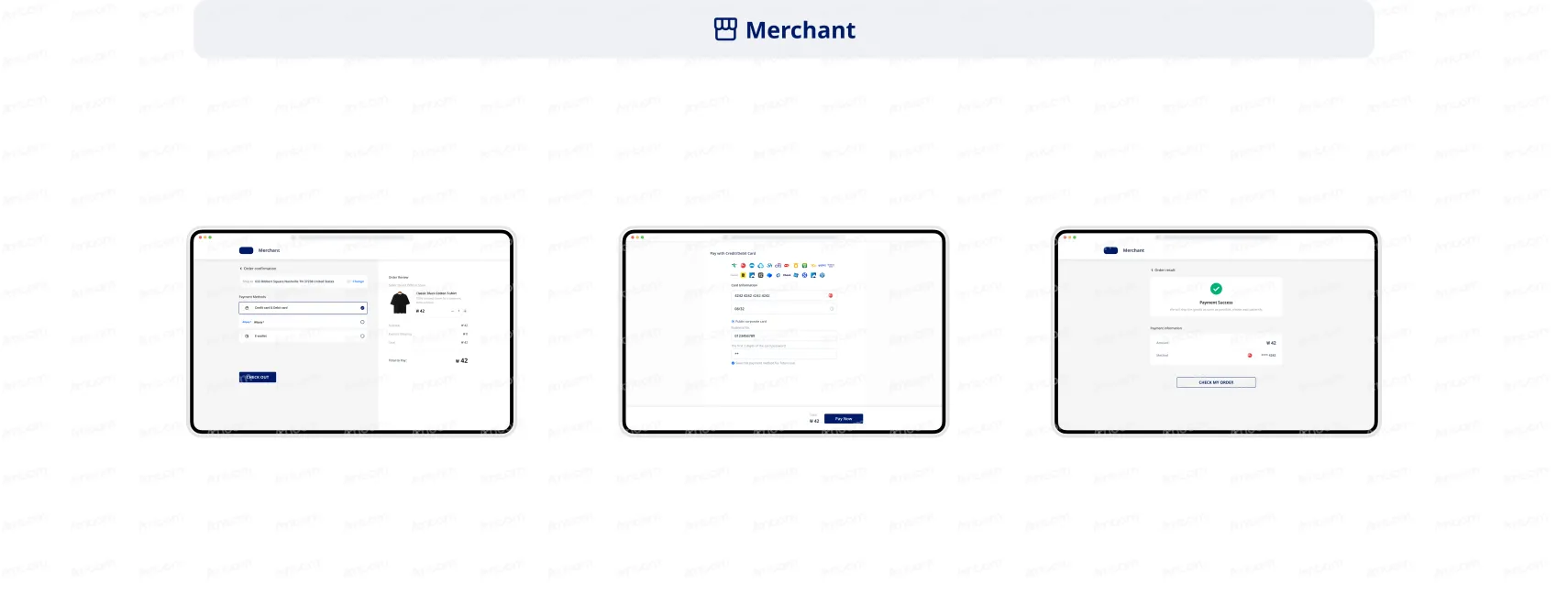
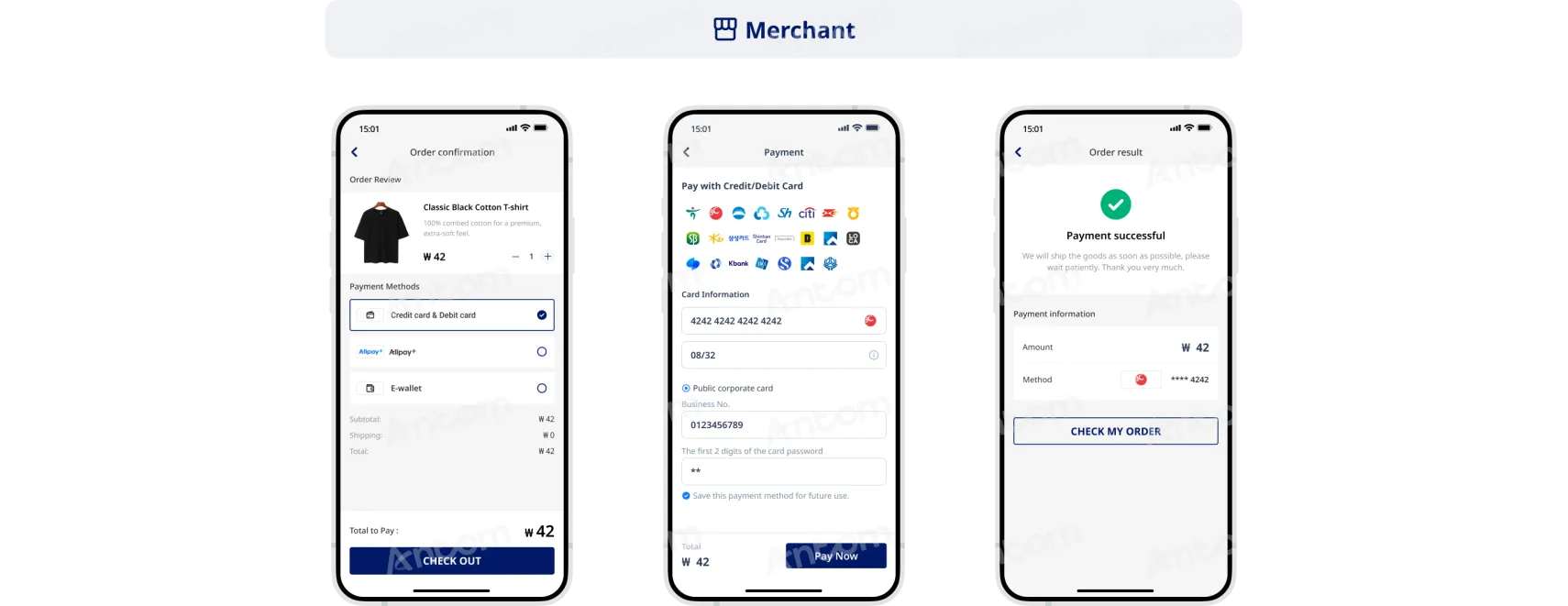
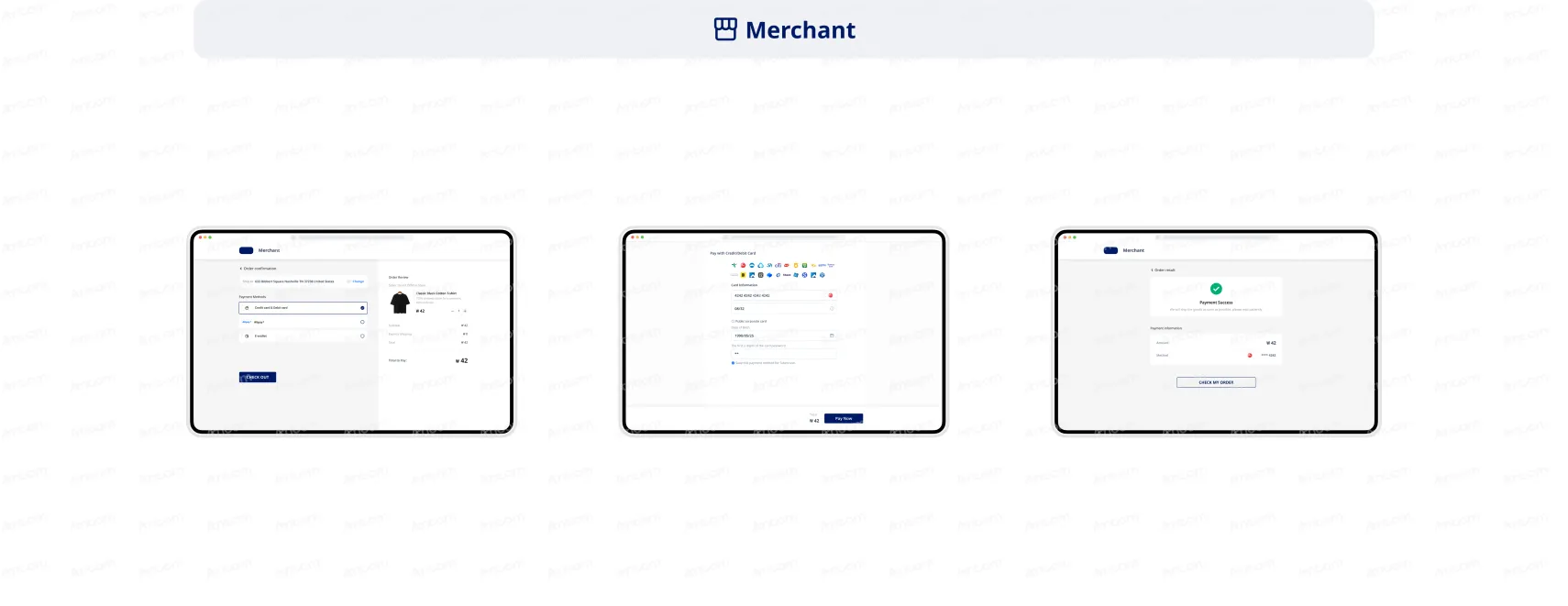
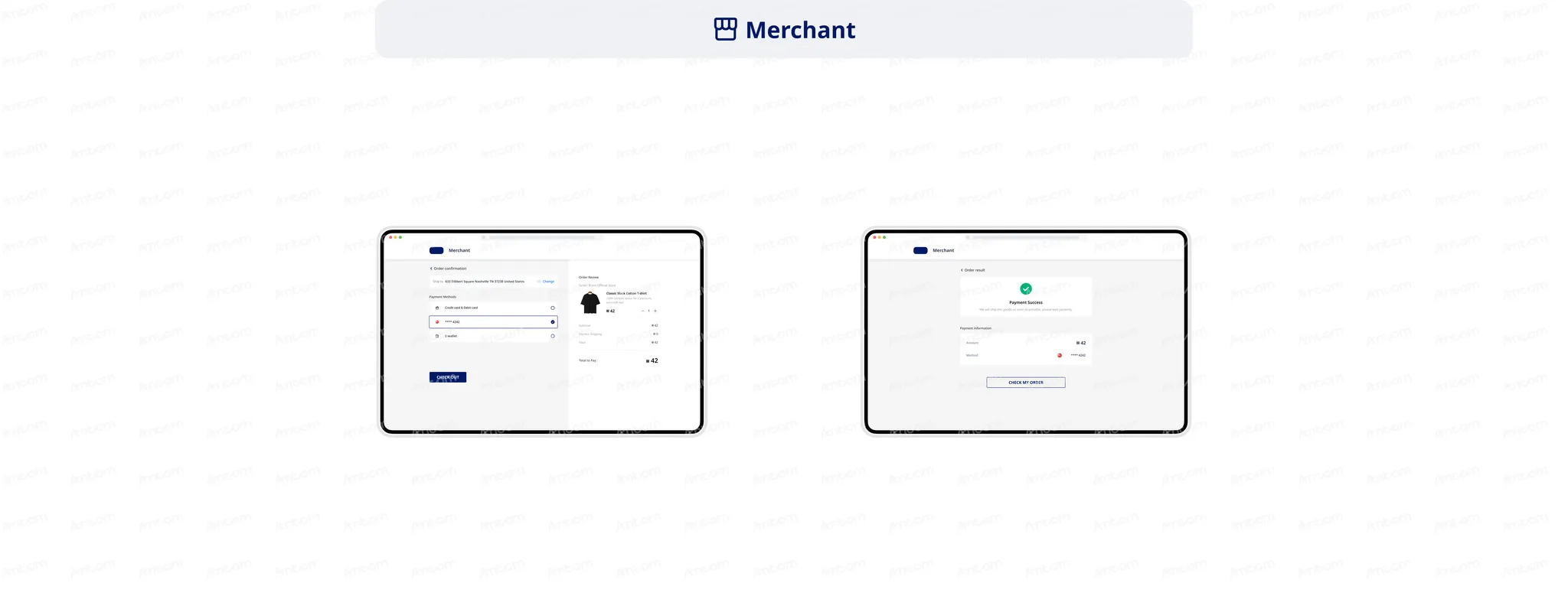
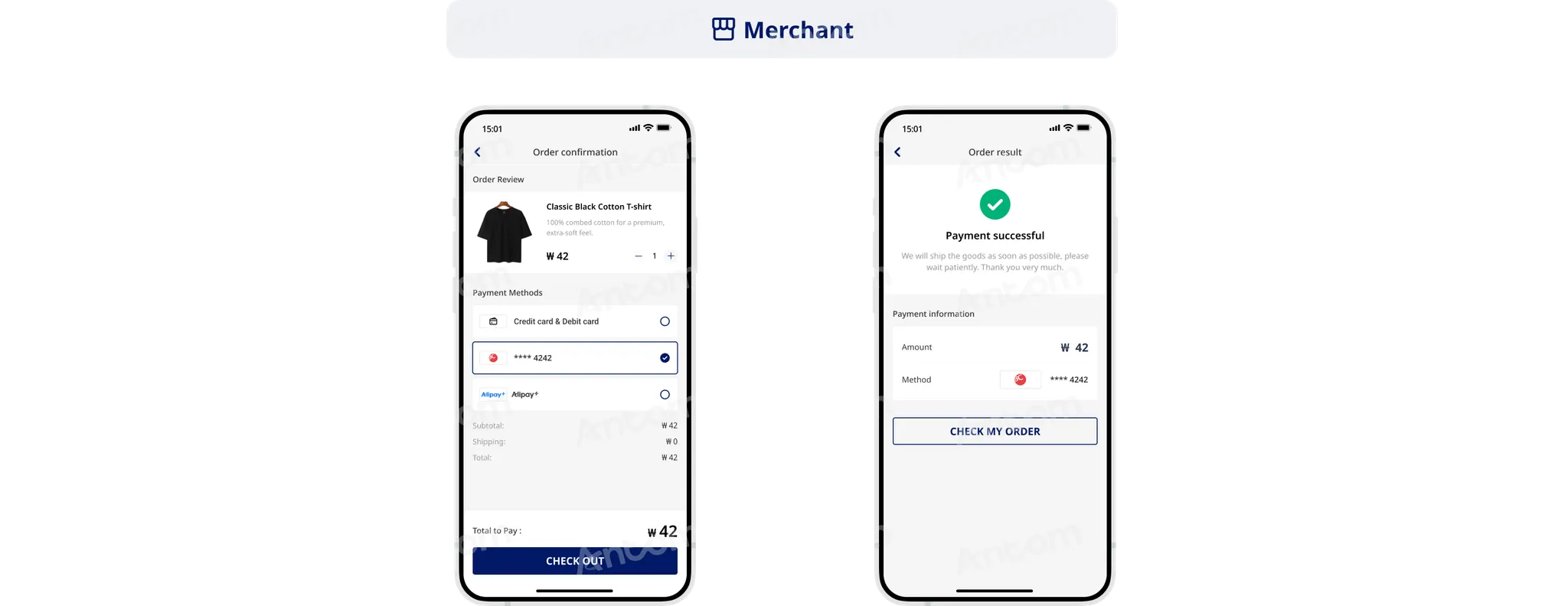
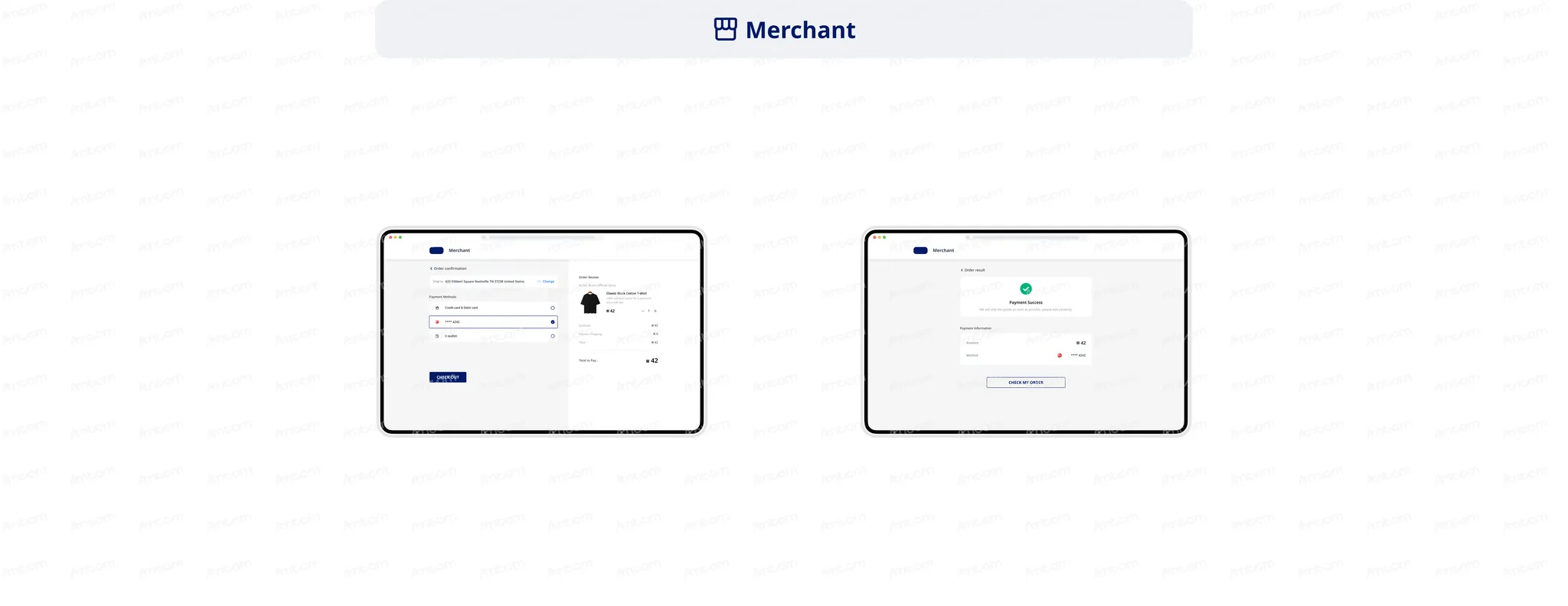
- Non-authenticated payment (Key-in): The buyer needs to manually key in their card details as per the typical international card payment process.
Note: For South Korean Cards-instalment function, merchants can design how to show 2-12 instalments for buyers, or merchants can redirect buyers to Antom's middle page for buyers to choose 2-12 instalments. When buyers choose a specific instalment plan, the common practice in the Korean market is that merchants do not show buyers the corresponding plan's interest rate on the checkout page. Instead, Korean buyers can check their interest fees on the card issuers' monthly bills or statements.
The following screenshots show the journey of paying with South Korean cards in different scenarios.
Issuer-authenticated payment
This section shows the journey of issuer-authenticated payments via API integration.
Bank list provided by merchant
Web
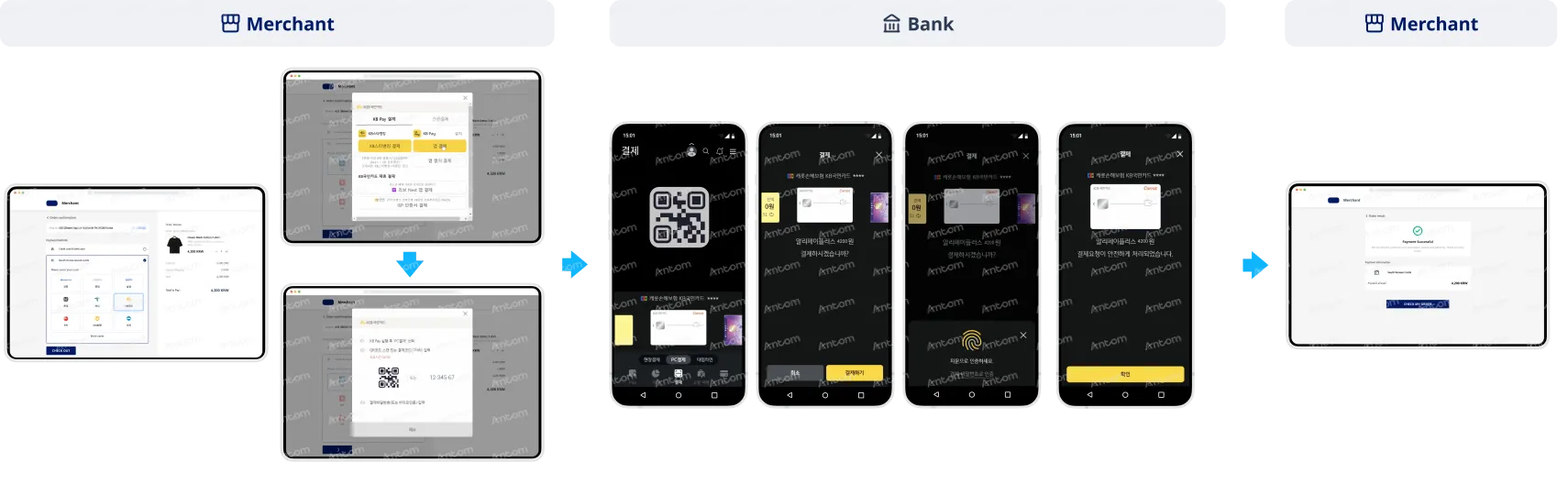
- The buyer selects a bank.
- The bank page is to be opened and presents available authentication methods. [1]
- The buyer selects an authentication method to proceed.
- The QR code and payment code are to be displayed on the page for the buyer to scan or input within a mobile app.
- The buyer selects a bank card within the app, complete user authentication, and confirm payment.
- The buyer is redirected back to the merchant's website and receives the payment result notification.
[1] Different banks may offer different authentication methods, including card number with password, the pre-installed mobile bank app, CVC, SMS OTP, ARS authentication, etc, based on the options that banks provide to buyers. ARS authentication is an authentication method that involves providing buyers with a PIN code over a phone call.
App
- The buyer selects a bank.
- The bank page is to be opened and presents available authentication methods.
- The buyer selects an authentication method to proceed.
- The pre-installed app is to be evoked for the buyer to proceed with payment using a mobile app. The buyer selects a card within the app, completes the user authentication, and confirms the payment.
- The buyer is redirected back to the merchant's website and receives the payment result notification.
[1] Different banks may offer different authentication methods, including card number with password, the pre-installed mobile bank app, CVC, SMS OTP, ARS authentication, etc, based on the options that banks provide to buyers. ARS authentication is an authentication method that involves providing buyers with a PIN code over a phone call.
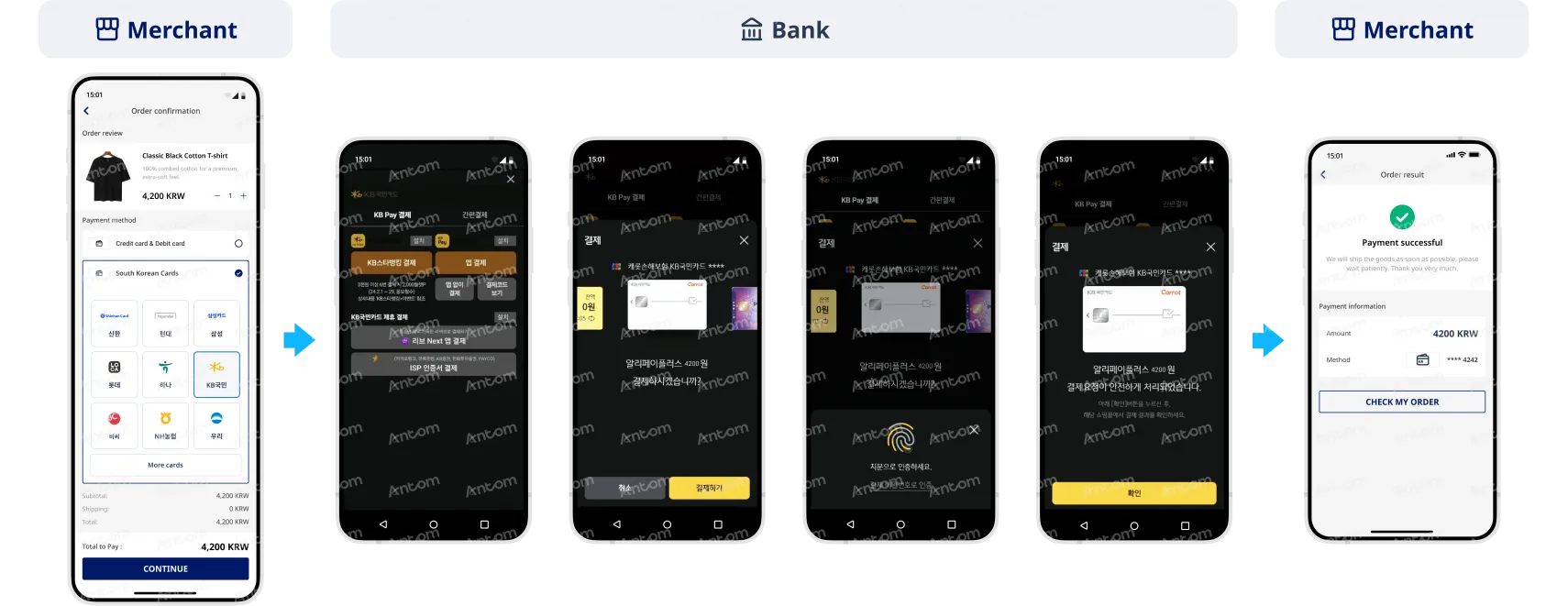
- The buyer selects a bank.
- The bank page is to be opened and presents available authentication methods. [1]
- The buyer selects an authentication method to proceed.
- The QR code and payment code are to be displayed on the page for the buyer to scan or input within a mobile app.
- The buyer selects a bank card within the app, complete user authentication, and confirm payment.
- The buyer is redirected back to the merchant's website and receives the payment result notification.
[1] Different banks may offer different authentication methods, including card number with password, the pre-installed mobile bank app, CVC, SMS OTP, ARS authentication, etc, based on the options that banks provide to buyers. ARS authentication is an authentication method that involves providing buyers with a PIN code over a phone call.
Bank list provided by Antom
Web
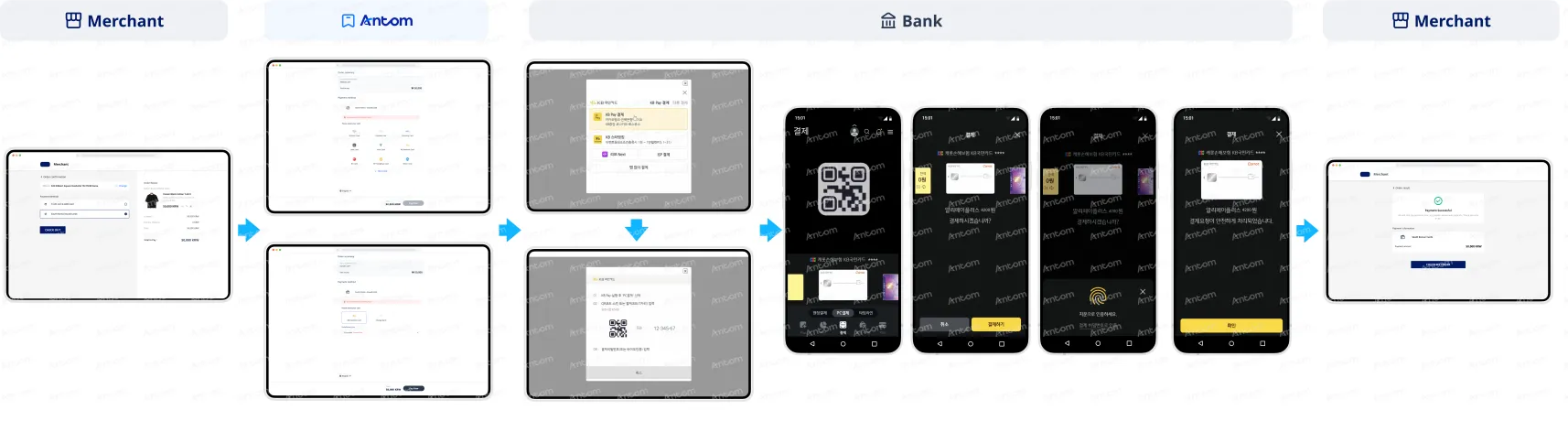
App
Non-authenticated payment
This section shows the difference of user experience between API-only and SDK integration under the non-authenticated payment.
API integration
For API integration, the journey of paying with South Korean cards differs between the first-time payment and subsequent payments.
First-time payment
PCI qualified (Corporate card)
Web
App
PCI qualified (Individual card)
Web
App
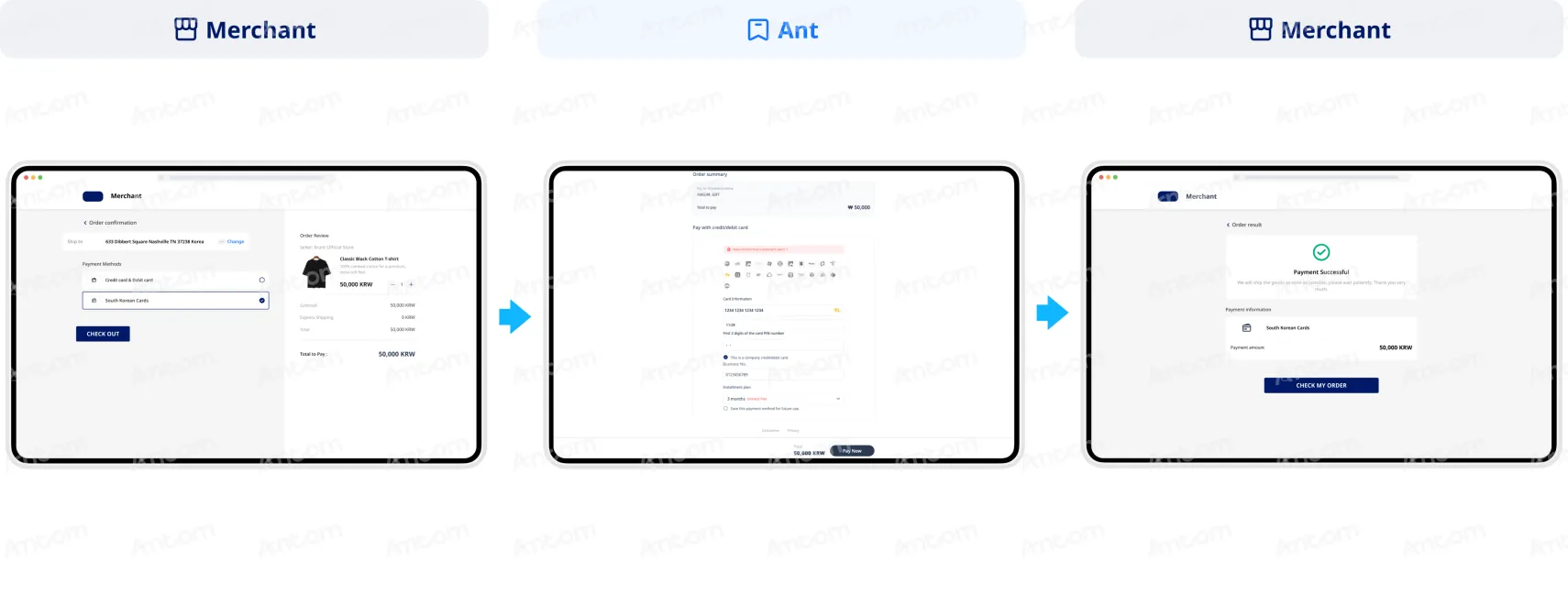
Non-PCI qualified (Corporate card)
Web
App
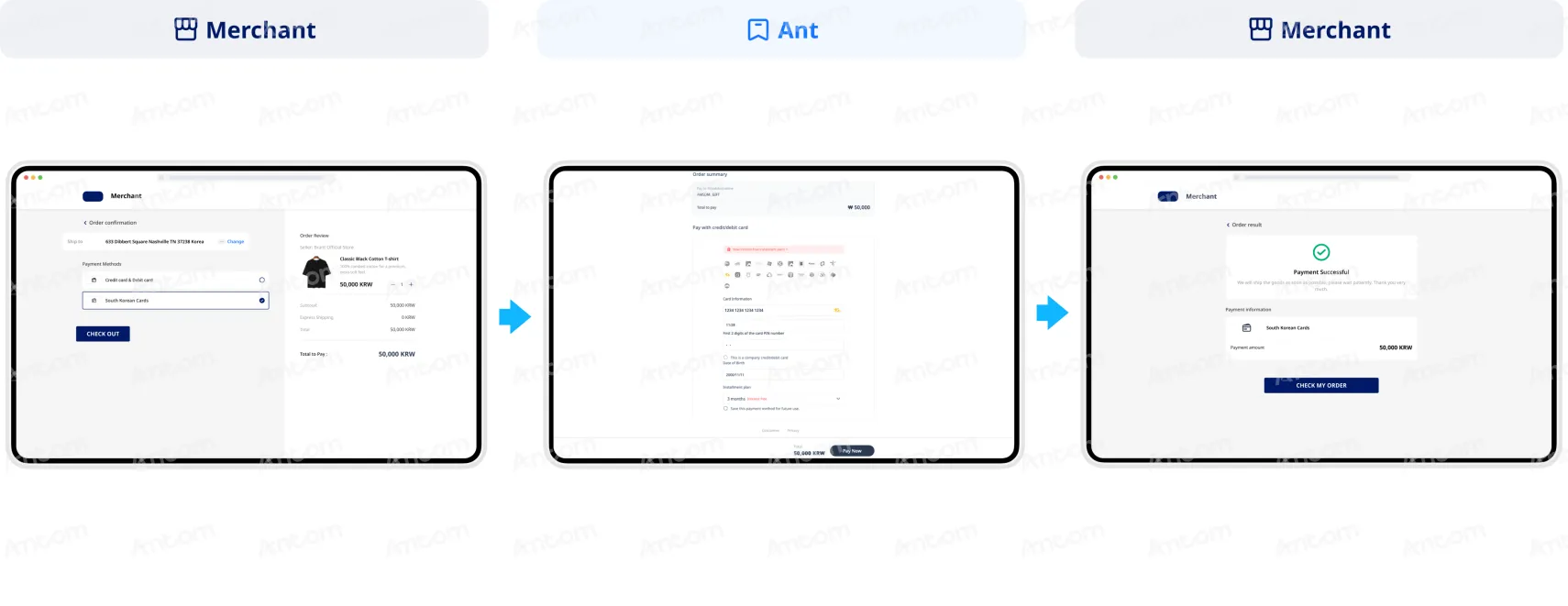
Non-PCI qualified (Individual card)
Web
App
Subsequent payments
PCI qualified
Web
App
Non-PCI qualified
Web
App
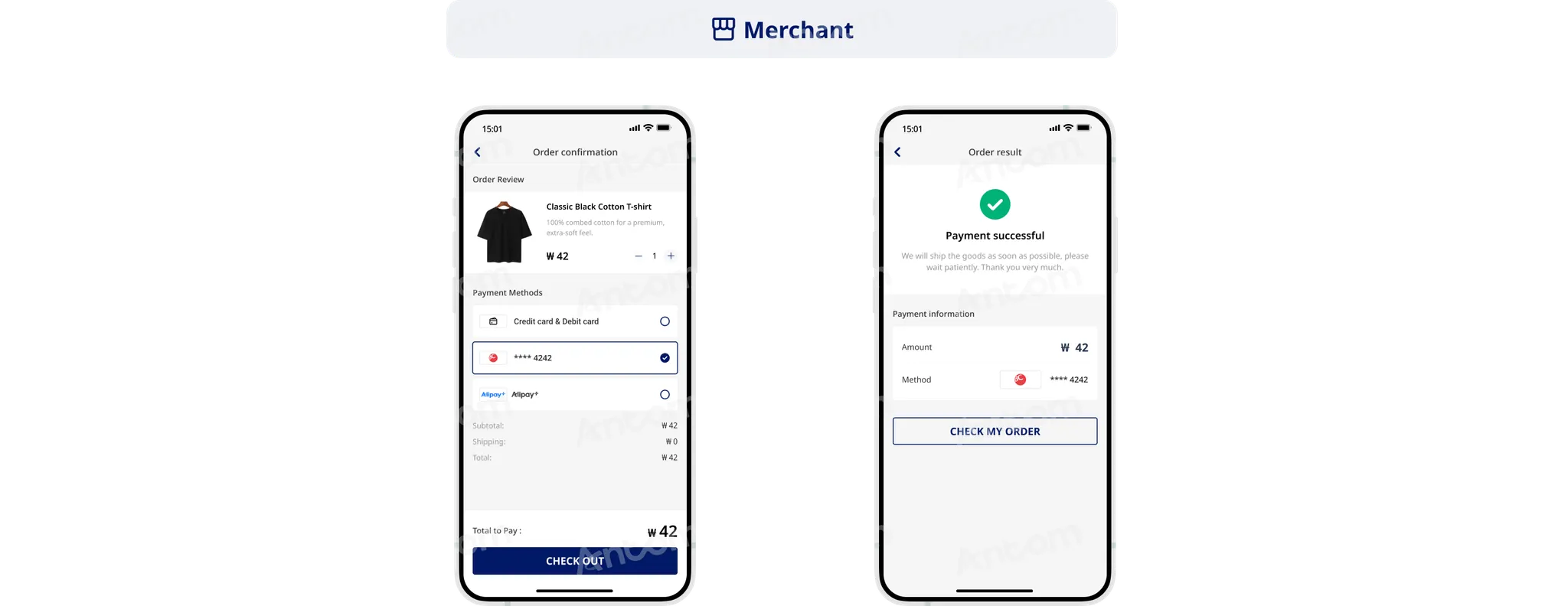
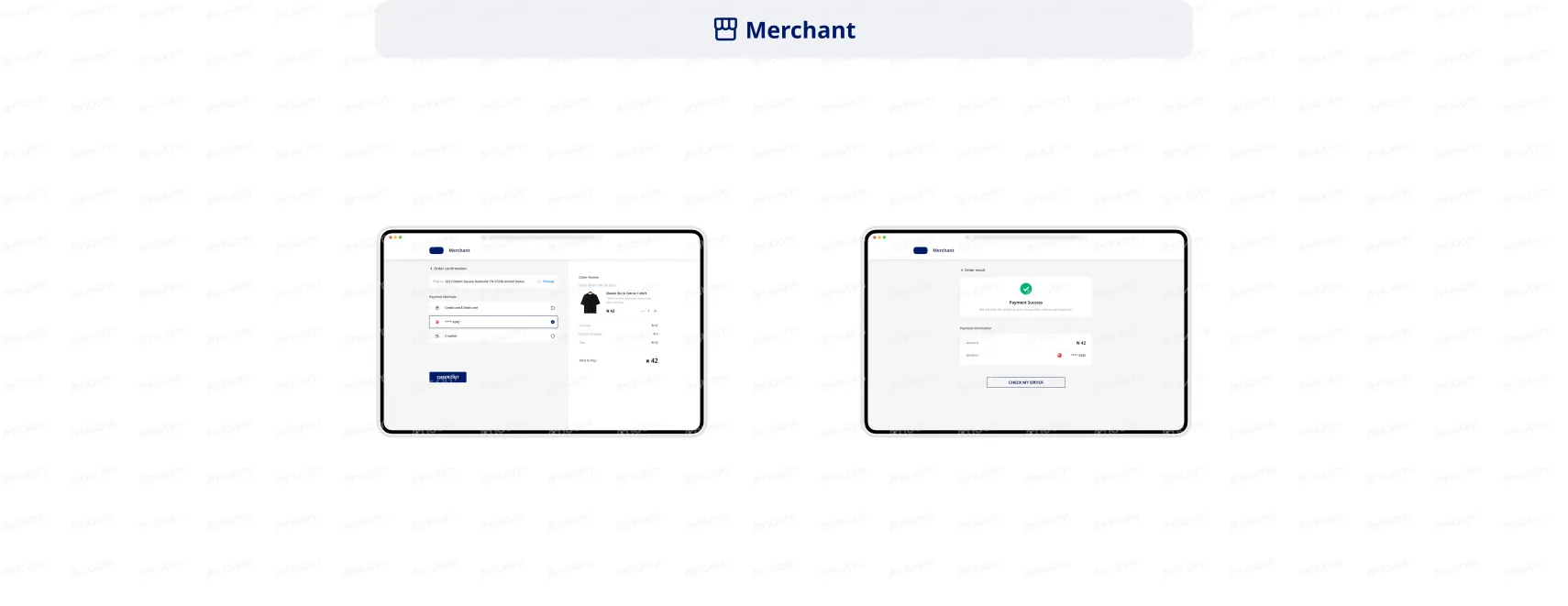
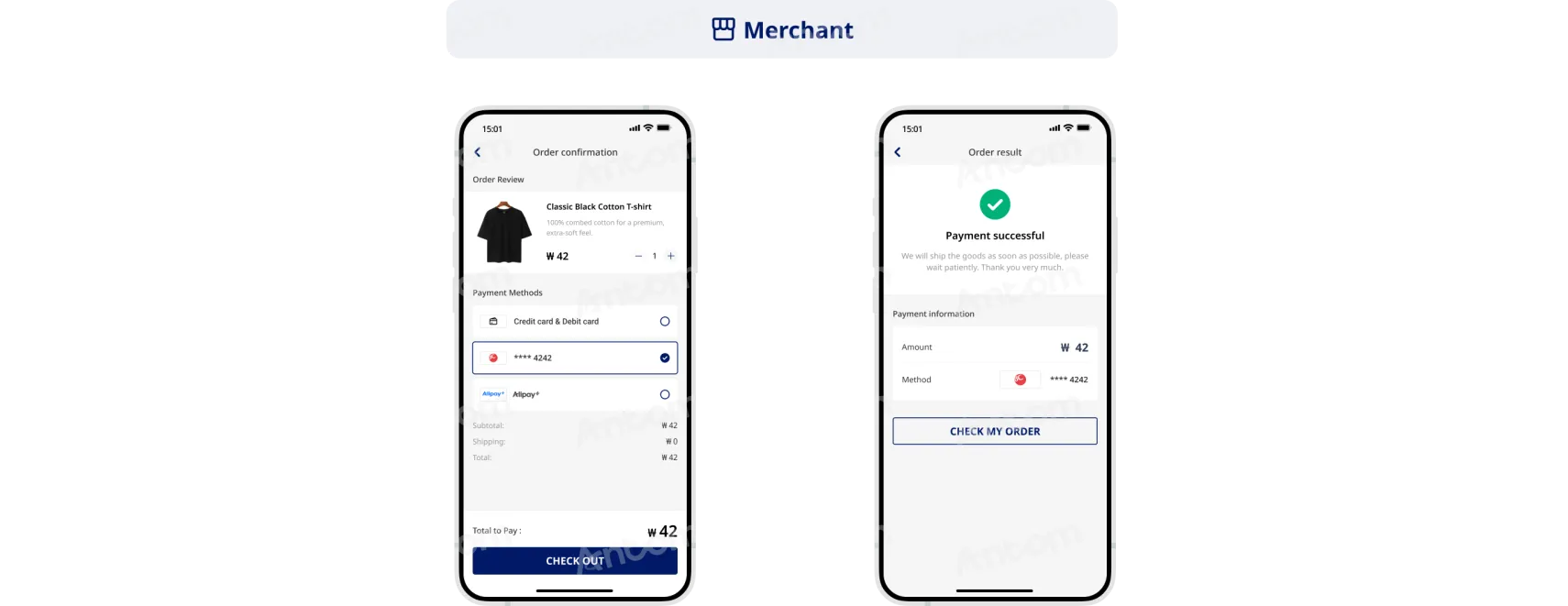
SDK integration
For SDK integration, the journey of paying with South Korean cards differs between the first-time payment and subsequent payments.
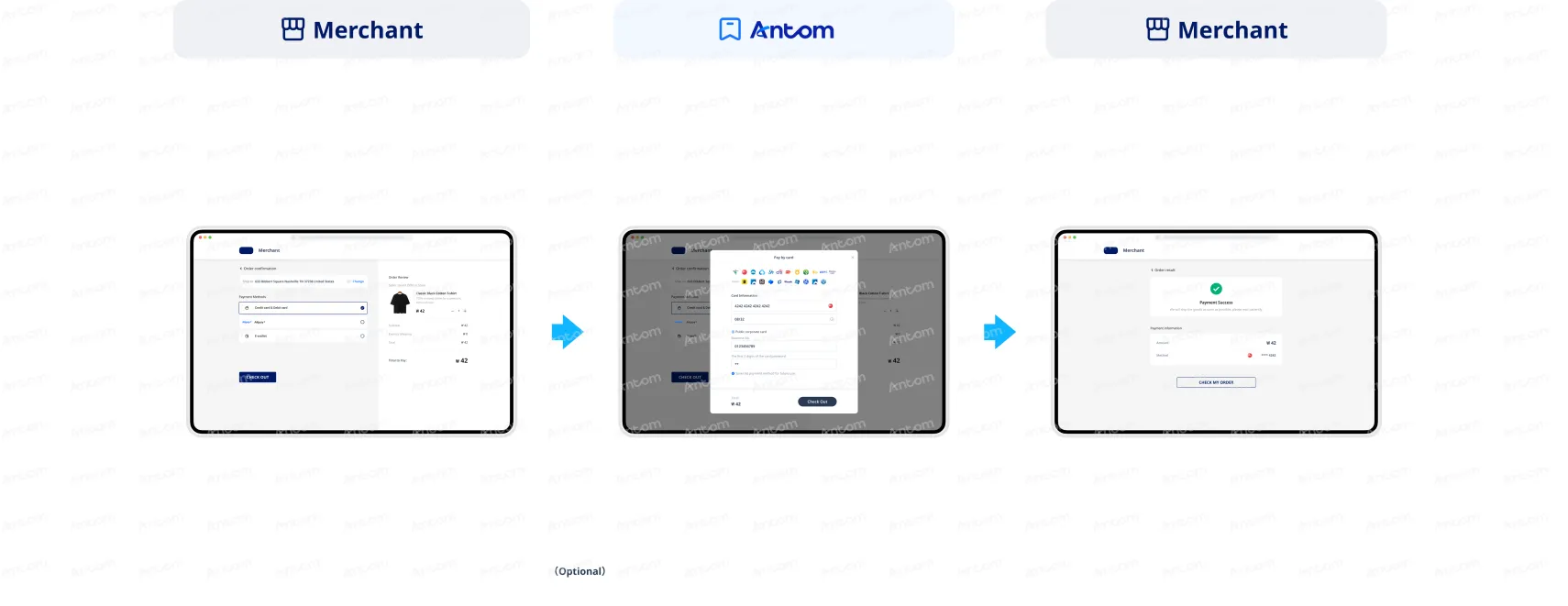
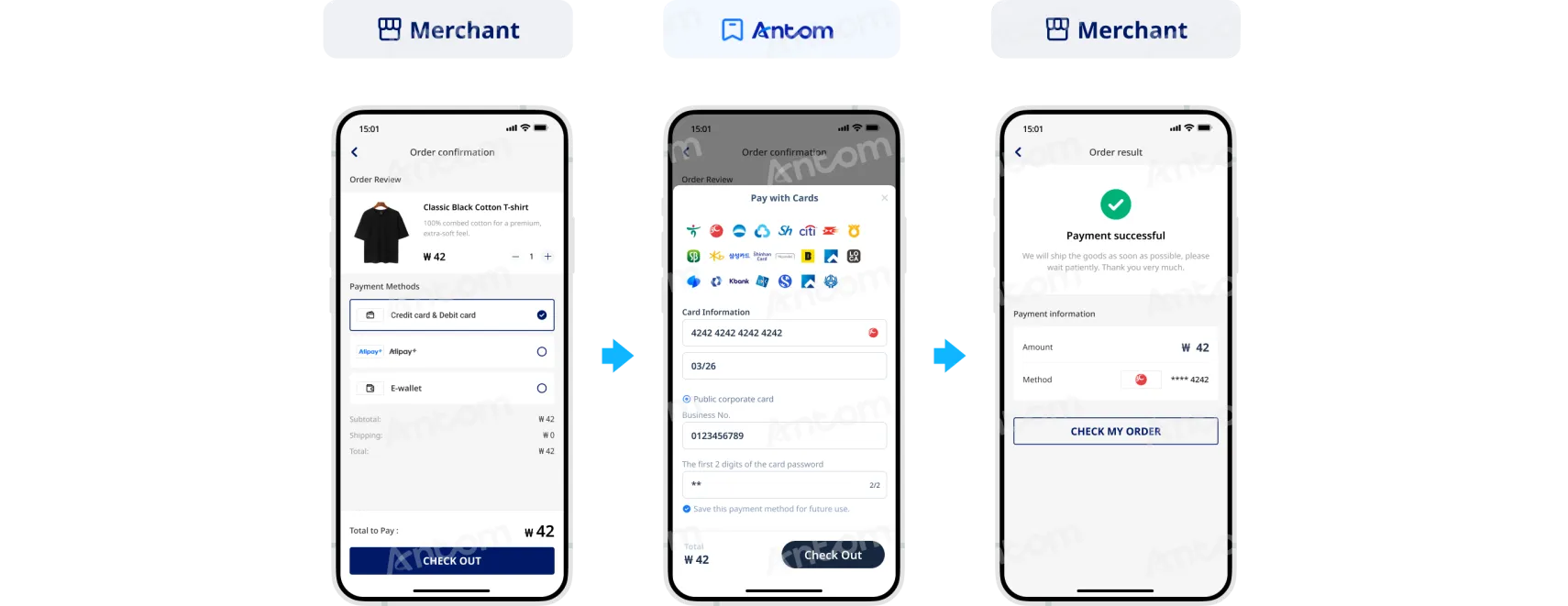
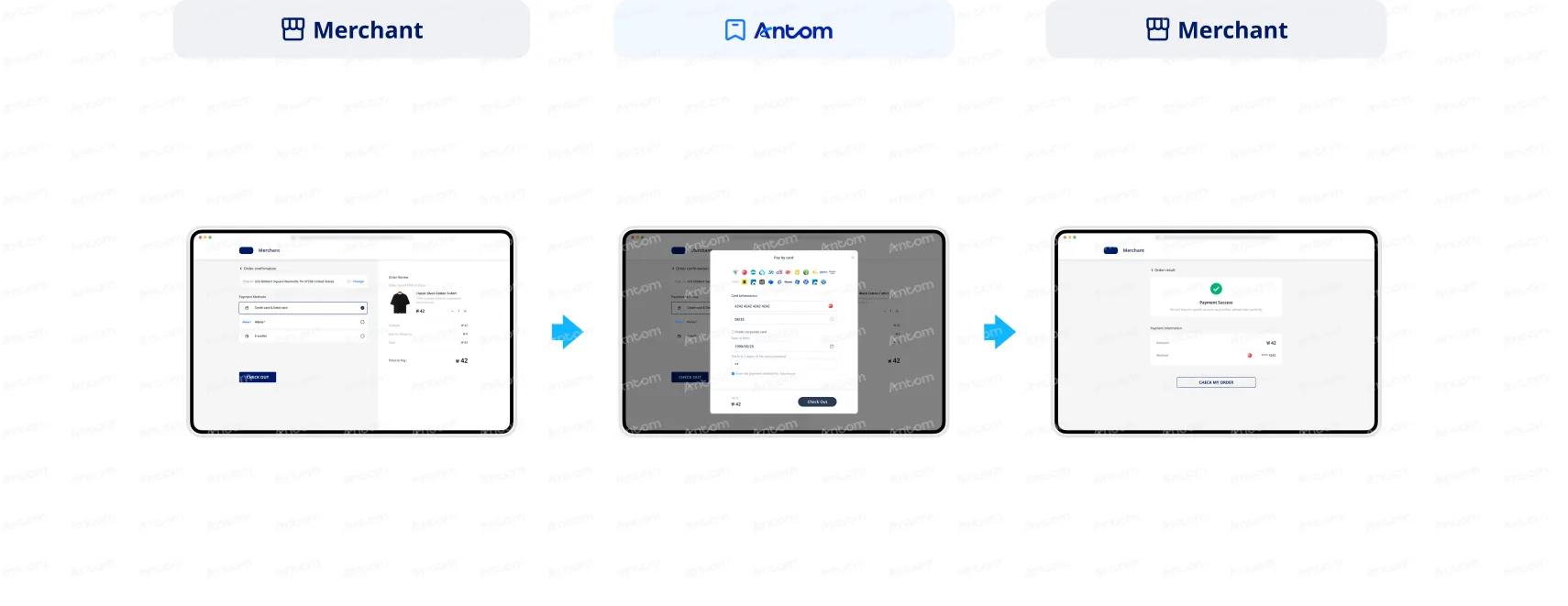
First-time payment
Corporate card (Web)
Corporate card (App)
Personal card (Web)
Personal card (App)
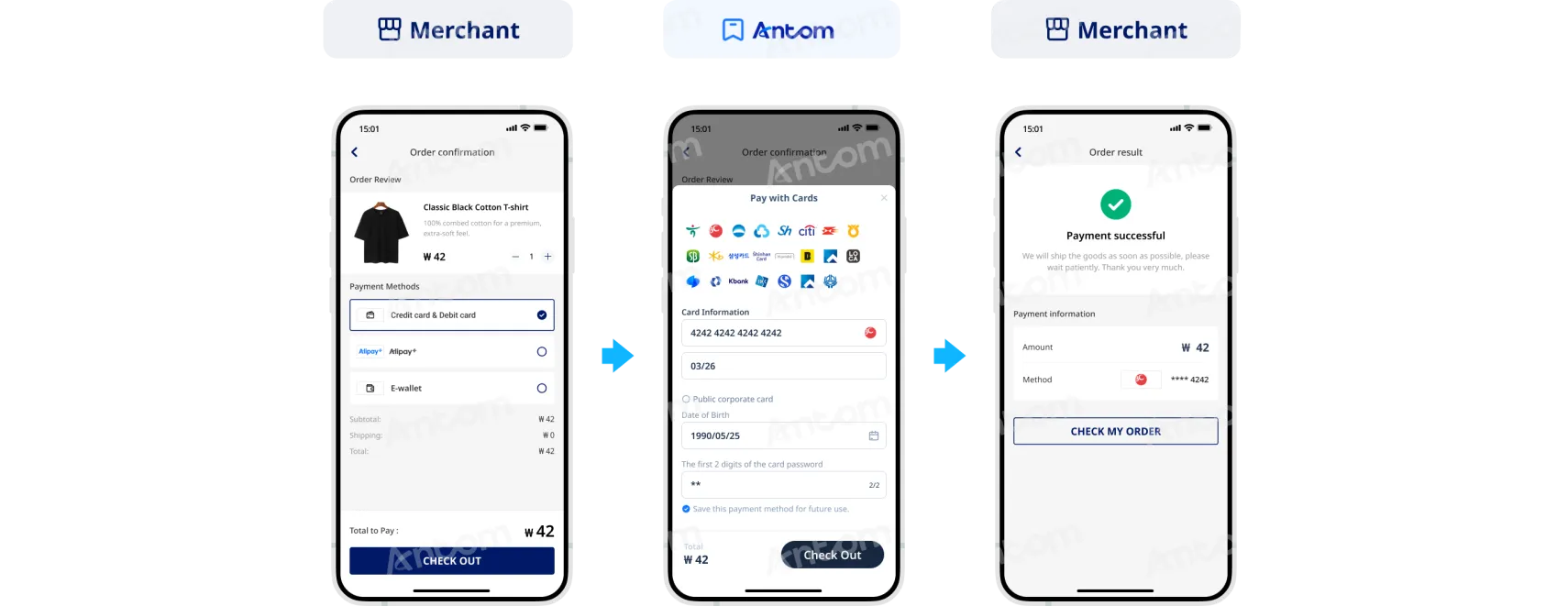
Subsequent payments
Web
App
South Korean Card issuers' interest-free instalment information
Interest-free instalment (transactions over 50,000 KRW) (1 Dec-31 Dec) | |||
Card issuer | Instalment months | Remarks | Applicable targets |
Samsung | 2-3 |
| Online PG services |
Lotte | 2-5 |
| |
Shinhan | 2-3 |
| |
Kookmin | 2-5 |
| |
BC | 2-5 |
| |
Woori | 2-5 |
| |
NongHyup | 2-6 |
| |
Hyundai | 2-3 | Transactions exceeding 10,000 KRW eligible for interest-free instalments (Transactions exceeding 50,000 KRW are eligible in certain cases)
| |
Hana | 2-4 |
| |
Jeonbuk | 2-3 | None | |
Gwangju | 2-7 | None | |
Partial interest-free instalment (transactions over 50,000 KRW) | |||
Card issuer | Instalment months | Charge to customer | Free for customer |
Samsung | 7 | 1-3 month | 4-7 month |
11 | 1-5 month | 6-11 month | |
23 | 1-10 month | 11-23 month | |
Kookmin | 6 | 1-3 month | 4-6 month |
10 | 1-5 month | 6-10 month | |
Shinhan | 7 | 1-3 month | 4-7 month |
9 | 1-4 month | 5-9 month | |
11 | 1-5 month | 6-11 month | |
23 | 1-10 month | 11-23 month | |
BC | 6 | 1-3 month | 4-6 month |
10 | 1-4 month | 5-10 month | |
12 | 1-5 month | 6-12 month | |
Woori | 6 | 1-3 month | 4-6 month |
10 | 1-4 month | 5-10 month | |
12 | 1-5 month | 6-12 month | |
Hana | 6 | 1-3 month | 4-6 month |
10 | 1-4 month | 5-10 month | |
12 | 1-5 month | 6-12 month | |
18 | 1-8 month | 9-18 month | |
NongHyup | 7-10 | 1-3 month | 4-10 month |
12 | 1-4 month | 5-12 month | |
18 | 1-5 month | 6-18 month | |
24 | 1-6 month | 7-24 month | |
Jeonbuk | 4-9 | Once | 2-9 month |
12 | 1-2 month | 3-12 month | |
Hyundai | 10 | 1-5 month | 6-10 month |
12 | 1-6 month | 7-12 month | |
| |||
Note: These information will be updated monthly and might change according to each card issuer's own policy.
FAQs
Will integrating only international card networks affect my business in the South Korean market
Yes, it will limit your market coverage. South Korea's payment market has a unique structure. Of the over 110 million cards in circulation, about 45% are single-branded cards that are only connected to domestic card networks. That means merchants that only support international cards like Visa or Mastercard will be unable to accept payments made with local mainstream card brands. Integrating local card networks, including the nine major South Korean card brands, ensures your payment gateway covers as many card-paying users as possible.
What's the point of listing major card brands' transaction limits for merchants' daily operations?
This allows you to implement more precise pricing and marketing strategies. These limits, for example, gaming top-up limits, are part of the South Korean card organisations' risk management frameworks. Understanding the specific rules of brands such as Shinhan, BC, Samsung, KB, Hyundai, Lotte, NH, Hana, and Woori will help you design appropriate top-up tiers and product pricing to avoid payment failures due to transaction limits and enhance consumer payment experience and success rates.
Do South Korean local cards support instalment payments? Which categories benefit from these the most?
Yes. Through Antom, merchants can offer instalment payment options to consumers. This feature is particularly important for product categories with higher average order values, such as consumer electronics, premium home appliances, and luxury goods. Instalment options can significantly reduce the immediate payment burden for consumers and are a key payment tool for stimulating purchase decisions and increasing the average order value.
Given the rapid growth of e-wallets in South Korea, does local card payment still have long-term value for integration?
Yes, and its value remains solid. Although e-wallets are growing rapidly, card payments still dominate the market with a 58% share. Moreover, local card payments are the foundation of South Korea's consumer credit. Their large user base and mature rule system are irreplaceable in the short term. Integrating local card networks enables you to ride the mainstream payment trend and build a solid foundation for your business.
What is the significance of supporting local card payments for merchants seeking to attract South Korea's cross-border consumers?
It helps build more localised trust. Data show that 82% of South Korean consumers are willing to make cross-border purchases. Their familiar local card logos on the overseas merchants' checkout pages can reduce their concerns and boost payment willingness. Offering local card options is a showcase of respect for consumers' payment habits and an effective way to build trust.
Integrate South Korea's local card payment networks through Antom to turn complex localisation challenges into your market edge.