
Share on
Cost Reference Guide
Part 1: Understanding Cost Models and Fee Structures
Cross-border payments are essential for global commerce, yet costs remain opaque for many merchants. Understanding the cost structure helps merchants manage expenses while improving payment efficiency. Antom uses data-driven insights to simplify complex fee models, helping merchants make smarter decisions.
Q1: How are costs calculated in a typical cross-border card payment?
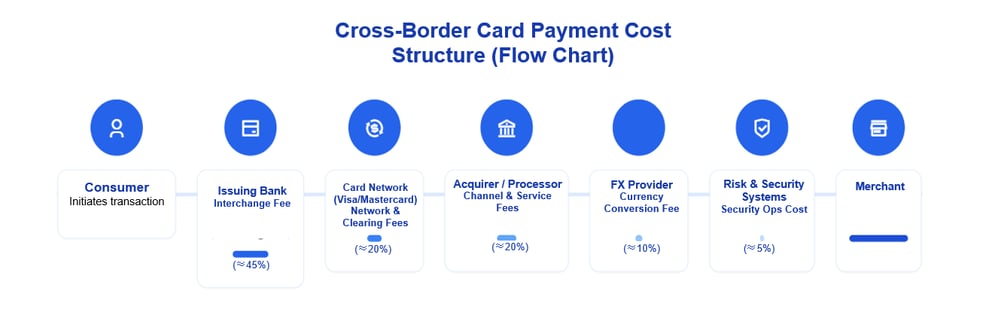
A cross-border card payment travels through several institutions, and each step adds a cost. What looks like a simple purchase is actually a chain of financial handoffs. The merchant ultimately pays for all of these layers combined.
The first cost comes from the issuing bank, which charges an interchange fee. This fee compensates the bank for liquidity, fraud risk, and network participation. It is usually the largest component, often making up more than one-third of the total cost.
Next, the transaction passes through an international card network such as Visa or Mastercard. These networks charge assessment, cross-border, and clearing fees to move messages and settle funds. While smaller than interchange, these fees remain meaningful for high-volume merchants.
The payment then reaches the acquirer or processor, who handles authorisation, settlement, and merchant support. Their processing and service fees cover infrastructure, compliance, reconciliation, and operational risk. These fees typically form another important share of the total cost.
If the transaction and settlement currencies differ, an FX conversion fee appears. This cost may come from the issuer, the card scheme, or a third-party provider. The merchant often bears this fee indirectly through blended pricing.
Finally, fraud detection, risk scoring, and security monitoring also carry operational costs. These functions protect both the merchant and the consumer. Even if not presented as a separate line item, they are built into the overall rate.
Taken together, a merchant’s true cost is the sum of interchange → network fees → acquiring fees → FX conversion → risk and security operations. A change in any single layer affects the final cost borne by the merchant.
Q2: Why do card-payment costs fluctuate so much, even for similar transactions?
Card-payment costs fluctuate because the cross-border fee structure depends on many external variables. Each variable, country, card type, scenario, or regulation, can shift independently. As a result, merchants often experience noticeable and unpredictable cost variations.
The first driver is regional interchange policy. Issuers in different markets set different interchange levels based on regulation and local competition. For example, the EU caps consumer debit interchange at 0.2% and credit at 0.3%, while Japan and other markets allow significantly higher rates.
A second driver is card type. Premium, rewards, and corporate cards usually carry higher interchange fees because they fund cardholder perks and loyalty programs. This means the same transaction amount can produce very different costs.
Payment scenario also matters. Online transactions carry higher fraud and chargeback risk than in-store payments, leading to higher fees. Cross-border online payments then add FX, regulatory, and compliance layers on top.
The transaction amount contributes as well. Large-ticket payments generate higher absolute costs even if the percentage rate is slightly lower. Meanwhile, high-frequency micro-transactions can accumulate relatively heavy per-transaction and risk-management costs.
Macroeconomic and regulatory changes can increase volatility further. For example, after Brexit, the UK was no longer bound by EU interchange caps, and several cross-border interchange categories were repriced upward. This led to sudden cost increases for merchants processing UK-EU card transactions.
|
Actual costs vary by region, card network, merchant category, average order value, and risk level.
Why this matters to merchants
Even small changes in one variable, such as card type mix or FX fees, can meaningfully shift the total cost per transaction. For merchants operating across multiple markets, these fluctuations can compound quickly. Without visibility, the same product price may produce different margins across countries.
How Antom can help
Antom leverages deep operational experience across markets, card types, and regulatory systems. Our global data models help merchants predict cost variability across regions, card mixes, and currencies. With intelligent routing and pricing optimisation, we help merchants stabilise costs, even in high-volatility markets.
Q3: How is the cost structure of digital-wallet payments different from card payments?
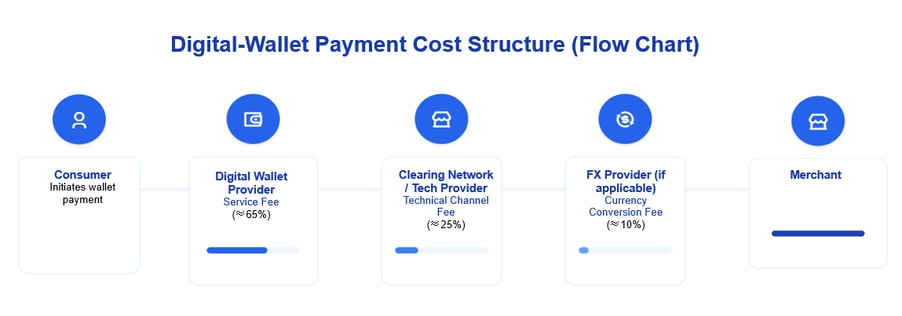
Digital-wallet payments follow a much simpler cost structure than card payments. They remove the traditional card-network layer, which shortens the value chain and reduces the number of fee components. This makes wallet-payment costs more predictable and easier for merchants to manage.
When a consumer pays with a digital wallet, the wallet provider effectively acts as both the issuer and the account manager. The provider charges a service fee to the merchant to cover account operations, transaction processing, and fraud prevention. This fee becomes the primary cost component in wallet-based transactions.
Clearing and settlement for wallet payments rely on technical service providers or clearing networks. These providers charge technical or channel fees to maintain infrastructure, uptime, and transaction routing. Although smaller compared to service fees, they remain an essential part of total cost.
If the transaction involves currency conversion, merchants still incur FX conversion costs. These FX charges depend on the currency pair, market volatility, and the wallet provider’s pricing model. While simpler than card-based FX, the fee may still vary across markets.
Overall, wallets reduce cost complexity by removing interchange and card-network fees entirely. This often results in 30%–50% lower total cost compared with traditional card payments. For merchants operating across multiple regions, this transparency significantly improves cost predictability.
|
Why this matters to merchants
For cross-border merchants, wallets offer lower costs, fewer variables, and higher predictability. In a landscape where card-payment costs fluctuate widely, wallets provide a more stable alternative. As wallet adoption grows globally, they increasingly complement traditional card-payment options.
Q4: Is wallet-based payment always cheaper than card payment? How should merchants choose?
Wallet payments are not inherently “low-cost,” as their real expense also depends on coverage, regional network strength, and risk-control needs. Merchants should evaluate user habits and target markets rather than focusing only on fees.
In markets where e-wallets are highly popular, such as parts of Southeast Asia, wallet payments may offer lower rates and better conversion. But in mature markets like Europe and North America, cards remain dominant, and relying only on wallets can reduce sales.
The right choice should balance cost, user experience, and conversion efficiency. If customers prefer cards, merchants should keep card payments even if fees are higher; if wallets dominate, prioritising them will bring better results.
Antom provides strong wallet-ecosystem advantages, especially in Southeast Asia, enabling merchants to adopt local payment methods easily. Its integrated payment-and-marketing services help lower costs while improving retention, turning payment selection into a strategic growth lever.
Q5: I often hear that acquiring fees for international card payments use either the IC++ model or Blended Pricing. What is the core difference?
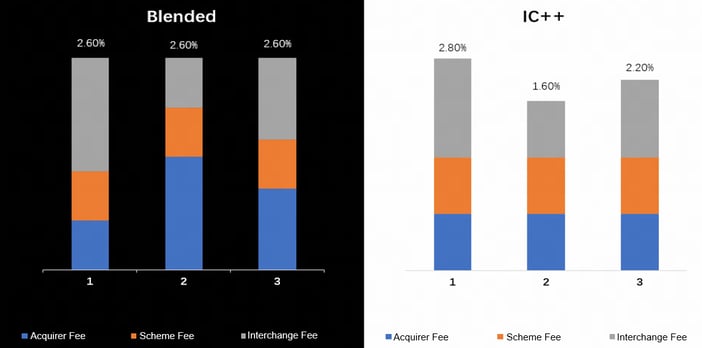
The key difference lies in transparency and predictability. IC++ breaks the acquiring cost into three parts, interchange, scheme fees, and acquirer margin, allowing merchants to see exactly where each cost comes from.
IC++ offers high transparency and flexibility, making it suitable for merchants who analyze transaction structures and optimise costs. However, fees vary by card type, region, and transaction category, so total cost can fluctuate.
Blended Pricing provides one fixed rate for all transactions. Merchants don’t need to understand the underlying rules, making financial planning easier, but they lose visibility into how each fee component changes.
In essence, IC++ highlights true cost transparency, while Blended Pricing prioritises simplicity and predictability. Each model fits different merchant needs and operational preferences.
Q6: So which pricing model should I choose: IC++ or Blended Pricing?
Merchants with strong finance teams and solid data capabilities usually benefit more from IC++, because its transparency allows them to analyse transaction structures and optimise overall costs. If you can manage fee fluctuations and value granular control, IC++ is a better fit.
For merchants who lack the resources to handle complex fee systems—especially in the early stage of overseas expansion—Blended Pricing offers simplicity. A fixed, predictable rate helps them focus on growth without dealing with detailed cost breakdowns.
In short, IC++ suits merchants seeking maximum optimisation and who can tolerate cost variability, while Blended Pricing suits merchants who prefer stability and operational simplicity. Different models align with different business stages and risk preferences.