


Share on
Key Insights
- In 2024, Turkey’s total population was approximately 85.60 million, with the population under 15 years old accounting for 20.9%, and the national median age was only about 34 years. Such a young population structure provides an adequate supply for the labour market.
- The Turkish retail market size reached USD 391.2 billion in 2024 and is expected to approach USD 868.3 billion by 2033, with an average annual growth rate of 8.3%. It not only reflects the prosperity of consumption, but also the combination of urbanisation, the purchasing power of young people, and digital payments.
- Point-of-sale (POS) non-cash payments surged to nearly 67% in 2024, demonstrating a clear trend of accelerated shift from cash to electronic transactions.
- Turkey’s online economy continues to boom, with e-commerce transaction volume increasing by 22% and transaction value soaring by 130% between 2022 and 2023. The industry expects online retail to exceed TRY 400 billion to 450 billion in 2026, accounting for more than 22% of total retail sales.
- Offline experience remains the main battlefield, and lifestyle goods are difficult to replace, which indirectly promotes the rapid rise of Q-Commerce.
- Turkey’s tourism revenue reached USD 25.8 billion in the first half of 2025, an increase of 7.6% over the same period last year, setting a new record for the period. Tourism accounts for approximately 12% of Turkey’s GDP, attracting over 30 million international tourists annually. This experience economy, combining culture, tourism, and shopping, is leading Turkish consumers from simple purchasing to a consumption upgrade at the sensory and spiritual levels.
- A survey of the Turkish market found that 83% of Turkish respondents conduct transactions through mobile banking services.
Turkey is the largest economy in the Middle East, with a high degree of industrial development, and is known as “Europe’s China” and the gateway to European industry. Turkey is located at the strategic crossroads of Europe, Asia, and Africa, and its every move attracts significant international attention.
In this foreign land of 783,000 square kilometres and a population of 85.60 million in 2024, Turkey is playing an unexpected role—it is quietly becoming a new springboard for businesses to enter Europe.
Although Turkey is facing inflation on one side and currency depreciation on the other, its economy has shown strong resilience. The largest economy in the Middle East has transformed from an underestimated market into a hidden ace for businesses in the new Eurasian region. Turkey, which cannot be ignored, heralds a new rhythm for the next wave of brand internationalisation. In 2025, Turkey is undergoing a fascinating economic transformation, with both the retail and manufacturing sectors heating up, creating a new wave of overseas opportunities for businesses. Get ready to embark on Turkey’s captivating hot air balloon ride with us and calmly uncover Turkey’s business secrets!
Overview of Turkey
Overview of Turkey Market
For thousands of years, Turkey has held the strategic position of the “Eurasian Hub”. With its unique geographical advantages and relatively low labour costs, it has successfully played the role of a “transit hub” and manufacturing base for the European, Middle Eastern, and North African markets.
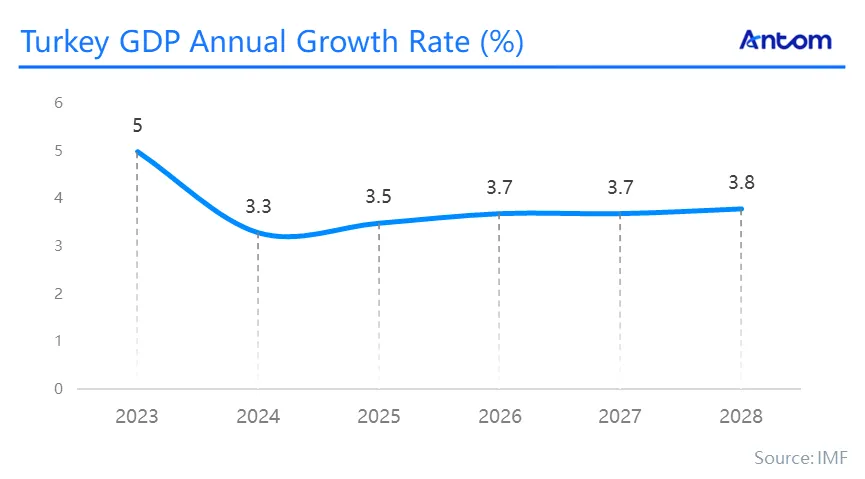
Turkey, the 16th largest economy globally and 7th largest in Europe, has a BB- sovereign credit rating from S&P. Its GDP in 2024 was approximately EUR 1.2 trillion (USD 1.3 trillion). IMF estimates that GDP growth will slow from 5.0% in 2023 to 3.3%, with an expected 3.5% in 2025. The GDP scale continued to grow, but the growth rate slowed down compared to 2023.
Although Turkey faces two major challenges: the depreciation of the TRY and high inflation, Turkey had a total population of 85.60 million in 2024. Its young population brightens Turkey’s economic prospects, with the youth population aged 15-64 accounting for approximately 68% of the total population, providing abundant labour and potential consumption power. The median age of residents is 34, which is 10.5 years younger than the EU. The GDP per capita in 2024 was USD 15,463.
According to market forecast, the Turkish Lira (TRY) to US Dollar (USD) exchange rate will be 42.70 (TRY42.70/USD) by the end of 2025. Regarding recent exchange rate trends, TRY significantly depreciated in March 2025, after which, under the intervention of the Central Bank (CBRT), it returned to an annual depreciation rate below 20%. Turkey is actively stabilising the exchange rate and curbing inflation.
In terms of the retail market, the size of the Turkish retail market was USD 391.2 billion in 2024, and is expected to grow to USD 868.3 billion by 2033, with a CAGR of 8.3% from 2025 to 2033. Modern organised retail accounts for 55% of the total retail sales, traditional channels account for 30%, and wholesale accounts for 15%. The strong consumption growth is driven by a young population of 85 million, a growing middle class, and strong consumption potential brought by an urbanisation rate of 77%.
E-commerce in Turkey is expanding at an astonishing rate, with e-commerce transaction volume growing by 22% between 2022 and 2023, and transaction value soaring by 130%. The industry expects online retail to exceed TRY 400 billion to 450 billion in 2026, accounting for more than 22% of total retail sales. Although physical stores remain the mainstream channel, supermarkets, discount stores and traditional grocery stores (Bakkal) coexist with e-commerce channels, forming a diversified retail landscape.
How to capture Turkey's young, digital-first consumers?
Download the report to find out!