

Share on
Payment optimisation improves how payments move from checkout through authentication, authorization, routing, capture, settlement, and reconciliation. For merchants, the goal is to help more legitimate customers pay successfully while controlling fraud, processing costs, checkout friction, and operational complexity.
A strong payment optimisation strategy is not a single feature. Smart routing, local acquiring, tokenization, 3-D Secure, fraud controls, and retries are tools within a wider process.
It also extends beyond authorization. A payment can be approved and still fail during capture, remain pending, settle late, or create reconciliation problems.
And it requires trade-offs. Higher approval rates should be evaluated alongside fraud, chargebacks, processing fees, and the operational work required to achieve them.
Imagine that you run a cross-border ecommerce business. A customer has chosen a product and reached checkout. Your job is not simply to display a Pay button. It is to help that customer complete the purchase through the right payment method and processing path—without letting risk, cost, or back-office complexity erode the profit.
In practice, payment optimisation answers three questions:
- Why can’t the customer pay?
- Why does this payment cost so much?
- Why can’t finance match the payment to an order?
Where Does Payment Loss Happen?
A failed payment is often shown as one simple result. The real cause may sit anywhere in the payment lifecycle.

At checkout, customers may leave because the form is slow, the page performs poorly on mobile, the price appears in an unfamiliar currency, or their preferred payment method is missing.
During authentication, a genuine customer may face an unnecessary challenge. EMV 3-D Secure supports both frictionless and challenge flows, allowing issuers to request additional proof when risk is higher instead of treating every transaction in the same way.
During authorization, the issuer may reject a card because of insufficient funds, suspected fraud, expired credentials, incomplete transaction data, or the acquiring route used. Some declines are final. Others may be recoverable.
Even an approved payment can still create problems. It may not be captured correctly, may remain pending because the merchant relies only on the customer’s return page, or may later appear in a settlement report that finance cannot match to the original order.
This is why authorization rate alone does not provide a complete measure of payment optimisation.
Start With the Problem, Not the Tool
Payment teams often begin with a proposed solution:
- Add another PSP.
- Enable smart routing.
- Introduce a new digital wallet.
- Retry more failed transactions.
A better approach begins with the symptom.
If customers leave before submitting payment, the first areas to review are usually page performance, mobile design, form length, currency display, and payment-method relevance—not the acquirer alone. The merchant should first examine page speed, mobile design, form length, currency display, and payment-method relevance.
If customers submit payment but card approvals are weak in one market, the team should examine decline reasons, issuer patterns, authentication, transaction data, acquiring location, and route performance.
If first attempts fail but later attempts succeed, outdated card details, temporary issuer conditions, or retry timing may be involved.
If authorization looks strong but finance still reports missing or unmatched revenue, the problem may sit after authorization—in capture, settlement, refunds, or reconciliation.
The practical sequence is simple:
1. Find where revenue is leaking.
2. Identify which stage owns the problem.
3. Choose the optimisation lever that fits the cause.
4. Measure the result and watch for side effects.
What the merchant sees | Likely problem area | What to review first |
Customers leave before paying | Checkout | Page speed, mobile design, currency, and payment methods |
Genuine card payments are declined | Authentication or authorization | 3DS challenges, decline reasons, transaction data, and acquiring routes |
Stored or recurring payments fail | Payment credentials | Network tokens, account updater services, and retry eligibility |
Payment results vary by provider | Routing | Provider performance, cost, uptime, and failover rules |
Payments succeed but records do not match | Capture, settlement, or reconciliation | Payment status, settlement files, refunds, and order matching |
Once merchants identify where the problem occurs, they can evaluate a more relevant optimisation strategy instead of adding tools by default.
Which Payment Optimisation Strategies Matter Most?
The most relevant payment optimisation strategies vary by market, business model, transaction type, and source of payment loss. The right strategy depends on the market, business model, transaction type, and source of payment loss.
Offer the right payment methods
Adding more payment methods does not by itself guarantee better results. The aim is to offer the methods customers actually use.
A card-first US checkout may not work equally well in markets where consumers prefer bank-based payments, QR payments, or local digital wallets. BNPL may support purchasing flexibility in suitable higher-ticket use cases, while real-time bank payments can provide a card alternative in supported markets.
Each new method also creates operational questions:
- Does it return a final payment result immediately?
- Does it support partial refunds?
- How are disputes handled?
- In which currency does settlement occur?
- Can finance reconcile it through the existing reporting process?
Payment-method expansion is therefore an optimisation decision, not a catalog-building exercise.
Improve authentication without challenging everyone
Authentication helps establish that the person paying is entitled to use the payment method. However, asking every customer to complete the same extra steps can create avoidable abandonment.
Risk-based authentication uses transaction, device, and behavioral data to help determine whether a low-friction flow is appropriate or additional verification is required.
The aim is not to remove security. It is to apply stronger checks where they add value. EMVCo identifies frictionless and challenge flows as the two primary EMV 3DS paths.
Keep payment credentials current
Tokenization replaces sensitive card details with a token.
Network tokens may also remain connected to updated card credentials when the underlying card is replaced, helping reduce payment failures caused by expired or outdated information. Visa describes network tokenization as a way to improve security and support stronger authorization performance, although results vary by merchant and transaction environment.
Account updater services address a similar problem by helping eligible merchants receive refreshed card information for stored-credential and recurring-payment transactions.
Route payments with a clear objective
Routing logic helps determine which available provider or acquirer handles a transaction.
A routing decision may consider:
- market;
- currency;
- card type;
- transaction value;
- processing cost;
- route availability;
- historical performance.
Smart routing can make these choices dynamically. Failover may redirect eligible traffic when a channel becomes unavailable.
But routing needs a clear objective. A lower-cost route may not always deliver the strongest approval performance, while a higher-performing route may carry a different cost structure. Repeatedly rerouting a hard decline may add fees without improving the outcome.
Recover only eligible failed payments
A retry may help when a transaction fails because of a temporary technical issue, an issuer timeout, or another recoverable condition.
It should not be used to keep submitting every decline.
Merchants need to distinguish potentially recoverable soft declines from hard declines, follow applicable scheme rules, and avoid duplicate charges or customer confusion.
The same principle applies to fraud management.
AI fraud detection estimates how likely a transaction is to be fraudulent. Adaptive risk controls then decide what to do: allow a low-risk payment, request stronger authentication, send the case for review, or block a high-risk attempt.
The objective is not to approve everything.
It is to help more legitimate payments succeed without accepting unreasonable risk.
How Should Merchants Measure Payment Optimisation?
Merchants should establish a reliable baseline before changing their payment setup.
They should also avoid treating one metric as the whole story.
The checkout-to-payment-submission rate measures how many customers who enter checkout go on to submit a payment.
First-attempt authorization rate typically measures the share of unique card authorization attempts approved on the first submission. It helps evaluate the quality of the initial payment decision.
Final payment success rate may include legitimate payments recovered through another method, updated credentials, or an eligible retry.
A broader operational view asks whether approved payments are captured, settled, and correctly matched to the merchant’s orders and finance records.
Useful guardrail metrics include:
- fraud losses and false declines;
- chargeback and refund rates;
- cost per successful payment;
- performance by market, issuer, device, and payment method;
- retry recovery rate and retry cost;
- settlement delays;
- reconciliation exceptions.
A useful evaluation compares the gain in legitimate revenue with any increase in fraud, fees, customer friction, and operational work.
Why Cross-Border Merchants Need a Wider View
Cross-border growth adds more than currencies and payment logos.
Example: A US Retailer Expanding into Asia
A US skincare retailer enters several Asian markets using the same card-only, US-dollar checkout it uses at home. Customer interest is strong, but payment completion is weak.
Instead of simply adding more payment logos, the retailer reviews each market separately. It introduces relevant local payment methods and currencies, compares local and cross-border acquiring, and improves payment-status reporting for methods that do not return an immediate final result. It also standardizes settlement data so finance can match payments, fees, and refunds to the correct orders.
The lesson is simple: cross-border payment optimisation is not about copying a home-market setup. It is about adapting checkout, transaction processing, and back-office operations to how each market actually works.
The diagram below is a highly simplified example designed to make the core concept easier to understand:
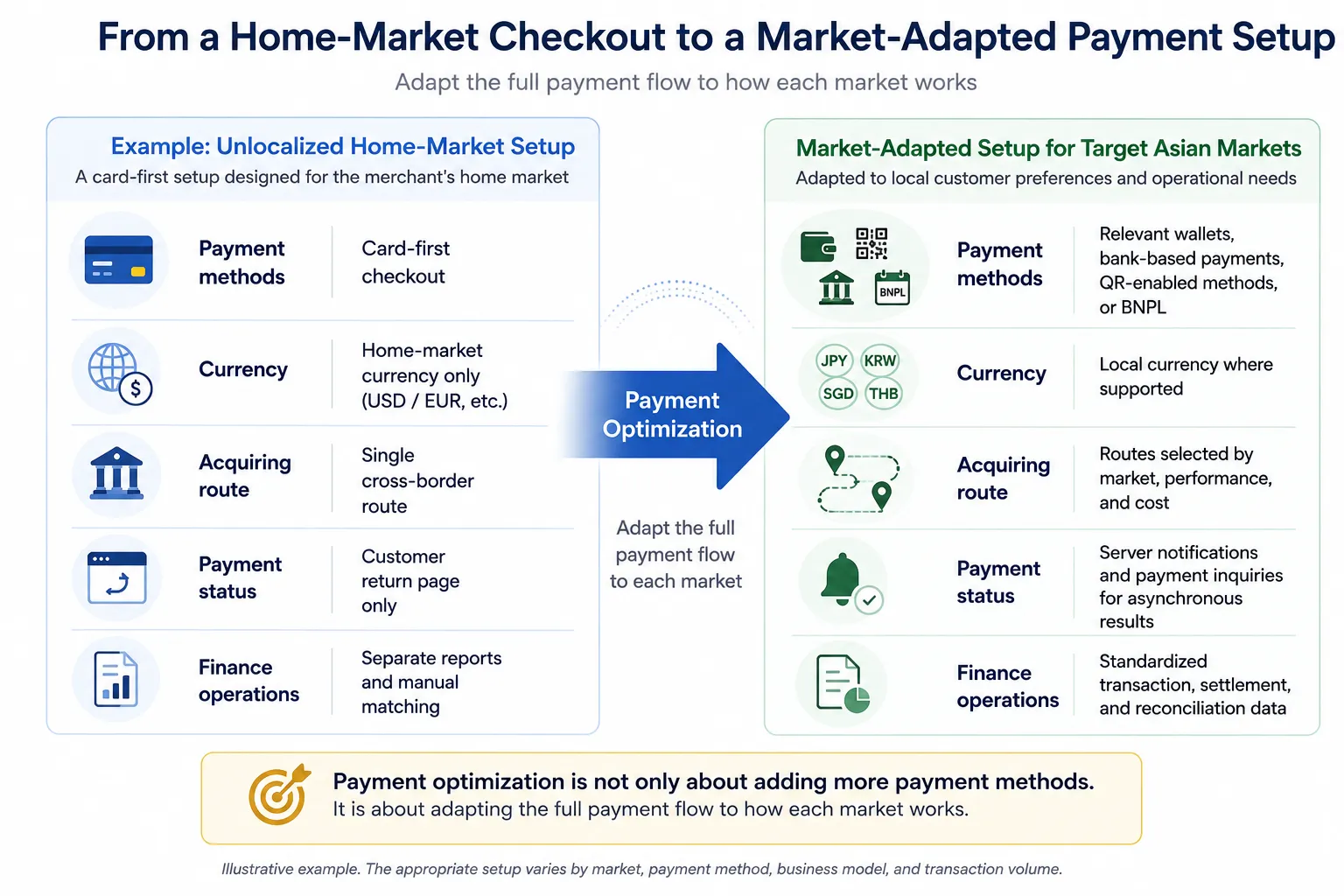
Merchants may need to choose between local and cross-border acquiring, decide which local payment methods justify integration, manage different payment-status models, and bring varied settlement reports into one finance process.
Local acquiring allows eligible transactions to be processed through an acquirer in or near the customer’s market. Depending on the setup, this may affect issuer recognition, authorization performance, and cross-border processing costs. In some circumstances, it can improve authorization performance or reduce cross-border processing costs.
It is not automatically the best option.
The merchant may also need to consider:
- local entity requirements;
- compliance;
- settlement accounts;
- implementation effort;
- transaction volume;
- reporting and reconciliation.
The same caution applies to multi-PSP setups.
A second provider may add resilience, market coverage, or stronger route performance. It may also introduce additional APIs, contracts, data formats, settlement schedules, and operational work.
Payment optimisation should reduce avoidable complexity—not create complexity without measurable value.
What Good Payment Optimisation Looks Like
A strong payment optimisation program returns to three principles.
It is a process, not a feature.
Merchants diagnose, test, measure, and adjust. They do not treat one new tool as a permanent answer.
It extends beyond authorization.
Checkout, authentication, capture, settlement, refunds, and reconciliation all affect how much revenue the merchant finally receives and can account for.
It balances several outcomes.
Payment success matters, but so do fraud, cost, customer experience, compliance, reliability, and operational effort.
A more useful question is not: How do we approve every possible payment?
It is: How do we help more legitimate payments get captured, settled, and matched to the correct order?
How Antom Supports Payment Optimisation
At Antom, we treat payment optimisation as more than a single tool or routing decision. Our optimisation capabilities currently include Antom Payment Orchestration(APO) and Card Revenue Booster, which address different layers of payment performance.
Aspect | APO | Card Revenue Booster |
Primary scope | Payment orchestration across acquirers and payment methods | Card payment performance optimization |
Main purpose | Manage payment connections, routing, transaction operations, reporting, and reconciliation | Improve card authorization rates and recover lost revenue |
Routing role | Routing within a multi-acquirer, multi-payment-method orchestration layer | Routing within a card-payment optimization and recovery stack |
Optimization logic | Routes transactions based on acquirer health, historical success rates, BIN/country signals, and merchant rules | Optimizes authorization strategies, retries, and recovery actions for card payments |
Key capabilities | Integration management, acquirer/payment-method management, transaction management, reporting, reconciliation | Authentication/authorization optimization, adaptive retries, tokenization, account updater |
Best fit | Merchants managing multiple acquirers and payment methods | Merchants focused on improving card payment performance |
Through Antom Payment Orchestration, we help merchants manage acquirer and payment-method connections, routing rules, transaction operations, reporting, and reconciliation within a broader payment management layer.
APO provides access to more than 100 acquirers and more than 300 payment methods, together with unified integration standards, smart and custom routing, transaction management, and financial reporting. The connections available to each merchant depend on supported configurations, acquiring agreements, and account activation.
We also provide standardized reconciliation reports for selected acquirers.
In this context, payment optimisation is not one smart-routing switch. It brings together several areas of payment management:
Integration | Acquirer and payment-method management | Routing | Transaction operations | Reporting | Reconciliation
Card Revenue Booster focuses more directly on card-payment performance. It includes Credential Lifecycle Management, Authentication Intelligence, Adaptive Messaging, Active Retries, and Smart Routing. Credential Lifecycle Management includes Network Tokenization and Account Updater services.
These capabilities are designed to support stronger card-payment performance, reduce avoidable declines, and reduce manual operational work.
Although both products include routing capabilities, they serve different purposes. APO uses routing as part of a broader multi-acquirer orchestration layer. Card Revenue Booster combines routing with card-specific authentication, credential, messaging, and retry optimisation.
Together, these capabilities reflect how we approach payment optimisation:
Improve how customers pay, how transactions are processed, and how merchants manage transaction and financial outcomes.
FAQs
What is payment optimisation?
Payment optimisation is the ongoing process of improving how payments move from checkout through authorization, settlement, and reconciliation. The goal is to help more legitimate payments succeed while controlling fraud, cost, customer friction, and operational complexity.
How is payment optimisation different from payment orchestration?
Payment optimisation is the broader business objective. Payment orchestration is a technology and management layer that can support that objective by connecting payment providers, applying routing rules, managing transaction flows, and standardizing payment data.
A merchant can optimize payments without using an orchestration platform. However, orchestration may become more useful as the number of markets, payment methods, acquirers, and PSPs increases.
How can merchants improve payment authorization rates?
Merchants can review decline reasons, improve transaction data, keep stored credentials current, apply authentication appropriately, and compare acquiring or routing performance. The right action depends on why the payment was declined; repeatedly retrying every failed transaction is not an optimisation strategy.