


Share on
Today’s travel merchants operate in one of the most complex payment environments. Almost every other booking involves cross-border transactions. These are marked by extended fulfilment windows, which can create a chaotic web of security checks and currency conversions that strain cash flow.
As travel demand continues to grow, payment infrastructure often struggles to keep pace. Skift Research estimates that by 2028, travellers globally will take 1.4 billion cross-border trips. This will be a 17% increase from 2019. A number like this illustrates the huge potential for travel merchants. It eventually translates into higher transaction volumes for travel merchants and a greater exposure to fraud.
Our guide reveals the hidden challenges of travel payment processing and how merchants can address them with more resilient, scalable infrastructure.
Common Challenges in Travel Payment Processing
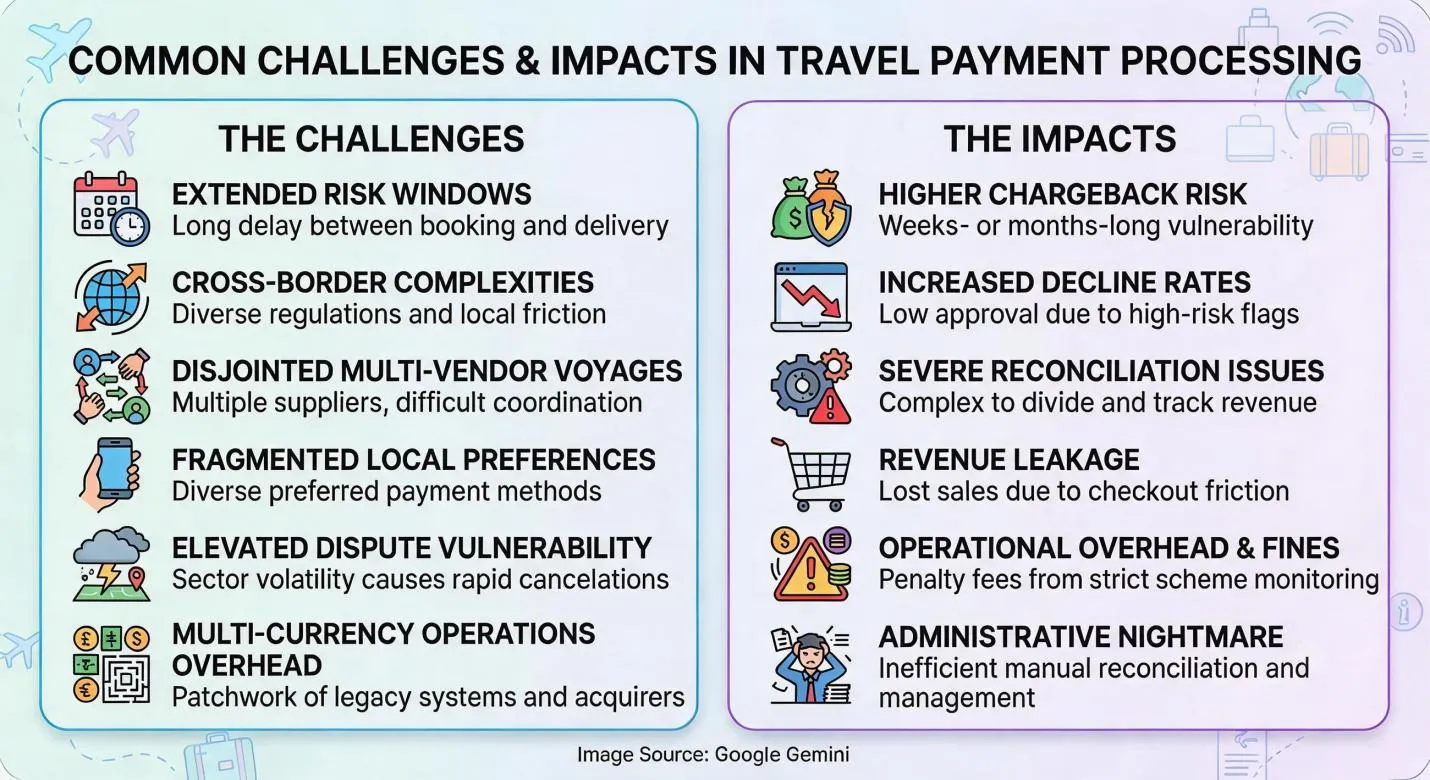
Unlike standard e-commerce transactions, a single travel booking often requires coordination across multiple currencies. There is also the passing of sensitive data through multiple legacy systems. When these systems don’t interact, there could be problems.
Some challenges to know about are:
Extended Risk Windows and Fulfilment Delays
The Challenge: Travel bookings often feature exceptionally long times between payment collection and service delivery. This weeks- or months-long delay drastically expands the merchant’s window of vulnerability. For example, a holiday booked nine months in advance can remain open to chargebacks for up to four months after travel. This creates more than a year of payment risk for merchants.
The Impact: This extends the transaction risk lifecycle for travel merchants. Chargebacks may occur weeks or even months after travel completion. This increases the risk of revenue loss and dispute-handling costs. Extended risk windows also increase dependency on card account updater services and fraud monitoring systems.
Cross-Border Complexities and Local Fragmentations
The Challenge: Serving an international clientele means routing money across a diverse landscape of localised regulations. Merchants have to deal with strict authentication protocols (such as Europe’s Strong Customer Authentication) and varying issuer risk appetites.
The Impact: International transactions face inherently higher decline rates when foreign issuing banks flag them as high risk. When there’s no localised routing, travel merchants suffer from low transaction approval rates. There are unexpected cross-border interchange penalties and significant foreign exchange (FX) slippage.
Disjointed Multi-Vendor and Split Journeys
The Challenge: Partnering with a cross-border business often involves multiple payments. The merchants may have to communicate and send payments to multiple supplier groups. Coordinating the incoming revenue and dividing it correctly among different businesses creates an operational nightmare.
The Impact: Managing these complex supplier ecosystems manually leads to severe reconciliation issues for online travel agencies (OTAs) and marketplaces. According to Statista, more than half (55%) of travel payment leaders say payment costs are their primary concern.
Fragmented Local Payment Preferences
The Challenge: Modern travel businesses want a frictionless checkout using the regional payment methods they trust. This could include domestic bank transfers, regional digital wallets, or Buy Now, Pay Later (BNPL) options where available. Platforms such as Antom (an AI-driven global payment platform) allow travel merchants to access over 300 local payment methods across 200 markets through a single integration. These include BNPL options in supported regions.
The Impact: Lack of payment methods can affect conversion rates. Merchants with high acquisition costs may notice that even small increases in checkout friction can lead to significant revenue leakage. The prospects pull out of the sales funnel before they check out. This often leads to lost revenue at the payment stage.
Elevated Chargeback and Dispute Vulnerability
The Challenge: The travel sector is likely to be volatile. For example, there could be weather anomalies, sudden strikes, geopolitical events, and systemic supplier failures.
In fact, according to a global report, these exact disruptions cause nearly nine in ten business trips to deviate from their plan. This can cost U.S. companies alone over $17 billion annually in unexpected accommodations, rebooking premiums, and logistics costs.
The Impact: When disruptions occur, mass waves of cancellations rapidly lead to a surge in payment disputes. There is an immediate loss of revenue. Plus, high chargeback volumes trigger operational overhead, penalty fees from card networks, and the risk of being placed on strict scheme monitoring programmes by acquiring partners.
Multi-Currency Operations and Global Acquiring Overhead
The Challenge: It’s evident that merchants today have to offer multi-currency pricing, settlement, and reconciliation. Their coverage area must cover multiple regions while maintaining competitive FX margins.
The Impact: To maintain high approval rates, merchants often assemble a network of local acquirers in each region where they operate. Local acquiring works. For example, it definitely boosts payment success. However, managing a messy patchwork of disconnected processors creates an administrative nightmare behind the scenes.
According to cross-border commerce analyses, merchants who successfully deliver localised pricing experiences see international conversion rates increase by 30% to 45%.
Solutions to Common Travel Payment Challenges
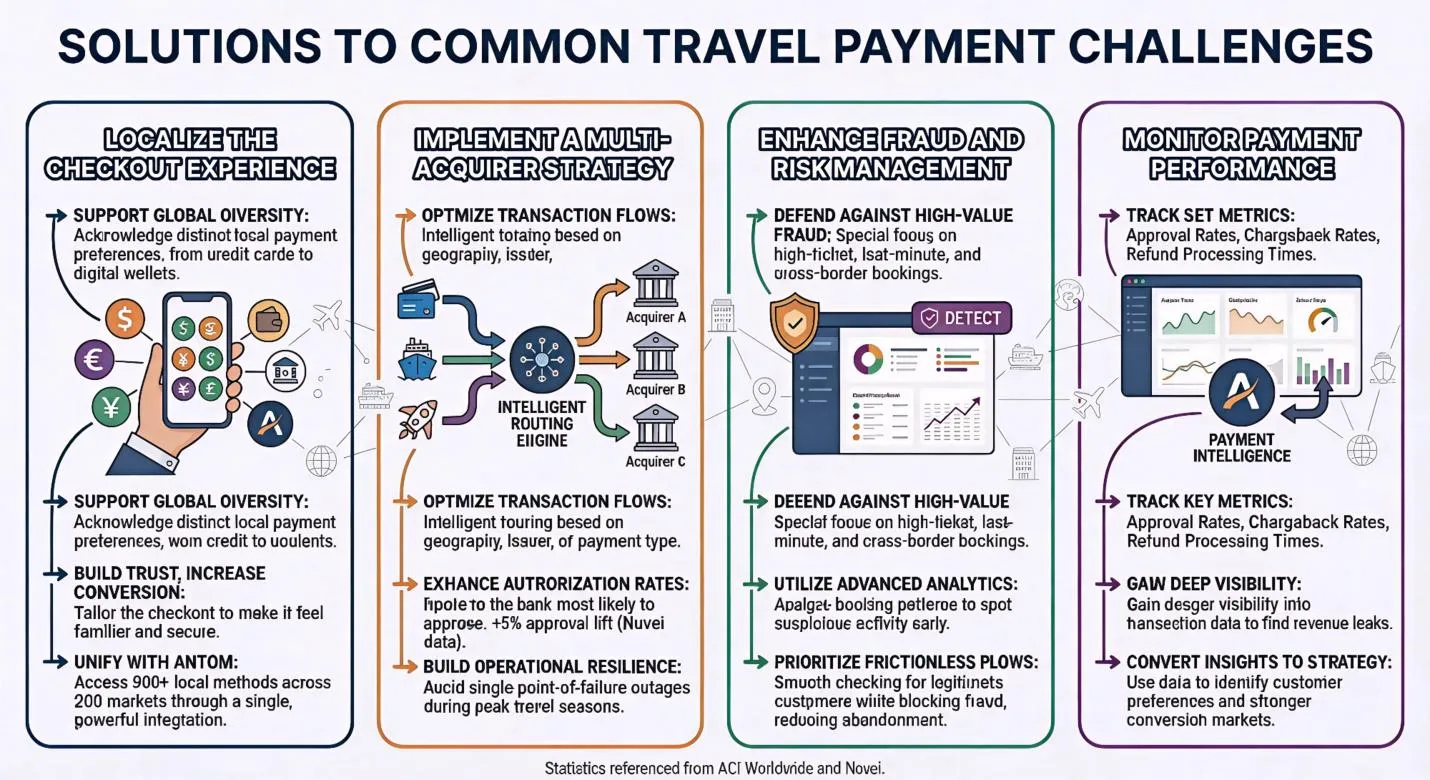
Overcoming the obstacles of travel payments requires moving away from rigid legacy setups toward unified financial networks. A few solutions that travel merchants can use are:
Localise the Checkout Experience
Merchants must align payment methods with regional expectations. Supporting local cards, bank transfers, and digital wallets improves authorisation rates and reduces checkout friction.
A global merchant platform like Antom can help travel brands to bridge this gap. Businesses can access multiple local payment methods across different markets with a single integration.
Implement a Multi-Acquirer Strategy
Deploying a multi-acquirer strategy allows international travel merchants to route transactions through a network of multiple acquiring banks, so merchants don’t rely on a single institution. Rather, the strategy helps prevent revenue loss during regional outages or peak booking periods.
Redundancy at this level builds vital operational resilience. This can protect travel brands from sudden, costly single-point-of-failure outages during peak booking seasons.
Research found that 85% of merchants who adopt a multi-acquirer approach see an immediate improvement in conversion rates. Further data shows that using multiple acquirers to route cross-border payments more effectively can increase transaction approval rates by up to 5%. This can help high-volume travel brands recover revenue that may otherwise be lost.
Enhance Fraud and Risk Management
Travel payments are a common target for fraud due to their high value. There can be last-minute purchases and transactions made across different locations. This makes risk detection more complex for merchants.
Businesses can reduce exposure to fraud by using solid prevention tools. Some of these tools can analyse booking patterns and transaction behaviour in real time. For example, Antom Shield, with its advanced solutions, can help travel merchants detect suspicious activity early on. This allows them to provide a smooth checkout experience for legitimate partners.
Monitor Payment Performance
The challenges listed above reflect that travel businesses should regularly track payment performance. This helps them figure out what’s working and what’s not. Important metrics to look at include approval rates, chargeback rates, and refund processing times.
Using payment intelligence tools such as Antom can help merchants gain deeper visibility into transaction data. This lets them identify revenue leaks and optimise payment flows across different markets.
Leading travel companies now view payment insights as more than just financial reporting. The data from these reports tells them about customer preferences. They discover markets with stronger conversion rates and show which payment methods drive higher-value bookings.
Conclusion
The global travel landscape is expanding rapidly. It brings with it an unprecedented volume of cross-border opportunities. And capturing this growth requires more than just appealing to itineraries. It needs a resilient and highly flexible payment infrastructure.
Ultimately, payments shouldn’t be the reason a traveller abandons a booking or switches to a competitor. Try to turn your payment strategy from a back-office challenge into a growth tool. This can help your business scale with the expanding travel industry. Just keep your entire focus on creating smoother experiences that turn every booking into a successful journey.
Frequently Asked Questions (FAQs)
What are network tokens? And how do they reduce travel booking friction?
Network tokens replace sensitive 16-digit card numbers with merchant-specific digital tokens, which card networks automatically update when card details change—preventing payment failures during long booking windows.
How do AI agents affect travel payments? And how can merchants prepare?
Agentic commerce is now allowing AI assistants to complete travel bookings within users’ defined spending limits. Merchants should ensure their payment systems can authenticate AI-driven transactions and distinguish them from fraudulent bot activity.
What is "friendly fraud" in travel? And how do clearer transaction descriptors stop it?
Friendly fraud occurs when customers dispute legitimate travel charges that they fail to recognise. Clear and precise transaction descriptors reduce this by helping them identify the booking source.