


Share on
A few years ago, going global was the ultimate growth milestone for companies. Today, it’s just business as usual until you hit the invisible walls of international payments.
Moving your business across borders brings revenue. At the same time, it hooks you into a high-stakes game of regulations and cross-border fraud. You have to juggle local compliance laws and fight off fraud plans that exploit cross-currency blind spots. However, managing global transactions shouldn’t feel like walking a tightrope in a storm.
But how do you scale without sacrificing security? This guide sheds light on how to create compliant, fraud-resistant international payment solutions.
The Biggest Challenges of Global Payment Gateways
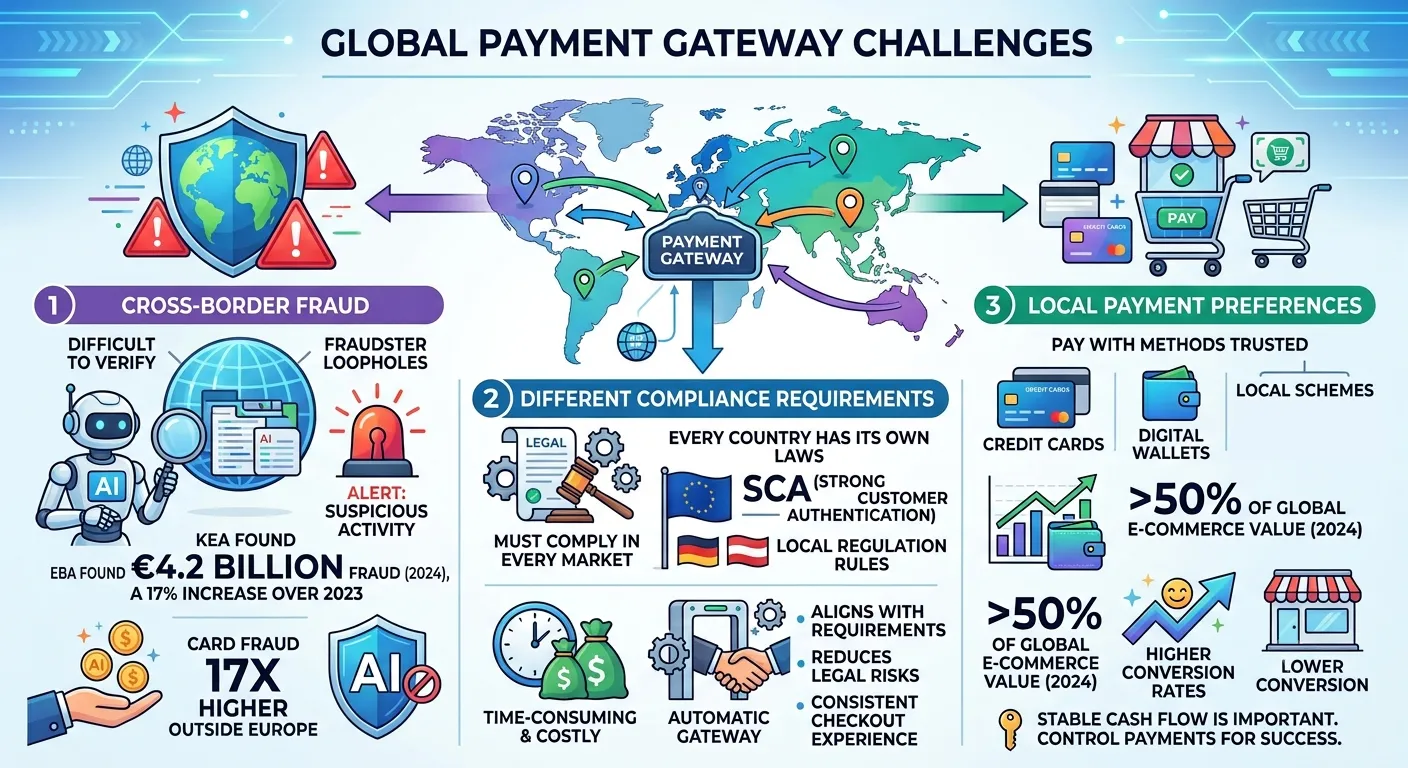
A few challenges global merchants face when entering new markets are:
Cross-Border Fraud
Generally, international transactions are more difficult to verify than domestic payments. The different payment methods create loopholes for fraudsters.
European Banking Authority (EBA) found that payment fraud across Europe reached €4.2 billion in 2024. This was a 17% increase over the previous year. The report also found that card payment fraud is 17 times higher when the payment recipient is outside Europe.
Today, payment gateways have AI-powered fraud detectors. They can spot the risks and monitor transactions closely. An alert is initiated whenever they spot suspicious activity.
Different Compliance Requirements
Every country has its own payment laws. An international business must comply with the requirements of the region it is expanding to.
For example, Europe requires Strong Customer Authentication (SCA). Similarly, other regions have different verification rules. Needless to say, complying with regulations across multiple markets can be time-consuming and costly.
An automatic payment gateway will align with these requirements. When done right, it can reduce legal risks, helping a business to provide a consistent checkout experience.
Local Payment Preferences
Prospects prefer paying with the methods they trust. Some believe credit cards are the safest option, while others prefer digital wallets or local payment schemes.
According to a Global Payments Report 2025, digital wallets accounted for more than 50% of the value of global e-commerce transactions in 2024. This shows how they’re the world’s most popular online payment method.
When a business doesn’t integrate preferred payment methods, it may face issues such as lower conversion rates.
These are a bunch of problems an international business usually comes across. It’s highly important for an expanding venture to have a stable cash flow. A solid control over international payment challenges is one way to achieve this.
Relying on a platform like Antom could be your best bet in this scenario. Its Antom Shield risk management engine works as a comprehensive defence framework. The tool is specifically designed for high-stakes cross-border environments. It can cross-reference transaction variables in real time to spot fraud before it reaches your bottom line.
Top International Payment Solutions for Modern Business Challenges
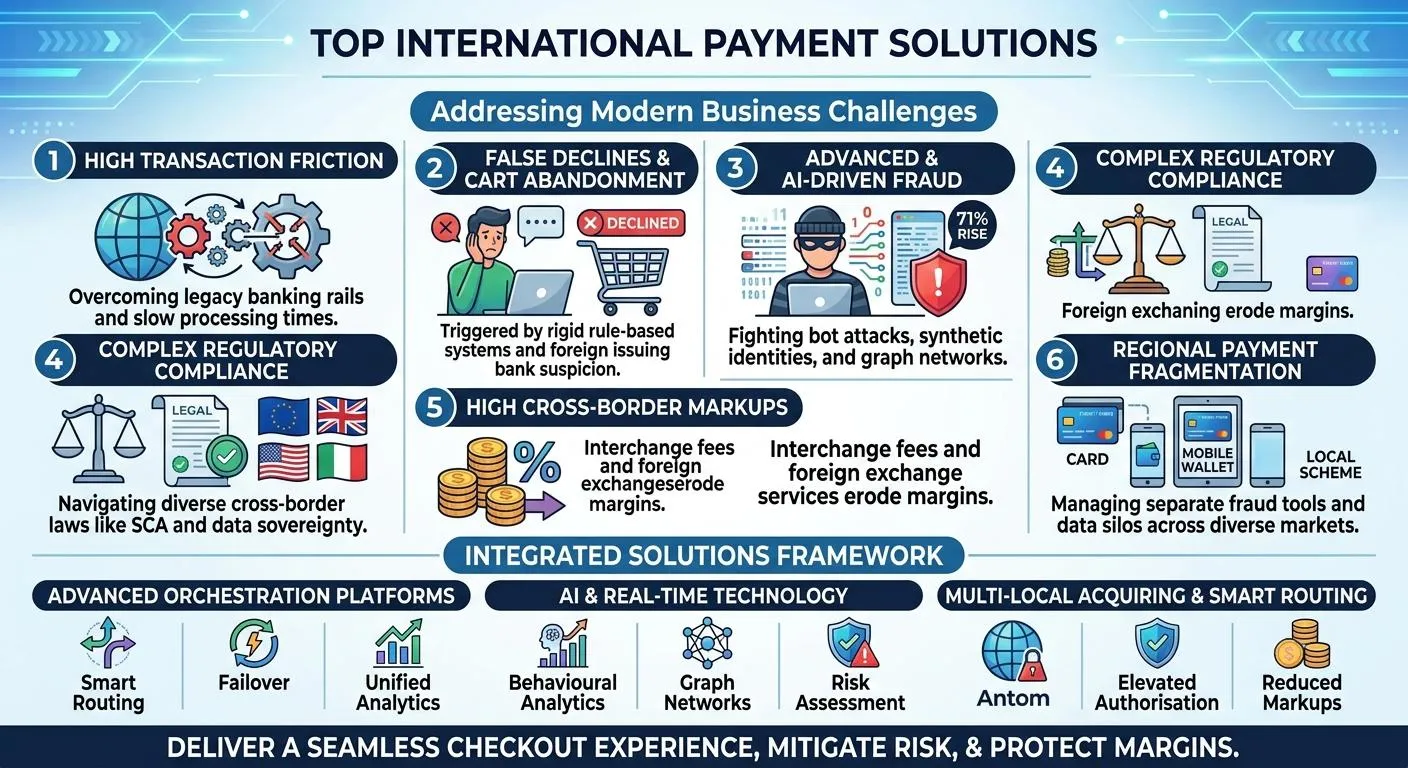
Overcoming international transaction friction requires moving past legacy banking rails. Forward-thinking enterprises use tech-driven payment solutions to protect their margins. The best solutions they’re using nowadays are:
Advanced Payment Orchestration Platforms
Payment orchestration serves as an intelligent routing layer between a checkout page and a global payment processor. Instead of tying a business to a single payment gateway, an orchestration platform puts each transaction through an efficient path. These include:
- Smart Routing for High Authorisation: The orchestration engine instantly reroutes the transaction to a local acquirer in a certain region if there is an international processor. This keeps legitimate sales from being falsely declined.
- Failover Redundancy: If one payment gateway doesn’t work, the platform will switch to a backup provider. This can protect the business revenue.
- Unified Data Analytics: Orchestration combines all global transaction data onto a single dashboard. The risk teams can spot what’s causing the fraud and hidden elements in regional payment silos.
Using a platform like Antom can be a way to mitigate current risks. Its localised payment capabilities allow businesses to connect with over 300 global and local payment methods in more than 200 markets. Combining broad payment coverage with built-in compliance can help a business deliver a seamless checkout experience.
AI and Real-Time Technology
Conventional fraud prevention worked on a rule-based logic. If an order exceeded a certain amount or originated from a specific zip code, it was automatically flagged or blocked.
These parameters are rigid and pose a roadblock to international payments. They trigger high numbers of false positives. On the contrary, modern cross-border defence requires instant payment dispatch rather than delayed analysis.
According to a 2026 Fraud Trends Report, 71% of organisations experienced a notable increase in AI-driven fraud attempts over the past year. Such a rise in fraud means businesses can no longer afford to review international transactions hours after they occur.
This is why modern payment platforms integrate artificial intelligence directly into the payment rail. They can process complex risk evaluations in milliseconds through three core capabilities:
- Behavioural Analytics: Modern AI looks past basic static identity metrics. It analyses precise telemetry markers (such as subtle hesitation patterns during checkout and navigation speeds). Any discrepancy can help them identify an automated bot or malicious entity.
- AI-driven Graph Networks: Hackers today use fake accounts and stolen credit cards. They can disguise themselves as financial institutions and crawl into any business network. AI-driven graph analytics can spot these anomalies before a transaction is approved.
- Risk Assessment: Machine learning uses certain algorithms to process transactions. If an international transfer shows zero risk signals, it flows without any problems. But if it raises red flags, it runs an authentication check. For example, they may ask for biometrics or a one-time passcode.
Artificial Intelligence has brought a drastic improvement in transaction processing. A business, regardless of its size, cannot anticipate success if it doesn’t integrate a well-designed AI monitoring system into its payment processing.
Local Acquiring and Smart Routing Architecture
The single most effective way to eliminate cross-border payment drop-offs is to hide the fact that the payment is international.
When you route a cross-border payment through a traditional domestic bank, the customer’s issuing bank often treats the foreign request with suspicion. This mismatch triggers fraud filters and leads to soft declines. Multi-local acquiring fixes this by processing the payment through a financial institution in the buyer’s region.
This can lead to:
- Elevated Authorisation Rates: When an issuing bank gets a request that flows through its own domestic network, it trusts and processes it without any delays. Shifting to local acquiring is one way to remove the international risk flags. As a result, the business can reclaim a large share of sales that would otherwise be lost to false declines.
- Fewer Cross-Border Markups: Standard cross-border transactions have high interchange markups and service charges. Local processing of these transactions allows merchants to use domestic interchange fee schedules. They may notice an improvement in the transaction margins.
- Smart AI Routing: Leading global payment service providers, such as Antom, natively integrate this multi-local architecture into their routing logic. Its intelligent routing engine studies transaction data points in real time. The finance team identifies the specific regional acquirer best positioned to clear the payment.
Managing separate fraud-prevention tools across markets is one way to handle it. But it can eat a lot of a company’s time and money. Businesses can use Antom Shield to monitor global transactions through a unified risk-management system. Its AI-powered fraud detection can detect suspicious activity in real time. The business is alerted to fraud well before it seeps into its structure.
Conclusion
Spreading a business across borders will always mean walking through a shifting landscape of regional regulations and compliance frameworks. Remember, fraud syndicates are actively working to progress their activities. A business must play its part in addressing it and protecting its revenue.
So, as the global payment ecosystem evolves, security doesn’t have to come at the expense of scale. The businesses winning the international market are the ones that use an agile infrastructure. The global market is ready and brims with international payment solutions.
Don’t just survive the transition. Work to stay on the edge and protect the business revenue as much as possible!
Frequently Asked Questions (FAQs)
1. Why does a business experience higher chargebacks on international sales than domestic ones?
International transactions often have higher chargebacks due to currency differences and strange merchant names. Not only this, but longer delivery times can confuse the stakeholders in other countries. Also, hackers target cross-border payments because they are harder to verify and investigate.
2. What is the difference between standard payment gateway encryption and network tokenisation?
Standard payment gateway encryption protects card details during transmission. It is then stored securely. On the other hand, network tokenisation replaces the card number with a unique token issued by the networks. This can improve payment approval rates and maintain security for future transactions.
3. How is synthetic identity fraud more difficult to detect in international payments?
Synthetic identity fraud combines stolen information with fabricated details to create convincing identities. The disguise is harder to detect across borders because businesses cannot verify foreign identities in real time. They have no other option but to rely on behavioural signals instead of database checks.