

Share on
Businesses that explore new global markets benefit from expanded opportunities for growth. But becoming a global merchant exposes them to complex payment operations. Consumers in different countries and regions have varying payment method preferences. There are also differences in technological adoption and regulations. This makes payment processing, settlement, compliance, and fraud prevention crucial considerations.
As a result, a payment facilitator (PayFac) emerges as an efficient way of simplifying these processes while also supporting business growth. PayFac provides a streamlined way to embed payment acceptance into a platform or marketplace. Instead of requiring every merchant to establish separate relationships with acquiring banks and payment providers, it manages key payment operations on their behalf.
What is a payment facilitator and why does it matter?
A payment facilitator (PayFac) is a payment service provider that enables platforms, marketplaces, and other businesses to accept payments on behalf of multiple merchants. For example, an e-commerce marketplace can use a PayFac to allow thousands of independent sellers to accept customer payments through a single integrated payment system. In this case, instead of every seller opening and managing their own merchant account with an acquiring bank, the PayFac acts as the master merchant and enables sub-merchants to process payments through its payment infrastructure. This model centralises key payment functions, including merchant onboarding, payment processing, settlement, compliance, and ongoing account management.
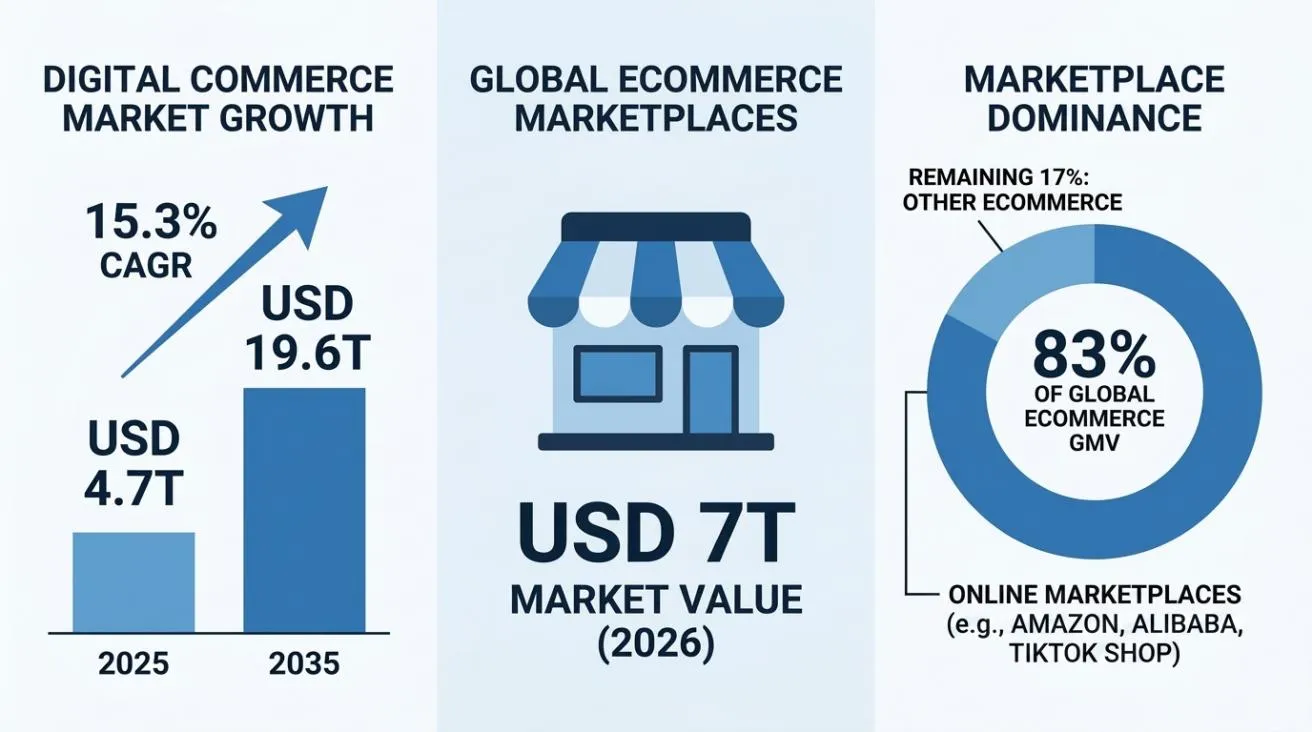
The PayFac model has become increasingly relevant today due to the growing demand for embedded financial services among businesses that support multiple merchants. For instance, the digital commerce market size will grow from USD 4.7 trillion in 2025 to USD 19.6 trillion by 2035. This reflects a compound annual growth rate (CAGR) of 15.3%. Similarly, global e-commerce marketplaces will generate approximately USD 7 trillion in 2026. This growth reflects the dominance of online marketplaces, which account for 83% of the global e-commerce gross merchandise value (GMV). These trends highlight the growing need for scalable payment solutions that can efficiently onboard merchants, manage payment operations, and support high transaction volumes across rapidly expanding digital platforms.
How to bring payments in-house
As businesses expand into new markets and manage growing transaction volumes, relying on disconnected payment providers can create operational inefficiencies and inconsistent merchant experiences. This highlights the significance of bringing payments in-house because it allows businesses to centralise payment operations within a single platform. Doing so gives them greater oversight of payment workflows while reducing reliance on multiple third-party integrations.
There are two ways a business can bring payments in-house:
- Use the traditional PayFac solution (which requires building substantial infrastructure in house): This involves partnering with an acquiring bank or an acquirer and a PayFac vendor. However, global merchants will need to build partnerships on a country-by-country basis, which can increase operational complexity as they expand into new markets.
- Partner with a commerce provider: This involves working with a provider that offers integrated payment capabilities through a single platform. This eliminates the challenges of managing multiple payment partners across different markets.
Build vs. partner with a PayFac
The table below summarises the estimated time and cost differences between building a proprietary PayFac infrastructure and partnering with an existing payment facilitator.
Consideration | Building a PayFac (estimated) | Partnering with a PayFac |
Implementation timeline | 6–18 months or longer. | Typically weeks to a few months, depending on integration complexity. |
Upfront investment | Merchant management system: USD 600,000+. PCI DSS validation: USD 50,000–USD 500,000. Licensing: USD 1 million+. | Significantly lower upfront investment because payment infrastructure, licensing, and compliance are already in place. |
Pricing model | Significant capital expenditure before processing payments. | Typically monthly SaaS fees (e.g., USD 500–USD 2,500 per month) and/or revenue‑sharing based on transaction volume. |
Understanding the payment facilitator model
For decades, processing card transactions was a complex process, especially for small businesses. They had to open a merchant account with an acquiring bank or a processor, wait for days or weeks for approval, fill out paperwork for onboarding, undergo underwriting reviews, and set up the hardware before they could start accepting payments.
The PayFac model simplified this process by allowing businesses to onboard through a master merchant instead of creating their own from scratch. This resulted in faster approvals and easier integrations. Businesses could now start accepting payments online or at a point of sale more easily and quickly. With the global adoption of popular payment platforms, the PayFac model has become a simpler and more efficient solution for many organisations worldwide.
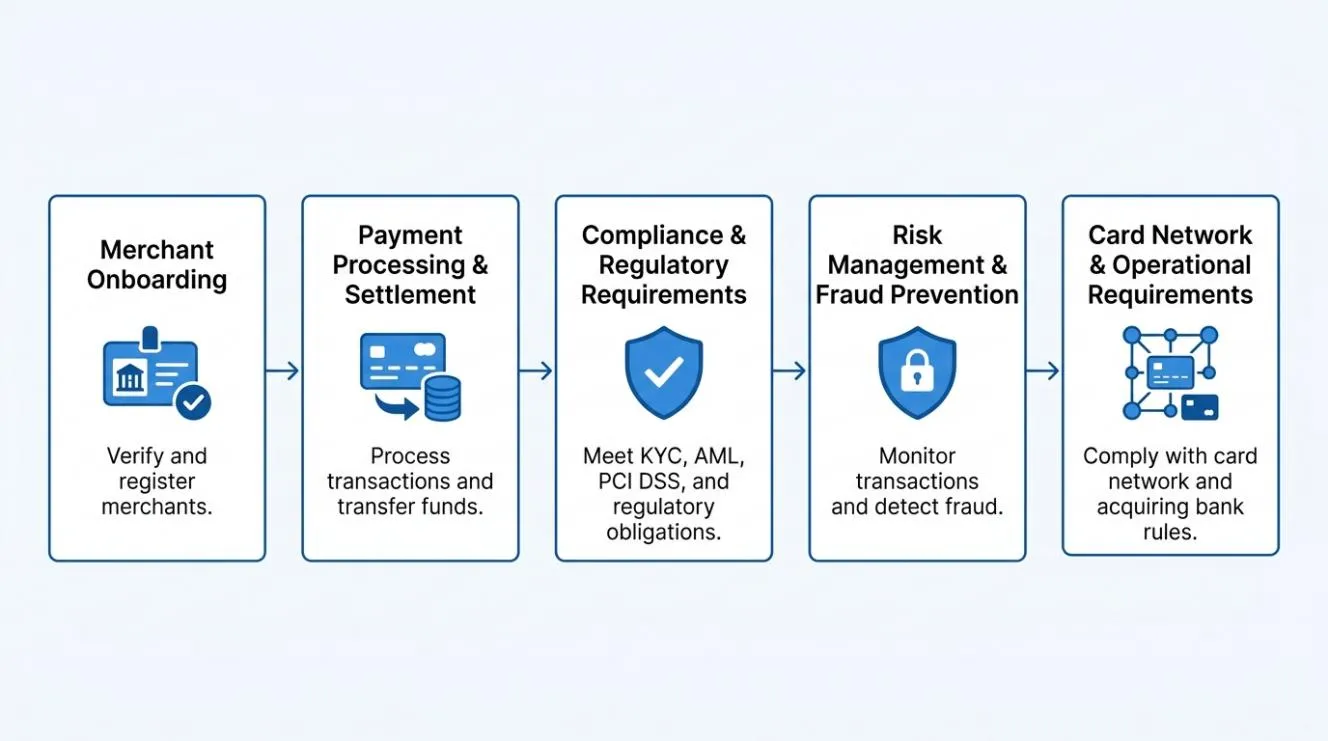
The PayFac handles multiple functions:
Merchant onboarding
PayFac is responsible for registering and verifying businesses before they can begin accepting payments. It replaces the traditional merchant account application with an automated signup process. The merchant completes a form that covers business information, ownership details, and the bank account for deposits.
Payment processing and settlement
The PayFac manages the flow of payment transactions between customers, merchants, acquiring banks, and card networks. For example, when a customer makes a payment, the PayFac’s infrastructure routes the transaction to the card network and the customer’s issuing bank for authorisation. The merchant sees the transaction on the dashboard. After processing the customer payments, the PayFac settles the funds to sub-merchants within the agreed settlement schedules.
Compliance and regulatory requirements
Every market has rules governing who can accept payments and how they must handle the payment data collected. This can complicate compliance for businesses that operate in multiple markets across the world. As a result, PayFac streamlines the compliance process by incorporating regulatory checks into its payment processes.
PayFac providers often perform checks, such as Know Your Customer (KYC) verification, anti-money laundering (AML) and sanctions screening, and the Payment Card Industry Data Security Standard (PCI DSS) compliance. This helps ensure that businesses meet the required legal and industry obligations in the markets they serve.
Risk management and fraud prevention
Payment risks don’t end after a transaction is approved. Businesses might encounter challenges like fraudulent transactions, chargebacks, account takeover attempts, or unusual payment activity. These can lead to significant financial losses and operational disruptions. PayFac infrastructure addresses these issues by integrating risk detection tools that allow businesses to continuously monitor transaction activity to identify suspicious behaviour, detect potential fraud, and respond to unusual payment patterns.
Card network and operational requirements
Accepting card payments involves more than processing transactions. Card networks and acquiring banks set operational standards that govern how payments are authorised, settled, disputed, and reported. By managing these requirements on behalf of merchants, a PayFac helps businesses participate in the card payment ecosystem without having to oversee these operational processes themselves.
What to look for in a payment facilitator
While providers may offer similar core services, their capabilities, geographic coverage, and level of support can vary significantly. For global merchants, PayFacs can influence the ability to expand to new markets and process international payments. Therefore, some factors they should consider when selecting a provider include:
Payment infrastructure
The payment infrastructure is the foundation of the services offered by a PayFac. It determines the security, reliability, and efficiency of payment processing across the entire payment lifecycle. When evaluating a provider, merchants should look for infrastructure that supports multiple payment methods, seamless system integrations, high transaction reliability, and the ability to scale as the business grows.
Onboarding efficiency
How quickly can the business start accepting payments?
An effective PayFac should support fast onboarding and reduce administrative effort while helping merchants become operational sooner without compromising compliance. Therefore, it should include features like digital identity verification, automated document collection, and efficient approval workflows.
Operational support
While payment processing is crucial, merchants shouldn’t underestimate the significance of access to operational support. For example, features like transaction reporting, payment reconciliation, dispute management, customer support, and developer resources can improve day-to-day payment operations. They can also make it easy for businesses to resolve issues more efficiently as they grow.
Global payment capabilities
Businesses that operate internationally or plan to expand require a PayFac with strong cross-border payment capabilities. In this case, the provider should support multiple currencies, local payment methods, international settlements, and merchant onboarding across your target markets. For example, a global merchant partnering with Antom can accept and process payments in over 200 markets worldwide. The platform also supports 300+ payment methods and over 140 currencies. This broad geographic coverage can simplify expansion while providing customers with familiar payment experiences.
Multi-regional licensing and compliance infrastructure
Global merchants should evaluate whether a PayFac holds the relevant licences in each target market. The table below outlines key regional frameworks.
Region | Examples of key licensing frameworks | Examples of key regulations and standards |
North America | United States: Money Transmitter Licences (MTLs) (state-specific). Canada: Retail Payment Activities Act (RPAA) registration (where applicable). | United States: Bank Secrecy Act (BSA), FinCEN AML requirements. Canada: Proceeds of Crime (Money Laundering) and Terrorist Financing Act (PCMLTFA). |
Europe | European Union: Electronic Money Institution (EMI) or Payment Institution (PI) authorisation. United Kingdom: Financial Conduct Authority (FCA) authorisation. | European Union: Payment Services Directive 2 (PSD2), Strong Customer Authentication (SCA), General Data Protection Regulation (GDPR). United Kingdom: Payment Services Regulations 2017, Electronic Money Regulations 2011. |
Asia-Pacific | Singapore: Major Payment Institution (MPI) licence. Hong Kong: Stored Value Facility (SVF) licence (where applicable).
| Singapore: Payment Services Act 2019 (PSA). Hong Kong: Anti-Money Laundering and Counter-Terrorist Financing Ordinance (AMLO). |
Middle East | United Arab Emirates: Retail Payment Services Licence. Saudi Arabia: Payment Services Provider (PSP) licence. | United Arab Emirates: Retail Payment Services and Card Schemes (RPSCS) Regulation. Saudi Arabia: Saudi Central Bank (SAMA) Payment Services Provider Regulations. |
Africa | Kenya: Payment Service Provider (PSP) licence. Nigeria: Payment Solution Service Provider (PSSP) licence or Payment Service Bank (PSB) licence. | Kenya: National Payment System Act and Regulations. Nigeria: Central Bank of Nigeria (CBN) Payment System Regulations. |
Final takeaway
A PayFac can simplify how businesses accept and manage payments. It consolidates merchant onboarding, payment processing, compliance, settlement, and risk management into a single solution. This unified solution reduces operational complexity and provides the scalability needed to support long-term growth for global merchants. Therefore, merchants looking to partner with a PayFac provider should consider more than payment processing features and evaluate other factors like integrations, global reach, and operational support. They should also ensure that the provider’s services align with their organisational goals.
FAQs
Are payment facilitators and payment processors the same thing?
A payment processor is different from a payment facilitator. While the processor offers the technical infrastructure that moves funds between banks and networks, a PayFac is a merchant service provider that simplifies this process by grouping small businesses under a single merchant account.
What costs should businesses consider beyond transaction fees?
In addition to transaction fees, businesses should evaluate onboarding, integration, chargeback, currency conversion, settlement, and other operational costs to understand the total cost of the payment solution.
Can a business become its own payment facilitator?
Yes, but becoming a PayFac requires significant investment in payment infrastructure compared to just integrating payment acceptance. Becoming a facilitator would require compliance programmes, risk management tools, support teams, monitoring systems, and partnerships with acquiring banks and card networks.