
Share on
As the largest economy in Southeast Asia, Indonesia has become the focal point for the global e-commerce and payment market, driven by its large consumer market, youthful demographics, and strategic geographic location. In 2024, the country's GDP is projected to reach USD 1.48 trillion. In terms of payment habits, e-wallets and bank transfers have emerged as the most widely used payment methods among Indonesian consumers.
PT Bank Maybank Indonesia Tbk (Maybank) is one of the leading online banks in Indonesia and part of Malayan Banking Berhad (Maybank Group), one of ASEAN's largest financial services groups.
Founded in 1959, Maybank obtained its foreign exchange banking licence in 1988 and was listed on the Jakarta and Surabaya Stock Exchanges in 1989, both of which are now integrated into the Indonesia Stock Exchange. The bank provides a comprehensive range of financial products and services for both retail and corporate customers. Maybank also places strong emphasis on corporate governance, implementing Good Corporate Governance (GCG) principles across all areas of its operations, including transparency, accountability, responsibility, independence, and fairness. Maybank is committed to becoming a leading financial services provider in Indonesia and has received multiple industry recognitions, including the Sustainable Finance Awards 2025 from Global Finance, the Euromoney Private Banking Awards 2025 from Euromoney, and the Retail Banking Awards 2025 from Asian Banking & Finance (ABF).
In Indonesia, Maybank serves more than 10 million customers through a network of over 300 branches. As of December 2024, the bank managed IDR 119 trillion in customer deposits and total assets of IDR 197.2 trillion. Maybank supports payments via bank transfers. This is particularly valuable for customer segments that remain less accustomed to digital payment methods, as well as consumers in regional and remote areas with growing purchasing power.
Properties
The following table lists the product properties supported by Maybank:
Payment type | Online banking | ||
Acquirer | AntomSG, AntomUS | Merchant entity location | SG, HK, US |
Payment flow | Redirect | Refund | ❌ |
Buyer country/region | Indonesia | Partial refund | ❌ |
Time to return payment result | Real-time | Refund period | ❌ |
Processing currency | IDR | Chargeback/Dispute | ❌ |
Minimum payment amount | IDR 10,000 | Customise the timeout | ✔️ |
Maximum payment amount | IDR 100,000,000 | Default timeout | 48 hours |
User experience
Note: The following payment flows on different terminals are for reference only. For supported merchants' terminal types, consult Antom Technical Support.
The following screenshots show the journey of paying with Maybank through app.
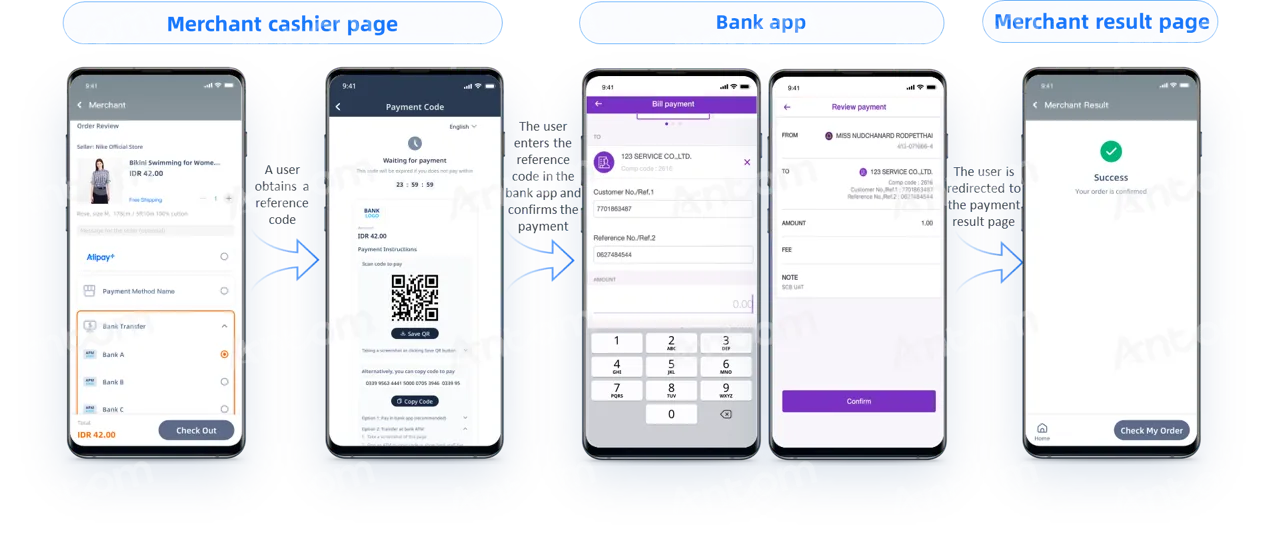
1. The buyer selects Maybank to pay.
2. The buyer obtains the QR code to scan.
3. The buyer enters the bill payment page.
4. The buyer confirms the payment.
5. The buyer is redirected to the merchant's result page.
FAQ
1. Does Maybank have a broad user base in Indonesia? Why?
Yes. Maybank has built a broad and well-established user base in Indonesia, driven by its extensive offline presence and highly localised digital banking services. As one of the leading foreign banks in Indonesia, Maybank has an extensive network that spans across major cities and key regions, ensuring wide accessibility for customers. In addition, its M2U ID App enables users to manage a wide range of financial services in one place, including opening savings accounts online, setting up time deposits, paying bills, transferring funds, topping up e-wallets, and accessing investment products—without the need to frequently visit physical branches. The app also features integrated QR payment functionality, supporting secure and seamless contactless transactions. By aligning closely with Indonesian consumers' growing preference for convenient, digital-first, and cashless payment experiences, Maybank has become one of the country's most widely used everyday financial platforms.
2. How does Maybank complement other Indonesian bank payment methods and e-wallets?
E-wallets account for 85% of Indonesia's digital payments market and are primarily used for small, high-frequency transactions. In contrast, Maybank, as a banking institution, is often preferred by users seeking greater fund security and support for medium- to large-value transactions. It also maintains a stable customer base in regional and emerging markets where traditional banking services remain important. Besides, Maybank complements local banking payment networks such as BNI and CIMB Niaga by serving different customer segments. Through Antom's unified integration capabilities, merchants can access a wide range of local payment methods, enabling comprehensive payment coverage across Indonesia while helping reduce checkout abandonment rates.
3. How does Maybank ensure account security?
Maybank employs a multi-layered security framework that includes two-factor authentication, transaction passwords, and real-time fraud monitoring. To address evolving cybersecurity risks, the bank also provides customers with guidance on topics such as phishing prevention and information security awareness. Protecting customer data and transaction security remains a key priority across Maybank's operations.
4. What security protections are available for merchants integrating Maybank credit and debit card payments through Antom?
Security and risk management are critical considerations for merchants. Antom leverages advanced technology capabilities to provide secure and reliable payment services. Our risk management system is rigorously tested to ensure transaction transparency and reliability across payment flows. In addition, Antom's fund management framework is designed to minimise risks, helping safeguard merchants' financial security.