


Share on
This article discusses why logistics payments are structurally complex, where they most commonly break down, and what merchants can do to build more reliable, efficient payment operations across global supply chains.
Why Logistics Payment Processing Is More Complex Than It Looks
On the surface, a logistics payment looks straightforward: goods move, services are rendered, invoices are issued, and payments are made. In practice, the process is considerably more involved.
A single cross-border shipment generates payment obligations to multiple parties: the carrier, the freight forwarder, the customs broker, and potentially warehousing and last-mile providers. Each of these operates on different billing cycles, in different currencies, and under different regulatory frameworks.
Standard payment infrastructure isn't designed for this environment. Consumer-facing payment systems are built around single transactions between two parties. Logistics payment processing involves multi-party settlements, high transaction values, variable timelines, and compliance requirements that shift by corridor.
Merchants who try to run logistics payments through general-purpose infrastructure tend to encounter higher failure rates, more reconciliation overhead, and greater exposure to compliance risk than those who build payment operations around the specific demands of cross-border freight.
Where Logistics Payment Processing Goes Wrong
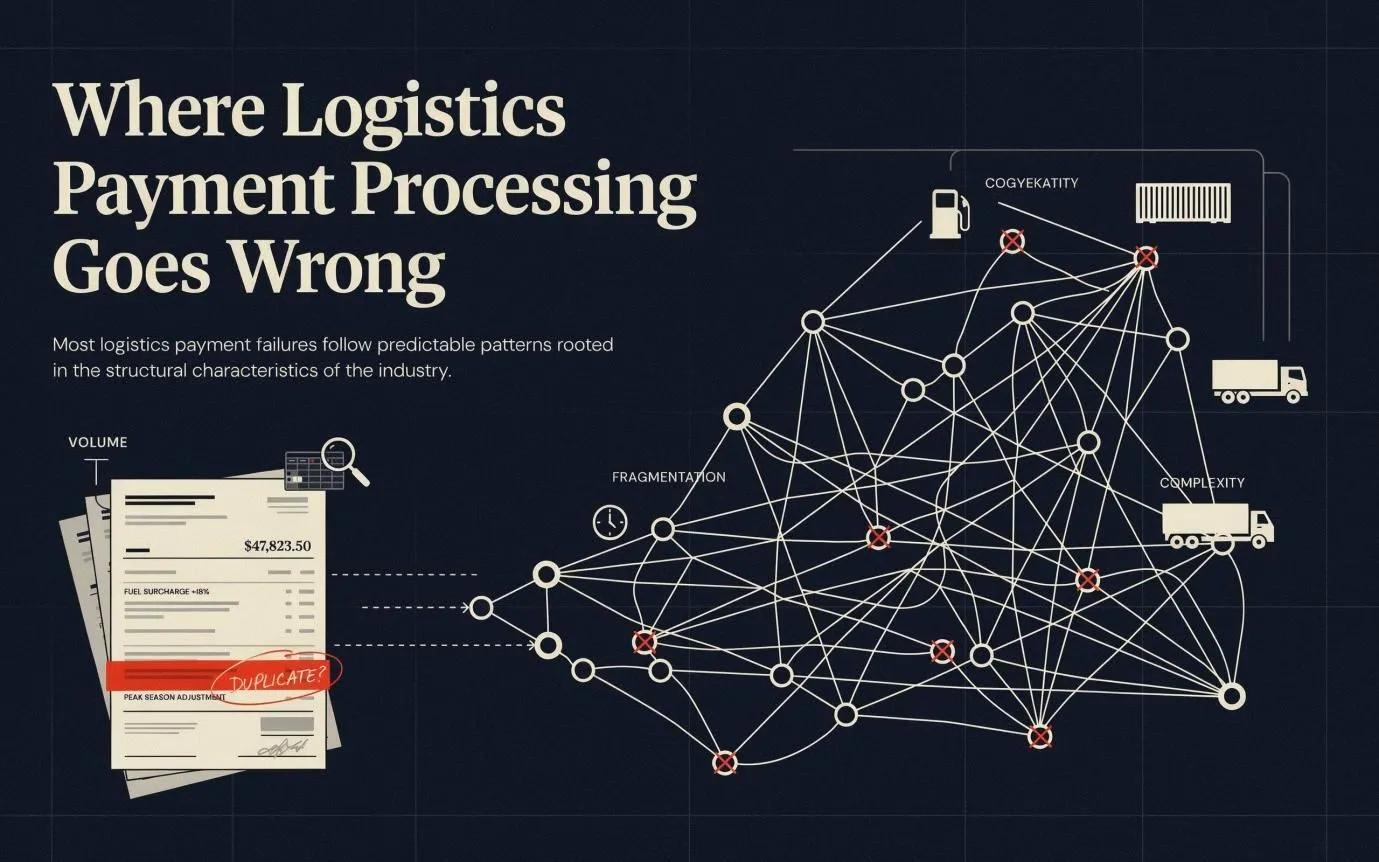
Most logistics payment failures follow predictable patterns rooted in the structural characteristics of the industry.
Volume is one factor. High-volume logistics operations generate large numbers of invoices from multiple sources simultaneously, and when those invoices are processed manually or through disconnected systems, errors accumulate. A duplicate charge or a mismatched reference number that would be caught immediately in a low-volume environment can go undetected for weeks when finance teams are processing at scale.
Fragmentation compounds the problem. When merchants are managing payment relationships with carriers, forwarders, and brokers across different regions through separate systems, there is no single view of what's been paid, what's pending, and what's in dispute. Reconciliation becomes a manual exercise, and by the time discrepancies are identified, payments have already moved.
Complexity in the underlying commercial relationships adds a further layer. Freight pricing is rarely static; fuel surcharges, peak season adjustments, and accessorial fees mean that the amount on an invoice frequently differs from the contracted rate, and without automated verification, those differences go unquestioned.
The Most Persistent Logistics Payment Processing Challenges
Carrier and Supplier Billing Disputes
Billing disputes between merchants and their logistics partners are among the most time-consuming payment challenges in the industry. They arise when invoiced amounts don't match contracted rates, when accessorial charges appear without prior agreement, or when the same service is billed more than once across different legs of a shipment.
The difficulty is that resolving a dispute requires both parties to trace the discrepancy back through shipment records, contracts, and payment histories. This process is slow when records are held in separate systems and slower still when those systems span different regions and time zones.
Multi-Party Settlement Complexity
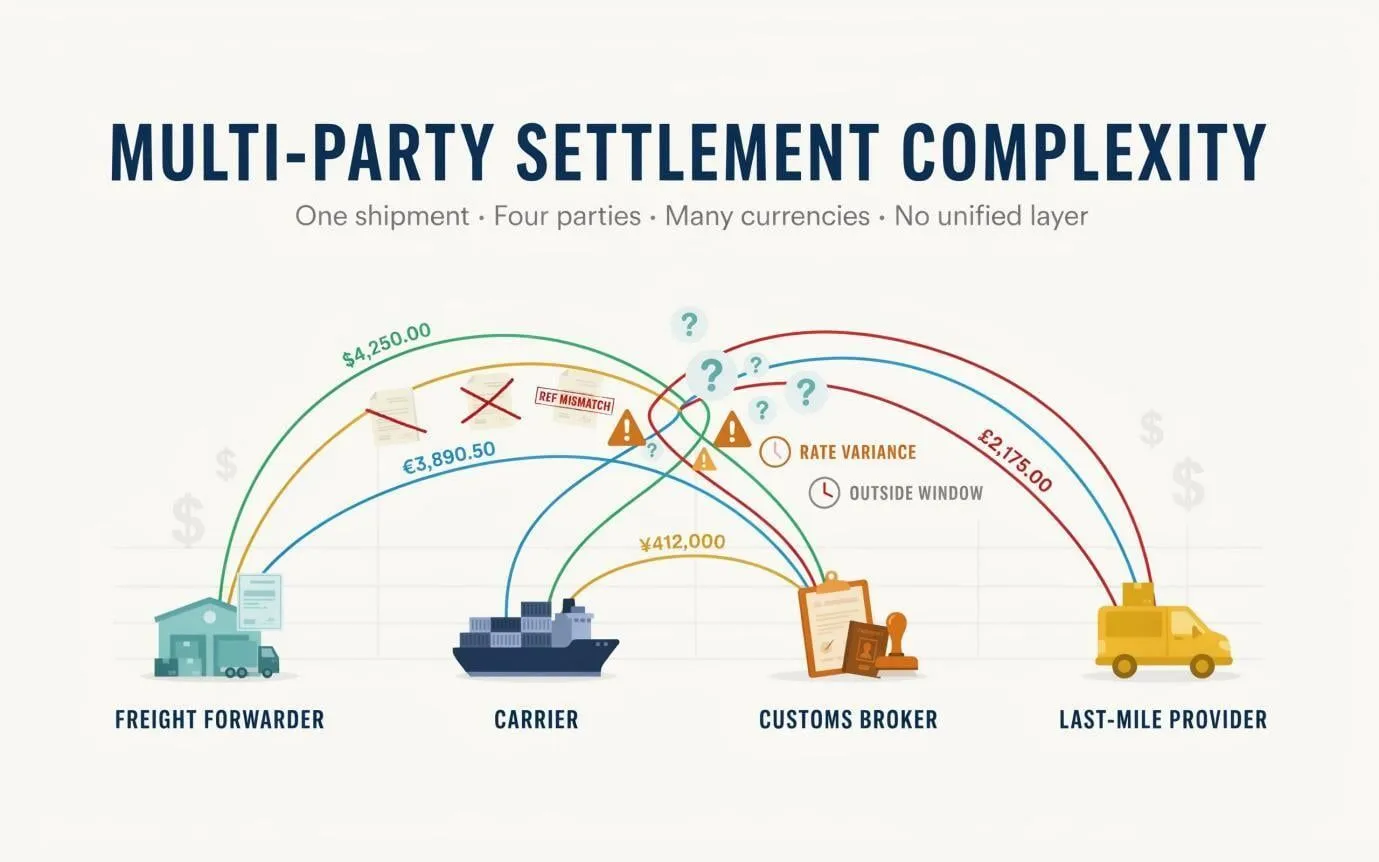
When a single shipment involves a freight forwarder, a carrier, a customs broker, and a last-mile provider, settling payment across all four parties in different currencies on different timelines is complex. Each party has its own invoicing format, its own payment preferences, and its own settlement expectations, and coordinating all of that without a unified payment layer requires significant manual effort.
Multi-party settlement creates multiple points at which payment data can become inconsistent. A payment reference that doesn't match across systems, a currency conversion applied at a different rate than expected, or a settlement that arrives outside the agreed window can each trigger a reconciliation issue that takes time to untangle. As shipment volumes grow, so does the overhead.
Cross-Border Regulatory and Tax Compliance
Every corridor in international logistics comes with its own regulatory requirements. Import duties, VAT obligations, withholding tax rules, sanctions screening requirements, and AML frameworks all vary by market and change frequently. For merchants expanding into Southeast Asia, the Middle East, or Latin America, keeping up with compliance obligations across multiple jurisdictions is a significant operational burden.
The consequences of non-compliance aren't limited to regulatory penalties. A payment held pending compliance review can delay a shipment, breach a service-level agreement, and damage a carrier relationship, costs that exceed the compliance overhead merchants were trying to avoid in the first place.
Working Capital Pressure From Uneven Payment Cycles
In cross-border logistics, outgoing payments to carriers, forwarders, and fulfilment partners rarely align with incoming settlements from customers. Merchants routinely pay logistics providers upfront or on short cycles while waiting significantly longer to receive payment from their own clients, and that gap has a direct impact on working capital.
The problem is more pronounced for merchants operating across multiple regions simultaneously. Settlement timelines vary by corridor, currency, and payment method, meaning the timing of incoming funds is difficult to predict with any accuracy. When several delayed settlements coincide, the shortfall has to be covered through credit facilities or reserves, both of which carry a cost.
Practical Ways to Address Logistics Payment Processing Challenges
Standardise Billing and Invoice Processes Across Partners
Establish a billing standard that applies consistently across your entire logistics partner network, specifying invoice format, mandatory reference fields, acceptable charge descriptions, and dispute escalation timelines.
Where possible, move to electronic invoicing with structured data fields that feed directly into your payment system. This makes automated invoice matching practical and removes the manual interpretation that introduces errors at scale.
Making compliance with your billing standard a condition of every new commercial agreement sets the right foundation. It also makes onboarding new logistics partners more straightforward, since a consistent data structure is easier to integrate into your payment system than a bespoke format for each new relationship.
Build a Unified View of Payment Obligations
Consolidating all payment activity across corridors, currencies, and logistics partners onto a single platform that updates in real time gives finance teams the visibility they need to manage cross-border payment operations effectively.
With a unified view, outstanding liabilities, payment status, and settlement timelines are accessible in one place rather than pieced together from multiple provider portals and spreadsheets.
The practical benefits extend across several areas of the business. Cash flow forecasting becomes more accurate when finance teams are working from real-time data rather than lagged reports from disconnected systems.
Dispute resolution is faster when payment histories and shipment records are accessible from the same interface. And identifying which corridors or partners are generating disproportionate payment overhead becomes a routine analytical exercise rather than a time-consuming investigation.
Match Payment Methods to Markets, Not the Other Way Around
Mapping your logistics payment flows against the payment infrastructure of each market you operate in, and ensuring your payment setup reflects those local realities, reduces failure rates and improves the experience for logistics partners on the receiving end.
Where a specific corridor has dominant local payment networks or established banking preferences, routing payments through those channels rather than defaulting to international card schemes produces materially better outcomes.
This matters because payment method suitability varies considerably across regions. The infrastructure that supports reliable settlement in Western Europe performs differently in Southeast Asia or the Middle East, where local payment networks, banking relationships, and settlement conventions follow different patterns.
Shorten Settlement Cycles Through Better Infrastructure
Reviewing your current payment arrangements with a focus on settlement timelines is a practical starting point. Many merchants accept slow settlement as an inherent feature of cross-border payments without examining whether their infrastructure is introducing delays that better-suited alternatives would avoid.
Local acquiring relationships in virtual accounts that reduce intermediary banking steps, and payment orchestration that routes transactions through the most efficient available channel all contribute to faster settlement without requiring fundamental changes to your commercial arrangements.
Shorter settlement cycles also improve the accuracy of cash flow forecasting. When settlement timelines are predictable and consistent across corridors, finance teams can plan more reliably.
How Modern Payment Platforms Support Logistics Operations
Purpose-built payment infrastructure addresses many of the challenges above in ways that general-purpose payment tools cannot. Payment orchestration is the ability to route transactions intelligently across multiple acquiring banks and local payment network. It reduces failure rates, improves settlement speeds, and provides a consolidated view of payment activity across all corridors through a single integration.
Antom brings together 300+ payment methods across 200+ markets into a single platform, enabling merchants to manage multi-currency settlements and transaction routing without maintaining separate payment arrangements for each corridor. For B2B merchants operating across multiple regions, that consolidation reduces reconciliation overhead and simplifies compliance management considerably.
Frequently Asked Questions
What is logistics payment processing?
Logistics payment processing refers to the financial settlements between merchants and their logistics partners, carriers, freight forwarders, customs brokers, and fulfilment providers. It involves multiple currencies, payment methods, and regulatory environments, making it considerably more complex than standard domestic payment processing
Why do logistics payments take longer to settle than standard transactions?
Logistics payments involve multiple intermediaries, cross-border banking networks, and compliance checks that add time to the settlement process. Currency conversion, varying banking infrastructure across markets, and high transaction values that trigger additional scrutiny all contribute to longer settlement timelines compared with domestic payments.
What should merchants look for in a logistics payment processing solution?
Multi-currency support, local payment method coverage across target markets, automated reconciliation capabilities, built-in compliance frameworks, and consolidated reporting are the key criteria. A solution that handles all of these through a single integration reduces operational complexity significantly compared with managing multiple specialist providers.