
Share on
The rise of digital payment solutions has made it easier than ever for businesses to cast a wider net and sell beyond their local markets. In fact, cross-border e-commerce is projected to grow from around $550 billion in 2025 to nearly $2 trillion by 2034.
As more businesses expand internationally, one challenge becomes impossible to ignore: creating a checkout experience that feels familiar to customers across different regions.
Payment preferences vary widely from one country to another. For example, digital wallets account for a large share of online purchases in Southeast Asia, but credit cards dominate the Japanese market. If businesses don't offer payment options that customers recognise and trust, they could lose sales. Their reach in valuable markets shrinks, and they cannot scale effectively.
In this guide, we'll explore the types of payment methods available today and the benefits they bring. We'll also cover how merchants can choose the right option for their business.
How Different Types of Payment Methods Influence Global Merchant Growth
The right payment methods can make or break your global expansion. Customer expectations are evolving with each passing day. This is a sign that one-size-fits-all models no longer work.
The table below illustrates the diversity of payment methods in different markets:
Market | Preferred Payment Methods | Benefit |
US and UK | Digital wallets | Faster checkout and secure payments through tokenisation |
France and Japan | Local card networks | Matches local payment preferences |
Germany and Malaysia | Bank transfers | Familiar and seamless checkout experience |
Mexico and Indonesia | Cash-based options, payment vouchers | Reaches customers without traditional banking access |
For further insights, the following table lists several top payment methods across different regions:
Region | Popular Payment Method | Market Insight for Businesses |
Indonesia | GoPay | Used by 71% of respondents in InsightAsia's survey, making it one of Indonesia's most widely used digital wallets. |
Indonesia | OVO | 70% of respondents had used OVO, with 53% continuing to use it regularly. |
Indonesia | DANA | Used by 61% of respondents; it remains one of Indonesia's leading digital wallets. |
Thailand | K PLUS | K PLUS has more than 23 million active users, making it one of Thailand's leading mobile banking apps. |
Southeast Asia | Digital Wallets | Digital wallets account for a significant share of online purchases across Southeast Asia. |
A cross-border platform like Antom can help businesses cater to diverse payment preferences in different markets, enabling them to accept payments through various channels, whether digital wallets, cards, or local payment methods.
Benefits of Different Types of Payment Methods
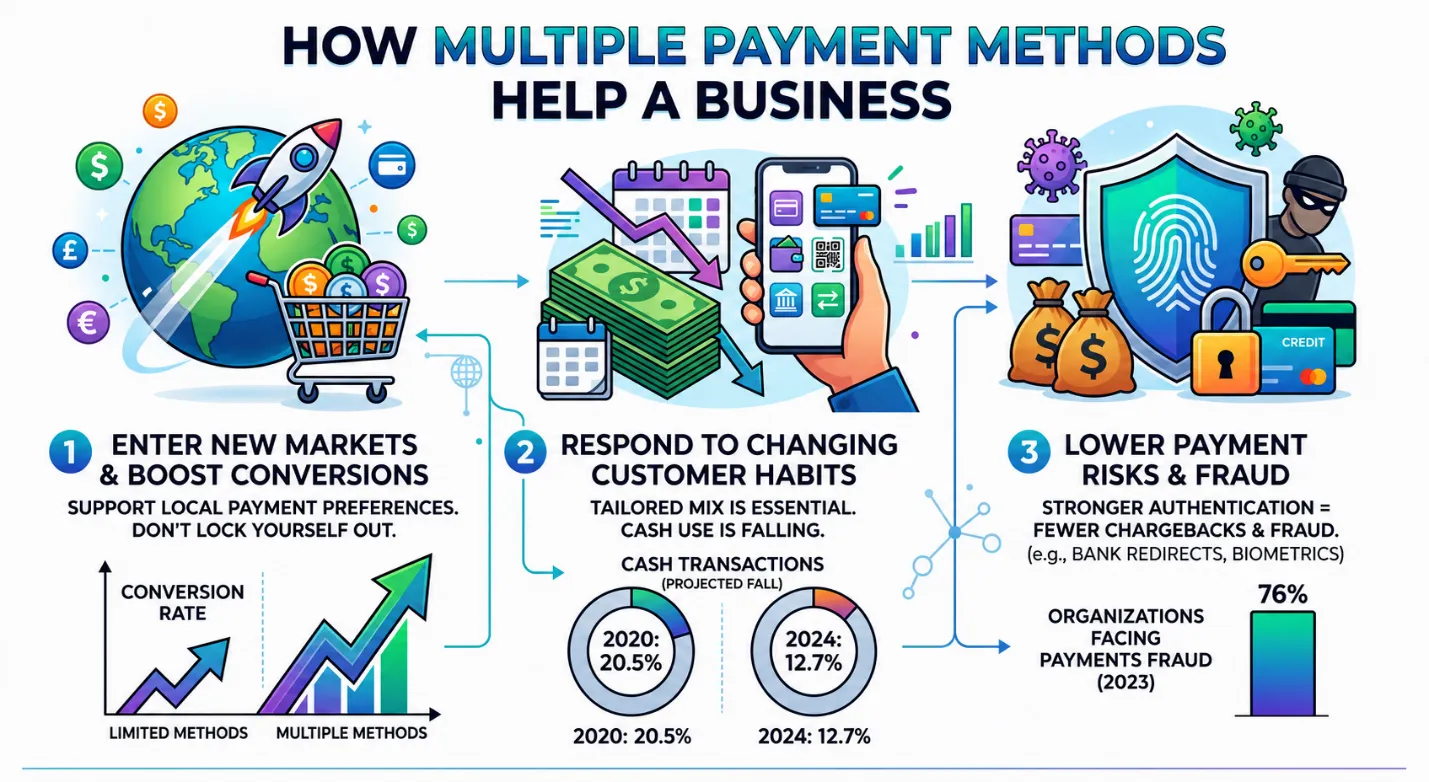
Choosing the right payment methods isn't just about giving customers more options. It also allows businesses to enter new markets. When a business supports local payment preferences, its chances of conversion go up. On the other hand, if its checkout doesn't support these options, it can effectively lock itself out of that market.
Moreover, the share of cash transactions is projected to fall from 20.5% in 2020 to 12.7% in 2024. This makes it even more essential for businesses to present a tailored mix of payment methods.
Payment risk depends on the method a business chooses. As a rule of thumb, methods with stronger built-in authentication (like bank redirects or biometric digital wallets) drastically lower the chances of chargebacks and unauthorised transactions. Fraud remains a very real threat for modern merchants.
In 2023, 76% of organisations faced some level of payments fraud. While this figure is slightly lower than in previous years, the risks persist – a clear sign that secure authentication is non-negotiable.
Finding the Best Payment Methods for a Business
The right payment method leads to a completed purchase. However, there's no universal solution.
The best payment methods depend on factors like the business model, customer location, and payment preferences. An e-commerce store selling globally may need to support digital wallets and local payment methods. In contrast, a professional services business may prioritise bank transfers and card payments.
Platforms like Antom can support multiple business models by providing access to 300+ payment methods across global markets. Now let's take a quick look at key payment categories and how they can support different businesses:
Payment Method | Why It Matters |
Cards | They are globally accepted and provide a trusted checkout option. |
Digital Wallets | They help businesses support local payment preferences, which eventually reduces checkout friction. |
Bank Debits | They support recurring payments and direct account-based collection. |
Bank Redirects | They are secure and provide locally preferred bank payment experiences. |
Bank Transfers | These are a cost-effective option for high-value and B2B transactions. |
Buy Now, Pay Later (BNPL) | They can make purchases more flexible and often bring in higher-value orders. |
Real-Time Payments | They give faster payment confirmation and improve cash flow. |
Nowadays, it's essential for businesses to offer a mix of payment methods. If they want to cater to a diverse audience, there's no other option but to increase payment options for their potential customers.
Which Method Works for E-commerce and Marketplaces
E-commerce and online marketplaces need smooth checkouts. Customers here come in, make a purchase, and leave the platform. They expect fast and flexible payments. And so, offering the right options keeps them coming for more.
So, a business in this domain can support:
· Cards: a widely accepted option that helps maximise sales while keeping processing costs under control
· Digital wallets and bank debits: a faster checkout experience that uses stored payment details and reduces payment friction
· Real-time payments: instant confirmation and faster settlement
· Buy now, pay later (BNPL): a flexible payment choice that can attract higher-value purchases
Which Method Works for On-demand Services
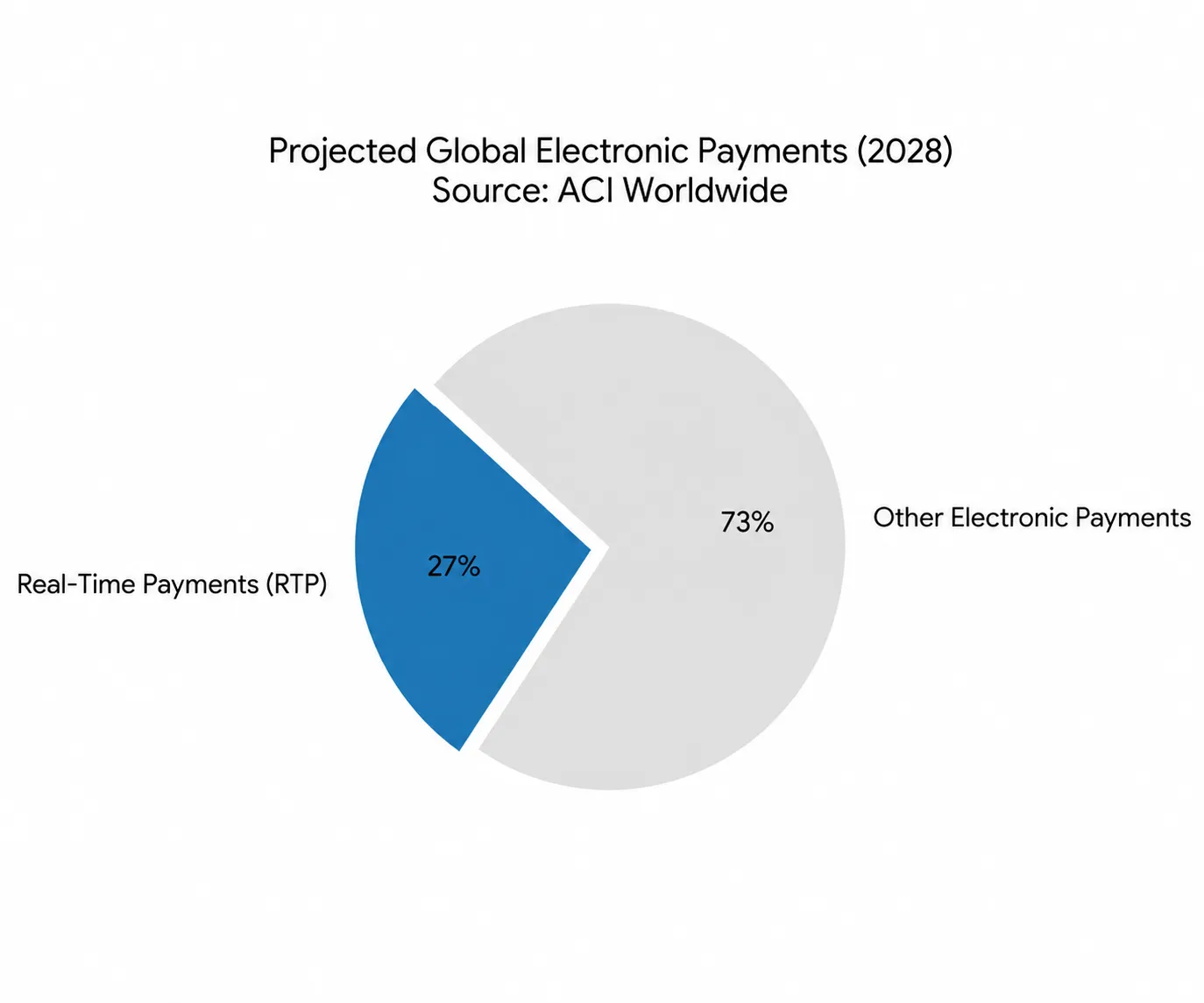
In today's fast-paced world, customers expect payments to happen as quickly as the service itself. This has made real-time payments (RTP) the best method for on-demand services. They can be enabled via digital wallets or a standalone payment method.
RTP systems are already gaining traction worldwide, as nearly 50 instant payment schemes are currently under development globally. According to ACI Worldwide, RTP is expected to account for 27% of all electronic payments worldwide by 2028.
Speed is only one piece of the puzzle for on-demand businesses. Customers here prefer a secure and hassle-free checkout experience. This is especially true when they pay through mobile devices. That instant confirmation beep and the display of their current balance assure customers that their finances are secure.
Some methods, like digital wallets, have heightened security. The added security via biometrics or passcodes increases customers' trust. Such methods help businesses lower fraud and also support saved payment details and one-tap checkout, making repeat transactions even smoother.
Ultimately, the best payment choice still depends on local customer habits. In some markets, customers may prefer payment methods with additional verification steps because they feel a greater sense of security.
Which Method Works for Professional Services
A failed payment is more than an inconvenience for professional service providers. A buyer dispute can negatively impact their cash flow. There is little room for trial and error. The right payment setup can help these businesses accept high-value payments securely.
A few payment strategies that can help them are:
- Flexible payment options: When a prospect sees multiple payment icons on the checkout page, it gives them peace of mind. They are likely to return for more purchases as the payment process is smooth.
- Real-time payment options: Money reaching another account within minutes is a relatively new expectation, and this speed and convenience are what make these methods widely accepted.
- Global payment coverage: Businesses are going global, and they need payment strategies to meet their needs. A platform like Antom that covers 200+ markets can help them offer payment options that match local customer preferences.
When a business implements a solid payment plan, its chances of success multiply. For example, real-time payment fraud affects only 2% of organisations, compared with 63% for cheque payments. Comparisons like these reflect the security benefits of digital payment solutions.
Conclusion
The discussion makes it clear that there are several payment methods out there. What works for one business model may not fit another. However, this doesn't mean that businesses should fall behind in technology. In fact, they must keep up with the latest advancements and adapt whenever possible.
In addition, they must also ensure they're using secure ways to transfer money. Antom Shield can be a good example here. A product of Antom, this tool safeguards transaction data and ensures money is transferred safely from one party to another. The right payment methods depend on a business's target markets and operational requirements. Businesses should evaluate which options best support their business model.
Frequently Asked Questions (FAQs)
1. What payment metrics should businesses track after adding a new payment method?
Businesses can track metrics like payment success rate, checkout conversion rate, transaction approval rate, and payment costs. Closely monitoring these can help merchants determine whether the new payment method is improving the customer experience or contributing to business growth.
2. Can offering too many payment methods confuse customers?
Yes, at times when a business offers multiple payment methods, it can leave customers confused. This slows down their decision-making. Instead of adding every available method, businesses should focus on the payment options their target customers use most to keep checkout simple and efficient.