


Share on
Austria, a mature market with a population of 9.16 million and a per capita GDP of nearly USD 57,000, is experiencing steady e-commerce growth. By 2025, the country's total online transaction value is projected to reach USD 12.2 billion. In a market defined by precision, security, and trust, a successful online business can only be built on a deep understanding of the local payment ecosystem.
Payment preferences in Austria strongly reflect the country's pragmatic and security-conscious consumer culture. Although debit cards, with an average of 1.12 cards per person, are the mainstream payment method, online transfers occupy an especially important position within the domestic payments landscape. In 2023, they accounted for 26% of total online transaction value, second only to card payments at 35%. Within this segment, EPS (Electronic Payment System) is more than just a tool; it is the fundamental payment infrastructure of the Austrian digital economy.
Established in 2005 through collaboration between major Austrian banks and the government, EPS has become one of the mainstream local online banking payment methods in Austria. More than 80% of Austrian online merchants accept EPS, demonstrating its status as an important entry point to the market.
For merchants seeking to establish deep trust in the Austrian market, EPS's core value lies in its direct connection to banks. By connecting over 3 million consumers who rely on domestic banking services, representing nearly one-third of Austrian households, it provides a highly accessible bank payment gateway. As an account-to-account online banking payment method, EPS also offers lower transaction costs than traditional card payments, while the direct bank transfer model fundamentally removes the chargeback risks commonly associated with credit cards. Furthermore, transaction verification is completed entirely within the user's online banking interface via the bank's existing security measures, including passwords, one-time verification codes, and biometric authentication. This means that by integrating EPS, merchants also gain access to a bank-grade, mature security authentication system.
Properties
The following table lists the product properties supported by EPS:
Payment type | Online banking | ||
Acquirer | AntomSG, AntomEU | Merchant entity location | SG, EEA, HK |
Payment flow | Redirect | Refund | ✔️ |
Buyer country/region | Austria | Partial refund | ✔️ |
Processing currency | EUR | Chargeback/Dispute | ❌ |
Minimum payment amount | EUR 1 | Refund period | 365 days |
Maximum payment amount | Unlimited | Time to return payment result | Real-time |
User experience
Note: The following payment flows on different terminals are for reference only. For supported merchants' terminal types, consult Antom Technical Support.
The following screenshots show the journey of paying with with EPS:
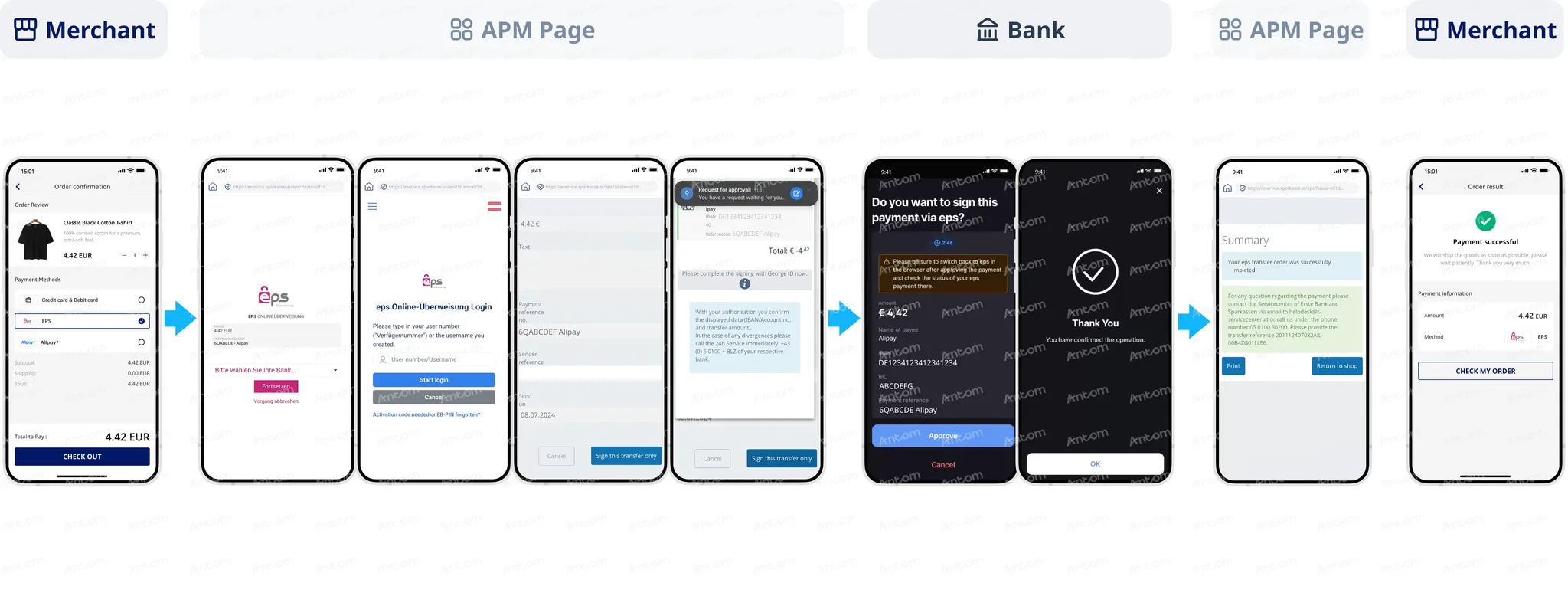
1. The buyer selects EPS to pay.
2. The buyer selects the bank to pay.
3. The buyer completes the online login of the bank.
4. The buyer confirms the order information.
5. The buyer receives an approval request message from the bank app.
6. The buyer opens the bank app and confirms the payment information.
7. The buyer approves the request.
8. The buyer manually returns to the APM page to view the payment result.
9. The buyer is redirected to the merchant's result page.
FAQ
Why is EPS integration important?
EPS is an online transfer payment method jointly launched by Austrian banks and the government. Due to its ease of use and strong security, it has become one of the most popular online payment methods in Austria. It has over 3 million users in Austria (nearly one-third of the total population), and more than 80% of local online merchants have integrated EPS. Therefore, for merchants looking to expand into Austria, prioritising EPS integration is an essential strategy to ensure that your business aligns with mainstream consumer payment habits from the outset and to prevent potential payment friction for customers.
EPS claims "higher transaction security". How does its security mechanism work, and how does it reduce risk for merchants?
EPS uses a more comprehensive and secure authentication mechanism. During payment, consumers are redirected to the issuing bank's online banking environment, where transaction authorisation is completed using one or more security methods supported by the bank, including passwords, SMS verification codes, and biometric authentication. This reduces account risk for consumers. For merchants, this means that fraud risks are intercepted upfront at the banking level, reducing the likelihood of fraudulent transactions and fund disputes. Furthermore, as an online banking payment method with instant confirmation, it inherently avoids the chargeback risks common in card transactions, providing merchants with more reliable settlement assurance.
As an online banking payment method jointly launched by Austrian banks and the government, what is the significance of EPS for online merchants?
EPS has evolved beyond being merely a commercial payment tool and is now widely regarded as part of Austria's payment infrastructure. Because the system is also used for government-related payments and public services, it carries a particularly high level of perceived compliance and trustworthiness among Austrian consumers. For online merchants, supporting EPS signifies more than providing a tool to complete a transaction; it communicates that the business operates in a secure, reliable, and professionally established manner. This trust factor can play an especially important role for unfamiliar merchants, particularly in cross-border commerce or higher-value transactions, where consumers may otherwise be more cautious during the purchasing process.
If my business is already using PayPal, do I still need to integrate EPS?
In Austria, card payments remain the dominant online payment method, followed by online banking payments and digital wallets. By integrating a broader range of local mainstream payment methods, you are better positioned to accommodate different consumer preferences and build a solid foundation for business expansion. Additionally, EPS offers relatively low processing costs. Beyond helping improve conversion rates, integrating EPS can also contribute to reducing transaction-related operational costs for merchants.