

Share on
Indonesia's digital banking services have seen significant progress in recent years. Data shows that digital banking adoption in the country increased by 57% from 2017 to 2021, with at least 78% of consumers now actively using digital banking services.
Founded in 1946, PT Bank Negara Indonesia (BNI) is the fourth largest state-owned bank in Indonesia in terms of assets, lending, and third-party funds. In 2014, BNI achieved a net revenue of IDR 10.8 trillion. In 2016, the number exceeded IDR 11.4 trillion, with a provision coverage ratio of 146% and a capital adequacy ratio of 19.4%.
BNI provides comprehensive deposit and lending services for both corporate enterprises and SMEs, while also offering a broad portfolio of financial products tailored to customers across every stage of life—from childhood, adolescence, adulthood to retirement. Since 2010, BNI has received many honours, including Best Local Cash Management Bank in Indonesia as Voted by Large Corporates, Best Local Cash Management Bank in Indonesia as Voted by Medium Corporates, and 2nd Best Local Cash Management Bank in Indonesia as Voted by Small Companies, for many years. These accolades, presented based on corporate surveys conducted by Asiamoney, underscore BNI's strong capabilities in banking services.
In terms of international business, BNI has built a global remittance network spanning key financial hubs that include Singapore, Hong Kong SAR, Tokyo, Osaka, Seoul, New York, London, Amsterdam, and Sydney. In addition, the bank works with more than 1,600 correspondent partners and remittance representatives across markets such as China, Malaysia, South Korea, Saudi Arabia, Qatar, the United Arab Emirates, and the Netherlands, further strengthening its cross-border financial service capabilities.
Properties
The following table lists the product properties supported byBNI:
Payment type | Online banking | ||
Acquirer | AntomSG, AntomUS | Merchant entity location | SG, HK, US |
Payment flow | Redirect | Refund | ❌ |
Buyer country/region | Indonesia | Partial refund | ❌ |
Time to return payment result | Real-time | Refund period | ❌ |
Processing currency | IDR | Chargeback/Dispute | ❌ |
Minimum payment amount | IDR 10,000 | Customize the timeout | ✔️ |
Maximum payment amount | IDR 100,000,000 | Default timeout | 48 hours |
User experience
Note: The following payment flows on different terminals are for reference only. For supported merchants' terminal types, consult Antom Technical Support.
The following screenshots show the journey of paying with BNI through app.
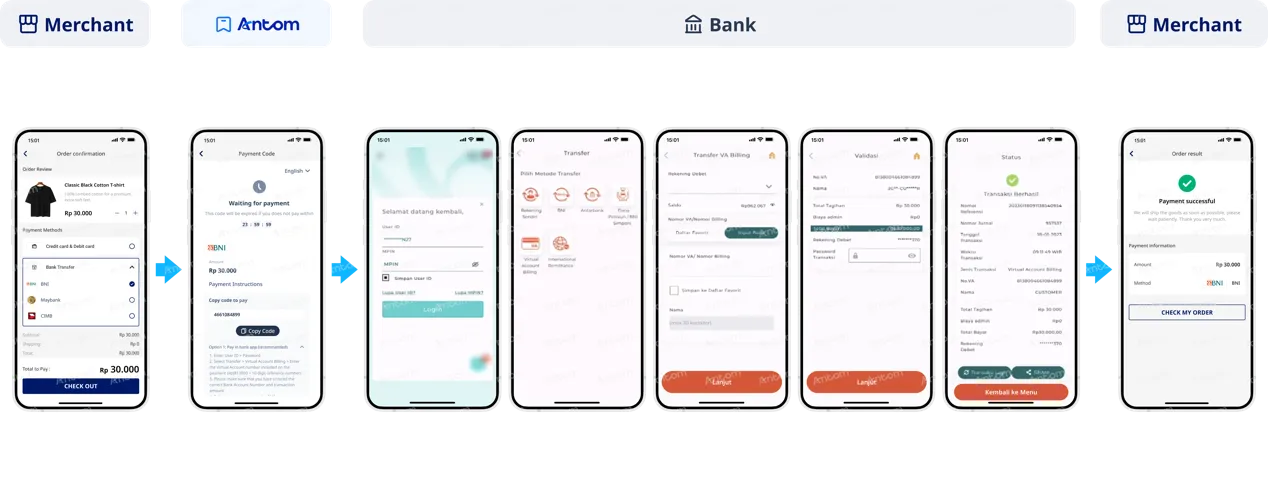
1. The buyer selects BNI to pay.
2. The buyer is redirected to the payment code page and copies the payment code.
3. The buyer manually opens the BNI Mobile Banking app and logs in.
4. The buyer chooses Virtual Account Billing.
5. The buyer pastes the payment code.
6. The buyer enters the password and confirms the payment.
7. The bank page displays the payment result.
8. The buyer manually switches back to the merchant's result page.
FAQ
1. As a state-owned bank, what are BNI's brand advantages in Indonesia?
Founded in 1946, BNI is one of the oldest state-owned banks in Indonesia, with the Indonesian government holding a 60% stake. The bank has built a strong reputation across public services, corporate banking, and retail finance, earning a high level of trust among local consumers. Compared with ordinary commercial banks, BNI enjoys stronger brand credibility, giving users greater confidence when making payments.
2. What are the benefits of using BNI for payments?
- Easily complete fund transfers, bill payments, e-wallet top-ups, and QRIS payments through simple operations;
- Access complete transaction reports quickly and efficiently;
- Use BNI's various applications and tools to better manage and safeguard personal finances.
3. What are the benefits for merchants integrating BNI through Antom?
From an integration perspective, merchants do not need to connect separately with Indonesian regulators or BNI directly. After completing business verification through Antom, merchants can quickly enable the service. Antom also provides one-stop support for clearing, reconciliation, and risk management. In terms of security, BNI adopts bank-grade encryption and real-time settlement, while Antom adds an additional layer of risk control. The overall solution complies with the regulatory requirements of Bank Indonesia (BI) and the Financial Services Authority (OJK), ensuring transaction traceability and helping merchants reduce financial risks.
4. How can BNI help with customer retention?
BNI's strong local advantages help continuously strengthen user loyalty across multiple dimensions, including user experience, trust, and payment accessibility, ultimately supporting higher retention rates. First, BNI's reputation and high market recognition as a state-owned bank provide users with a natural sense of trust and security, increasing confidence in the platform's payment ecosystem. Second, its operational logic closely aligns with the habits of Indonesian consumers, minimising the learning curve and making transactions more intuitive and accessible. Third, BNI supports a wide range of online and offline payment scenarios, including e-commerce purchases, QR code payments, and everyday bill payments, enabling users to complete different transactions through a single channel. Fourth, BNI's bank-grade security standards, regulatory compliance, and stable transaction performance ensure a smooth and reliable payment experience, reducing friction and user concerns. Finally, as one of Indonesia's mainstream local payment methods, BNI also offers stronger compatibility with local consumer habits and payment scenarios, further encouraging repeat purchases and long-term user retention.