


Share on
The retail sector is one of Japan's largest industries, contributing more than 10% of the country's GDP. In recent years, growth has been sustained by advances in retail technology, the expansion of supply chain networks, and adjustments in store layouts. Throughout this development, mobile payments have steadily gained traction as a mainstream payment method.
According to a Statista report, retail market sales in Japan reached JPY 163 trillion in 2023, the highest level in 15 years. The penetration rate of digital payments in Japan reached 65.4% in 2023, with transaction values exceeding USD 353.7 billion, ranking Japan fourth globally. This reflects the growing acceptance of digital payments among Japanese consumers. A 2022 survey showed that the most common use cases include in‑store shopping, online purchases, and payments for offline services.
In this market, au PAY, launched by telecommunications operator au/KDDI, has become one of the most prominent digital payment services. Users can top up their accounts by linking their credit or debit cards or via offline ATMs. They can also offset payments directly with Ponta points (1 point = JPY 1). Importantly, au PAY requires no application forms or personal information, making it simple and accessible to users.
Currently, au PAY has over 30 million users in Japan, with more than 5 million merchants and nearly 1,000 offline outlets accepting the service. By the end of 2023, its cumulative transaction volume surpassed JPY 50 trillion. To strengthen user engagement and loyalty, au PAY runs regular discounts and promotions every month, such as double Ponta points for payments made through the platform, alongside discount coupons and cashback campaigns.
Properties
The following table lists the product properties supported by au PAY:
Payment type | Digital wallet | ||
Funding source | Wallet balance | ||
Acquirer | AntomSG, AntomUS, AntomUK, AntomEU, AntomJP | Merchant entity location | SG, HK, US, UK, EU, JP |
Payment flow | Redirect | Refund | ✔️ |
Buyer country/region | Japan | Partial refund | ✔️ |
Processing currency | JPY | Chargeback/Dispute | ❌ |
Minimum payment amount | JPY 1 | Refund period | 90 days |
Maximum payment amount | JPY 300,000 per transaction; JPY 500,000 per day; JPY 2,000,000 per month | Time to return payment result | Real-time |
User experience
Note: The following payment flows on different terminals are for reference only. For supported merchants' terminal types, consult Antom Technical Support.
The following screenshots show the journey of paying with au PAY:
Web
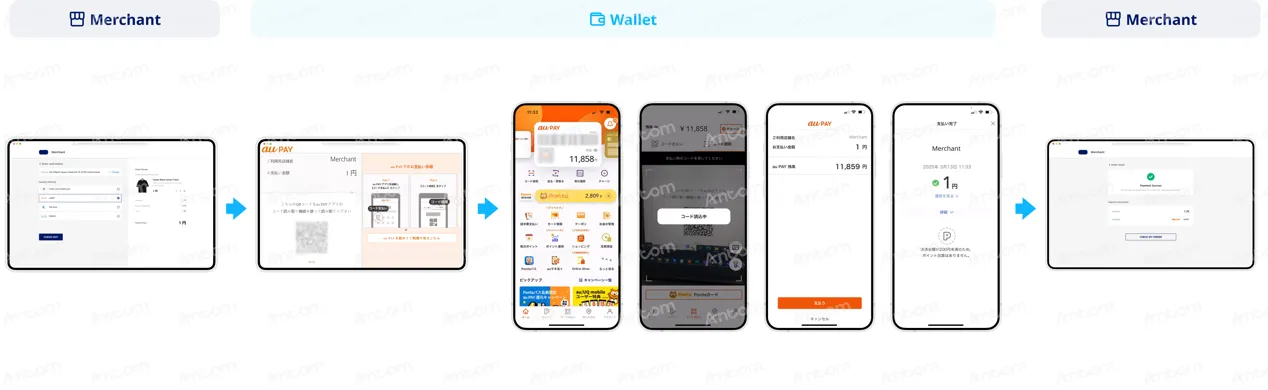
1. The buyer selects au PAY to pay.
2. The buyer is redirected to au PAY's web page.
3. The buyer opens the au PAY app and scans the QR code.
4. The buyer views the prefilled payment information and clicks the Pay button to complete the payment.
5. The buyer reviews the payment result.
6. The buyer is redirected to the merchant's result page.
App
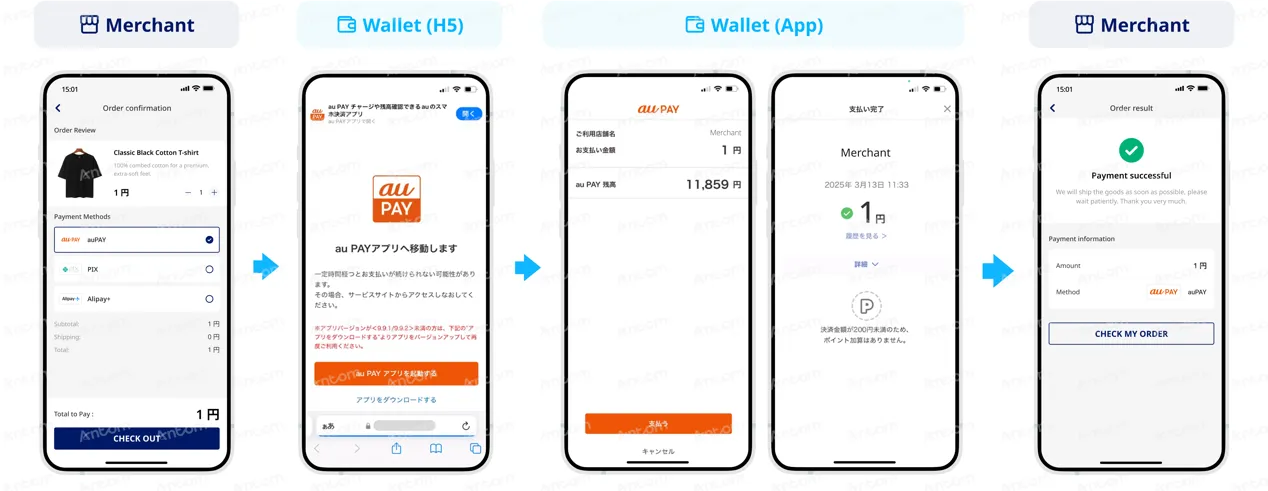
1. The buyer selects au PAY to pay.
2. The buyer is redirected to au PAY's mobile browser payment page (H5) and taps the Launch the auPAY app button.
3. The buyer taps the Pay button to complete the payment.
4. The buyer reviews the payment result.
5. The buyer is redirected to the merchant's result page.
FAQ
1. How extensive is au PAY's user base and merchant coverage?
As of April 2025, au PAY has approximately 37 million members. The service is accepted at 7.45 million locations and partner merchants across Japan, covering offline stores, online shopping, and bill payments.
2. What makes au PAY accessible to users?
- With an au ID, users can complete payments simply by entering a PIN, with no further steps required.
- There is no need for prior registration or app downloads. au PAY cards can be used directly at all supported merchants, with no annual fees or transaction charges.
- Users can consolidate monthly expenses, such as telecommunications bills, into their au PAY account for one‑time payment, enabling immediate use even without cash.
- Payments do not require the entering of card details online, and users can set custom spending limits, helping them manage expenses and avoid overspending.
3. Why do users trust and use au PAY?
Users' trust in au PAY is rooted in its comprehensive security framework, which protects accounts against misuse and unauthorised transactions while reducing disputes for merchants. Key security measures include:
- Two-factor authentication (2FA): It is designed to protect users' account credentials from unauthorised access. In addition to an au ID and password, users verify via SMS (C-mail) or email when logging in on smartphones or computers.
- Carrier authentication: Transactions are restricted to the customer's contracted communication service, enhancing transaction security. On websites that have implemented carrier authentication, or for certain customers, au PAY cannot be accessed via computers or smartphones connected through Wi-Fi, further reducing risk.
- SMS authentication: For specific partner sites or certain users, a verification code is sent directly to the registered mobile number whenever au PAY is used.