
Share on
If you are new to payments in Asia, Alipay and Alipay+ can easily sound like two versions of the same product. They are not.
Alipay is a consumer-facing digital payment platform and app. Established in 2004, it primarily serves the Chinese market, where consumers use it for online and in-store payments as well as a wider range of everyday digital services. For an overseas merchant, the easiest way to understand Alipay is as a specific payment option that an Alipay user may choose when making a purchase.
Alipay+ operates at a different level. It is not simply an international edition of Alipay or another wallet that customers need to download. Alipay+ is a unified wallet gateway operated by Ant International that connects merchants with participating wallets and payment apps across markets. Its current network connects 50 mobile payment providers and more than 10 national switches, reaching more than 2 billion consumers across 220+ markets.
From a merchant perspective, the distinction is relatively straightforward. Alipay is one payment option a customer may use, while Alipay+ connects multiple participating payment methods across markets. The distinction matters because your real business decision is not which brand is "better". It is which payment methods your customers need as you expand, and how you can support them without creating unnecessary payment complexity.
Contents
- What is Alipay?
- What is Alipay+?
- Alipay vs Alipay+: the key differences
- How payment needs can grow beyond Alipay?
- Which payment coverage does your business need?
- How we help you build the right payment setup?
What is Alipay?
Alipay began in 2004 as a payment service designed to help create trust between online buyers and sellers. It has since developed into a major consumer digital payment platform in China.
International merchants do not need to understand every service within the broader Alipay ecosystem before deciding whether Alipay belongs at checkout. Start with what happens when your customer actually pays.
In a physical store, a Chinese consumer may open the Alipay app, scan a supported merchant QR code and complete the transaction. Online, the customer may reach checkout, select Alipay and complete the payment through the Alipay flow.
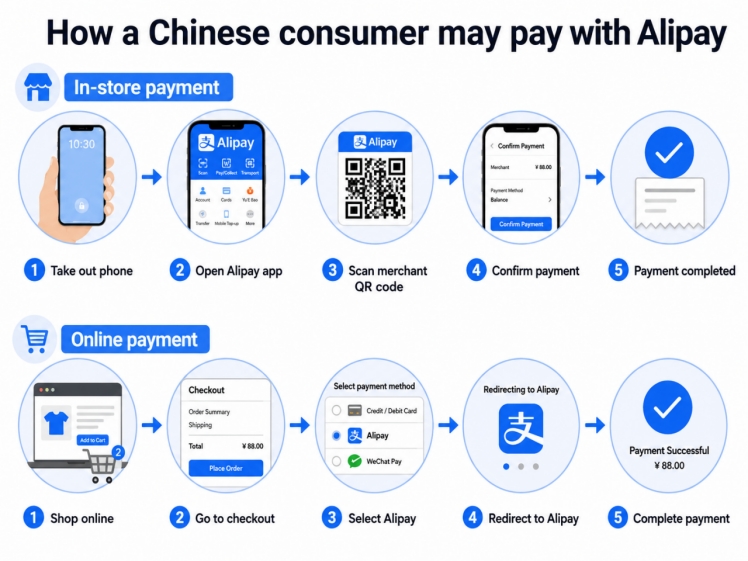
For your business, accepting Alipay therefore means supporting a specific payment method for customers who already prefer to use Alipay.
At the checkout level, this places Alipay in a similar merchant decision category to GCash in the Philippines, Kakao Pay in South Korea or PayPay in Japan. These digital wallets differ in how they work and connect to the underlying payment infrastructure, but they create a similar business question: will the customers you want to reach expect to see that payment option when they are ready to buy?
This can matter even if your company has no physical presence in China.
A US travel business serving Chinese travellers, a European retailer attracting Chinese shoppers or an independent online store receiving meaningful demand from Chinese consumers may all have a reason to evaluate Alipay.
What is Alipay+?
Alipay+ addresses a broader challenge: consumers in different markets often prefer different local ways to pay.
Your customers generally do not replace their existing wallet with an "Alipay+ app". They continue using the payment apps they already know. Alipay+ provides the connectivity that allows participating payment methods to work across a broader merchant network.
Consider a US travel website serving customers across several Asian markets:
Market | Example preferred payment method | What this means for the merchant |
Chinese mainland | Alipay | Chinese customers can use a familiar payment method |
South Korea | Kakao Pay | Korean customers may prefer a local wallet |
Philippines | GCash | Filipino customers may expect a familiar local app |
Malaysia | Touch ’n Go eWallet | Malaysian customers may prefer a local wallet |
Japan | PayPay | Japanese customers may use a local QR payment app |
Alipay, GCash, Kakao Pay, Touch ’n Go eWallet, TrueMoney and PayPay are all listed within the Alipay+ payment-provider ecosystem.
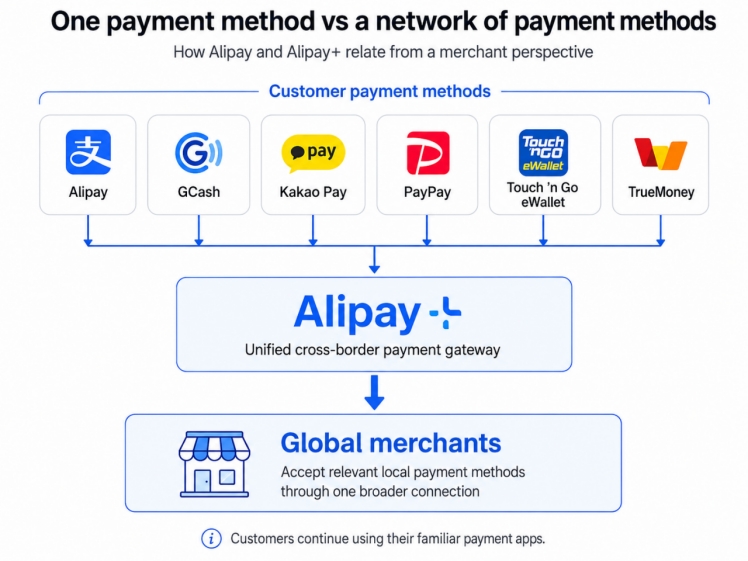
The important point is that these consumers do not need to adopt the same app. A customer from the Chinese mainland can continue paying with Alipay, while customers in other markets can continue using participating payment methods familiar to them.
PayPay provides a useful example. PayPay is a Japanese payment app and an Alipay+ mobile payment provider. Through Antom, eligible overseas merchants can integrate PayPay as part of a broader local-payment setup rather than building their global strategy around one consumer wallet alone.
Alipay vs Alipay+: the key differences
The table below shows how the two differ from a merchant perspective.
| Alipay | Alipay+ |
What is it? | Consumer-facing digital payment platform | Unified wallet gateway for cross-border payments |
Primary role | Enables Alipay users to make payments | Connects multiple participating payment methods across markets |
Does the customer use it directly? | Yes | Customers generally continue using their existing wallet or payment app |
Is it one payment method? | Yes, from a merchant checkout perspective | No |
Main market relevance | Primarily associated with consumers in the Chinese mainland | Multi-market and cross-border |
Merchant decision | Do my customers need Alipay? | Do I need broader local-payment coverage across markets? |
Alipay itself is one of the payment methods connected through Alipay+. The same ecosystem also includes providers such as GCash, Kakao Pay, Touch ’n Go eWallet, TrueMoney and PayPay.
For your business, that changes how the comparison should be used. Rather than treating Alipay and Alipay+ as competing alternatives, start with the markets you want to serve, the payment methods customers already use there and the checkout experience you want to provide. The next challenge is turning that payment mix into something your technical, finance and operations teams can manage efficiently.
How payment needs can grow beyond Alipay?
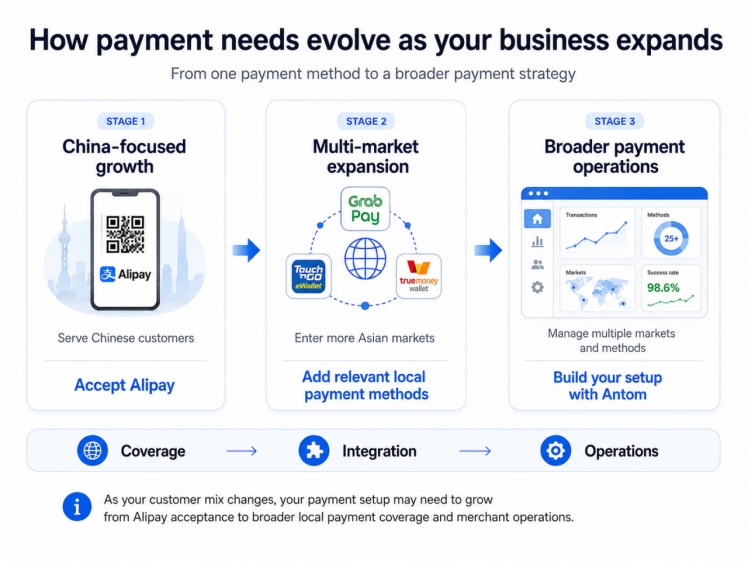
An independent store may encounter the same issue with fewer markets and lower transaction volumes. The scale changes, but the business question does not: which payment methods should you make available as your customer mix changes?
Which payment coverage does your business need?
There is no universal answer because Alipay and Alipay+ are not two competing wallets that every merchant needs to choose between. Your starting point should be your customer mix and expansion plan.
If Chinese customers are your priority
Your payment mix should reflect the customers you are trying to convert. If Chinese demand is the immediate opportunity, Alipay may be a logical place to start.
As your customer base becomes more international, the decision may extend beyond wallets alone. Cards, online banking, real-time payment rails and other payment methods may also become relevant depending on the markets you enter and how customers prefer to pay.
If your independent store is expanding across Asia
Your challenge is to localise checkout across several markets without treating every new country as a completely separate payment project.
This is particularly relevant to independent stores and other growing cross-border merchants. In our Shopify local payment methods guide, we explain why local-payment planning needs to consider merchant eligibility, customer location, currency and target-market requirements together.
For a broader market-by-market approach, our guide to accepting local payment methods globally covers checkout design, payment flows and post-launch performance across different local methods.

If you run a gaming or digital business
Gaming and digital businesses can encounter this fragmentation particularly early because customers may be distributed across several countries from launch.
A game serving China, South Korea and Southeast Asia may need to support very different payment preferences across its player base. Alipay may be relevant to Chinese players, while other markets may require local wallets, domestic payment rails or bank-based methods.
If you operate across many markets
AirAsia MOVE illustrates how these requirements become more complex at larger scale.
We work with AirAsia MOVE and 2C2P on payment acceptance across cards and local payment methods, including acquiring and payment-orchestration capabilities. The teams have worked across markets including Thailand, Cambodia, Singapore, Malaysia and the Philippines, while also evaluating local payment behaviour market by market.
As the number of payment providers, acquirers and operational workflows grows, businesses may also need to consider whether a more centralized payment orchestration layer is appropriate for managing that complexity.
How Antom helps you build the right payment setup
Antom is Ant International's merchant payment and digitalisation platform for businesses worldwide.
Through our single gateway, you can access 200+ payment markets, accept 300+ payment methods and work across 140+ currencies. Our coverage includes international and local cards, digital wallets, online banking and other local payment options.
For smaller online businesses
This does not necessarily mean starting with a fully customised API integration. We support commerce plugins as well as more flexible integration options for businesses that need greater control. Our current WooCommerce payment plugin, for example, supports US merchants and provides access to cards and alternative payment methods, including Alipay and Kakao Pay.
For larger e-commerce, gaming, digital or travel businesses
The payment setup may need to cover more markets, providers and operational requirements from the beginning.
Connect Alipay+ with Antom
This is where understanding Alipay and Alipay+ becomes commercially useful.
- Alipay may help you serve customers who want to pay with Alipay.
- Alipay+ explains how multiple participating wallets can connect across markets.
- Antom helps you turn those payment priorities into a broader merchant payment setup that can grow with your business.

FAQs
Is Alipay+ the same as Alipay?
No. Alipay is a consumer digital wallet and super app used primarily in the Chinese mainland. Alipay+ is a separate global wallet gateway operated by Ant International that connects Alipay and other participating payment methods to merchants through broader payment infrastructure.
Is Alipay+ an international version of Alipay?
No. Alipay+ is not simply "international Alipay". Consumers generally continue using participating wallets and banking apps they already know rather than replacing them with a standalone Alipay+ consumer wallet.
Does a customer need an Alipay+ app to pay?
No standalone Alipay+ consumer wallet is required for the payment model described here. Customers use participating payment apps, while Alipay+ provides the connectivity behind the cross-border payment experience.
Is Alipay part of Alipay+?
Yes. Alipay is one of the payment providers connected through the Alipay+ ecosystem, alongside payment methods such as GCash, Kakao Pay, Touch ’n Go eWallet, TrueMoney and PayPay.
Should I accept Alipay or Alipay+ payment methods?
Start with your customers and target markets. If customers from the Chinese mainland are a major priority, Alipay may deserve particular attention. If you serve customers across several markets, you may need a broader mix of local payment methods. The appropriate setup depends on factors including your business location, target markets, business model and payment-method availability.
Can I accept Alipay and other local payment methods with Antom?
We support Alipay alongside a wider range of global and local payment methods, subject to merchant eligibility, market availability and the relevant commercial arrangements. If you are deciding which methods fit your expansion plans, our payment specialists can help you map your target markets and payment requirements to an appropriate setup.
Build your payment mix around the customers you want to reach
Alipay may be the right starting point when customers from the Chinese mainland are central to your growth strategy. As your business expands into more markets, you may need to add the wallets, bank-based methods and cards that customers already use locally.
We can help you turn those market priorities into a practical Antom setup, whether you run an independent online store or manage payment operations across multiple markets.