


Share on
If your business already accepts cards but is seeing more customers from China—or you are preparing to expand into Asia—adding local payment methods may be one of the next decisions on your payment roadmap.
But the first question is not technical.
You need to decide which customers you want to reach, which payment methods they expect to use, and which setup can support your expansion without creating a new integration project every time you enter another market.
With our payment solutions, eligible international merchants can accept Alipay and build a broader local-payment setup that can extend to Alipay+ payment methods. Depending on your market, business model and payment scenario, Antom can support payment experiences including one-time payments, recurring or subscription payments, and QR-code payments.
We can also help you evaluate eligibility, select suitable payment methods, complete merchant onboarding, choose an integration approach, and manage payments after launch.
If you already know your target markets, you can talk to our team to discuss the payment setup that fits your business.
Table of contents
- Should you accept Alipay or Alipay+ payment methods?
- Where can you accept Alipay with Antom?
- What should you prepare before onboarding?
- How to start accepting Alipay with Antom
- What should you consider before going live?
- Is Antom the right fit for your business?
Should you accept Alipay or Alipay+ payment methods?
Alipay and Alipay+ solve different parts of the payment problem.
Alipay is the consumer payment and digital lifestyle platform widely used by consumers from Chinese mainland.
Alipay+, operated by Ant International, connects merchants with multiple mobile wallets, banking apps and national payment schemes through a broader cross-border payment network. It currently connects more than 2 billion consumer accounts through participating payment partners across 220+ markets.
For merchants, the distinction becomes a business decision.
If your immediate priority is serving customers from Chinese mainland, accepting Alipay may be the logical starting point.
If your growth plan also includes markets such as Malaysia, the Philippines, South Korea or other parts of Asia, a broader Alipay+ payment strategy may make more sense.
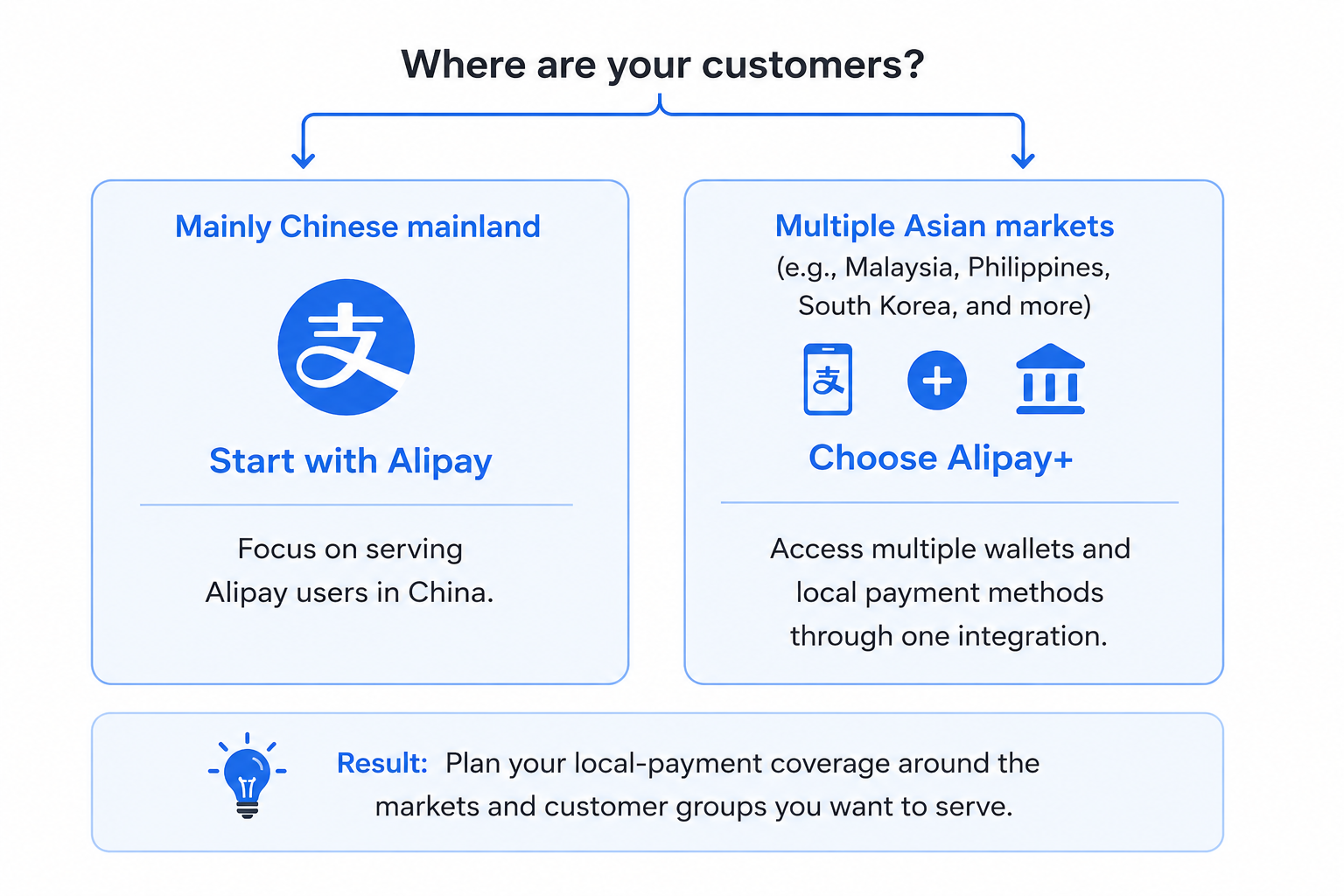
Instead of treating every new wallet as an independent payment project, you can plan your local-payment coverage around the markets and customer groups you want to serve.
This can give growing businesses several advantages:
Advantage | What it means |
Broader coverage | Support more local payment preferences |
Simpler expansion | Avoid separate integrations for every new market |
More relevant checkout | Show payment methods that fit each market |
Future flexibility | Start with Alipay, then expand across Asia |
In practice, the decision comes down to three questions:
Who are your customers today? Where do you plan to expand next? How many local payment methods do you expect to manage over time?
If your answer is mainly 'customers from Chinese mainland,' start by evaluating Alipay. If your expansion roadmap already covers several Asian markets, discuss an Alipay+ payment setup at the same time.
You can also review the Alipay+ official FAQ for information about participating payment partners and network coverage. You can also accept Alipay+ via Antom
Where can you accept Alipay with Antom?
Before deciding how to integrate Alipay, first establish whether the payment setup fits your business.
Two locations are especially important:
- where your business is registered;
- where your customers are located.
Antom supports different payment scenarios, including one-time payments, recurring payment use cases and QR-code payment experiences. The markets and payment methods available can vary by product and merchant configuration.
Take One-time Payments as an example.
Alipay is currently listed for acquiring regions including Singapore, Australia, Hong Kong SAR, the United States, the EU and the UK. The current capability table identifies China as the consumer region and CNY as a supported payment currency for this configuration. Refunds and partial refunds are also supported.
You can review the latest details in our One-time Payments capability table.
However, coverage does not equal automatic merchant approval.
Availability can still depend on your registration country, business model, customer market, compliance review, acquiring requirements and the Antom product you plan to use.
This distinction matters commercially.
If a merchant chooses a payment method based only on a coverage table and starts development immediately, the business may later discover that additional compliance checks, contracting requirements or payment-method activation steps are still required. That can delay launch and create unnecessary development work.
There are therefore two ways to evaluate your setup.
You can use Antom's payment capability information to review supported markets and payment methods yourself.
Or, if you are entering several markets or are unsure which payment product applies to your business, you can contact an our payment specialist before development begins. We can help you review your merchant location, customer markets, payment scenarios and intended payment mix before your technical team starts integration.

What should you prepare before onboarding?
Before accepting live payments, merchants need to complete Antom merchant onboarding and the applicable KYC and compliance review.
The exact information required varies by registration location and business type, but businesses should generally be prepared to provide information relating to the company, ownership and control structure, authorized representatives, business operations, website or app, settlement arrangements and relevant contacts.
For example, the onboarding process for a US merchant can include company information, beneficial ownership information, directors, authorized persons, shareholders and business contacts.
You can review the detailed process in our merchant onboarding guide.
For many merchants, the more important decision is when to start onboarding.
Do not wait until development is finished.
A more practical approach is to let your legal or finance team prepare onboarding and KYC materials while your product team defines the payment experience. This helps surface eligibility or compliance questions before they become launch blockers.
Again, you have two routes.
If your business already understands the required structure and documents, your team can follow the Antom onboarding guide and complete the process directly.
If your entity structure, payment flow or target markets are more complex, you can work with an Antom payment specialist to clarify the requirements before submitting your onboarding information.
How to plan your Alipay and Alipay+ setup with Antom
Once you know which markets you want to serve, turn those priorities into a practical payment setup. Focus on four decisions before moving into implementation.
1. Define your target markets
Start with the business case rather than the API.
Identify your registration country, customer markets, expansion plans, target payment methods, and settlement needs.
A US travel company mainly serving customers from Chinese mainland may prioritize Alipay. A gaming company operating across China, Malaysia and the Philippines may benefit from a broader Alipay+ setup.
The goal is not to enable the most payment methods, but to build the right mix for your customers and growth plans.
2. Confirm commercial eligibility
Confirm that the relevant Antom products and payment methods are available for your business.
Eligibility can depend on your registration location, business model, customer markets, payment scenario and compliance requirements. Merchant onboarding also does not automatically mean every payment method is activated.
You can review current requirements through our payment resources and Antom Dashboard, or talk to our team to confirm eligibility before committing development resources.

3. Choose the right checkout model
Choose a checkout approach based on the level of control, implementation effort and maintenance your business needs.
For One-time Payments, we support hosted checkout, pre-built payment components and API-based integrations, as well as options for Shopify and WooCommerce merchants.
Smaller businesses may prioritize faster implementation and lower maintenance, while larger travel, gaming or digital platforms may need greater checkout flexibility.
Explore Antom Checkout Payment or work with our payment specialists to identify the right approach.
4. Prepare for launch and operations
Before going live, confirm that:
- customers can complete payments across your main devices and channels;
- failures, cancellations and refunds have been tested;
- order fulfilment relies on confirmed payment status, not only the customer-facing success page.
Your technical team can use our Antom Sandbox guide for implementation details.
Your finance and operations teams should also understand how refunds, settlement and reconciliation will work after launch. A good payment setup should be manageable as your transaction volume, markets and payment methods grow.
What should you consider before going live?
Accepting a payment is only the first part of operating a payment method.
Before choosing a provider, consider what happens after the transaction as well.
- Can your team process refunds?
- Can finance reconcile payments and settlement records?
- Can your business understand which transactions succeeded, failed or were refunded?
- Can your payment setup continue to support additional markets as you expand?
With Antom, eligible refunds can be initiated through APIs or Antom Dashboard, subject to payment-method and contractual requirements. Transaction and settlement reporting can also support reconciliation between payments, refunds, settlements and your own order records.
This becomes particularly important for merchants operating across several markets.
A gaming business processing large numbers of small transactions needs more than a checkout button. Its product team needs reliable payment status information, while its finance team needs to understand refunds and settlement.
An e-commerce merchant expanding from China-facing sales into Southeast Asia also needs to consider whether its payment infrastructure can add relevant local payment methods without repeatedly rebuilding the checkout.
That is why payment-provider evaluation should go beyond:
'Can my customer pay?'
The better question is:
'Can this payment setup support the markets, customers and operational complexity my business expects over the next few years?'

Is Antom the right fit for your business?
Antom can be particularly relevant if your business wants to serve customers from Chinese mainland today while also preparing for broader expansion across Asia.
Instead of evaluating Alipay as an isolated checkout feature, you can consider it as part of a wider payment strategy covering local wallets, cards, banking apps and other payment methods relevant to your target markets.
You can research Antom's payment capabilities and onboarding requirements through our online resources if you already know what your business needs.
Or, if you would rather confirm your payment strategy before committing development resources, talk to an Antom payment specialist.
We can help you review your target markets, payment scenarios, eligibility and integration options—and determine whether you should start with Alipay or build a broader Alipay+ payment setup from the beginning.