

Share on
The leading wallets in Southeast Asia vary by country. Key examples include GoPay, OVO and DANA in Indonesia; GCash and Maya in the Philippines; TrueMoney in Thailand; Touch n Go and Boost in Malaysia; GrabPay and ShopeePay in Singapore; and MoMo and ZaloPay in Vietnam. There is no single wallet that covers the whole region, so merchants normally need a country-specific payment mix.
With 13 countries and 4.3 billion people, the Asia-Pacific (APAC) region presents a huge opportunity for merchants to scale their business.
E-wallets in Southeast Asia are dominated by locally entrenched apps rather than global players. GoPay, OVO, and DANA lead in Indonesia; GCash commands ~89% market share in the Philippines; TrueMoney holds over 52% of mobile wallet traffic in Thailand; Touch n Go and Boost lead in Malaysia; GrabPay and ShopeePay dominate Singapore; and MoMo, ZaloPay, and ShopeePay compete in Vietnam.
But for businesses outside APAC, it can be challenging to understand the various factors that lead to successful expansion into the region's markets.
That's because APAC is home to a well-developed digital economy that looks very different from the Western one. For instance, China, Japan, South Korea, India and Indonesia are among the world's largest e-commerce markets, generating a combined US$1.3 trillion in e-commerce revenue in 2023. And for these markets, the preferred method for digital payments are e-wallets. Each country has its own mix of e-wallets, along with its own currency and financial regulations.
This diversity means expanding into APAC without accounting for their payment preferences is like trying to navigate a foreign city without a map. You might make some progress, but you're bound to miss out on the most efficient routes along the way — and probably end up finding yourself quite lost.
Leading wallets in Southeast Asia at a glance
The following table provides a quick reference for merchants entering Southeast Asian markets. Each country has distinct wallet leaders, and accepting the right mix is essential for conversion.
Country/region | Payment methods | Good to know |
Indonesia | GoPay, OVO, DANA, QRIS (national QR standard) | High mobile wallet penetration, super app ecosystem — Prioritise at least two wallets
|
Philippines | GCash, Maya, PESONet, InstaPay (instant bank rails) | Strong remittance culture, growing e-commerce — GCash dominant for consumer payments |
Thailand | TrueMoney, PromptPay (national QR) | QR payment culture, tourism-driven — Accept TrueMoney and PromptPay-linked wallets
|
Malaysia | Touch n Go, Boost, DuitNow QR | E-wallet incentive phase-out complete, balance shifting — Touch n Go for transit-linked payments
|
Singapore | GrabPay, ShopeePay, PayNow, SGQR | High digital literacy, mature market — Both super app wallets strong
|
Vietnam | MoMo, ZaloPay, VietQR | Fast-growing mobile adoption, cash preference shifting — MoMo leads in user base
|
Let's look at why e-wallets are so popular in the region and how you can integrate this into your payment mix as part of your strategy to grow your business in APAC.
How do e-wallets work?
E-wallets — also known as digital or mobile wallets — are electronic versions of physical wallets. US-based merchants might be familiar with e-wallets such as Apple Pay, Google Wallet, PayPal and Venmo. In APAC, Alipay, Paytm and Go-Pay are just some of the widely used e-wallets.
E-wallets allow users to securely store digital payment methods on a smartphone app so they can make payments both online or in a physical store, without having to memorise individual PIN codes and passwords. These methods can include credit or debit cards, gift cards, coupons and more. You can use your e-wallet to buy goods online and at physical stores, earn and transfer rewards points, and even send money to other users.
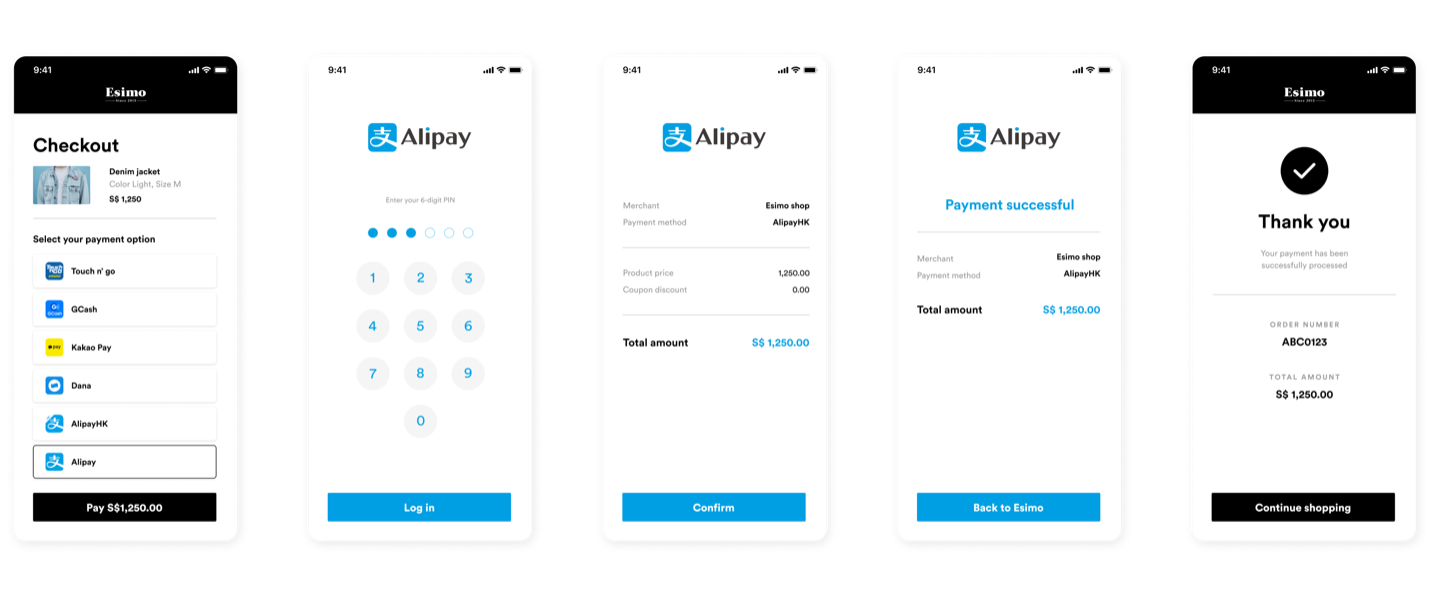
Above:How e-commerce shoppers can easily pay online with their Alipay mobile wallet.
E-wallets use mobile apps, cameras, near-field communication (NFC) and security measures such as tokenization and biometrics to create a safe, frictionless and convenient payment experience. You'd typically fund your e-wallet by entering your credit or debit card information, linking it to your bank account, or loading it with cash deposited into kiosks at convenience stores. This information is then encrypted and available once you authorize the wallet. You can then use the e-wallet to pay for your purchases.
There are three types of e-wallets:
- Open wallets
- Semi-closed wallets
- Closed wallets
And below, we've outlined some of the key differences between the three types of wallets:
Type of e-wallet | Issuer | Features | Example |
Open wallet | Bank | ✓ Accept incoming funds to a bank account ✓ Fund transfer to other bank accounts ✓ Cash withdrawal at ATMs | Send funds to a merchant's bank account to pay for a purchase |
Semi-closed wallet | Fintechs | ✓ Accept incoming funds to a bank account ✓ Fund transfer to other users and to own bank account | Scan a QR code using the e-wallet app to transfer funds to a business owner's e-wallet |
Closed wallet | Private companies | ✓ Purchase goods from issuing merchant | Buy coffee at Starbucks using your Starbucks card |
Why shoppers in Asia Pacific prefer e-wallets
The rise of e-wallets as the preferred payment method is unsurprising for APAC, which was one of the earliest regions to adopt a mobile-first lifestyle. Around 2.6 billion people — more than half the region's population — use smartphones.
So why have e-wallets become so popular in APAC? The answer is because they were necessary.
- The demand for cashless payments during the COVID-19 pandemic drove e-wallets to become the preferred payment across many Asian countries. Even in China where digital payments were already mature, e-wallet usage surged to become adopted by 84% of consumers. And because of the high cost and processing fees of point-of-sale terminals, merchants and consumers opted not to accept cards and instead leapfrog over them to go from accepting cash to offering contactless mobile payments through e-wallets.
- In Southeast Asia, as many as six out of 10 people don't have bank accounts. Yet, the region is also home to a young, internet-savvy population. This has caused digital payments to boom, fueled by payments made through e-wallets, which are predicted to exceed USD 114 billion by 2025.
- Super apps are beginning to dominate daily life in many Asian countries. From China's Alipay to Singapore's Grab, these apps tend to offer their own e-wallets while also letting users link their accounts to other e-wallets. Users can order food, pay their bills, book a cab and even buy groceries through a single app, helping to make e-wallet payments an entrenched consumer habit.
- Even people without accounts at either traditional or digital banks can use e-wallets through physical kiosks, which are typically found at convenience stores. They can deposit into or withdraw from their e-wallets through these kiosks, or by paying at cash registers in convenience stores. Even some convenience stores and pawn shops help process deposits and withdrawals in exchange for cash.
How to choose which wallets to support
Selecting wallets is not about accepting everything. It is about matching your customer base. Follow these five steps:
1. Start with your target markets. Map which countries generate the most traffic and revenue for your business.
2. Compare wallet penetration by demographic. Younger audiences skew toward specific wallets, so age and income profiles play a role.
3. Check mobile web and app compatibility. Some wallets work only through dedicated apps, which affects checkout flow.
4. Confirm refund and recurring-payment support. Not all wallets handle subscriptions or easy refunds the same way.
5. Prioritise by expected transaction volume. Focus integration effort on wallets that will drive the most checkouts.
Wallets versus QR and bank-transfer rails
A common point of confusion is the difference between a wallet brand, a national QR standard, and an account-to-account (A2A) rail. These are related but not identical.
A wallet is a consumer account or app that stores funds and enables payments, such as GoPay or GCash. A QR scheme is an acceptance rail that connects wallets or bank accounts to merchants through a standardised QR code, such as QRIS in Indonesia or PromptPay in Thailand. An A2A rail enables direct bank-to-bank transfers without a wallet, like PESONet in the Philippines or PayNow in Singapore.
One national QR standard often supports several participating apps. For example, a merchant displaying a QRIS code can accept payments from GoPay, OVO, DANA, and other QRIS-connected wallets. Understanding this distinction helps merchants avoid unnecessary integrations.
How merchants can accept several local wallets
Most merchants use one of three approaches to accept multiple Southeast Asian wallets:
Direct wallet integrations: Connect to each wallet API individually. This offers full control but requires separate technical builds for each market and ongoing maintenance as wallets update their interfaces.
Regional payment service provider: Use a PSP with existing wallet connections across the region. This reduces integration work but may limit customisation and routing options.
Payment orchestration platform: Deploy an orchestration layer that manages multiple connections through a single API. This provides the most flexibility, supports smart routing, and centralises reporting — but adds platform complexity and cost.
The right choice depends on your technical resources, transaction volume, and how much control you need over the payment experience.
Local payment methods are key to higher revenue in Asia Pacific
By allowing your APAC customers to pay with their local e-wallets, you'll be on your way to expanding your consumer base in APAC and helping them to complete purchases more easily.
While online retail sales in APAC are expected to reach USD 2.8 trillion in 2025, the region also has the world's highest cart abandonment rate at nearly 80%. Eight out of 10 APAC shoppers fail to complete their online purchases for many reasons, such as preferring to shop on their mobile phones instead of their computers, abandoning the checkout when processes get too complicated, and even varying internet speeds.
One way of helping customers to complete their purchase is by offering localised payments. This means offering the preferred payment method in each market. For example, you could offer Alipay in China, Paypay in Japan, or Kakao Pay in South Korea. This way, customers can complete their purchase on their preferred device, enjoy simplified transactions, and complete the checkout process faster.
Payments localisation is especially critical considering that 44% of consumers abandon a purchase if their preferred payment method is not offered. The reverse is also true — when merchants offered local payment methods in APAC, their cart abandonment risk decreased by as much as 32%.
Despite that, merchants entering the APAC market tend to ignore the advantages of local payment methods. Data shows that while e-wallets accounted for 69% of all e-commerce transactions in the region, 29% of non-APAC merchants selling to the market still believe that local shoppers prefer global debit card schemes.
At the same time, only 13% of non-APAC merchants accepted domestic mobile wallets as payment methods. These statistics show how important it is that you meet consumers where they are. It's the key to increasing sales, lowering cart abandonment rates and engaging more shoppers.
Indonesia
Indonesia is the region's largest digital payments market and has seen the one of the fastest shifts away from cash. POS cash share dropped from 77% in 2019 to 36% in 2025, driven primarily by QRIS, the national QR code standard. By August 2025, QRIS connected 40 million merchants and 57 million users.
Dominant wallets: GoPay (anchored to the Gojek super-app), OVO, and DANA. Most consumers hold multiple wallets and switch between them based on promotions. With e-wallets accounting for roughly 42% of e-commerce payments, leaving any of these three out of your Indonesian checkout is leaving money on the table.
Philippines
GCash tends to dominate here: 94 million registered users, roughly 89% market share among digital wallets, and a processing volume of up to PHP 500 billion (approximately USD 9.3 billion) monthly. The platform connects to over 6 million merchants. Maya is the closest competitor, with ShopeePay also widely used.
That said, the Philippines still records the highest in-store cash usage in the entire region, at 42% of POS transaction value. Around 50% of the population remained unbanked as of 2024. Cash on delivery still represents 23% of e-commerce value.
Thailand
Thailand's payment story is split between wallets and account-to-account (A2A) transfers. PromptPay drives enormous A2A volumes: A2A accounted for 44% of e-commerce and 43% of POS value in 2025. Among wallets specifically, TrueMoney commands over 52% of mobile wallet traffic in the country, with ShopeePay and LINE Pay following behind.
Malaysia
Malaysia's digital payments shift has seemed swift. Cash at POS dropped from 64% in 2019 to 22% in 2025. DuitNow QR reached 2.6 million acceptance points by end-2024. The wallet market is led by Touch n Go and Boost, with GrabPay and ShopeePay also popular.
Singapore
Singapore hit a milestone in 2025: digital wallets overtook debit cards at POS for the first time, capturing 36% of POS value and 40% of e-commerce value. GrabPay and ShopeePay lead among local wallets, while PayNow drives A2A volume through the SGQR unified QR system.
Vietnam
Vietnam is one of the region's most competitive wallet markets by number of players: 49 licensed operators as of 2025. MoMo tends to lead consumer surveys, followed by ZaloPay and ShopeePay. VietQR transactions grew 62% in volume and 151% in value year-on-year in 2025.
For merchants operating across multiple markets, there's a structural shift worth watching. Five major ASEAN economies (Indonesia, Malaysia, Singapore, Thailand, and the Philippines) have linked their QR code schemes. Project Nexus, established in 2025 by the central banks of India, Malaysia, the Philippines, Singapore, and Thailand, is building multilateral infrastructure to enable real-time cross-border payments.
In practice, this means a Thai consumer with TrueMoney will increasingly be able to pay a Malaysian merchant via a single scan. For merchants, this helps to simplify what has historically been a fragmented technical problem.
3 takeaways for businesses that want to expand into Asia Pacific
- APAC is a region with diverse markets. Take the time to understand the consumer behaviors and trends in different countries rather than viewing APAC as a single, homogeneous market.
- Offering local payment methods like e-wallets can lower cart abandonment rates among your Asian shoppers.
- The e-wallet ecosystem in APAC is vast and varied. No single e-wallet dominates the region for now, so it's important for global merchants to accept payments from several e-wallet providers.
Understanding a complex market
We've covered the importance of offering e-wallets as a payment method to APAC shoppers. But there are other factors to consider as part of your strategy to win in this region.
The APAC landscape encompasses many different currencies, financial regulations, and languages. Then there's integrating multiple payment methods, waiting times for fund settlement, chargebacks, declined payments, and needing to enter into separate contracts with multiple payment providers. With all these to consider, it's understandable if you find the APAC region daunting.
To overcome this complexity, you can work with a payments service provider that already has an established network of partners in the region.
Antom can help you improve your payment success rates in Asia Pacific. We offer the widest range of APAC's most widely-used payment methods, including the most prevalent e-wallets preferred in each specific market. This lets you offer the local payment methods most used by shoppers and accept payments from all over the region — which is your key to boosting conversion, lowering cart abandonment and unlocking revenue growth. A single integration with Antom can give you access to 1.5 billion consumers.
Antom's Payment Orchestration platform connects merchants to 300+ global and local payment methods across 200+ markets through a single integration, including GoPay, GCash, TrueMoney, Touch n Go, GrabPay, ShopeePay, MoMo, and more. Local acquiring in key Southeast Asian markets means better authorisation rates and simplified reconciliation.
Interested in expanding to Asia Pacific, overcoming market complexity and generating sales from this dynamic region? Contact us today.
FAQs
Which e-wallets should I accept in Southeast Asia?
It depends on the market. GoPay, OVO, and DANA in Indonesia; GCash (89% market share) and Maya in the Philippines; TrueMoney (52% wallet traffic) in Thailand; Touch n Go and Boost in Malaysia; GrabPay and ShopeePay in Singapore; MoMo, ZaloPay, and ShopeePay in Vietnam. There is no single wallet that dominates the whole region.
Why dont global wallets like PayPal dominate in Southeast Asia?
Southeast Asian markets developed their own local wallets tied to super-app ecosystems (Gojek, Grab), government-backed QR standards (QRIS, DuitNow QR, VietQR), and domestic instant payment rails. These local options offer lower fees, better merchant integration, and deeper consumer trust.
How big is the e-wallet market in Southeast Asia?
The digital payments market in Southeast Asia was valued at over USD 120 billion in 2023 and is projected to reach USD 306 billion by 2028 (PwC 2026). E-wallet usage grew from USD 22 billion in 2019 to exceed USD 114 billion.
What is QRIS and why does it matter in Indonesia?
QRIS is Indonesias national QR code standard, mandated by Bank Indonesia. By August 2025, QRIS connected 40 million merchants and 57 million users. Its a key driver of Indonesias shift away from cash.
Can I accept multiple Southeast Asian wallets through one integration?
Yes. Antom's Payment Orchestration platform provides access to 300+ global and local payment methods across 200+ markets through a single integration. This includes GoPay, GCash, TrueMoney, Touch n Go, GrabPay, ShopeePay, MoMo, and more.
What is Project Nexus?
Popular wallets vary by country. Common examples include GoPay, OVO and DANA in Indonesia; GCash and Maya in the Philippines; TrueMoney in Thailand; Touch n Go and Boost in Malaysia; GrabPay and ShopeePay in Singapore; and MoMo and ZaloPay in Vietnam. Merchants should confirm current usage for the exact customer segment they serve.