


Share on
Payment orchestration is a centralized management and control layer that helps merchants coordinate payment providers, acquirers, payment methods, routing logic, and related payment operations through a more unified architecture.
In Brief
- Payment orchestration coordinates multiple payment connections, acquirers, payment methods, and routing rules through a more centralized management layer.
- Smart routing is only one part of orchestration. Depending on the platform, orchestration may also support provider management, merchant-defined rules, transaction operations, and financial reporting.
- The business case tends to become more relevant as merchants add markets, providers, payment methods, and operational complexity.
What Is Payment Orchestration?
Start with a simple question: What actually happens when someone pays online?
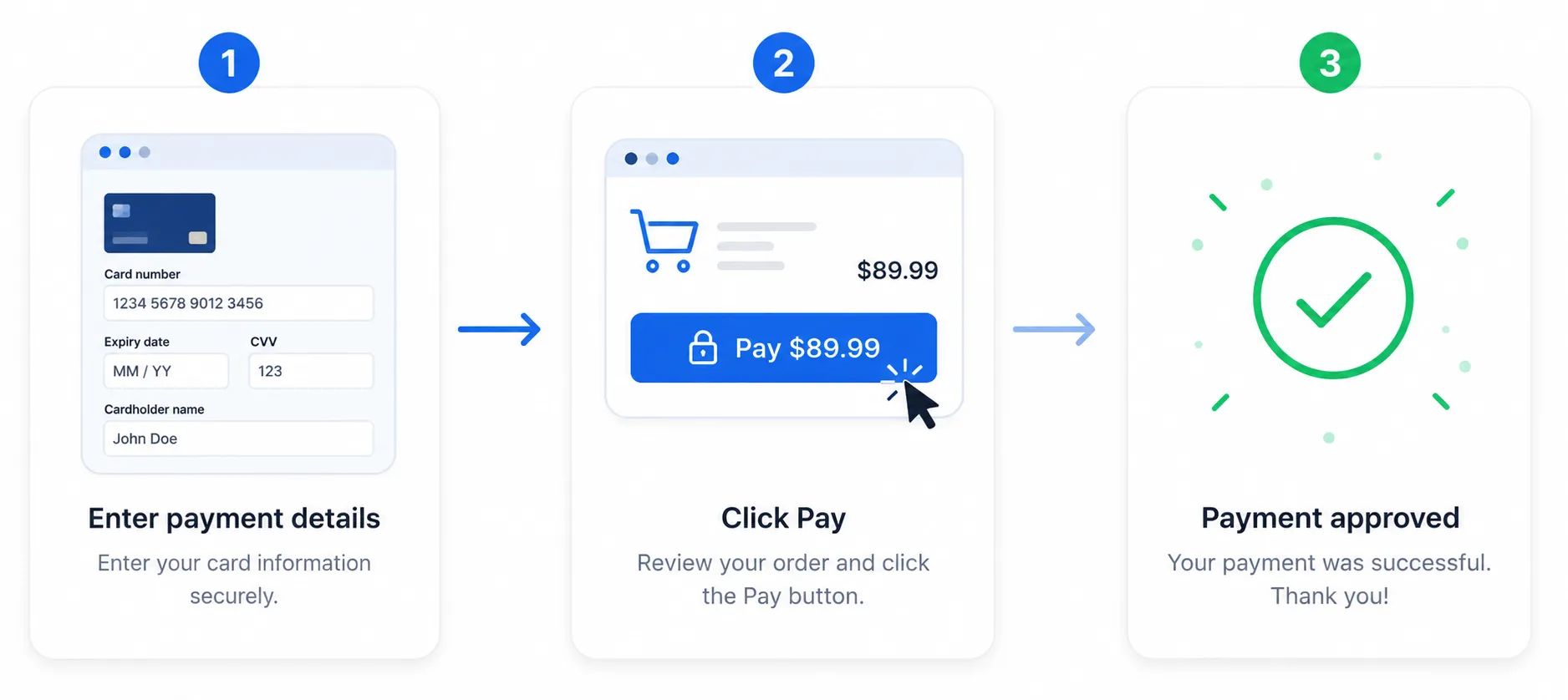
Imagine you run a US-based ecommerce business that sells internationally. A customer in Thailand visits your website, buys a pair of shoes for $89.99, and clicks Pay.
From the customer’s perspective, the experience may look simple:
Behind the scenes, however, even a basic card transaction may involve several participants:
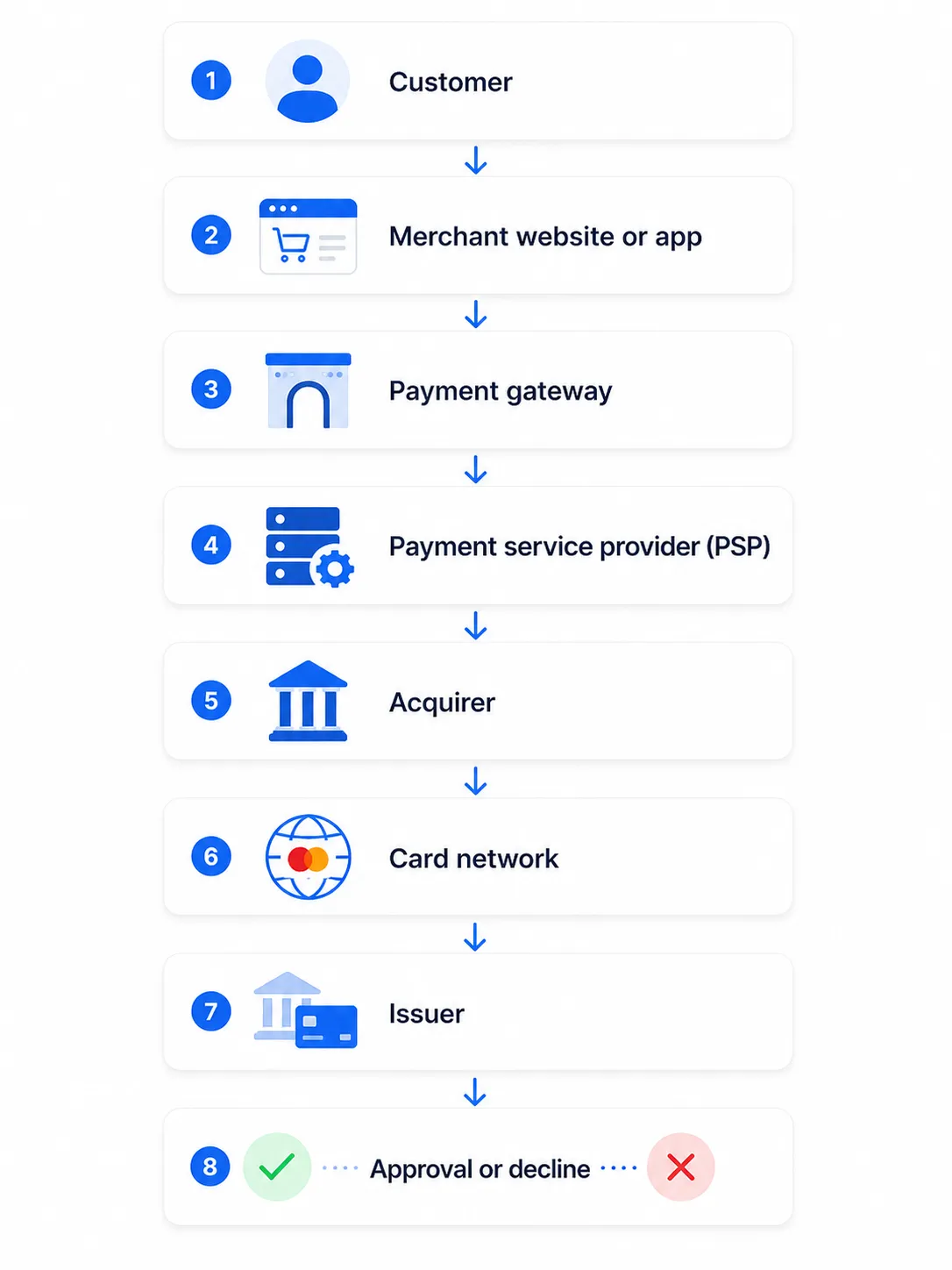
This is a simplified example. The exact payment flow depends on the merchant setup, and one provider may perform multiple roles.
Now consider what happens when the customer does not use a traditional card. Depending on the market, shoppers may prefer digital wallets, bank-based methods, QR payments, or other local options. The US International Trade Administration notes that payment-method preferences vary by country and geography, which is one reason cross-border merchants cannot assume that a single payment setup will fit every market.
As a business expands, the challenge is therefore no longer simply:
Can we accept a payment?
A more difficult question is: How do we manage multiple payment methods, providers, acquirers, routing rules, markets, and financial workflows through a coherent payment setup?
This is the problem payment orchestration is designed to address.
The important word is coordinate.
A payment orchestration platform does not necessarily perform every function in the payment chain. Instead, depending on its architecture, it may help a merchant:
- connect multiple payment capabilities
- manage available acquirers
- activate or manage payment methods
- apply merchant-defined routing rules
- use data-driven routing for eligible transactions
- centralize transaction visibility
- standardize operational or financial data
- support reconciliation workflows
- connect related capabilities such as risk controls
This distinction matters because payment orchestration is not simply another term for payment processing.
It is better understood as a management and control layer around a complex payment stack.
A simplified architecture may look like this:
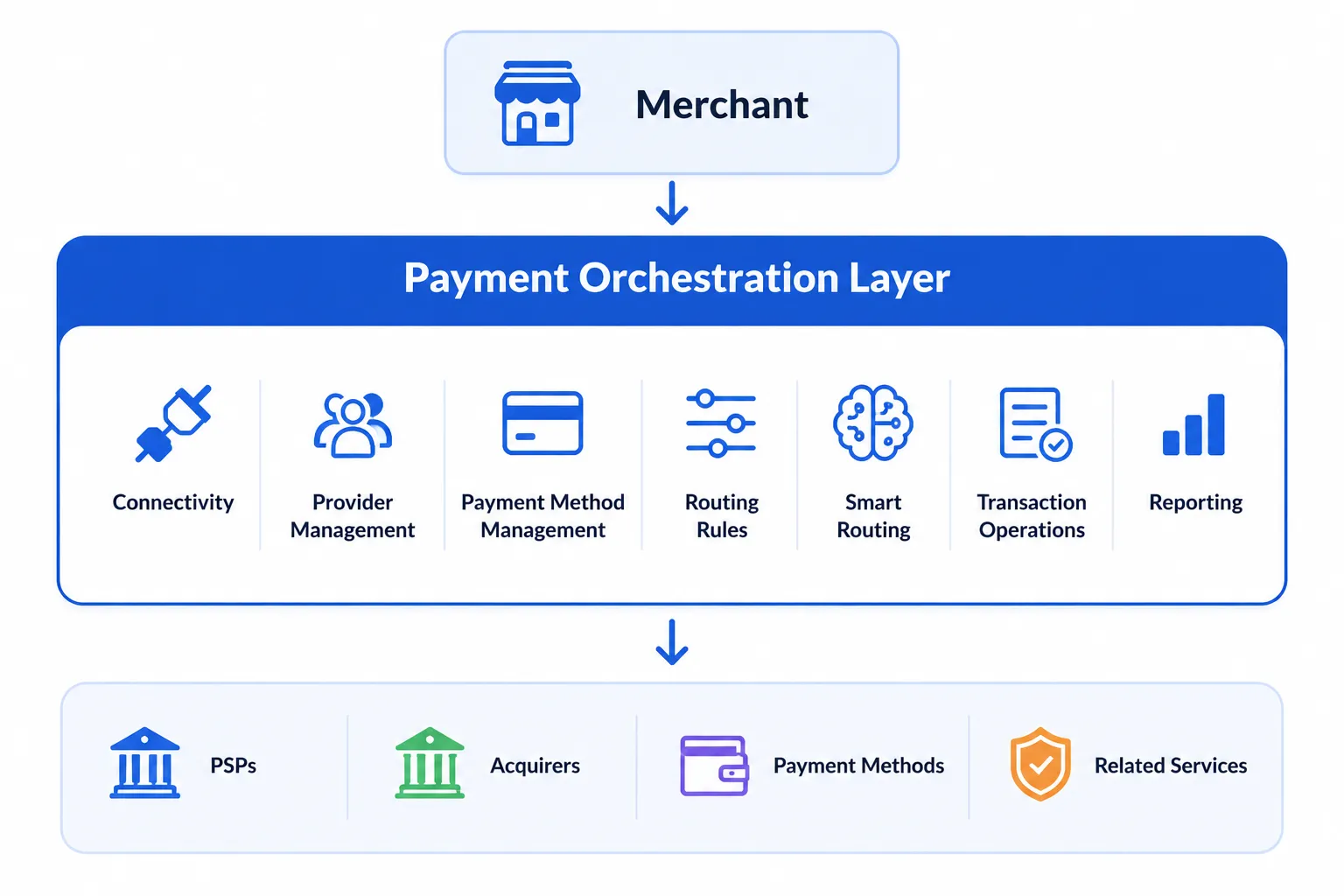
The exact architecture varies. Some orchestration providers primarily coordinate third-party connections. Others combine orchestration with acquiring, risk management, or additional payment capabilities.
That is why merchants should evaluate actual responsibilities rather than rely on category labels alone.
Why Does Payment Orchestration Exist?
Payment orchestration becomes valuable when a merchant’s payment operations expand beyond a single provider or market.
Adding more PSPs, acquirers, and payment methods can improve coverage, but it may also create fragmented integrations, inconsistent transaction data, and separate settlement processes.
Merchants then need to manage:
- Connectivity: multiple provider APIs and integration standards;
- Payment availability: which payment methods and acquirers are active in each market;
- Routing: which connection should process each eligible transaction;
- Transaction visibility: how payment statuses are monitored across providers;
- Reconciliation: how orders, payments, refunds, settlements, and bank deposits are matched.
Payment orchestration provides a centralized layer for coordinating these activities. Its value therefore goes beyond routing: it helps merchants manage payment infrastructure and financial operations more consistently as the business grows.
How Does Payment Orchestration Work?
The exact workflow depends on the platform. A practical model can be understood in six stages.
Step 1: Integrate payment capabilities
The first challenge is connectivity.
Instead of treating every payment connection as a separate project, an orchestration architecture may provide a more unified integration layer.
Depending on the platform, this can help connect combinations of:
- PSPs
- acquirers
- payment methods
- related payment services
Some platforms may also integrate additional capabilities such as risk controls.
However, a unified integration does not mean all business complexity disappears.
Merchants may still need to manage:
- provider contracts
- eligibility requirements
- settlement arrangements
- market restrictions
- security responsibilities
- operational ownership
Technology can reduce integration fragmentation without removing every dependency.
Step 2: Manage available acquirers and payment methods
Once connections exist, the merchant needs to determine which resources are actually available and active.
This is where orchestration can move beyond connector count.
For acquirers, relevant questions may include:
- Is the connection active?
- Which merchant entities or configurations can use it?
- Which transactions are eligible?
- What commercial relationship supports it?
For payment methods:
- Is the method active?
- Where is it relevant?
- Under what setup is it available?
- How are resulting transactions monitored?
A platform with a long integration list may still be a poor fit if the merchant cannot effectively manage the connections that matter to its priority markets.
Step 3: Apply merchant-defined routing rules
Some payment decisions require explicit business logic.
A merchant may configure a rule such as: Route eligible transactions meeting Condition X to Acquirer A.
Possible conditions may involve:
- geography
- currency
- merchant entity
- payment method
- transaction characteristics
- business policy
This is generally known as custom routing or rules-based routing.
The main advantage is control.
The merchant defines what should happen when specified conditions are met.
Step 4: Use smart routing for eligible transactions
Transactions that are not governed by fixed business rules may be evaluated using data-driven routing logic.
Depending on the platform, routing inputs may include:
- market
- transaction characteristics
- payment method
- available connections
- historical performance
- merchant configuration
The purpose is not necessarily to find one universally “best” provider.
A more precise description is: Select an eligible route aligned with a defined business objective and available data.
That objective may involve:
- payment performance
- cost
- operational requirements
- another merchant priority
A lower-cost route, for example, is not automatically the route with stronger payment performance. The appropriate decision depends on the merchant’s goals and available options.
Step 5: Execute and monitor payment activity
Once a route is selected, the payment moves through the relevant downstream flow.
The orchestration environment may then help operations teams understand:
- transaction status
- processing connection
- payment results
- cancellations
- refunds
Capabilities differ by platform, so merchants should verify what is actually centralized.
Step 6: Standardize transaction and financial data
Payment execution is not the end of the operational lifecycle.
Merchants may still need:
- transaction records
- settlement information
- financial reports
- refund data
- reconciliation support
A mature orchestration strategy should therefore ask whether data from multiple connections can be brought into a more consistent operating model.
Smart Routing vs Custom Routing: Why Merchants May Need Both
Smart routing receives much of the attention in payment orchestration, but merchant-defined routing rules can be equally important.
The two approaches solve different problems.
What is custom routing?
Custom routing applies explicit merchant-defined rules.
For example: If an eligible transaction meets specified market and currency conditions, send it to the designated acquiring connection.
The advantage is predictability.
A merchant can define an outcome for a particular transaction segment.
Custom routing may be relevant when decisions reflect:
- contractual arrangements
- merchant-entity structures
- market strategies
- business policies
- operational requirements
The trade-off is governance. As the number of rules grows, teams need to manage conflicts, priorities, testing, and change control.
What is smart routing?
Smart routing uses available data and decision logic to choose among eligible routes according to a defined business objective.
The advantage is adaptability.
But merchants should understand:
- what inputs influence the decision
- what objective is being optimized
- which routes are eligible
- how performance is measured
- whether decisions can be reviewed
Why both may be useful
A practical orchestration model may combine the two:
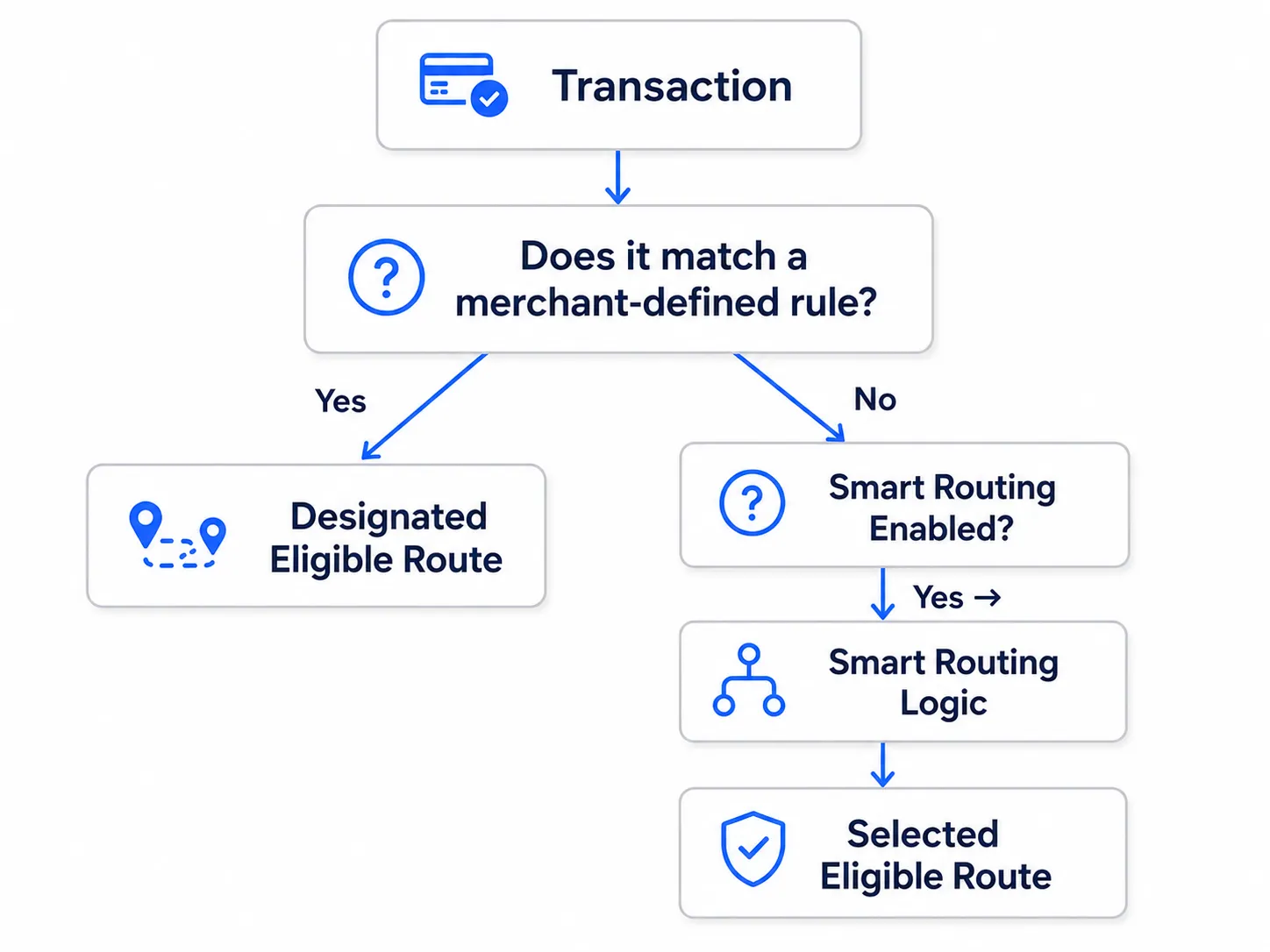
This illustrates a broader principle: Automation and merchant control do not have to be mutually exclusive.
What matters is whether priority rules are clear.
Payment Orchestration vs Payment Gateway vs PSP vs Acquirer
These terms are related, but they are not interchangeable.
Layer | Primary role | Core question |
Payment orchestration | Coordinates multiple payment connections, rules, and workflows | How should payment capabilities be managed and coordinated? |
Payment gateway | Transmits payment information into downstream payment infrastructure | How is the payment request passed onward? |
PSP | Provides one or more payment services to merchants | Which payment capabilities can the merchant access? |
Processor | Processes transaction messages within a payment flow | How is the transaction instruction processed? |
Acquirer | Supports merchant acceptance within an acquiring relationship | Which acquiring connection supports the merchant transaction? |
Network or rail | Provides infrastructure and rules for a payment flow | Through which underlying system does the payment travel? |
Issuer | Maintains the relevant customer card or account relationship | Is the transaction approved under the applicable flow? |
This table is intentionally simplified.
In practice, one company may perform multiple roles.
A provider may combine:
- gateway capabilities
- processing
- acquiring
- risk management
- orchestration
That overlap leads to an important principle: Do not evaluate payment architecture by labels alone. Map actual responsibilities.
Merchants should ask:
- Who owns the acquiring relationship?
- Who applies routing logic?
- Who stores payment credentials?
- Who provides transaction visibility?
- Who provides settlement information?
- Who supports refunds?
- Who manages risk controls?
Payment Orchestration for Cross-Border Growth
Cross-border growth makes payment orchestration particularly relevant because payment complexity does not increase evenly across markets.
Different markets may involve different combinations of:
- cards
- digital wallets
- bank-based methods
- QR payments
- local payment methods
- currencies
- acquiring relationships
- operational requirements
Acquirer coverage vs local depth
A merchant may have access to several acquiring connections without having the same capabilities in every market.
Important questions include:
- Which markets does the setup actually support?
- Which merchant entities are eligible?
- Which currencies are available?
- How are transactions reported?
- How are funds settled?
This is why connection count alone is not enough. Coverage breadth and local operating depth are different.
Payment-method coverage vs payment-method management
The same principle applies to payment methods.
A platform may display a large number of supported options.
But a merchant should also ask:
- Which methods can this business actually activate?
- In which markets?
- Under which setup?
- How are transactions monitored?
- How are refunds handled?
- How is financial data reported?
This leads to one of the most important distinctions in payment orchestration: Payment-method coverage is not the same as payment-method management.
Example: A US merchant expanding into Asia
Imagine a US ecommerce merchant that begins with:
- one primary provider
- card payments
- USD settlement
- one reporting workflow
The company then expands into several Asian markets.
Its payment environment may gradually include different combinations of:
- cards
- wallets
- bank-based methods
- local options
- acquiring connections
- currencies
The problem is no longer: Which single PSP should we choose?
It becomes: How do we manage an evolving portfolio of payment connections across markets?
That is where payment orchestration can become a broader payment-management strategy.
Beyond Routing: Transaction Operations and Reconciliation
A payment can be successfully routed and still create an operational problem if transaction and financial data remain fragmented across providers.
This is one of the most important reasons not to define orchestration as smart routing alone.
Authorization is not the end of the process
Additional events may occur:
- cancellation
- refund
- partial refund
- another post-payment adjustment
Different platforms support different parts of this lifecycle.
Centralized transaction visibility
Operations teams may need to answer:
- Which connection processed the transaction?
- What is the current status?
- Was it canceled?
- Was it refunded?
- Which reference should customer support use?
If those answers require switching among several portals, multi-provider complexity can increase operational workload.
Financial reporting
Different providers may use different:
- file formats
- settlement identifiers
- transaction fields
- fee structures
- status definitions
A more standardized reporting model can help finance teams work across these differences.
But a transaction dashboard should not automatically be treated as a full reconciliation solution.
Reconciliation support
Reconciliation connects payment activity to financial outcomes.
Finance teams may need to connect:
- Order
- Transaction
- Processing Acquirer
- Payment Status
- Settlement Details
- Settlement Summary
- Finance Reconciliation
This is a valuable evaluation area because merchants need more than successful payment execution.
They also need to understand what happened afterward.
When Does a Business Need Payment Orchestration—and How Should It Evaluate a Platform?
Payment orchestration is not necessary for every business.
A merchant operating in one market with one effective provider and straightforward reporting may gain limited value from adding another technology layer.
The business case tends to become more relevant as complexity grows.
Signals that orchestration may be worth evaluating
Business signal | Why it matters |
Multiple PSPs or acquirers | Separate integrations and data flows may become harder to manage |
Expansion across markets | Payment methods and acquiring needs may vary |
Growing routing complexity | Merchant-defined rules may become difficult to maintain across systems |
Fragmented transaction operations | Teams may need to switch between provider portals |
Inconsistent financial reporting | Finance teams may spend more time normalizing data |
Payment performance varies by market or route | The merchant may benefit from more structured routing decisions |
Engineering teams repeatedly rebuild payment connections | A centralized integration model may reduce repeated work |
When a simpler setup may still be sufficient
A single-provider model may remain appropriate when:
- one provider covers the merchant’s priority markets
- payment-method complexity is limited
- transaction operations are straightforward
- reporting is manageable
- multi-acquirer control is not required
- the organization lacks a clear owner for payment orchestration
The right question is not: Is payment orchestration more advanced?
It is: Does orchestration solve a business problem valuable enough to justify another layer of technology, cost, and governance?
What to evaluate in a platform
1) Acquirer depth
Ask:
- Which acquirers are supported?
- Which are relevant to priority markets?
- Can existing acquiring relationships be connected?
- Who owns the commercial relationship?
2) Payment-method management
Ask:
- Which methods are supported?
- Which can the merchant actually activate?
- In which markets?
- How are transactions monitored?
3) Custom-routing controls
Ask:
- Which rules can merchants configure?
- How are rule conflicts resolved?
- Can routing logic be reviewed and updated?
4) Smart-routing governance
Ask:
- What objective does routing optimize?
- What information influences decisions?
- Which routes are eligible?
- How are outcomes measured?
5) Transaction operations
Ask:
- Can teams search transactions?
- Can they identify processing connections?
- Can records be downloaded?
- Are cancellations and refunds visible?
6) Financial reporting
Ask:
- Are transaction details available?
- Are settlement details available?
- Are summary reports available?
- Can finance teams integrate the data into existing workflows?
7) Risk and security responsibilities
Merchants should evaluate payment security across the broader transaction journey rather than assume that adding an orchestration layer removes fraud, data-protection, or compliance responsibilities.
Ask:
- Who handles sensitive payment data?
- Who performs risk checks?
- Which controls are native?
- Which are integrated?
- How are responsibilities divided?
8) Ownership and exit strategy
Ask:
- Who owns transaction data?
- Can records be exported?
- What happens during migration?
- Can provider relationships continue if the orchestration model changes?
The ability to leave a platform can reveal how much control the merchant truly retains.
How Antom Approaches Payment Orchestration
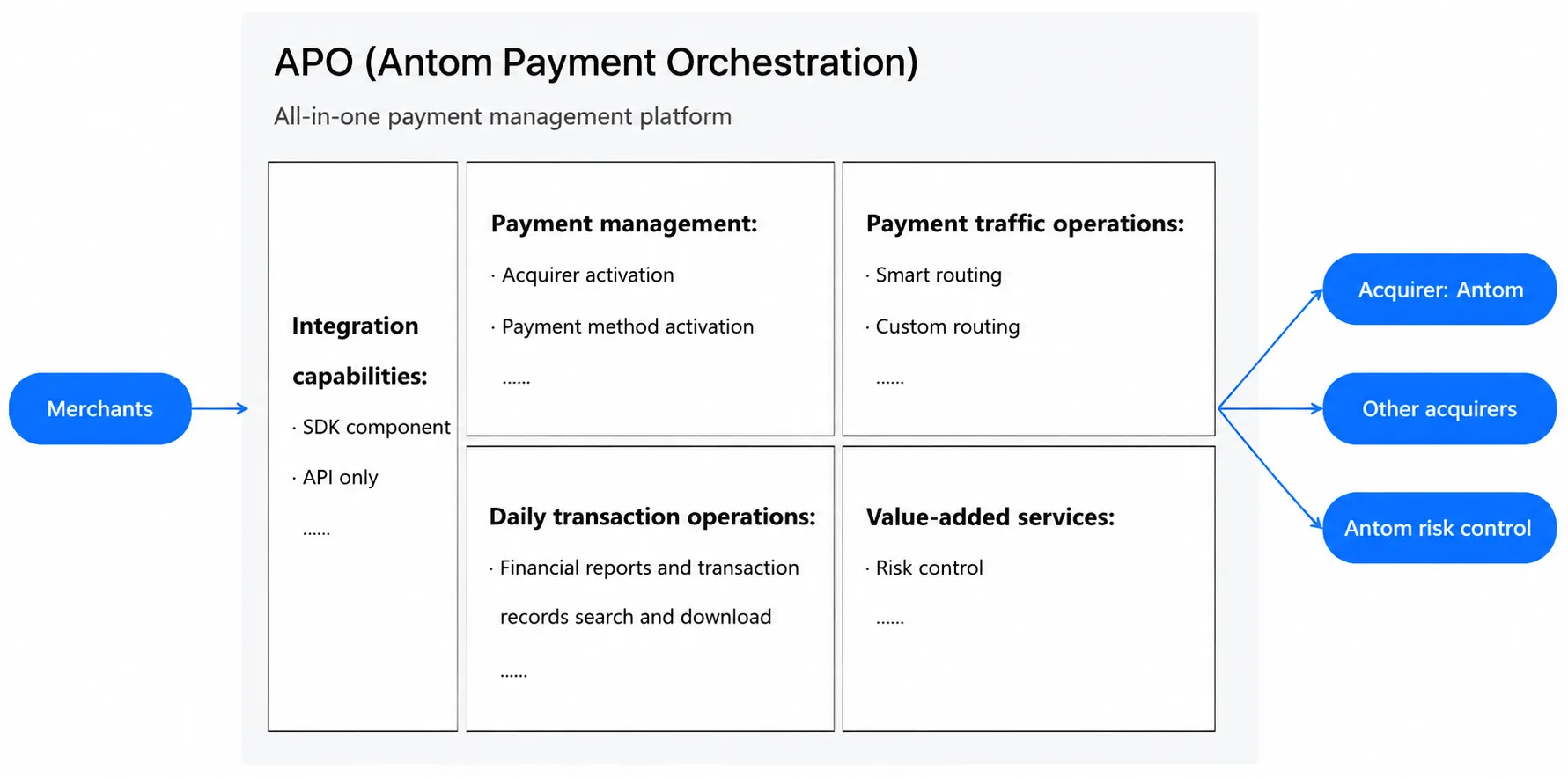
Antom Payment Orchestration (APO) is designed as a global payment-management platform that brings together payment connectivity, routing, transaction operations, and related capabilities within a unified environment.
APO provides access to more than 100 acquirers and more than 300 payment methods, together with unified integration standards. Its core capabilities cover integration, payment management, payment routing, transaction operations, and value-added services.
APO provides the following capabilities:
Unified integration
APO supports SDK-based integration for supported card-payment experiences and API-based integration for payment operations.
APO supports payment-related operations such as:
- payment
- capture
- payment-result inquiry
- payment and capture notifications
- cancellation
- refund
- refund-result inquiry
Depending on the integration model, APO supports payment initiation, capture, payment-result inquiry and notification, cancellation, refunds, and refund-result inquiry.
Acquirer and payment-method activation
APO supports:
- acquirer activation
- payment method activation
This reflects an important orchestration principle: Connecting a payment resource is only the beginning. Merchants also need to manage which resources are active and how they fit the operating model.
Smart and custom routing
APO supports two routing approaches:
- Smart routing
- Custom routing
Custom routing allows merchants to define rules for matching transactions and target acquirers.
In APO’s routing logic, custom routing takes precedence over smart routing, while eligible transactions that do not match custom rules may be evaluated through smart routing when it is enabled.
APO routing capabilities also support configurable conditions, traffic allocation, and combinations of static and intelligent routing, indicating that actual routing workflows can be more granular than a simple custom-versus-smart split.
This illustrates why routing governance matters.
The issue is not simply whether a platform offers AI or automation. Merchants may also need explicit rules defining when business control takes priority.
Transaction operations
APO supports transaction search and download capabilities, including visibility into information such as:
- processing acquirer
- transaction status
This can help operations teams access a more centralized view of relevant transaction information.
Financial reporting and reconciliation support
APO provides standardized financial reports including:
These reports support reconciliation workflows and can be accessed through supported delivery methods.
The availability and scope of standardized reconciliation reporting can vary by acquirer and configuration, so merchants should verify current support for their specific setup.
This is why Antom’s orchestration model should not be understood only as a routing engine.
The practical value of this model depends on each merchant’s markets, provider relationships, operational requirements, and payment complexity.
Risk-control integration
APO also supports an optional Antom risk-control capability. When activated, transactions undergo risk consultation before execution. Merchants should evaluate the precise data flows, controls, and responsibilities that apply to their setup.
Explore payment orchestration with Antom
Talk to our team about your markets, provider connections, routing requirements, and reconciliation needs to understand how APO may support your payment operations.
FAQs
Is payment orchestration the same as a payment gateway?
No.
A payment gateway primarily helps transmit payment information into downstream payment infrastructure. A payment orchestration layer is designed to coordinate a broader set of payment connections and rules.
Actual provider capabilities may overlap.
Is payment orchestration the same as a PSP?
No.
A PSP provides one or more payment services to merchants. A payment orchestration platform coordinates multiple payment services or workflows.
Some companies combine both roles.
What is the difference between smart routing and custom routing?
Custom routing uses merchant-defined rules.
Smart routing uses data and decision logic to choose among eligible routes according to a configured objective.
Some orchestration models may combine both approaches.
Does payment orchestration guarantee higher authorization rates?
It may create opportunities to improve how eligible transactions are routed, but outcomes depend on factors such as:
- available providers
- issuer behavior
- transaction mix
- market
- data quality
- merchant configuration
- routing logic