


Share on
Imagine you run an independent online store in your home country selling headphones.
At home, many customers are comfortable paying with cards or wallets such as Visa, Mastercard, or Apple Pay. Then your store starts attracting buyers in Thailand, the Philippines, Japan, and South Korea. The checkout that felt simple in the home country suddenly has to accommodate customers who may be more familiar with local wallets, bank-based payments, QR payments, or other local options.
At that point, the issue is no longer basic payment acceptance. You may need a payment setup that can adapt to different markets without forcing your team to find a new provider and rebuild the checkout every time the business expands.
That is a useful way to understand Antom.
Antom is Ant International’s merchant payment and digitalisation platform. Through our single gateway, businesses can access 200+ payment markets, 300+ payment methods and 140+ currencies. You can view the full list of supported payment methods here.
Our role also extends beyond payment acceptance into payment optimisation, fraud management, merchant growth and marketplace integrations.
If you searched for “Antom Pay,” this guide explains what those capabilities mean in practical terms and where they may fit into your growth plans.
Contents
- What is Antom Pay?
- Accept payments globally
- Optimise payments and manage risk
- Support business growth
- Choose the right Antom setup
Global expansion turns payments into a business decision
Payments can look like a technical item on a market-entry checklist. In practice, the decisions made at checkout can affect how quickly you enter a market, how easily customers complete a purchase, and how much operational work sits behind every transaction.
EY describes merchant payments strategy as an issue that can influence market-entry speed, customer experience, working capital, and growth. That becomes particularly relevant when a US or European business expands internationally, because the payment experience that works at home may not fit customer expectations elsewhere.
For an independent store moving into Asia, the first priority is usually payment fit. Our Checkout Payment solution brings global cards and local payment options into one checkout integration, including digital wallets, online banking, and other supported methods. Availability varies by buyer region and business setup, so localisation is less about showing as many payment logos as possible and more about making the relevant methods available to the customers you actually want to reach.
Integration effort matters too, particularly for smaller direct-to-consumer businesses. Our Shopify and WooCommerce plugins provide a simpler route to supported global and local payments without requiring every merchant to build a customised payment stack from the ground up.
The same localisation challenge exists at enterprise scale. Booking.com has worked with us to broaden local payment options across Asian markets, while Adobe has worked with us to introduce alternative payment options for customers across Asia. Their payment infrastructure is very different from that of an independent store, but the underlying commercial problem is familiar: expansion works better when checkout reflects how customers in the target market prefer to pay.
The payment flow should match how your customers buy
Once payment coverage is in place, the business model starts to matter.
A customer buying a pair of headphones once does not behave like a subscriber renewing every month or a gamer making frequent in-app purchases. Using the same payment journey for all three can create unnecessary friction.
Infographic introducing four Antom customer‑oriented payment workflows
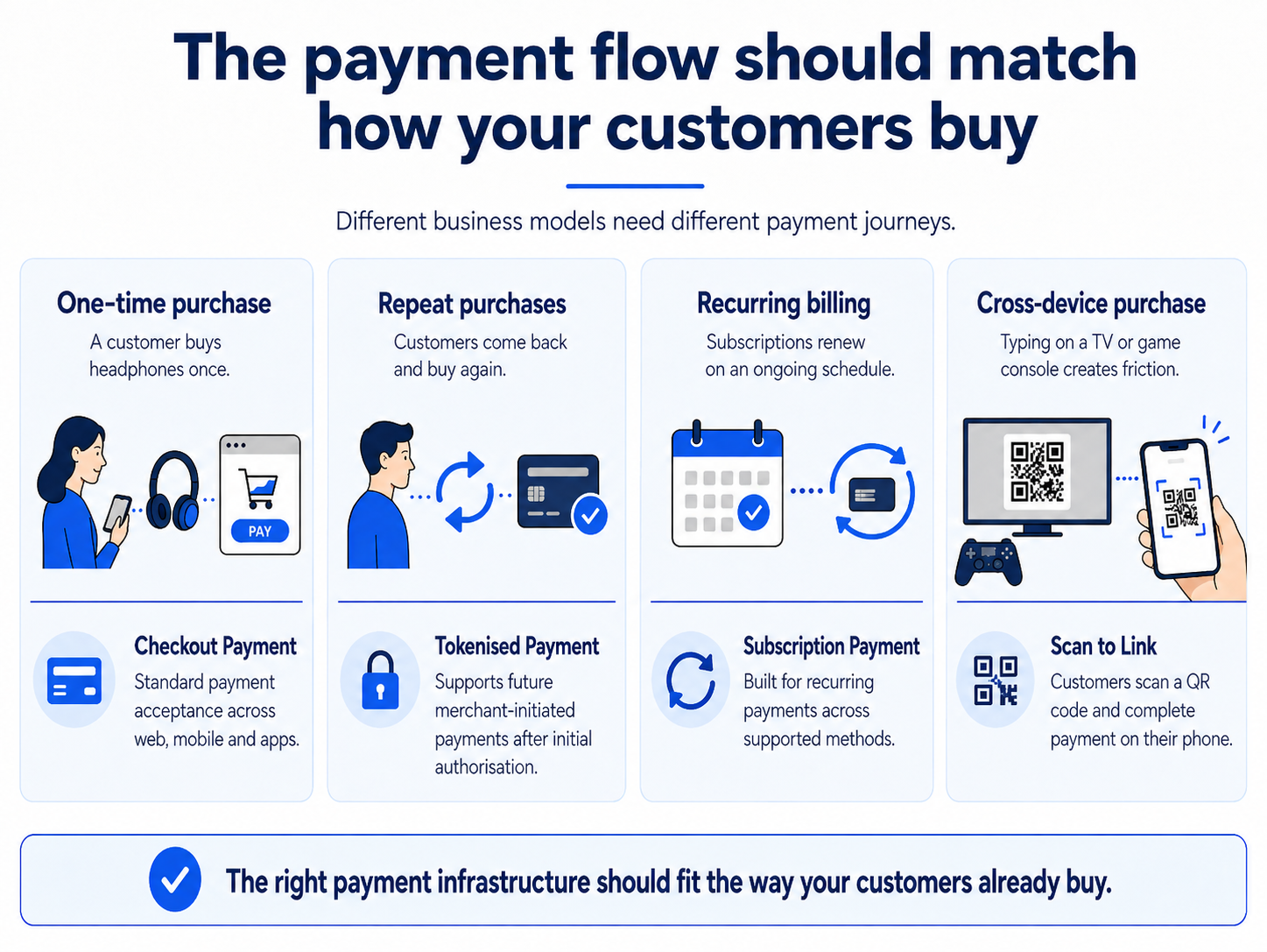
Our Checkout Payment solution is designed for standard payment acceptance across web, mobile, native apps and other supported devices, with different integration approaches available depending on how much control you need over checkout.
For businesses with frequent repeat purchases, our Tokenised Payment solution can support future merchant-initiated payments after the customer gives initial authorisation. The exact experience remains subject to the relevant payment method, scheme and regulatory requirements.
Subscription businesses have a different requirement because billing follows an ongoing schedule rather than a customer actively making every purchase. Our Subscription Payment solution is designed for recurring payments across supported wallets, cards and other local payment methods, making it relevant to memberships, digital services and other recurring-revenue models.
Digital entertainment can create another very practical checkout problem. Entering payment details with a television remote, keyboard or game controller can interrupt the purchase flow. Our Scan to Link solution lets customers move that step to their phone by scanning an on-screen QR code, making it relevant to TV, computer and gaming environments.
Across these scenarios, the commercial value is straightforward: payment infrastructure should support the way your customers already interact with your business instead of forcing customers to adapt to the infrastructure.
Optimise payments and manage risk as you scale
As your business expands, payment complexity can start to appear behind the checkout. You may work with more PSPs, acquirers and local payment connections, while card performance and fraud can become harder to manage across markets.
Our Antom Payment Orchestration (APO) is designed for businesses operating across multiple payment providers. It provides one integration layer for connecting and managing different acquirers and payment methods, with routing and unified payment-management capabilities. This can help reduce the fragmentation that builds up as a payment stack grows.
Payment performance is another part of the picture. Customers can reach checkout with genuine purchase intent and still fail to complete a card payment because of routing, authentication, credentials or issuer decisions. Our Card Revenue Booster brings together capabilities such as smart routing, adaptive messaging, authentication intelligence, retry and credential lifecycle management to help address avoidable payment failures.
As payment volume and market coverage grow, exposure to payment fraud can increase. Antom Shield, our fraud prevention and risk-management solution, uses machine-learning risk assessment and configurable controls to help identify risky transactions while limiting unnecessary friction for legitimate customers.
Together, these capabilities are relevant when payment stops being only a checkout question and becomes an operational, conversion, and risk-management issue.
Payments can support growth at more than one stage
For a growing business, payments affect more than the moment when money changes hands. The right setup can make it easier to enter a new market, convert existing demand, support repeat revenue, reduce the operational burden of expansion and, in some markets, create new ways to reach and engage customers.
Remove friction when entering a new market
For an independent US store attracting customers from Southeast Asia, generating traffic is only part of the job. Customers still need to find payment options at checkout that make sense in their market.
Our global and local payment coverage helps you adapt the payment experience without building separate payment integrations market by market. This does not create demand by itself, but it helps prevent payment friction from becoming the reason existing demand is lost.
Convert more demand and support repeat revenue
Growth also depends on what happens after a customer decides to buy.
For businesses built around repeat purchases or subscriptions, customers need to be able to pay again without unnecessary friction. Our Tokenised Payment and Subscription Payment solutions support different returning-customer and recurring-payment models, while Card Revenue Booster is designed to address avoidable card-payment failures.
Together, these capabilities help protect a part of revenue that is easy to overlook: demand the business has already spent time and money acquiring.
Reduce the operational cost of expansion
Entering more markets can gradually leave a merchant managing more PSPs, acquirers, integrations and payment operations.
At sufficient scale, our payment orchestration capabilities can provide a more unified layer across that infrastructure. Reducing fragmentation may not be visible to customers, but it can make expansion easier for teams that would otherwise spend increasing amounts of time maintaining payment complexity.
Use payment ecosystems as growth channels
In parts of Asia, digital wallets can play a broader role in the customer journey. Consumers may use the same apps not only to pay, but also to discover offers, receive rewards and interact with merchants.
Our A+ Rewards solution is designed for this opportunity. It connects merchant marketing activities with participating digital-payment channels and supports use cases including customer acquisition, reactivation, repeat purchases and average-order-value growth.
For a direct-to-consumer brand entering Asia, local wallet acceptance can first make checkout more relevant to customers in the new market. Where the relevant payment ecosystem supports it, growth capabilities can then provide additional ways to reach prospective customers, bring previous customers back and encourage further purchases.
This broader role for payments is also reflected in industry research. EY has described payments as moving beyond transaction processing toward commerce services that can support customer engagement, loyalty and growth.
A+ Rewards has received independent industry recognition as well. In 2025, The Asian Banker named A+ Rewards by Antom the Best Merchant Service in Asia Pacific, recognising its use of digital-payment channels for merchant marketing and customer engagement.
Growth stage | How payments can help | Relevant capabilities |
|---|---|---|
Enter a new market | Reduce checkout friction with relevant local payment options | Global and local payment coverage |
Convert existing demand | Reduce avoidable payment failures and support repeat purchases | Tokenised Payment, Subscription Payment, Card Revenue Booster |
Scale internationally | Reduce fragmentation across providers and payment operations | Payment orchestration |
Grow customer value | Support acquisition, reactivation and repeat engagement | A+ Rewards |
For your business, this makes the value of a payment platform broader than transaction processing alone. The right setup can help you enter markets more smoothly, convert more of the demand you already have, support repeat customer relationships, reduce the operational burden of expansion and, where relevant, use payment ecosystems as another channel for growth.
Different businesses need different parts of the platform
The right payment setup depends on where your business is in its growth journey.
- Independent stores expanding into Southeast Asia may prioritise relevant local payment methods and a practical integration path. For Shopify or WooCommerce merchants, reducing development work can matter more than adding sophisticated payment infrastructure from day one.
- Gaming and digital entertainment businesses often need to think about several parts of the customer journey at once. Local payment preferences shape checkout, repeat purchases require smoother returning-user flows, cross-device behaviour affects how payment is completed, and higher transaction volumes make fraud controls more important.
- Subscription businesses are more exposed to recurring-payment performance because revenue depends on successful renewals over time, not just the first payment.
- Larger international merchants with several existing providers may find orchestration and payment optimisation more relevant than simply adding another gateway.
Across all of these scenarios, the same principle applies: payment infrastructure should reduce the work created by expansion and support the commercial model behind each transaction.

Start with your payment problem, not our product list
You do not need to decide whether you need Checkout Payment, APO, Antom Shield or A+ Rewards before speaking with us.
A more useful starting point is your own business: where you are registered, which markets you serve, where you want to expand, how customers buy, which payment providers you already use and where payment is creating friction today.
For some merchants, the priority will be better access to local payment methods. Others may need a recurring-payment flow, simpler management of multiple providers, stronger card payment performance or more precise fraud controls. Businesses expanding in Asia may also want to understand whether relevant digital-payment ecosystems can contribute to customer acquisition and engagement alongside checkout.
Our payment experts can help you assess those needs against your current setup and expansion plans, then identify the payment capabilities that are relevant to your business.
If payments are becoming a barrier between your business and its next market, talk to our team about what you are trying to solve.
FAQs
What is Antom Pay?
If you searched for “Antom Pay,” you are likely looking for our merchant payment services. Antom is Ant International’s merchant payment and digitalisation platform, helping businesses accept and manage payments across markets while also supporting payment optimisation, fraud management and merchant growth.
Is Antom a digital wallet?
No. Antom is a merchant-facing payment platform rather than a consumer payment app. Your customers may use cards, digital wallets, bank-based payments or other supported payment methods at checkout, while we provide the merchant-side infrastructure behind those payment experiences.
What payment methods can I accept with Antom?
We support a broad range of global and local payment methods, including cards, digital wallets, online banking and other market-specific payment options. Exact availability depends on factors such as your business setup, target market and the payment products you use.
Is Antom only for large global companies?
No. Different businesses can use different parts of our platform. Independent stores can use integration options such as our Shopify and WooCommerce plugins, while larger international businesses may need capabilities such as payment orchestration, card payment optimisation or more advanced fraud management.
Can Antom support repeat and subscription payments?
Yes. Our Tokenised Payment solution is designed for authorised future payments in supported scenarios, while Subscription Payment supports recurring billing models such as memberships and digital services. The exact payment experience depends on the relevant payment method, scheme and regulatory requirements.
How can Antom help my business grow beyond accepting payments?
Payment can support growth by reducing checkout friction, helping convert existing demand, supporting repeat customer relationships and reducing the operational complexity of expansion. In participating Asia-Pacific digital-wallet ecosystems, our A+ Rewards solution can also support merchant marketing activities such as customer acquisition, reactivation, repeat purchases and average-order-value growth.
How do I know which Antom products are right for my business?
The right setup depends on where you operate, which markets you want to enter, how your customers prefer to pay, your business model and the payment infrastructure you already use. Our payment experts can help you assess those needs before deciding which payment capabilities are relevant.