
Share on
One-time payments are widely used by businesses to accept online payments. A customer chooses a product, service, booking, or invoice, authorizes a single transaction, and completes the purchase without setting up automatic future billing.
For ecommerce businesses, digital platforms, and global merchants expanding into new markets, one-time payments affect more than checkout. They can influence conversion, customer experience, fraud exposure, settlement, and payment method selection.
This is especially important for cross-border businesses entering Asia. Worldpay’s Global Payments Report 2025 notes that digital wallets are the leading online payment method in 8 of the 14 APAC markets it covers. A one-time payment may look simple to the customer, but behind the checkout page, the transaction can involve local payment methods, card networks, digital wallets, authentication, fraud checks, foreign exchange, and settlement across multiple markets.
Risk is another reason checkout design matters. Juniper Research estimates that ecommerce fraud will grow from $56 billion in 2025 to $131 billion in 2030, making secure checkout and payment risk management important for businesses processing online transactions at scale.
This guide explains what one-time payments are, how they work, when businesses should use them, and how to optimize them for cross-border ecommerce growth.
What are one-time payments?
One-time payments are single customer-authorized transactions for a specific purchase, invoice, booking, or service. They do not create automatic future charges unless the customer separately agrees to another payment arrangement.
In practice, this means each new purchase requires a new payment action from the customer. Common examples include ecommerce orders, hotel bookings, online courses, one-off invoices, digital goods, and project-based services.
The key point is authorization: the customer approves one transaction only. By contrast, recurring payments allow a business to charge the customer again under agreed billing terms.
How do one-time payments work?
A one-time payment may feel instant to the customer, but several steps happen behind the scenes.
Step 1: The customer starts checkout
The customer selects a product, service, booking, or invoice and confirms the order amount, currency, and preferred payment method.
Step 2: The payment request is created
The merchant or payment provider sends the payment request for processing. This request usually includes the transaction amount, currency, payment method, order details, and risk signals.
Step 3: The customer completes authentication
The customer may need to verify the payment. For card payments, this may involve 3D Secure or another verification step. For digital wallets or bank-based payment methods, the customer may authenticate through a wallet app, banking app, or payment interface.
Step 4: The payment is authorized
The issuer, wallet provider, bank, or payment network checks whether the transaction can be approved. This step checks available funds, payment details, and transaction risk before approval.
Step 5: The payment is captured and confirmed
After authorization, the merchant captures the payment and confirms the transaction. In many ecommerce transactions, authorization and capture occur together or in close sequence. In sectors such as travel, hospitality, or rental services, the merchant may authorize the payment first and capture it later.
Step 6: Funds are cleared and settled
Funds are cleared and paid out to the merchant based on the payment method, acquiring setup, currency, and settlement rules.
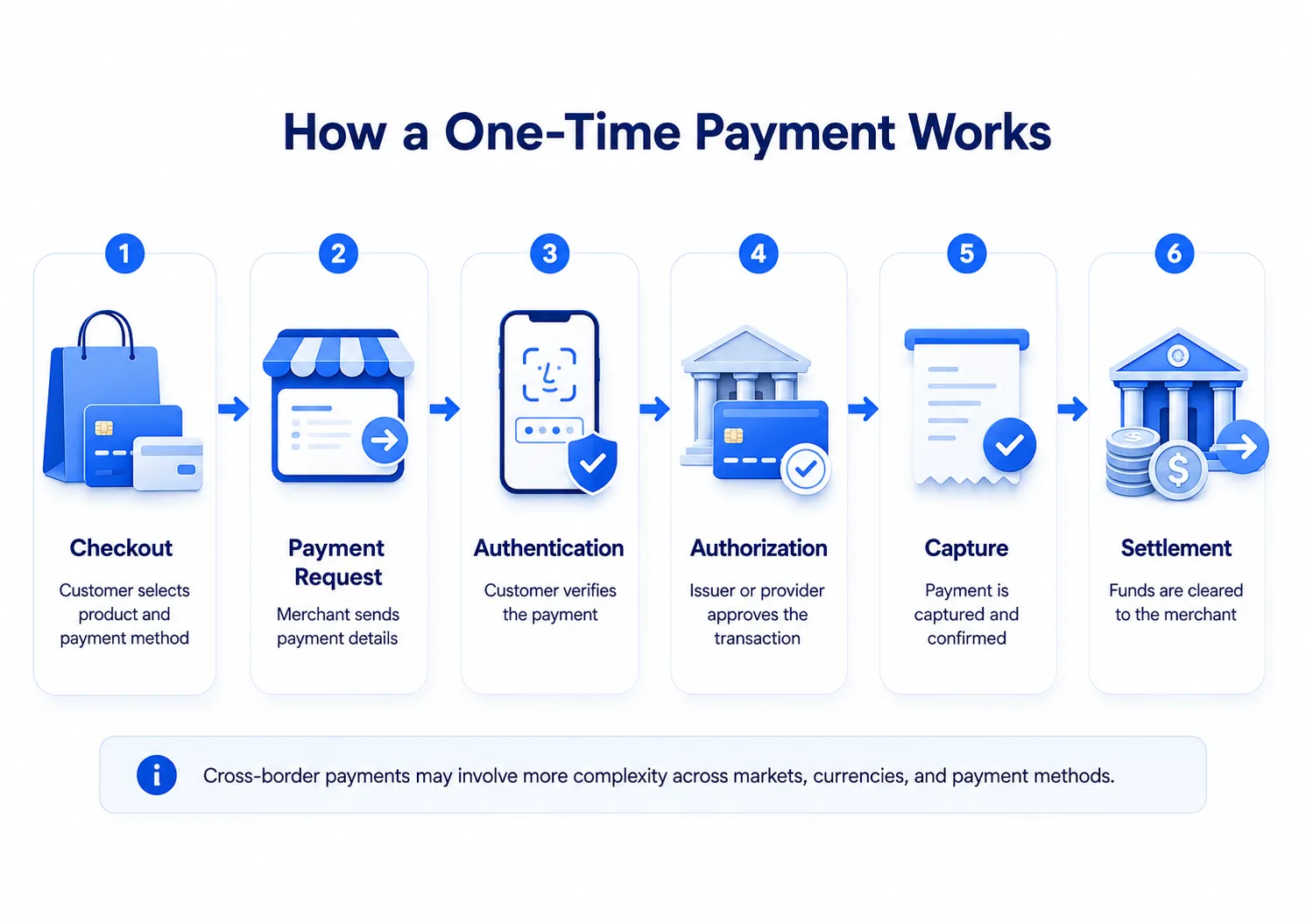
For cross-border merchants, this process can become more complex because the customer, merchant, payment method, currency, and settlement account may be located in different markets.
One-time payments vs recurring payments: key differences
The difference between one-time payments and recurring payments is not only about frequency. It is also about customer authorization, billing rights, payment operations, and revenue model.
Factor | One-time payments | Recurring payments |
Billing frequency | Single transaction | Repeated charges |
Customer authorization | Customer approves one specific payment | Customer authorizes future payments under agreed terms |
Best for | Ecommerce orders, bookings, invoices, digital goods, one-off services | Subscriptions, memberships, SaaS, ongoing services |
Revenue model | Immediate revenue from each transaction | Predictable revenue over time |
Customer commitment | Lower commitment | Higher commitment |
Payment operations | Simpler transaction management | Requires subscription management, retries, cancellations, and billing lifecycle support |
Risk focus | Fraud, chargebacks, refund abuse, payment failures | Failed renewals, expired cards, cancellations, disputes, chargebacks |
Payment method fit | Cards, wallets, bank transfers, local payment methods, payment links | Cards, direct debit, selected wallets, stored credentials, mandates |
One-time payments typically fit purchases where value is delivered once. Recurring payments are better suited to ongoing access, usage, or service models.
Many businesses use both models. For example, an ecommerce business may use one-time payments for individual orders and recurring billing for memberships, subscriptions, or premium services.
When should businesses use one-time payments?
One-time payments work well when the product or service has a clear start and end, and when the customer receives value immediately or within a defined delivery window.
Common use cases include:
- Ecommerce and online retail: physical goods such as fashion, electronics, cosmetics, home goods, or accessories.
- Travel, ticketing, and bookings: flights, hotels, events, attractions, and transport services tied to a specific date or usage window.
- Digital goods and online services: ebooks, design templates, plugins, reports, online courses, software licenses, or single consulting sessions.
- Marketplaces and platforms: individual buyer transactions for products, services, bookings, or digital assets.
- B2B invoices and project-based services: consulting, training, implementation, or one-off professional services.
For global ecommerce businesses, the bigger challenge is making sure checkout supports the payment methods customers trust in each market.
Why one-time payments matter for cross-border ecommerce
Cross-border demand is already mainstream: DHL eCommerce reports that 59% of global shoppers buy from retailers outside their home country, and 35% do so at least once a month.
In cross-border ecommerce, the customer, currency, payment method, authentication flow, and settlement process may all vary by market. This makes one-time payment performance depend on more than checkout design. It also depends on local payment methods, acquiring setup, fraud prevention, and settlement visibility.
Common challenges include:
- Payment method mismatch: If a merchant only supports international cards, customers in markets where wallets, bank transfers, or other local payment methods are preferred may drop off.
- Higher decline risk: Cross-border transactions may face higher decline risk when the merchant, cardholder, and acquiring route are located in different regions.
- Market-specific fraud patterns: Fraud risks such as stolen cards, card testing, chargebacks, refund abuse, and false declines can vary by market. Merchants need risk management that can adapt to local customer behavior and transaction patterns.
- Settlement and reconciliation complexity: Businesses selling across multiple Asian markets may need to manage different currencies, payment methods, refund rules, settlement timelines, and reporting formats.
How to optimize one-time payment checkout
A strong one-time payment checkout should help real customers complete payment quickly while reducing fraud, failed payments, and operational complexity. For cross-border ecommerce businesses, optimization depends not only on page design, but also on payment method coverage, local acquiring, risk control, and performance tracking.
Keep the checkout flow simple
Reduce unnecessary steps and ask only for information needed to process the order, assess risk, and fulfill the purchase. Long forms, forced registration, unclear errors, and too many redirects can increase abandonment. Guest checkout can also help first-time customers complete one-time purchases faster.
Support local payment methods
Payment preferences vary by market. A customer in the US may prefer card payments, while a customer in Southeast Asia may expect local wallets, bank transfers, QR-based payments, or other local payment methods. For cross-border merchants, supporting global and local payment methods through a single integration can help reduce checkout friction and improve conversion.
Optimize for mobile and transparency
Many one-time payments happen on mobile devices, especially in wallet-led markets. Checkout should load quickly, use mobile-friendly input fields, and display clear calls to action. Merchants should also show pricing, currency, taxes, shipping fees, refund policies, and delivery information clearly to reduce last-step hesitation and post-payment disputes.
Balance security and conversion
Payment security should help detect and reduce suspicious activity without creating unnecessary friction for legitimate customers. Strong risk management can help detect fraud signals, reduce chargeback exposure, and limit false declines. This balance is especially important for single transactions because customers may not return if the checkout feels difficult or unfamiliar.
Improve payment success and monitor performance
Payment success can vary by market, issuer, payment method, and acquiring setup. Local acquiring and payment optimization can help improve authorization performance and reduce avoidable declines in target markets. Businesses should regularly monitor payment success rate, authorization rate, checkout abandonment, failed payments, refunds, chargebacks, and false declines by market, currency, and payment method.
FAQs
What is a one-time payment?
A one-time payment is a single transaction authorized by a customer for a specific purchase, invoice, booking, or service. It does not automatically create future charges.
What is the difference between one-time payments and recurring payments?
One-time payments happen once for a specific transaction. Recurring payments repeat on a schedule, usually under a subscription, membership, or ongoing service agreement.
How can cross-border merchants improve one-time payment success?
Cross-border merchants can improve one-time payment success by supporting local payment methods, optimizing checkout for mobile, using localized acquiring where possible, improving risk control, and monitoring payment performance across markets.