
Share on
If you’re a global B2B merchant, international business payments are part of your sales, customer experience, market entry, and revenue growth. When your buyer from another country is ready to pay, they expect a clear, trusted, and local payment process.
This guide will explain how you can accept payments from customers worldwide, what payment methods to consider, and how to build a payment setup that supports global expansion without adding extra work for finance and operations teams.
What are international business payments?
International business payments refer to payments made between a business and a customer, partner, or distributor in another country. They can happen through online checkout, invoice links, bank transfers, cards, digital wallets, or local payment methods.
For B2B merchants, international business payments can involve many payment systems and documentation requirements beyond simply accepting foreign cards. For instance, enterprise buyers often need invoices with tax details and internal approvals, while smaller buyers expect a local payment option or a preferred currency before completing the payment.
The table below explains international payment setup for global merchants:
Payment need | What it means for merchants |
Payment acceptance | Letting customers pay through methods they know and trust |
Currency handling | Showing prices and accepting payments in relevant currencies |
Settlement | Receiving funds through a process that supports cash flow |
Reconciliation | Matching orders, invoices, fees, refunds, and payouts |
Compliance support | Following payment, tax, and customer verification rules in target markets |
In short, good international business payments help customers pay with less confusion while assisting merchants in collecting money with less manual work.
Why international payment acceptance is different from local payments
Cross-border selling adds more moving parts to the payment process. Different buyers may trust different payment methods based on their local markets. Additionally, a card payment may work well in one country, while a bank transfer or a local wallet may be more common in another.
The main challenge is making the payment feel suitable for the market, the sales model, and the buyer’s internal process.
As a global merchant, you may need to consider:
- Local payment habits in each country
- Currency display and conversion
- Payment authorisation and settlement routes
- Tax invoices and buyer records
- Refunds, chargebacks, and dispute handling
- Fraud checks, risk control, and transaction security
If you’re entering a new market, it’s best to plan global payment acceptance in advance, not fix it after payment failures start affecting revenue.
How to set up international business payments for customers worldwide
To set up international business payments, begin with the customer journey, not the payment technology. The right setup depends on where buyers are located, how they prefer to pay, and how your sales process works.
1. Choose your target markets
Start by listing the countries or regions where you already have demand or plan to grow. Then, review how buyers in each market pay for business purchases.
Explore these questions:
- Are buyers mainly small businesses, enterprises, platforms, or resellers?
- Do they pay through checkout, invoice, sales contract, or payment link?
- Do they expect local currency pricing?
- Do they need tax details before payment?
- Do they prefer instant payment or bank settlement?
Try to avoid building a generic global checkout that does not fit any market well.
2. Match payment methods to the buyer journey
Different B2B payments need different flows. A self-serve customer may prefer fast, online payment. An enterprise buyer may need an invoice, purchase order number, and approval from finance.
Your goal is to support both speed and control. Smaller buyers should be able to complete payment smoothly without talking to sales. Larger buyers should have enough payment options and documentation to move through approval.
For example, a payment platform like Antom helps connect payment acceptance with local customer expectations without adding complexity to your payment stack.
3. Decide how you will handle currencies
Currency affects trust and conversion. If a buyer sees only a foreign currency, they may worry about exchange costs, card fees, or invoice mismatch.
You should decide whether to:
- Display prices in local currencies or one main currency
- Accept payment in local currency but settle in another currency
- Use separate pricing rules for different regions
When it comes to B2B sales, clarity matters as much as currency choice. Buyers should know what they are paying, what currency will appear on their statement or invoice, and whether taxes or fees are included.
4. Prepare checkout, invoice, and payment link flows
Not all international payments happen through a shopping cart. Many B2B merchants need flexible flows for sales teams, account managers, and finance teams.
The table below shows common payment flows:
Scenario | Suitable payment flow |
Self-serve software plan | Online checkout with card or local payment method |
Enterprise contract | Invoice payment with bank transfer or payment link |
Cross-border wholesale order | Pro forma invoice followed by final payment |
Marketplace or platform payment | Buyer payment with seller or partner payout flow |
Event, travel, or booking service | Deposit payment followed by balance payment |
The payment flow should match how the buyer makes decisions. For example, an invoice payment link can reduce back-and-forth emails because the buyer gets a clear amount, due date, and payment route in one place.
Which payment methods should global merchants support?
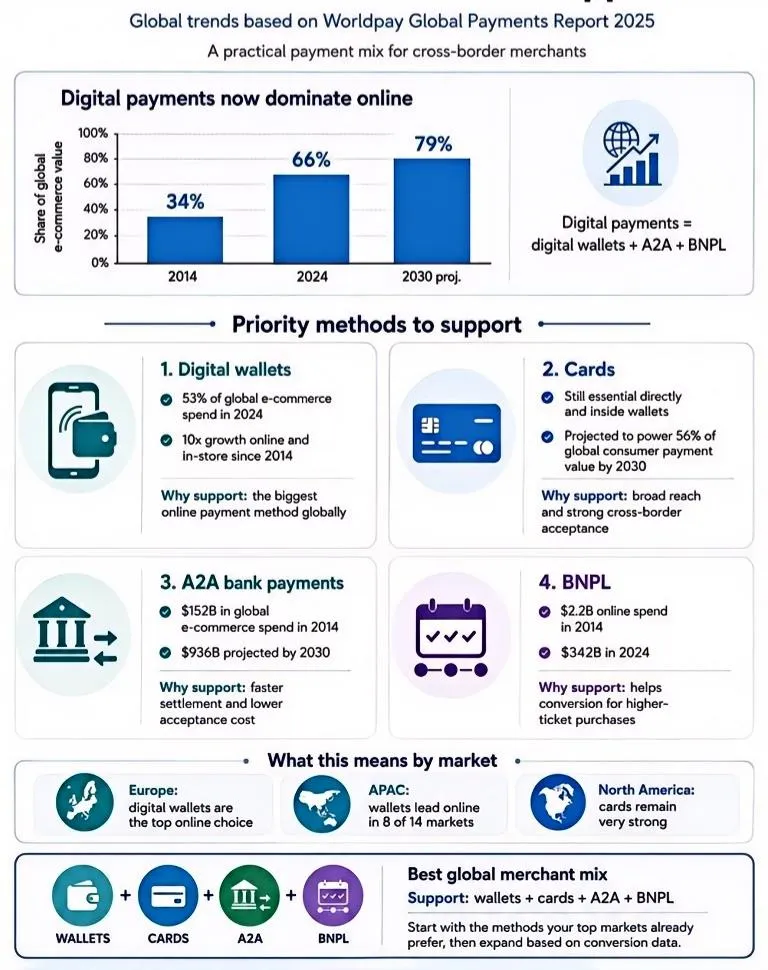
There is no single payment method that works everywhere. The best approach is to build a mixed payment system based on market demand, order value, buyer type, and operational cost.
Cards
Cards are useful for fast checkout and smaller transactions. They are often suitable for SaaS, digital services, online retail, and booking flows. They can also support recurring payments when customers need repeat billing.
But you do not want to rely on just cards for every market. Some buyers may face card limits, local restrictions, or finance approval rules.
Bank transfers
Bank transfers are common for larger B2B payments because finance teams are familiar with them. They are useful for invoices, high-value orders, and enterprise contracts.
Keep in mind that bank transfers can create more manual work if payment references are missing or if finance teams need to match payments across currencies and entities.
Local payment methods
Local payment methods help buyers pay in a way that’s familiar in their market. These may include account-to-account payments, wallets, online banking options, or domestic payment schemes.
For merchants, local payment methods can improve payment completion when customers do not want to use international cards or foreign bank transfers.
Payment links and invoice payments
Payment links are useful when a big part of your sales happen through email, chat, phone, or account managers. They allow a merchant to send a secure payment request without building a full checkout page for every case.
For B2B merchants, payment links can support deposits, renewals, upgrades, one-off service fees, and late invoice follow-ups.
How to build checkout and invoice flows that fit B2B buying
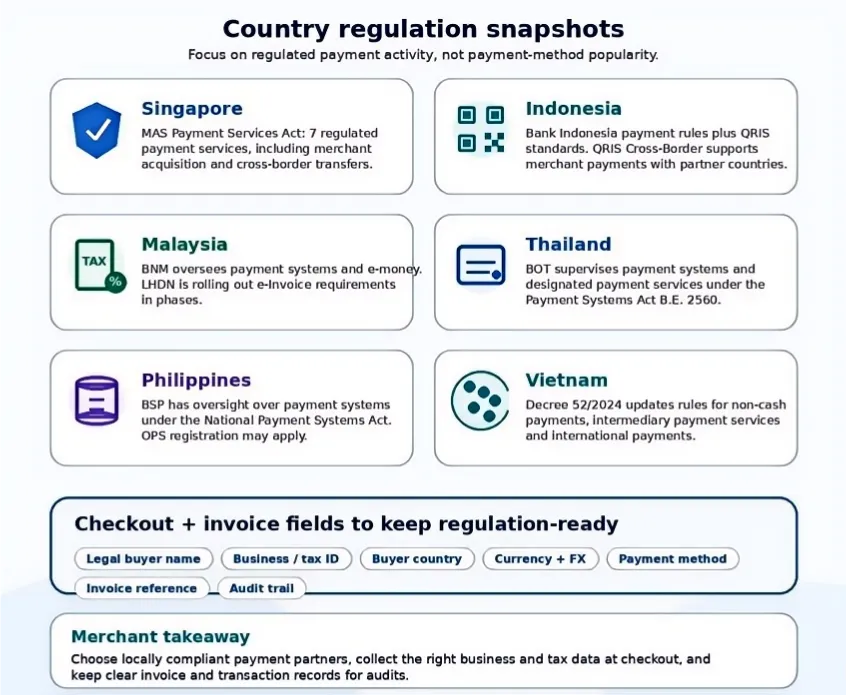
B2B buyers often need more information before they pay. They mostly need a legal business name, tax number, billing address, purchase order reference, or contract details. If the payment page does not support these needs, the buyer may leave the flow and ask for manual help.
A strong B2B payment experience should be simple, but it should not remove important business fields. Your job is to collect the right details once and pass them clearly to finance, sales, fulfilment, and customer support.
Include the following in your B2B payment flow:
- Clear business name and billing details
- Local currency or clear currency notice
- Payment method options based on buyer location
- Invoice or receipt delivery after payment
- Order reference, invoice number, or purchase order field
- Simple refund and dispute support process
Additionally, your payment page should also explain what happens after payment. For example, will the customer get instant access, wait for manual approval, or receive a confirmation from the sales team?
Clear next steps, reduce support tickets, and make the buyer feel more confident in processing the payment.
How to manage settlement, reconciliation, and reporting
Accepting international payments is only the first part. You also need to receive, record, and reconcile funds across markets.
This is where many global payment setups can become confusing. Payments can arrive in different currencies, at different times, and with different fees. If order IDs, invoice numbers, and settlement reports do not match, your finance team will have to spend hours checking records by hand.
Therefore, before launching your products or services in a new market, define how you’ll handle the following:
- Settlement currency and payout schedule
- Payment fees and exchange costs
- Refund records
- Chargeback or dispute records
- Invoice numbers and order IDs
- Reporting access for finance teams
Make sure your reporting setup answers some simple yet important questions, such as: Which customer paid? Which order does the payment belong to? What fees were deducted? Which refunds are pending? Which payouts have reached the bank account?
When this data is clean, international expansion becomes easier to manage.
How to protect payment success without adding unnecessary friction
As a global merchant, revenue protection is important, but at the same time, you should also ensure you aren’t blocking good customers. If checks are too weak, your business may face payment abuse and disputes. If checks are too strict, real buyers may be declined or asked for too many extra steps.
The best approach is to review payment risk by market, order value, buyer type, and payment method. A low-value renewal from an existing customer may not need the same checks as a high-value first order from a new buyer.
With payment security and risk control, you can build a safer payment process while keeping the buyer journey as smooth as possible.
As a B2B merchant, keep in mind that your payment process should protect the business, but it should also help trusted customers complete payment quickly and easily.
Conclusion: Make payments part of your global growth
International business payments affect how buyers trust your brand, how fast deals close, how finance teams track revenue, and how easily your business can expand into new markets.
For global B2B merchants, the right payment setup should do three things flawlessly. It should support the payment methods customers expect, keep currency and invoice details clear, and help internal teams manage settlement and reporting.
When payment acceptance is planned as part of market expansion, you can turn more global demand into completed revenue.
If your business is expanding across regions, Antom can help you support 300+ global and local payment methods across 200+ markets, so your customers can pay through familiar options in their own markets.
FAQ
Can international business payments support offline sales teams?
Yes. International business payments can support offline sales through payment links, invoice links, and account manager-led payment requests. With the right setup, sales teams can collect payment after calls, demos, trade shows, or contract discussions.
How should merchants test international business payments before entering a new market?
Merchants should test local payment methods, currency display, invoice fields, refund flow, and payment confirmation messages before launch. They should also check whether finance and support teams can see the right payment data after each test transaction.
Are international business payments useful for B2B platforms with many sellers or partners?
Yes. B2B platforms can use international business payments to collect from buyers and manage payouts to sellers, partners, or service providers. The exact setup depends on the platform model, settlement needs, and local rules.