

Share on
Online shopping came as a revolutionary concept a few decades ago. Fast forward to today, the addition of AI into e-commerce has taken the world by storm. Agentic commerce has entered this landscape and is now an integral part of businesses.
It can help shoppers find products and even complete purchases on their behalf. Instead of simply supporting merchants behind the scenes, intelligent AI agents are now becoming part of the customer buying journey.
But what exactly is agentic commerce? And why are businesses paying attention to it? This guide explains key concepts of agentic commerce, followed by its use cases, and what the future holds for it.
Let's find out!
What is Agentic Commerce?
In short, agentic commerce is an AI-driven approach to digital shopping. Buyers no longer have to open multiple tabs and manually check the prices. They simply prompt AI to do the tasks. For instance, they could instruct "reserve a table at the highest-rated Italian restaurant near the hotel for 7 pm" or "find the best laptop under $1000."
The AI will then assess the available options, present the best ones, and complete the transaction using agentic commerce payments.
A Quick History of E-commerce
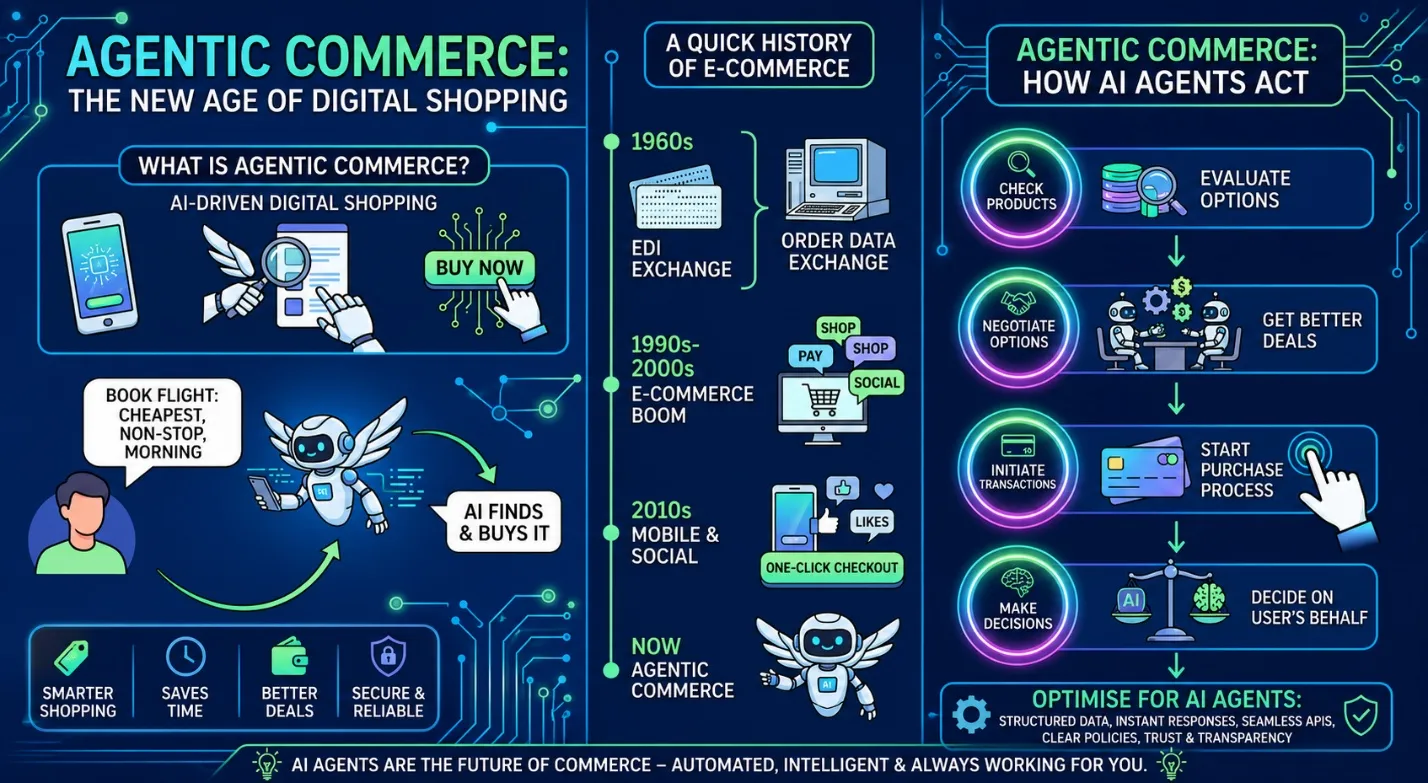
The image above illustrates the next stage in e-commerce's evolution.
- In the 1960s, businesses used Electronic Data Interchange (EDI) to exchange orders digitally.
- Decades later, smartphones, one-click checkout, subscriptions, and social commerce made online shopping more convenient.
Each innovation reduced friction for buyers.
Agentic Commerce Takes It Further
Agentic commerce takes that concept even further. Rather than helping customers browse online stores, AI agents are the active participants in the purchasing process. They:
- Check the products
- Negotiate options
- Initiate transactions
- Make buying decisions on the user's behalf
Also known as a-commerce, this model changes how businesses compete. Instead of designing experiences solely for human shoppers, merchants must also optimise their product data. They must also optimise the checkout systems for AI agents that value structured information, instant responses, and seamless purchasing experiences.
The Essentials of Agentic Commerce
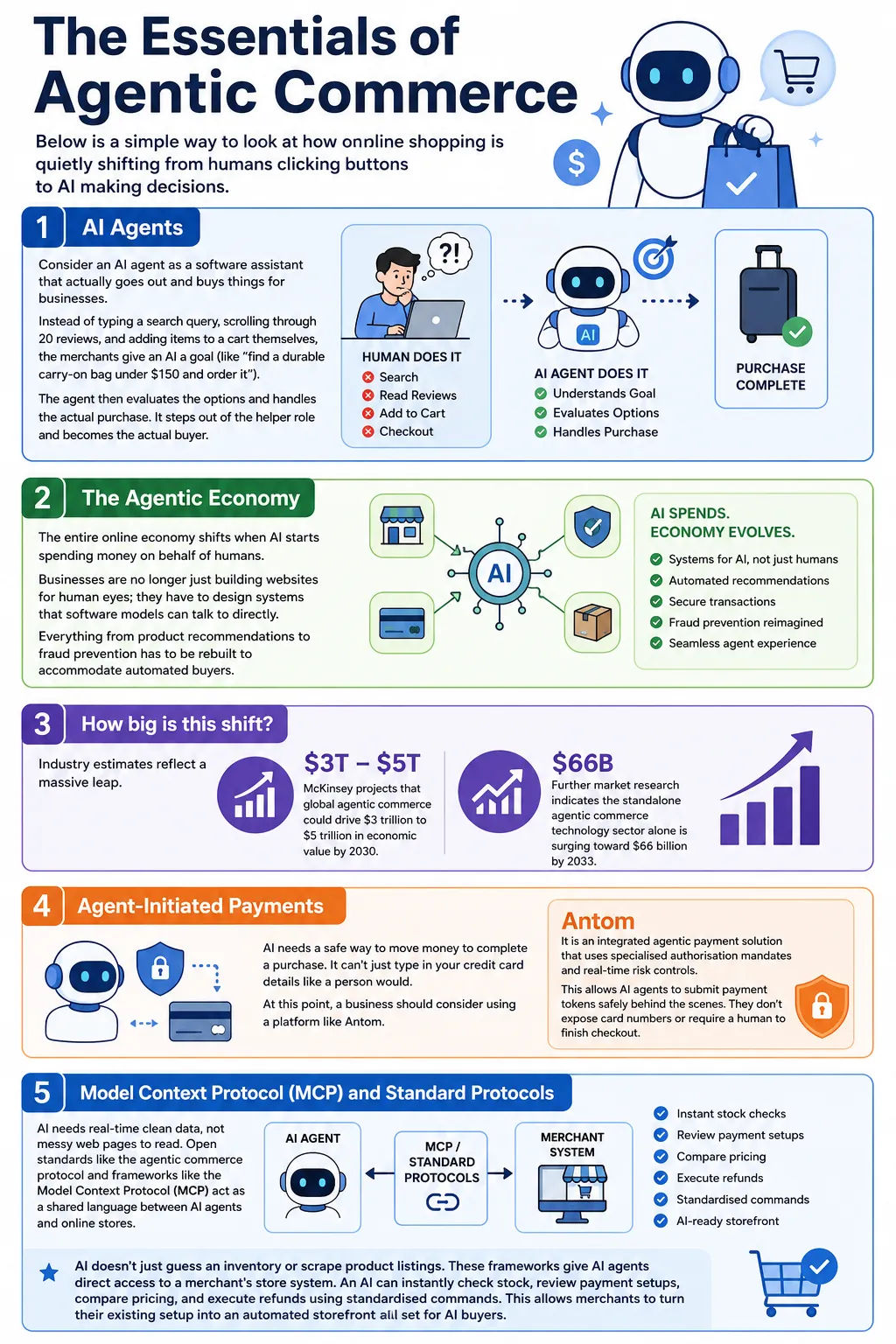
Below is a simple way to look at how online shopping is quietly shifting from humans clicking buttons to AI making decisions.
AI Agents
Consider an AI agent as a software assistant that actually goes out and buys things for users. Instead of typing a search query, scrolling through 20 reviews, and adding items to a cart themselves, the user gives an AI a goal (like "find a durable carry-on bag under $150 and order it").
The agent then evaluates the options and handles the actual purchase. It steps out of the helper role and becomes the actual buyer.
The Agentic Economy
The entire online economy shifts when AI starts spending money on behalf of humans. Businesses are no longer just building websites for human eyes; they have to design systems that software models can talk to directly. Everything from product recommendations to fraud prevention has to be rebuilt to accommodate automated buyers.
How big is this shift?
Industry estimates reflect a massive leap. McKinsey projects that global agentic commerce could drive $3 trillion to $5 trillion in economic value by 2030. Further market research indicates the standalone agentic commerce technology sector is surging toward $66 billion by 2033.
Agent-Initiated Payments
AI needs a safe way to move money to complete a purchase. It can't just type in a user's credit card details like a person would. At this point, a business should consider using a platform like Antom.
It is an integrated agentic payment solution that uses specialised authorisation mandates and real-time risk controls. This allows AI agents to submit payment tokens safely behind the scenes. They don't expose card numbers or require a human to finish checkout.
Model Context Protocol (MCP) and Standard Protocols
AI needs clean data to extract information. Messy web pages fail to provide the right data. Recent standards like the agentic commerce protocol and frameworks like the Model Context Protocol (MCP) act as a shared language between AI agents and online stores.
AI doesn't just guess stock levels or scrape product listings. These frameworks give AI agents direct access to a merchant's store system. An AI can instantly check stock, review payment setups, compare pricing, and execute refunds using standardised commands. This allows merchants to turn their existing setup into an automated storefront all set for AI buyers.
How Agentic Commerce Works
Imagine a world where customers never actually visit a website. Their AI agents do.
Humans are no longer clicking through pages. An agent handles the heavy lifting. It hunts down product details, reads the fine print on return policies, and secures the exact item in seconds. All the user has to do is tap "approve."
Stage | What Happens |
The prompt | Buy a cordless vacuum cleaner with strong suction, rated 4 stars and above, and have it delivered to Manchester this Friday evening. |
The agent at work | AI agent checks products, stock, delivery times, and prepares the order. |
The result | A smooth purchase with payments, fraud checks, and transaction details handled automatically. |
Just like SEO involves optimising websites for search engines, agentic commerce services require businesses to optimise their entire operation for AI agents. That means building structured product catalogues and automated checkout flows for agent-initiated payments.
If a business platform isn't ready to talk to agents, they’re missing out on transactions entirely.
The shift is already here. According to the UiPath AI and Agentic Automation Trends Report, 78% of executives agree they must reinvent their operating models to capture the full value of this revolution.
So, businesses shouldn't build just for human eyes anymore. They need to make themselves ready for the autonomous buyer!
Top Applications of Agentic Commerce
Now that we've covered the mechanics, let's talk about how businesses are actually using this and where it's going next.
1. Autonomous AI Buying Agents
So far, the most impactful use case is letting AI agents handle the entire purchasing lifecycle for the user. Until now, AI shopping tools were mainly known for offering product recommendations and links, while users still had to complete the checkout themselves.
Today, secure payment rails allow agents to handle the money transfer directly.
- Autonomous Consumer Shopping: Users of platforms like OpenAI's ChatGPT simply state a goal. For instance, "Book a flight to NYC landing before noon under $300." The agent then looks at live product databases, verifies shipping details, and completes the purchase.
- Smart Travel and Deal Snipers: Another use case of AI agents is commonly seen on travel and event booking platforms. They monitor price fluctuations 24/7, and as soon as a flight or ticket drops below a user-defined limit, they place the order instantly.
- Enterprise and Cross-Border Payments: In global commerce, systems like Antom are using domain-specific AI agents to solve cross-border payment friction. Products like Antom Copilot and a well-integrated agentic payment architecture allow AI agents to check multi-currency routes and pass real-time risk checks across several global markets.
2. Monetising Agent Usage and Intent
AI agents aren't merely the final step in the checkout process. They also act as key players in AI decision-making. This shift introduces new revenue models that go far beyond a standard product sale:
- Pay-per-Query APIs and Data Access: If a business works with valuable data (such as real-time flight availability, verified hotel inventories, or niche B2B supplier pricing), it can introduce machine-readable endpoints (like Model Context Protocol servers). Other companies' agents will pay to query these.
- Agent-Optimised Priority and Fulfillment Tiers: Merchants can offer specialised service tiers designed for autonomous buyers. These could be verified inventory guarantees or same-day fulfillment SLAs. Such features help merchants prioritise their listings when AI agents are rapidly narrowing down options for a buyer.
- Usage-Based Infrastructure Billing: There's also an option to charge per resolution or per interaction when using agent support tools. A customer service agent can complete actions. Meanwhile, the platform tracks usage and bills the client only for the exact computing resources as well as the API calls consumed.
Conclusion
The rise of agentic commerce isn't a passing trend in e-commerce. It is here to stay, and the future holds a lot more in this domain. Moving from human-centric user interfaces to machine-driven workflows changes everything from how business products are discovered to how orders are fulfilled. Winning in this new era requires a foolproof security system. This is where modern AI-native risk engines become vital. Frameworks like Antom Shield are leading the charge by running real-time risk evaluations on every transaction. They ensure that agent-initiated payments remain secure.
Flashy websites are no longer the key to high conversion rates. Those who build trusted highways for AI agents to find and safely buy their products are more likely to succeed.
Frequently Asked Questions (FAQs)
1. What happens if an AI agent buys the wrong item?
In most cases, AI agents use temporary payment credentials with spending limits. As a result, any unauthorised or incorrect purchase is automatically declined. However, if there's a chance for the agents to make wrong decisions, the business must prompt the system to ask for permission before final order placement.
2. What are the best design patterns for building human-in-the-loop approval limits?
Businesses should set approval rules according to the risks involved. For instance, they can allow the AI agent to complete low-risk purchases on its own, but require human approval for high-value or sensitive transactions.
3. How can a business ensure that its products become the default choice when an AI agent checks multiple options?
Businesses can improve their selection chances by providing accurate product data, mentioning clear delivery details, and highlighting reliable customer reviews. AI agents are more likely to prioritise products with complete and easy-to-compare information.