


Share on
Key Insights
- The global food delivery market experienced five years of high growth, with size set to exceed USD 500 billion
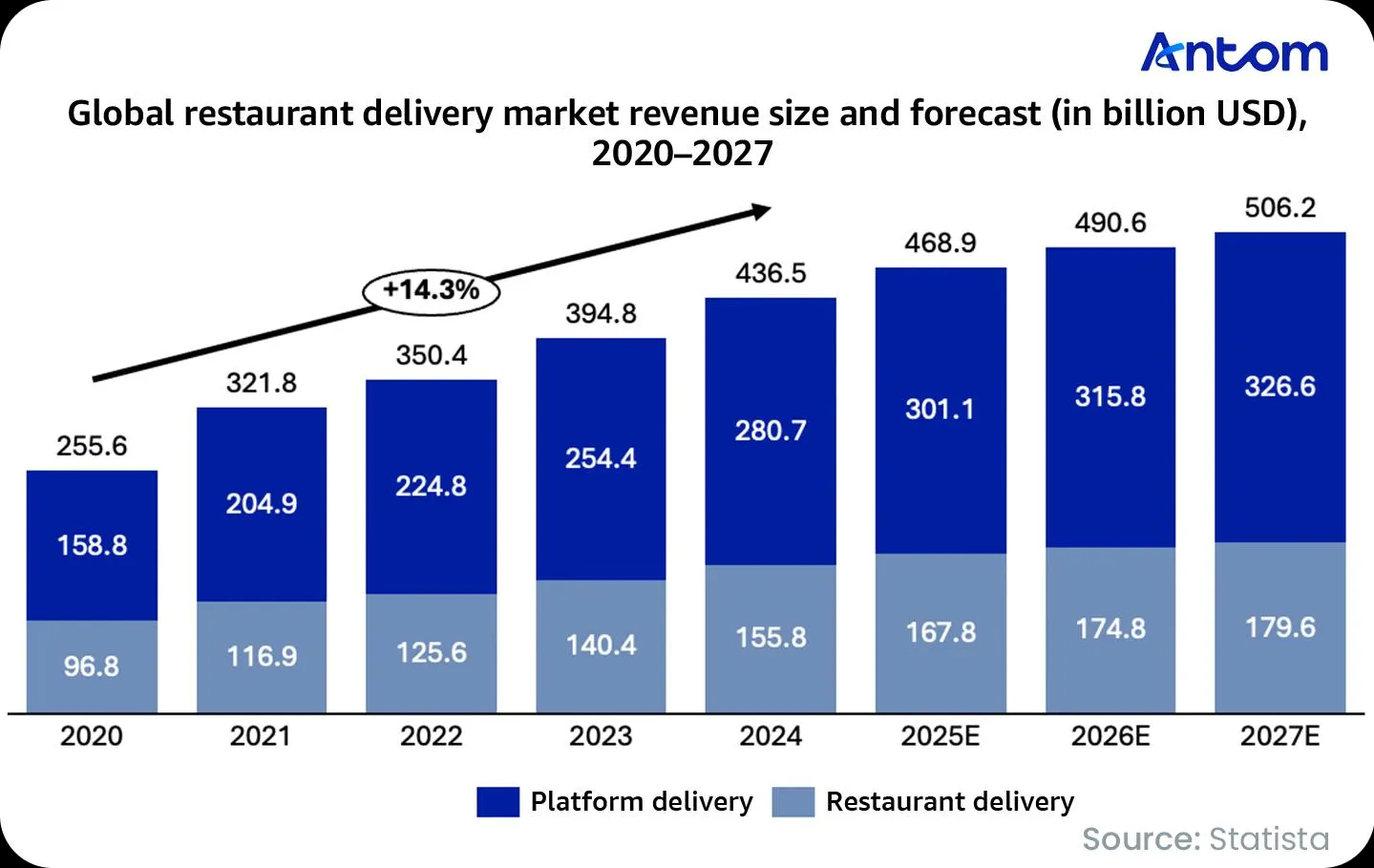
The global food delivery market has developed rapidly over the past five years, reaching a size of $436.5 billion in 2024, with a compound annual growth rate of 14.3%. Driven by digitalisation and shifts in consumer behaviour, the market is expected to surpass $500 billion by 2027, demonstrating strong growth resilience and sustained momentum. - Asia and the Americas account for over 80% of the market, while emerging regions become growth engines
The global food delivery market is highly concentrated, with Asia and the Americas contributing the majority of total market share. The Asia-Pacific region, led by China, reached a market size of $255.9 billion in 2024, accounting for 58% of the global total, while the Americas accounted for 27%. In contrast, emerging markets such as Latin America, the Middle East, and Southeast Asia currently hold smaller shares but are exhibiting the fastest growth rates globally, driven by young population structures and digital dividends, and are becoming the primary engines of future industry growth. - Regional oligopolies and ecosystem competition take shape, with leading brands exceeding 30% share in their regions
The global food delivery market has formed a differentiated regional landscape. In the United States, DoorDash (36%) and Uber Eats dominate a duopolistic market. Europe shows strong regional leadership, with Just Eat Takeaway holding approximately a 31% market share in parts of Western Europe and Uber Eats leading in markets such as the UK and France. Southeast Asia is highly concentrated, with Grab accounting for around 55% of regional market share and, together with ShopeeFood, holding 95% of the market in Vietnam. Competition in this region centres on building integrated super app ecosystems. - Overseas expansion can focus on three regions, combining technology enablement with localisation strategies
The core opportunities for global food delivery companies expanding overseas lie in the incremental growth potential and operational efficiency gaps found in highgrowth markets such as Southeast Asia, the Middle East, and Latin America. Success depends on deep localisation, the export of technological efficiency, and ecosystem collaboration. Examples include Meituan’s Keeta improving delivery efficiency through technology in Saudi Arabia, and DiDi leveraging its mobility ecosystem in Mexico. At the same time, companies must navigate regulatory compliance, cultural differences, and intense competition from both local and global players to achieve sustainable overseas growth.
Over the past decade, the global food delivery industry has evolved from a basic model of online ordering and delivery into a comprehensive ondemand retail ecosystem encompassing restaurants, fresh groceries, convenience goods, pharmaceuticals, and other categories. This expansion has been driven not only by urbanisation, improved transport networks, and widespread adoption of smart devices, but also by the coordinated development of data algorithms, digital payment systems, and supply chain infrastructure. As regulatory frameworks mature, capital investment remains strong, and user demand becomes increasingly diversified, the industry is entering a new phase defined by efficiency, enhanced user experience, and ecosystem-based competition.
Global food delivery at scale: growth momentum and market foundations
Market size continues to expand, with penetration steadily rising
The global food delivery industry has experienced rapid growth over the past five years, becoming a key component of the digital economy and a core growth driver within the modern service sector. Measured by revenue, the global restaurant delivery market reached $436.5 billion in 2024, with a compound annual growth rate of 14.3% between 2020 and 2024. The market is projected to expand further to $468.9 billion in 2025 and is expected to surpass $500 billion by 2027, demonstrating strong growth resilience. This momentum is primarily driven by accelerating global digitalisation, shifts in consumer lifestyles, and continuous improvements in delivery networks. Although regions remain at different stages of development, the overall market continues to show sustained upward momentum.
Digital infrastructure becomes the industry’s core foundation
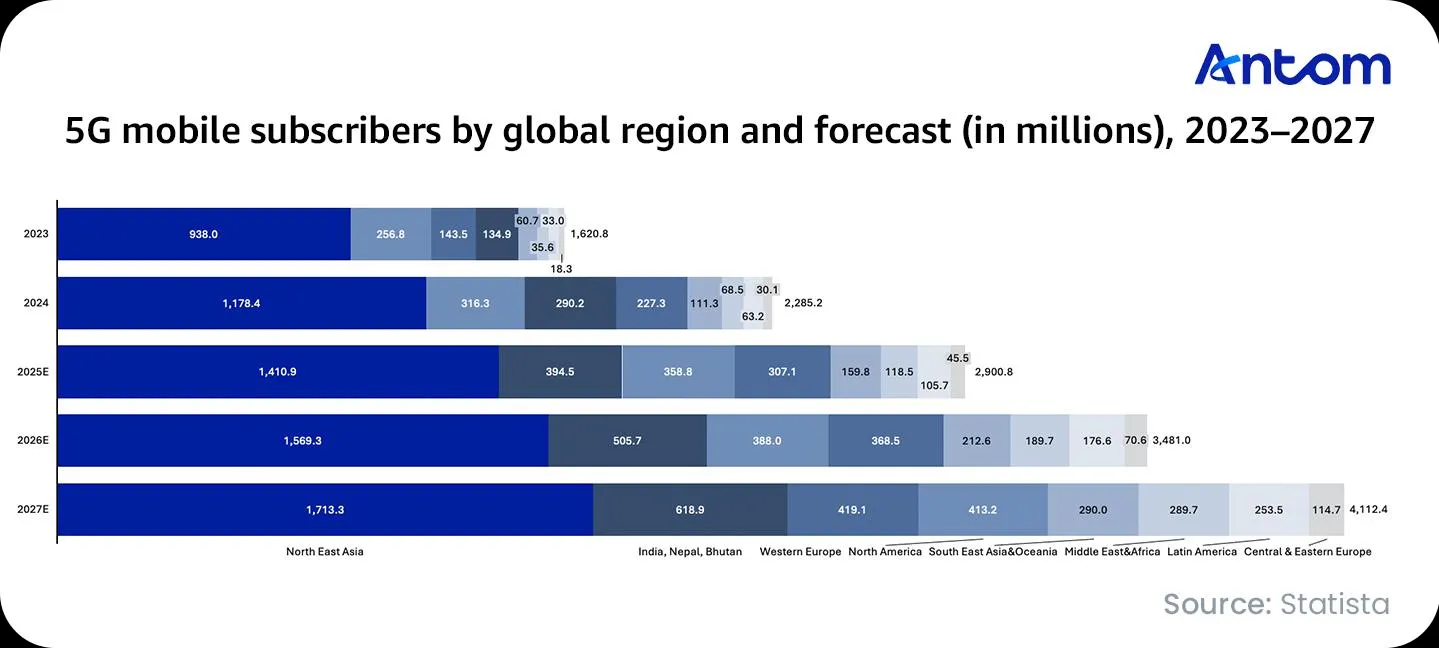
The widespread adoption of digital infrastructure has become a critical factor underpinning the evolution of the food delivery industry. Between 2023 and 2027, the global number of 5G mobile subscribers is expected to continue expanding, with Northeast Asia as the primary growth region, increasing from 900 million to an estimated 1.7 billion users. Markets such as India are also projected to record significant growth, rising from approximately 100 million to 600 million users. Globally, total 5G subscribers are forecast to increase from 1.6 billion in 2023 to 4.1 billion by 2027, with consistent growth across regions and Northeast Asia maintaining a leading share. As 5G coverage expands, platforms are increasingly able to process high volumes of concurrent orders and conduct real-time route planning. At the same time, smartphone penetration has exceeded 85%, further lowering barriers to user access. The rapid adoption of e-wallets and contactless payments has significantly improved order completion rates and payment experience, reducing transaction friction. In parallel, algorithm-driven dispatch systems analyse multiple data dimensions including traffic conditions, weather, courier distribution, and order density, delivering substantial gains in delivery efficiency and laying the technical foundation for the large-scale rollout of instant retail services.
Get Started With Antom For The Full Report !