


Share on
Key Insights
- The global 3C market is set to exceed one trillion US dollars, with per capita consumer electronics spending rising to USD 128
The global 3C market reached $976 billion in 2024 and is expected to surpass one trillion dollars in 2025, entering a period of steady, moderate growth. Consumers’ willingness to spend on electronics continues to rise, with communication devices remaining the largest category, while emerging segments such as gaming hardware and drones show strong upward momentum. - India’s 3C market is forecast to grow at 5.7% over the next five years, outpacing the global average of 2.8%
India’s 3C sector is driven by robust domestic demand and supportive government policies. A large young population and an expanding middle class are fuelling both first-time adoption and upgrade cycles. The “Digital India” strategy and “Make in India” initiative, alongside the global shift toward “China+N” supply diversification, are accelerating local manufacturing and export growth. - AI adoption is accelerating market recovery, with penetration reaching an estimated 16% in smartphones and 30% in PCs
Consumer electronics is among the earliest sectors where AI is moving from concept to widespread commercial application. AI-enabled smartphones are expected to account for around 16% of shipments in 2025, rising to 54% by 2028. AI PC shipments are projected to reach 77 million units in 2025, representing 30% of the total market. AI integration is also driving health-monitoring devices toward more proactive and personalised functionality. - 81% of consumers consider privacy and security when purchasing, and 63% find smart devices “creepy”
As devices become increasingly smart and interconnected, 3C products have evolved into terminals that continuously gather and transmit data. While this delivers convenience, it also heightens consumer concern over privacy and security. As a result, data compliance has become a fundamental requirement for 3C brands entering overseas markets.
Reshaping the global 3C landscape: regional dynamics, AI integration and supply chain evolution
The global 3C consumer electronics market is entering a new growth cycle. The convergence of artificial intelligence, the Internet of Things and smart home ecosystems is accelerating the shift from single-function devices to multi-scenario, intelligent experiences. Demand is becoming increasingly diversified — from high-end wearables in North America and energyefficient home appliances in Europe to the smart-home boom across Southeast Asia and India. At the same time, the alignment between overseas brand expansion and localised manufacturing is emerging as a defining industry trend. How can global brands navigate regional differences with precision? Can localisation efforts coexist with brand premium? As technology and consumer psychology continue to reshape expectations, the next battleground for competitiveness is beginning to take shape.
How global 3C markets are evolving through AI, premiumisation and supply chain shifts
The 3C market stabilises as per-capita spending diverges
The global 3C market has moved through a full cycle — from rapid expansion to a period of adjustment and towards structural recovery. Between 2018 and 2021, widespread smartphone adoption and concentrated replacement demand driven by remote work, entertainment and education pushed sales sharply upwards. After a cyclical correction in 2022, the market began to recover and stabilise from 2023 to 2025. According to Statista, the global 3C market was valued at $976 billion in 2024 and is projected to surpass one trillion dollars in 2025. Looking ahead to 2025–2030, the market is expected to enter a new phase of moderate but sustained growth. This next cycle will be powered not only by rising device volumes but also by premiumisation, smarter features and higher average selling prices. Generative-AI-driven hardware upgrades — such as high-performance AI smartphones and smart wearables — together with rising disposable income among middleclass consumers in emerging markets, will further support the steady increase in per-capita electronics spending and the continued expansion of the global market.
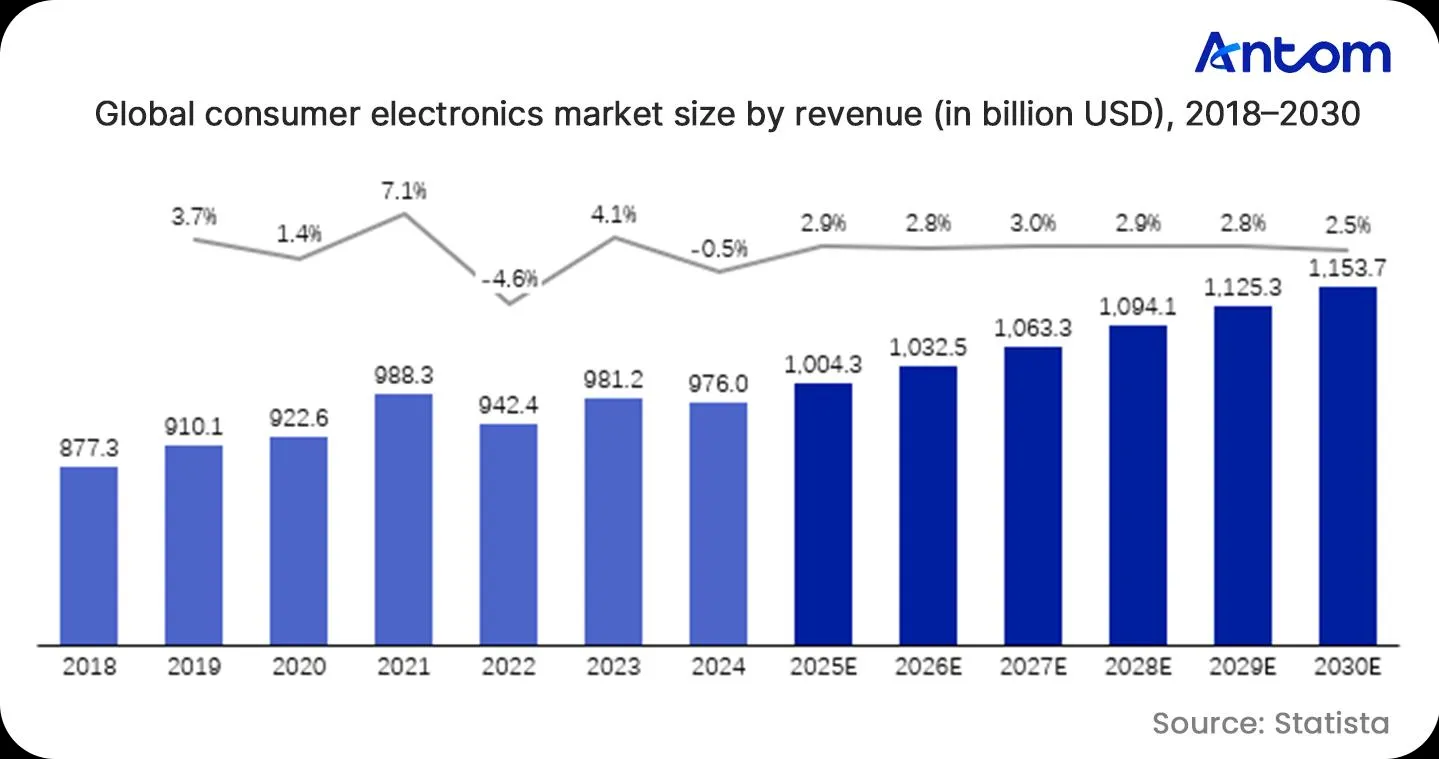
Note: smart home devices are not included.
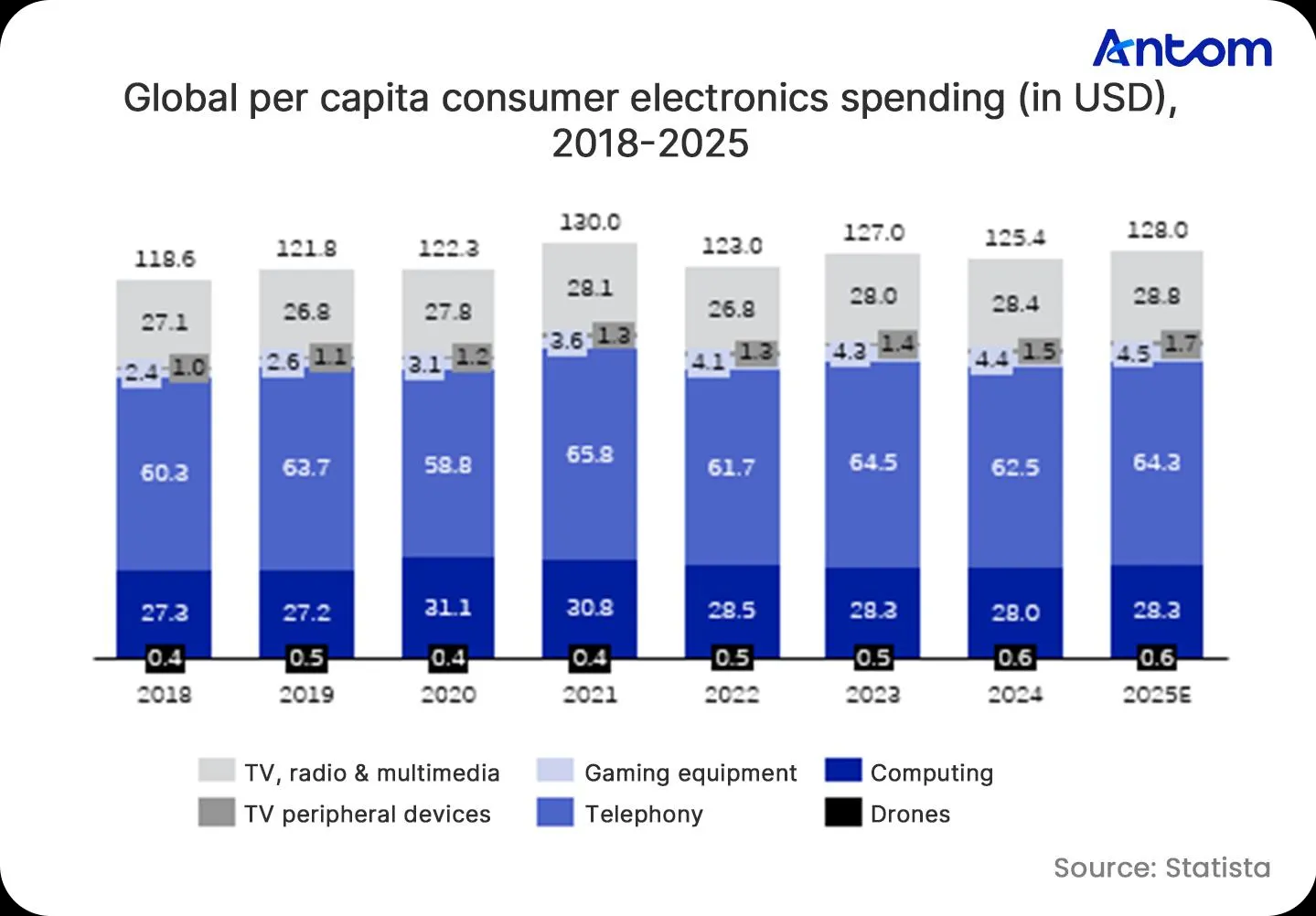
In recent years, per-capita spending on consumer electronics has risen steadily, increasing from around $123 in 2022 to an estimated $128 in 2025. This upward trend reflects not only the market’s overall recovery but also growing consumer willingness to invest in higher-value electronic products. Communication devices continue to dominate spending, with their share remaining relatively stable. Meanwhile, categories such as gaming equipment and drones are gaining traction, underscoring consumers’ sustained appetite for high-value, entertainment-oriented and personalised technology products.
Get Started For The Full Report!