


Share on
Knowing the reality of cross-border settlements is important for global merchants. Issues like overlapping time zones, diverse local regulations, and disconnected banking hours mean that money movement from Point A to Point B is rarely in a straight line.
Amidst all this, relying on outdated payment rails can trap the hard-earned revenue in transit or even expose it to unexpected fraud. If a merchant wants to scale sustainably, they must know where the traps are and how to build a modern mitigation strategy.
This article sheds light on some common cross-border settlement risks and ways to reduce them. Let’s find out!
The Cross-Border Transaction Lifecycle
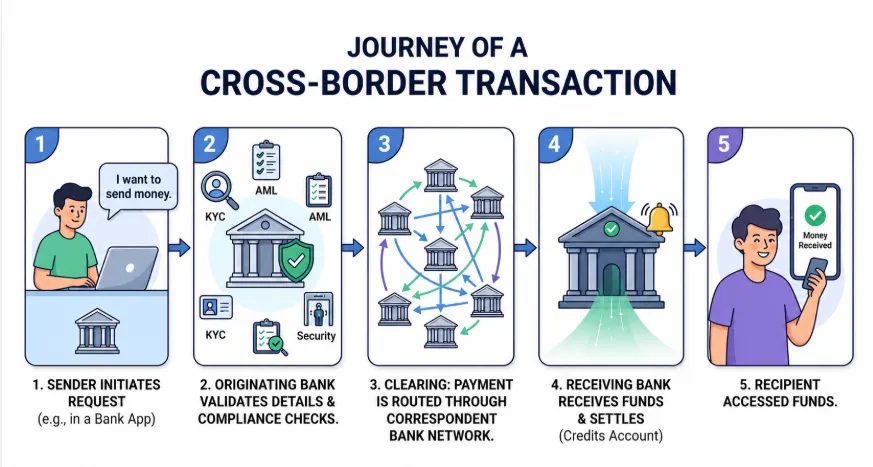
Cross-border transactions create new growth opportunities, but they also introduce operational complexity.
It’s important to understand what actually happens behind the scenes. A cross-border transaction is a long journey with a bunch of check-ins. If one piece goes missing or gets delayed, the whole trip can be a headache.
This is called the transaction lifecycle, and it’s basically the journey your payment takes. This goes like:
- The merchant instructs the bank (the originating bank) to send funds to a partner/supplier after specifying the details.
- The bank checks those funds and whether the transaction fits with regulatory requirements.
- The payment is processed through banking networks. The bank needs a way to get the funds to the other country. They often have to route it through a network of correspondent banks. These are middleman banks that hold accounts with each other. They bridge gaps between different banking systems.
- The receiving bank confirms the funds and credits them to the recipient’s account. This is when the transfer is complete.
The biggest challenge in all of this is interoperability, or how well different national banking systems can actually communicate. According to recent industry data, 15% to 20% of cross-border payments are delayed or interrupted by exceptions. These delays are caused by formatting errors, missing information, and incorrect routing instructions. Such issues usually result from incompatible banking messaging standards.
Essentially, the more hands that have to touch the money, the more time it takes, the more chance there is for error, and the fees go higher.
Top Cross-Border Settlement Challenges and How to Prevent Them
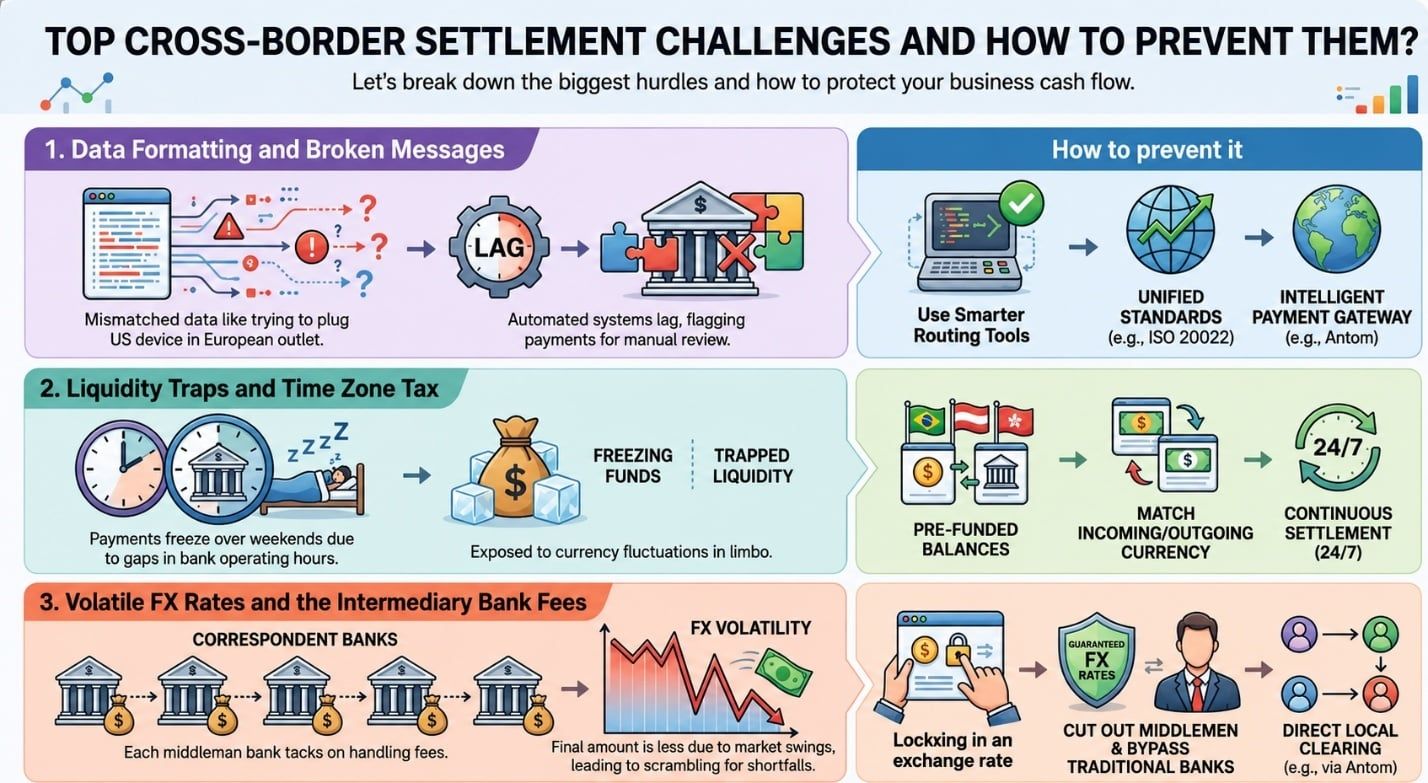
Settlement delays can leave merchants without payment visibility for several days, disrupting supplier relationships and cash flow. The vendors keep sending emails asking where their money is. These delays can affect supplier confidence and working capital. But it’s not just about annoying delays. They are roadblocks that can cost a business serious cash and disrupt its cash flow.
Listed below are the primary settlement challenges global merchants face, followed by the strategies that reduce their impact.
1. Data Formatting and Broken Messages
One of the most common reasons a cross-border payment stalls early in the lifecycle is fragmented data formats.
For instance, a bank might use a certain format for names or reference codes. But the banks involved during transfers are using different formats. This causes the automated system to slow down or flag the payment for manual review. A study in Singapore found that these processing errors account for $420 million in annual operational supplier repair fees. This shows how it’s a major problem for this region and others, too.
How to prevent it: Don’t leave data formatting up to chance. The financial world is slowly moving toward a unified standard, ISO 20022, to address this, but until it’s universal, the burden is on you to use smarter routing tools.
A great way to avoid this setback entirely is to leverage specialised global payment platforms like Antom. It doesn’t rely on legacy, rigid banking rails. It comes with Antom Shield, which is an integrated risk management solution that helps businesses prevent fraud and enhance transaction security.
2. Liquidity Traps and Time Zone Tax
Given that most national payment networks operate strictly during standard business hours, international settlements frequently run into operating hour gaps. The actual impact of these delays is severe. One B2B payments study found that 26% of B2B decision-makers have terminated relationships with buyers or suppliers due to slow payments.
If a business sends a payment from New York on a Friday afternoon to a vendor in Tokyo, that money doesn’t just instantly cross the Pacific. It gets frozen in mid-air because the Japanese settlement systems are closed for the weekend.
This is known as trapped liquidity in the financial world. Money gets locked in a digital vault. And while it’s there, the exchange rate continues to fluctuate. The business can easily end up losing the value of its transaction before it even lands.
How to prevent it: Merchants should not rely on bank-dependent schedules. A switch to continuous settlement models can solve these problems. Alongside, modern interoperable payment infrastructures can also reduce exposure to the usual fluctuations.
Another way to protect a business from the time zone tax is by using multi-currency accounts. They don’t convert and send money on demand. Instead, the platforms hold pre-funded balances in the local currencies of major markets (like USD, EUR, or JPY). According to a 2025 McKinsey Global Payments Report, businesses that use multi-currency solutions experience significant foreign exchange cost cuts.
A well-designed platform like Antom can provide an effective solution. It allows merchants to make payments without waiting for cross-border clearing windows. The delays are less, and merchants get more control over when funds are settled.
3. Regulatory Compliance and Sanctions Screening
Global merchants should know international regulatory frameworks to keep fund transfers smooth. Transactions in transit must comply with the regulatory standards of each jurisdiction involved. The most notable frameworks among these are Anti-Money Laundering (AML), Know Your Customer (KYC), and economic sanctions screening.
Also, given how fragmented these checks are, any data mismatch or false-positive flag can instantly halt a payment.
According to data from the Financial Stability Board, approximately one-third of retail cross-border payments take longer than a full business day to settle. When a transaction is flagged for review, funds are frozen in regulatory escrow. And if a company is managing a global supply chain, dealing with these structural delays means locked-up liquidity and vague cash flow insight.
How to prevent it: One way to prevent these issues is to choose payment providers with strong local acquiring networks. Prioritise providers that offer automated AML and sanctions screening engines. They must be integrated directly into the localised acquiring networks.
When everything goes according to plan, funds move through the payment chain more efficiently. Eventually, finance teams have better visibility into cash flow and settlement status.
4. Volatile FX Rates and Bank Fees
Money doesn’t go straight from bank A to B when traveling across borders. There’s a chain of banks it must go through. And while it’s on this track, every single bank that touches the transaction takes a cut. This means that by the time the funds arrive, the original sum has been chipped away by several intermediary tolls.
Given that these settlements can take days to finalise, the business is also exposed to foreign exchange (FX) volatility. Sellers may initiate a transaction when the exchange rate is favourable, only to watch the market dip while the payment sits in clearing.
The final amount that lands in a partner’s account might be significantly less than what was originally owed, leaving the merchant scrambling to cover the shortfall and damaging vendor trust.
How to prevent it: To beat the FX guessing game, merchants must cut out intermediaries and lock in rates before hitting send. This operational efficiency is critical for modern merchants who are exploring an increasingly complex global commerce ecosystem. Juniper Research forecasts that this will reach $100 trillion in total transaction value by 2030.
Enterprise payment providers and modern fintech platforms have guaranteed FX rates at the exact moment of transaction initiation. Many dedicated multi-currency platforms allow businesses to see the exact conversion fee upfront and lock it in for a set period (such as 24 or 48 hours).
Businesses can also bypass the correspondent bank sequence by using networks like Antom. It will provide direct local clearing integrations in both the sending and receiving countries. Merchants can then manage profit margins without fretting over market swings while funds are in transit.
Conclusion
The old way of moving money globally is a lot like flying commercial with three tight layovers. It’s highly stressful, prone to delays, and packed with hidden fees. But as businesses go completely borderless, waiting days for a transaction to clear or facing uncertainty from sudden exchange-rate drops shouldn’t be part of doing business.
Knowing where the pipeline breaks can help a business take back control of its cash flow.
Whether a team is manually double-checking transaction data to meet new standards or using AI-driven payment networks to bypass traditional banking rails, the ultimate goal remains the same. Merchants want to achieve fast cross-border settlements and move money without friction, as easily as sending a text message.
Frequently Asked Questions (FAQs)
How can enterprise merchants mitigate foreign exchange settlement risks?
Enterprise merchants can mitigate FX settlement risks by using Payment-versus-Payment (PvP) mechanisms or instant multi-currency networks. These ensure that funds are exchanged only when the corresponding currency is delivered at the exact same time.
How often should a business audit its cross-border payment setup?
Businesses should audit their cross-border payment infrastructure regularly. It is especially needed when entering new markets or handling high transaction volumes. These occasional reviews can keep payments secure and detect risks way before they creep in.
Why should global merchants care about transaction and settlement transparency?
Real-time payment tracking gives merchants the clear data they need to accurately forecast cash flow and address delivery delays before they escalate. Plus, eliminating transit time removes endless manual follow-ups and establishes trust with the suppliers.